 ← All animals
 crustacean · Homarus americanus
Lobster
Gallery
1 photo Real photograph Why we love them
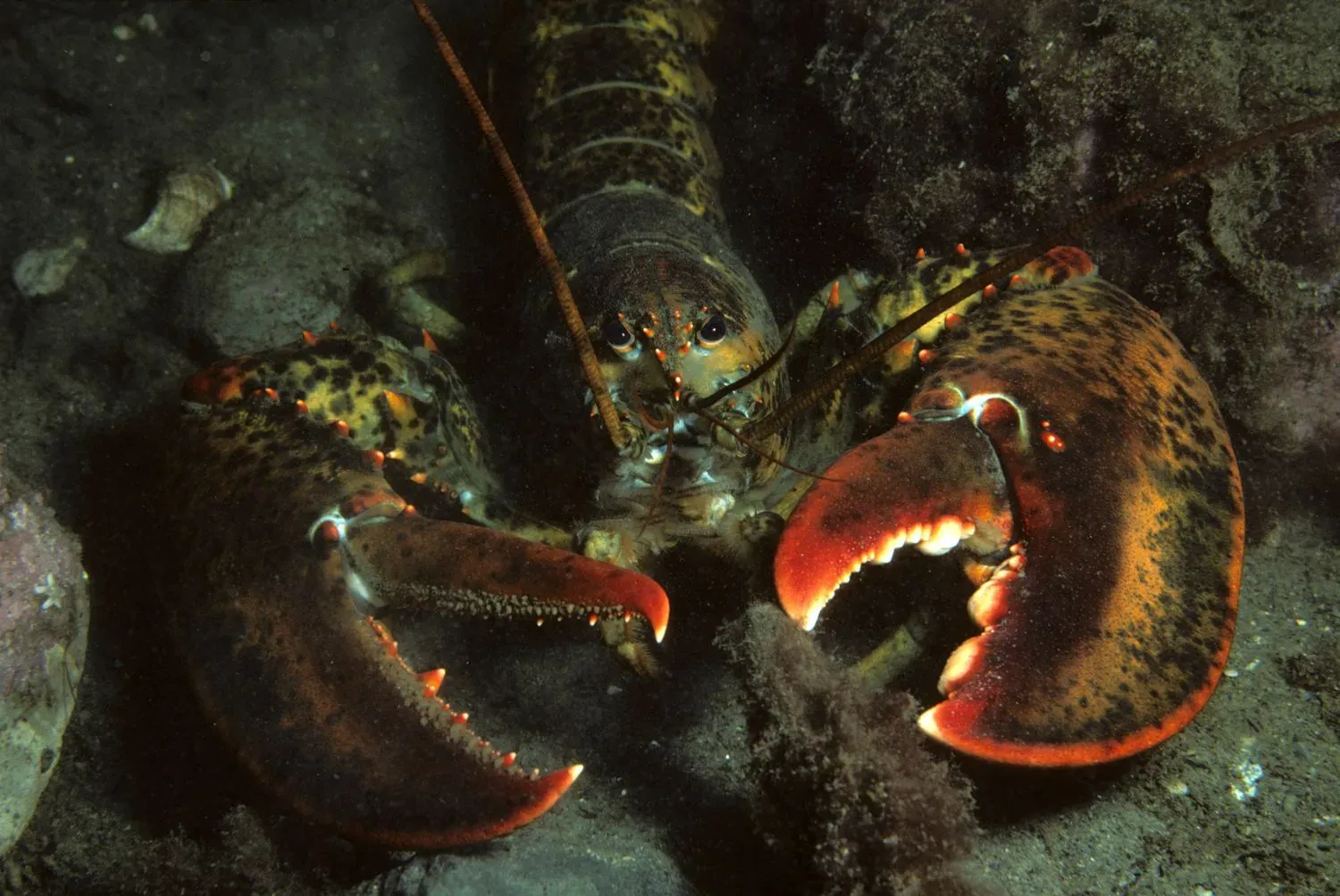
The American lobster lives on the cool, rocky seabed of the Atlantic Ocean, along the coast of North America. It has a hard shell, a long body, and ten legs. The front two legs are big claws that it uses to catch food and to hold on to things.
Its two claws are not the same. One is a chunky crusher claw, strong enough to crack open shells. The other is a slimmer claw with a fine edge for tearing softer food. With them the lobster hunts mussels, clams, snails, crabs and small fish along the bottom of the sea.
Many people think lobsters are bright red, but a live one usually is not. In the water most American lobsters are a greenish-brown colour that helps them hide among the rocks. They only turn red after they are cooked. Now and then a very rare lobster is born bright blue instead.
A lobster wears its skeleton on the outside, like a suit of armour. To grow bigger, it must wriggle out of its old shell and grow a fresh, larger one. It does this many times as it gets older. Lobsters can live a surprisingly long time, and scientists believe some may reach about a hundred years old.
People catch American lobsters for food, so fishers and scientists work together to look after them. They set rules about which lobsters may be kept and return egg-carrying mothers to the sea. This care helps keep plenty of lobsters living along the coast.
My home
Ocean, rocky seabed, coastal waters
Where I live
Atlantic Ocean
What I eat
Mussels, clams, snails, crabs, sea stars, small fish
How heavy I am
20 kg
How long I live
100 years
A lobster has two different claws — a big crusher claw and a finer claw for tearing food.
Live lobsters are usually greenish-brown; they only turn bright red after being cooked.
Lobsters can live a very long time, and scientists think some reach about 100 years old.
Every lobster can feel happy, scared and loved — just like you.
Looking after my friends
How many are there?
U.S. fishers landed about 51,256 tonnes of American lobster in 2024.
This is the weight landed by the U.S. fishery in one year, not the number or total biomass of lobsters still in the sea.
Estimate source: American Lobster Trap Transfer Program
How are they doing?
Lower extinction riskThis species has a lower global extinction risk right now. Local populations can still grow or shrink.
You can help by learning their names, keeping wild places clean, and telling someone why this animal matters.
Where this came from
- Homarus americanus (American Lobster) — Red List Assessment — IUCN Red List of Threatened Species
- American Lobster — Species Directory — NOAA Fisheries
- American lobster — Wikipedia
- Species Status Assessment: American Lobster — New York State Department of Environmental Conservation
- Integrated Fisheries Management Plan: Lobster in the Maritimes Region — Fisheries and Oceans Canada
- American Lobster Trap Transfer Program — NOAA Fisheries