Today's animal friend · 25 November 2026
The Red Squirrel’s Tree-Top Treasure Hunt
A fluffy-tailed acrobat is racing through the treetops. Where is it going—and why might a forgotten nut be good news for a tree?
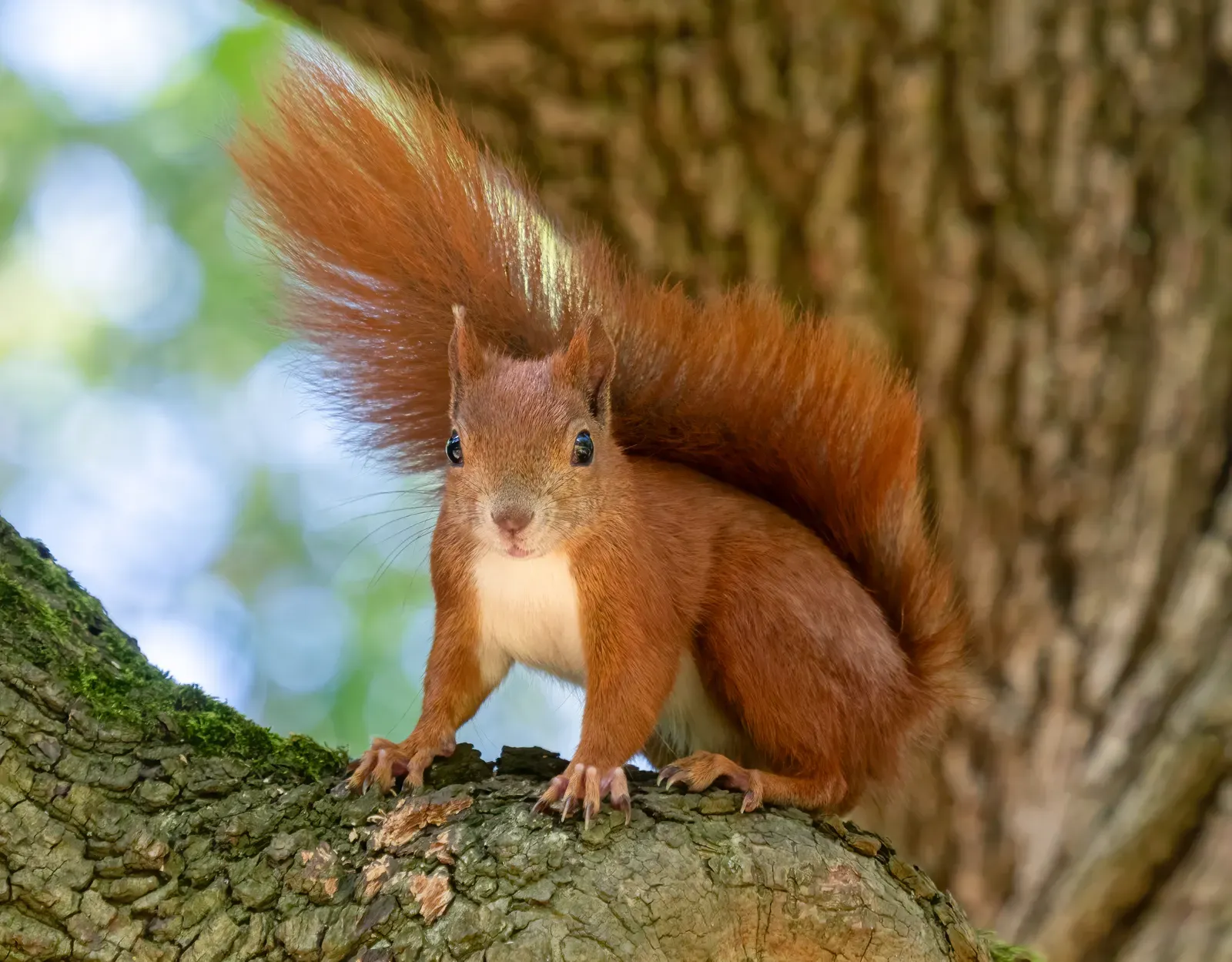
A fluffy-tailed acrobat is racing through the treetops. Where is it going—and why might a forgotten nut be good news for a tree?
A rustle, a leap, and—whoosh!
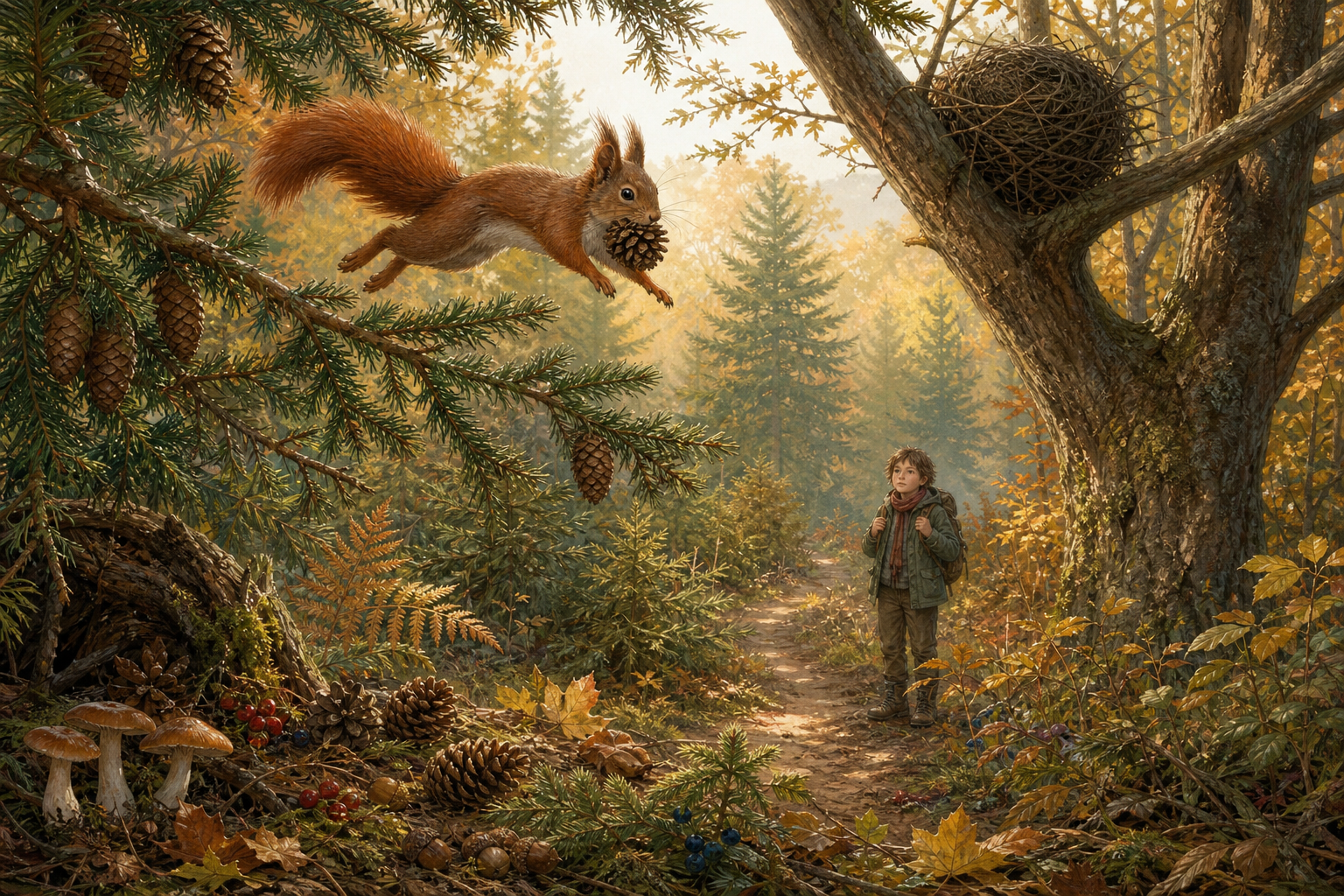
Imagine you are walking beneath tall trees on a bright morning. A cone bumps onto the forest floor. Then comes a quick scratch-scratch above your head. Before you can say “Was that a tiny furry comet?” a red squirrel has dashed along a branch and vanished behind a trunk.
The red squirrel, also called the Eurasian red squirrel, is Sciurus vulgaris. It lives in woods and forests across much of Europe and northern Asia. Its coat can be reddish, and it has a pale tummy and a spectacular bushy tail. In winter, long tufts can grow at the tips of its ears, giving it the look of a woodland wizard who has forgotten where it put its hat.
This squirrel is small enough to seem almost toy-sized: an adult’s head-and-body length is about 19–23 centimetres. But do not let its size fool you. Up in the branches, it is built for bold moves, speedy decisions, and snack-based missions.
Evidence: IUCN Red List of Threatened Species: Sciurus vulgaris (Red Squirrel) — Red List Assessment; Animal Diversity Web, University of Michigan Museum of Zoology: Sciurus vulgaris (Eurasian red squirrel); Wikipedia: Red squirrel
What is that giant tail actually for?
That tail is not just fancy forest decoration. As a red squirrel races and leaps from branch to branch, its long, fluffy tail helps it balance and steer. Think of it as a soft, swishy steering wheel—except you should definitely not try steering a bicycle with one.
When the weather turns cold, the same tail can wrap around the squirrel like a blanket. A red squirrel’s home is a drey: a round nest of twigs, usually high in a tree. It may use the drey as a snug place to rest, especially during rough weather.
Red squirrels are active in the day, particularly in the morning and later afternoon. That means a patient visitor to a woodland may have a chance to spot one. Look up quietly, listen for rustling, and remember that the squirrel has somewhere important to be. Its appointment may be with a pine cone.
Mothers raise their young in a drey. Baby red squirrels are born blind and helpless, so the high, cosy nest is a safe beginning before they are ready to explore the branches themselves.
Evidence: Animal Diversity Web, University of Michigan Museum of Zoology: Sciurus vulgaris (Eurasian red squirrel); Wikipedia: Red squirrel; IUCN Red List of Threatened Species: Sciurus vulgaris (Red Squirrel) — Red List Assessment
The woodland’s little treasure keeper
What is on the menu? Red squirrels mostly feed on plant foods, including conifer seeds, acorns, nuts, fungi, and berries. A pine cone can be a packed lunch, with seeds tucked between its scales. A squirrel often holds food in its front paws while it nibbles—like someone concentrating very seriously on a particularly good biscuit.
But winter can make finding food trickier. So red squirrels stash extra nuts and seeds in the ground or in trees. This is called caching. Later, their strong sense of smell helps them search for their hidden snacks. It is a woodland treasure hunt where the prize is lunch.
Of course, no one finds every buried seed again. Some forgotten caches may have the chance to grow, helping new trees begin in the woodland. So a squirrel saving food for itself can also play a small part in the forest’s future. That is a lovely accident: “Oops, I misplaced my snack” can be good news for a tree.
Different woods offer different foods. Conifer forests, mixed woodland, and broadleaf woodland can all be homes for red squirrels. They are mostly tree-living animals, so a connected canopy—branches reaching across a wood like a leafy climbing frame—matters enormously to their daily travels.
Evidence: Animal Diversity Web, University of Michigan Museum of Zoology: Sciurus vulgaris (Eurasian red squirrel); Wikipedia: Red squirrel; IUCN Red List of Threatened Species: Sciurus vulgaris (Red Squirrel) — Red List Assessment
Are red squirrels doing okay? The answer has two parts
Globally, the red squirrel is listed by the IUCN as Least Concern in its 2023 assessment. That is encouraging, and red squirrels remain common across large parts of their range. Yet its overall population trend is decreasing, and in some places the picture is much more worrying. A global label is useful, but it cannot tell the whole story of every single wood.
In much of Great Britain, red squirrels have become far harder to find. One reason is competition from introduced eastern grey squirrels, which can take food and space. Grey squirrels can also carry squirrelpox disease, which is a serious threat to red squirrels. Losing and breaking up woodland makes life tougher too: a squirrel cannot safely leap across a gap where there are no branches.
This is not a story about blaming an individual animal. Grey squirrels are animals making their own way, just as red squirrels are. The problem began when humans moved species into places where they did not naturally live. Understanding that can help people make kinder, wiser choices for whole ecosystems.
There is hope in careful local work. Protecting red-squirrel strongholds, managing and planting suitable woodland, and community reporting projects can all help. Each healthy patch of woodland is more than scenery: it is a pantry, a path, a nursery, and a roof for countless living neighbours.
Evidence: IUCN Red List of Threatened Species: Sciurus vulgaris (Red Squirrel) — Red List Assessment; Animal Diversity Web, University of Michigan Museum of Zoology: Sciurus vulgaris (Eurasian red squirrel); Wikipedia: Red squirrel
How to be a good woodland visitor
If you are lucky enough to see a red squirrel, the best greeting is space. Watch from a distance, keep voices gentle, and let it choose where to go. Never chase it for a photo or try to touch it. A wild animal’s day is full of finding food, avoiding danger, and caring for young; it does not need an audience waving snacks around.
You can become a squirrel detective instead. Notice which trees grow in a park or wood. Can you find cones that have been nibbled? Are there safe-looking routes through the branches? Share sightings through a trusted local wildlife group if your area has a project, and ask an adult before joining in.
The biggest lesson from a red squirrel may be this: a forest is made of connections. Seeds connect to trees, trees connect to nests, and careful people can connect patches of habitat by supporting woodland protection and restoration. Every time that fluffy tail crosses a branch, it is showing us what a living woodland makes possible.
Evidence: Animal Diversity Web, University of Michigan Museum of Zoology: Sciurus vulgaris (Eurasian red squirrel); Wikipedia: Red squirrel; IUCN Red List of Threatened Species: Sciurus vulgaris (Red Squirrel) — Red List Assessment
A kind choice can begin at the lunch table
Red squirrels depend on forests full of seeds, fungi, berries, shelter, and space. We can care about that web of life in everyday ways: enjoy plants, notice where food comes from, and waste less. The World Health Organization describes healthy diets in general as including plenty of foods such as whole grains, vegetables, fruit, pulses, nuts, and seeds. If you want to try more plant-based meals, talk with a trusted adult so choices work for you and your family.
Choosing more plant-based foods can be a gentle way to think about other animals and their habitats. The IPCC reports that shifts toward sustainable, healthy, more plant-based diets can reduce food-system emissions and pressure on land and biodiversity. It is not about being perfect. It is about practising curiosity and kindness—perhaps starting with a bean-filled wrap, a lentil soup, or a handful of nuts and seeds if they are safe for you to eat.
Evidence: World Health Organization: Healthy diet; Intergovernmental Panel on Climate Change: Climate Change 2022: Mitigation of Climate Change — Chapter 7
Questions people ask
Do red squirrels hibernate?
No. They do not hibernate. In bad weather they may stay in a drey, but they still need to find food when they can.
Evidence: Animal Diversity Web, University of Michigan Museum of Zoology: Sciurus vulgaris (Eurasian red squirrel); Wikipedia: Red squirrel
Why do red squirrels bury nuts and seeds?
They cache extra food for times when it is harder to find. Their sense of smell helps them locate some of those hidden stores later.
Evidence: Animal Diversity Web, University of Michigan Museum of Zoology: Sciurus vulgaris (Eurasian red squirrel); Wikipedia: Red squirrel
Why are red squirrels rare in many parts of Britain?
Important pressures include competition with introduced eastern grey squirrels, squirrelpox disease carried by greys, and woodland loss or fragmentation.
Evidence: IUCN Red List of Threatened Species: Sciurus vulgaris (Red Squirrel) — Red List Assessment; Animal Diversity Web, University of Michigan Museum of Zoology: Sciurus vulgaris (Eurasian red squirrel); Wikipedia: Red squirrel
Can one small squirrel really matter to a forest?
Yes. By moving and caching seeds, red squirrels are part of woodland food webs, and some seeds they do not retrieve can help trees regenerate.
Evidence: Animal Diversity Web, University of Michigan Museum of Zoology: Sciurus vulgaris (Eurasian red squirrel); Wikipedia: Red squirrel
Read the evidence
Sources behind this story
- Sciurus vulgaris (Red Squirrel) — Red List Assessment — IUCN Red List of Threatened Species
- Sciurus vulgaris (Eurasian red squirrel) — Animal Diversity Web, University of Michigan Museum of Zoology
- Red squirrel — Wikipedia
- Healthy diet — World Health Organization
- Climate Change 2022: Mitigation of Climate Change — Chapter 7 — Intergovernmental Panel on Climate Change
Health information is general education, not personal medical advice. Young readers should make food choices with a trusted adult and qualified health professional.