Today's animal friend · 11 August 2026
The Pine-Cone Mystery: A Day with a Red Squirrel
A fluffy tail is not just for showing off. For the Eurasian red squirrel, it is a steering wheel, a warm wrap, and part of one dazzling day in the trees.
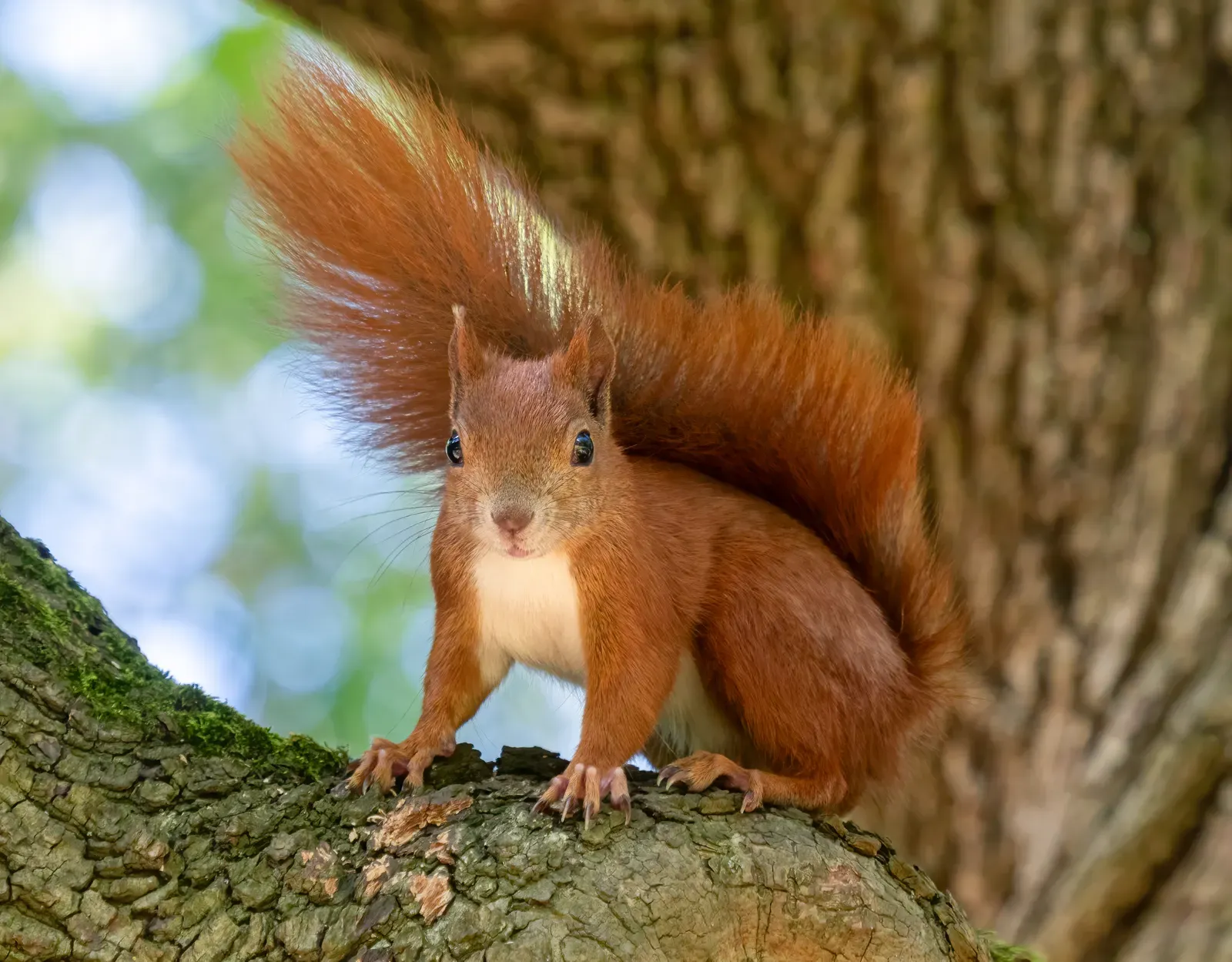
A fluffy tail is not just for showing off. For the Eurasian red squirrel, it is a steering wheel, a warm wrap, and part of one dazzling day in the trees.
A rustle overhead—and then, zoom!
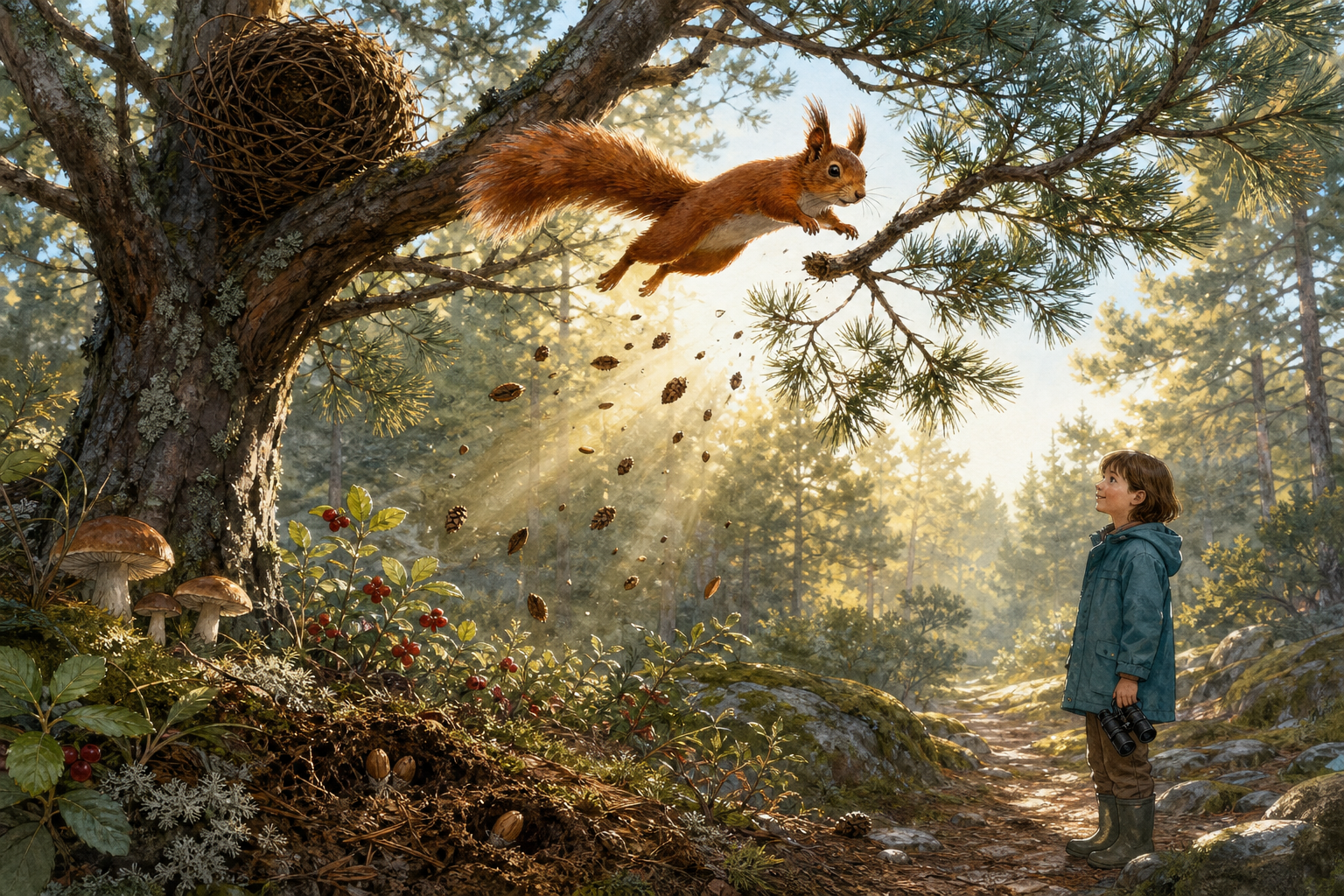
You are walking beneath woodland trees when something sends a shower of tiny pine-cone scales ticking onto the path. Look up! A red squirrel may be racing along a branch, then springing to the next one with the confidence of a playground expert who has practised every climbing frame in town.
The red squirrel, also called the Eurasian red squirrel, is Sciurus vulgaris. It lives among forests and woodlands across Europe and northern Asia. It is a mammal and a rodent, but don’t picture a creature that spends its day hiding in a dark corner. This squirrel is mostly up in the trees, where branches become roads, bridges, snack tables, and sometimes a very bouncy roof.
It is active in daylight, especially when morning or late afternoon makes the woodland feel busy. A red squirrel can be small enough to seem like a reddish flicker against bark, yet its work is important: finding food, travelling through the treetops, and keeping an eye on its surroundings. Every twiggy route is an adventure map.
Evidence: IUCN Red List of Threatened Species: Sciurus vulgaris (Red Squirrel) — Red List Assessment; Animal Diversity Web, University of Michigan Museum of Zoology: Sciurus vulgaris (Eurasian red squirrel); Wikipedia: Red squirrel
Meet the tail with three jobs
A red squirrel’s body is about as long as a school ruler, while its bushy tail is nearly another ruler’s length. Adults weigh roughly as much as a couple of apples. That may sound tiny for such bold acrobatics, but being light is useful when your world is made of bendy branches.
Its magnificent tail is no useless fluff. While the squirrel leaps, the tail helps it balance and steer. Think of it as a feather duster, a rudder, and a superhero cape all rolled into one—though it is probably wiser not to try steering with a feather duster yourself.
When cold weather arrives, that same tail can curl around the squirrel like a blanket. Red squirrels do not hibernate. During rough weather, they may stay tucked into their nest instead. In winter, long tufts on the ears can make their already alert face look particularly fancy, as if it has put on tiny fuzzy party hats.
Evidence: Animal Diversity Web, University of Michigan Museum of Zoology: Sciurus vulgaris (Eurasian red squirrel); Wikipedia: Red squirrel
What is inside that pine cone? Lunch!
Listen for the scratch-scratch of a squirrel working at a cone. Red squirrels mainly eat plant foods: conifer seeds, acorns, nuts, fungi, and berries. The seeds hidden inside cones are especially useful woodland fuel. Food can vary with the trees growing nearby, so a squirrel must be a sharp-eyed, sharp-nosed explorer.
Here comes the truly clever part. When there is extra food, a red squirrel hides some in the ground or in trees for later. This is called caching. Imagine packing snacks for a rainy day, except your cupboards are scattered through a forest and you have no labels on any of them.
So how does it find its hidden meals? Its sense of smell helps it sniff out buried seeds and nuts. Not every stash is recovered. Some forgotten seeds may get the chance to grow, which means a squirrel searching for dinner can also play a small part in woodland renewal. A messy pantry can sometimes help a forest.
A squirrel’s meal is a reminder that woodlands are full of quiet connections. Cones feed squirrels; squirrels move through the trees; and seeds that stay hidden may become tomorrow’s saplings. Nature is rather good at turning a missed snack into a surprise.
Evidence: Animal Diversity Web, University of Michigan Museum of Zoology: Sciurus vulgaris (Eurasian red squirrel); Wikipedia: Red squirrel
High above, a home called a drey
Where would you sleep if the ground were full of puddles, feet, and curious dogs? A red squirrel chooses a higher address. It builds a round nest of twigs called a drey, often in a tree. Inside, it can use softer lining such as moss and grass, making a snug shelter among the branches.
Red squirrels are usually solitary outside the breeding season, so one squirrel often has its own busy schedule. But a mother squirrel has a very important job when babies arrive. The young are born blind and helpless in the drey. She keeps them protected until they are ready to begin exploring their grand, green climbing world.
This does not mean a drey is easy to spot—or that people should try to inspect one. A hidden nest needs peace. If you notice a squirrel vanishing into thick branches, the kindest response is to pause, watch quietly from a distance, and let it get on with squirrel business. There may be babies resting inside.
Evidence: Animal Diversity Web, University of Michigan Museum of Zoology: Sciurus vulgaris (Eurasian red squirrel); Wikipedia: Red squirrel
Why one woodland can feel different from another
Red squirrels use conifer forests, mixed woods, and broadleaf woodland. In one place they may search beneath pine trees; in another, acorns and nuts may be part of the menu. Large forests can offer lots of connected treetop routes. When patches of woodland are lost or broken apart, travelling safely between food and nesting places can become harder.
Across its global range, the species is assessed as Least Concern on the IUCN Red List, but its overall population trend is decreasing. Those two facts belong together: a species can be widespread and still need careful attention, especially where local populations are shrinking.
In much of Great Britain, red squirrels have become far rarer. Introduced eastern grey squirrels compete with them for food and space, and grey squirrels can carry squirrelpox disease that seriously affects red squirrels. Woodland loss and fragmentation add to the challenge. It is not a story about blaming individual animals; it is a reminder that moving species around and changing habitats can have big, unexpected effects.
There is hope in practical care. People can protect red-squirrel strongholds, look after suitable woodland, plant trees, and support community projects that report sightings. A healthy patchwork of woods gives more than one creature a home: birds, fungi, insects, plants—and one bright squirrel with a tail like a flying brush.
Evidence: IUCN Red List of Threatened Species: Sciurus vulgaris (Red Squirrel) — Red List Assessment; Animal Diversity Web, University of Michigan Museum of Zoology: Sciurus vulgaris (Eurasian red squirrel); Wikipedia: Red squirrel
How to be a respectful squirrel detective
Want to look for clues? Search with your eyes, not your hands. Chewed pine cones beneath conifers, a quick shape on a trunk, or a soft rustle above can all tell you that a small tree-dweller has been nearby. Go in daylight, stay on paths where possible, keep voices low, and bring patience. Wildlife watching involves a lot of standing still—and occasionally being outsmarted by a squirrel.
Never offer human snacks or try to feed a wild squirrel. Its natural diet is made for woodland foods, and food left by people can change animal behaviour or attract unwanted visitors. A photograph, a sketch, or a note about where you saw it is a much better souvenir.
If you live somewhere with a squirrel-sighting project, a trusted adult can help check whether your observation can be reported. The important thing is not collecting the animal’s attention. It is noticing that its life matters, even when it is only a reddish blur disappearing around the far side of a tree.
Evidence: Animal Diversity Web, University of Michigan Museum of Zoology: Sciurus vulgaris (Eurasian red squirrel); Wikipedia: Red squirrel
A kind choice that reaches beyond the branches
Caring about a red squirrel can begin with noticing its own life: a warm tail wrapped close, a hidden seed cache, a quiet drey high in a tree. Animals are not props in our world; they are neighbours with places to go and reasons to be there.
Our food choices are one gentle way to care about shared habitats. The World Health Organization describes healthy eating patterns that include foods such as whole grains, vegetables, fruit, pulses, nuts, and seeds. With a trusted adult, families can enjoy more plant-based meals—perhaps bean chilli, lentil pasta sauce, or a nut-free seed sprinkle where it is safe for everyone.
The IPCC reports that shifts toward sustainable, healthy, more plant-based diets can reduce pressure from food systems on the climate, land, and biodiversity. No one has to be perfect. Choosing a plant-based meal now and then is a friendly little vote for a world with room for woods, wild neighbours, and red squirrels leaping through the leaves.
Evidence: World Health Organization: Healthy diet; Intergovernmental Panel on Climate Change: Climate Change 2022: Mitigation of Climate Change — Chapter 7
Questions people ask
Is a red squirrel the same as every squirrel with reddish fur?
Not necessarily. This feature is about the Eurasian red squirrel, Sciurus vulgaris, which is native across much of Europe and northern Asia. Fur colour can vary, so a careful identification uses more than colour alone.
Evidence: Animal Diversity Web, University of Michigan Museum of Zoology: Sciurus vulgaris (Eurasian red squirrel); Wikipedia: Red squirrel
Do red squirrels sleep all winter?
No. They do not hibernate. They may stay in a drey during especially bad weather, but they need to find food through winter, including caches they hid earlier.
Evidence: Animal Diversity Web, University of Michigan Museum of Zoology: Sciurus vulgaris (Eurasian red squirrel); Wikipedia: Red squirrel
Why do squirrels bury food and then forget it?
Caching gives a squirrel food to search for when meals are scarce. When a seed is not found again, it may have a chance to grow. Forgetfulness is not always a disaster—sometimes it is a tree’s lucky break.
Evidence: Animal Diversity Web, University of Michigan Museum of Zoology: Sciurus vulgaris (Eurasian red squirrel); Wikipedia: Red squirrel
Are red squirrels safe everywhere because they are Least Concern?
No. Least Concern is the global IUCN category, not a promise that every local population is thriving. The overall population trend is decreasing, and red squirrels have declined sharply in parts of Britain.
Evidence: IUCN Red List of Threatened Species: Sciurus vulgaris (Red Squirrel) — Red List Assessment; Animal Diversity Web, University of Michigan Museum of Zoology: Sciurus vulgaris (Eurasian red squirrel); Wikipedia: Red squirrel
Read the evidence
Sources behind this story
- Sciurus vulgaris (Red Squirrel) — Red List Assessment — IUCN Red List of Threatened Species
- Sciurus vulgaris (Eurasian red squirrel) — Animal Diversity Web, University of Michigan Museum of Zoology
- Red squirrel — Wikipedia
- Healthy diet — World Health Organization
- Climate Change 2022: Mitigation of Climate Change — Chapter 7 — Intergovernmental Panel on Climate Change
Health information is general education, not personal medical advice. Young readers should make food choices with a trusted adult and qualified health professional.