Today's animal friend · 8 August 2026
Rainbow Trout: The River’s Flash of Pink
A pink-striped fish, a drifting insect, a river-road to the sea: meet a quick-eyed swimmer with a surprisingly big journey.
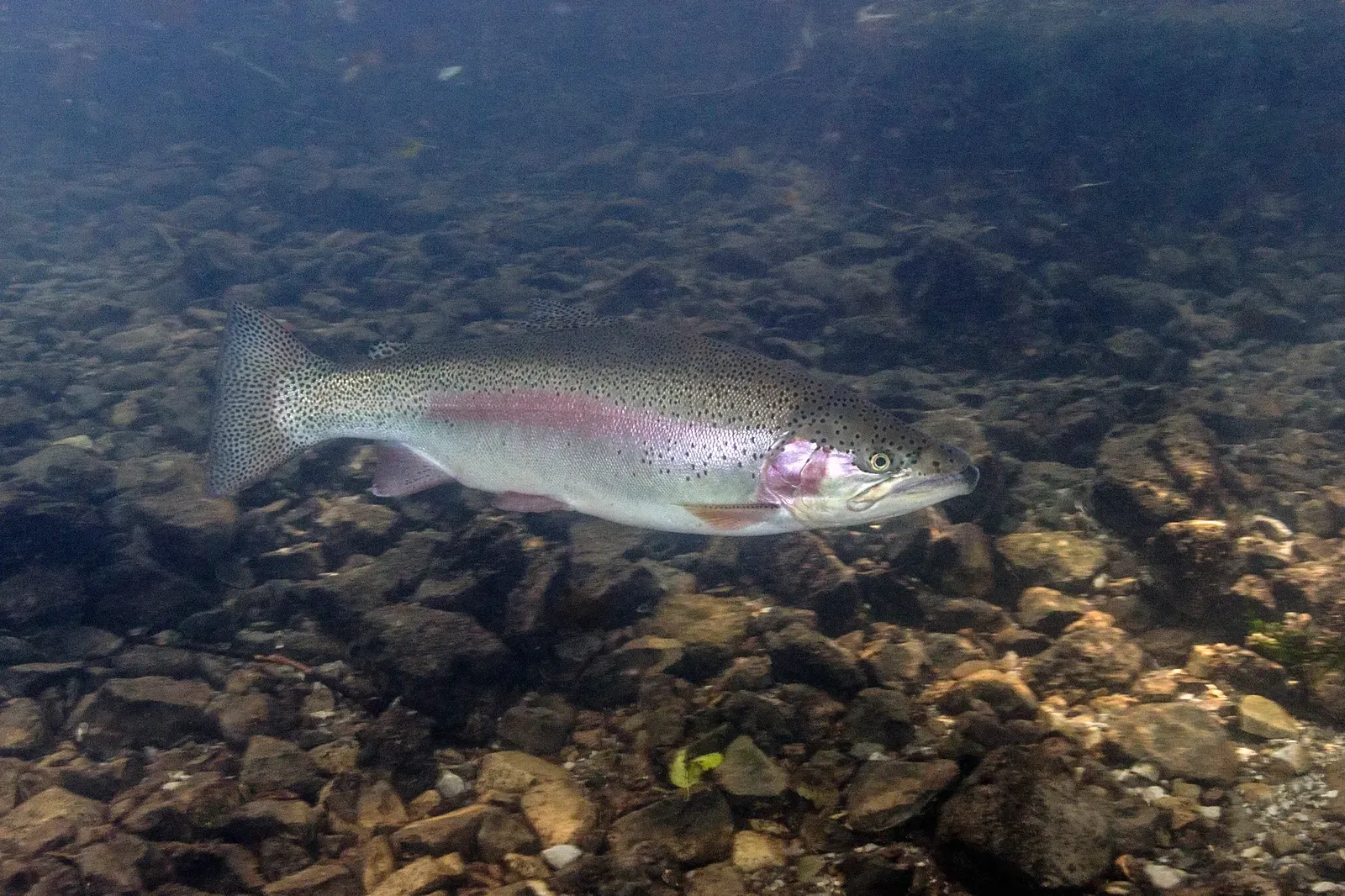
A pink-striped fish, a drifting insect, a river-road to the sea: meet a quick-eyed swimmer with a surprisingly big journey.
A pink streak in the rapids
Imagine kneeling beside a cool stream. Water chatters over stones, bubbles slide past like tiny silver marbles, and then—zip!—a fish flickers from the current’s shadow. Along its side runs a broad band of pink to reddish colour, as if somebody gently brushed a sunset crayon across it. That cheerful stripe gave the rainbow trout its name.
Rainbow trout are sleek fish called Oncorhynchus mykiss. They belong to the salmon family, and they are built for watery places where the river never quite sits still. Their backs can look blue-green or olive, with small dark spots adding a speckled finish. In clear, cool water, that pattern helps a trout blend into its shimmering world while still looking wonderfully fancy to us.
Spotting one can feel like finding a moving piece of the river itself. One moment there is only gravel, ripples, and light; the next, there is a bright-eyed swimmer holding steady against the flow.
Evidence: IUCN Red List of Threatened Species: Oncorhynchus mykiss (Rainbow Trout) — Red List Assessment; Animal Diversity Web, University of Michigan Museum of Zoology: Oncorhynchus mykiss (Coast rainbow trout); Wikipedia: Rainbow trout
How can a fish stand still in a rushing river?
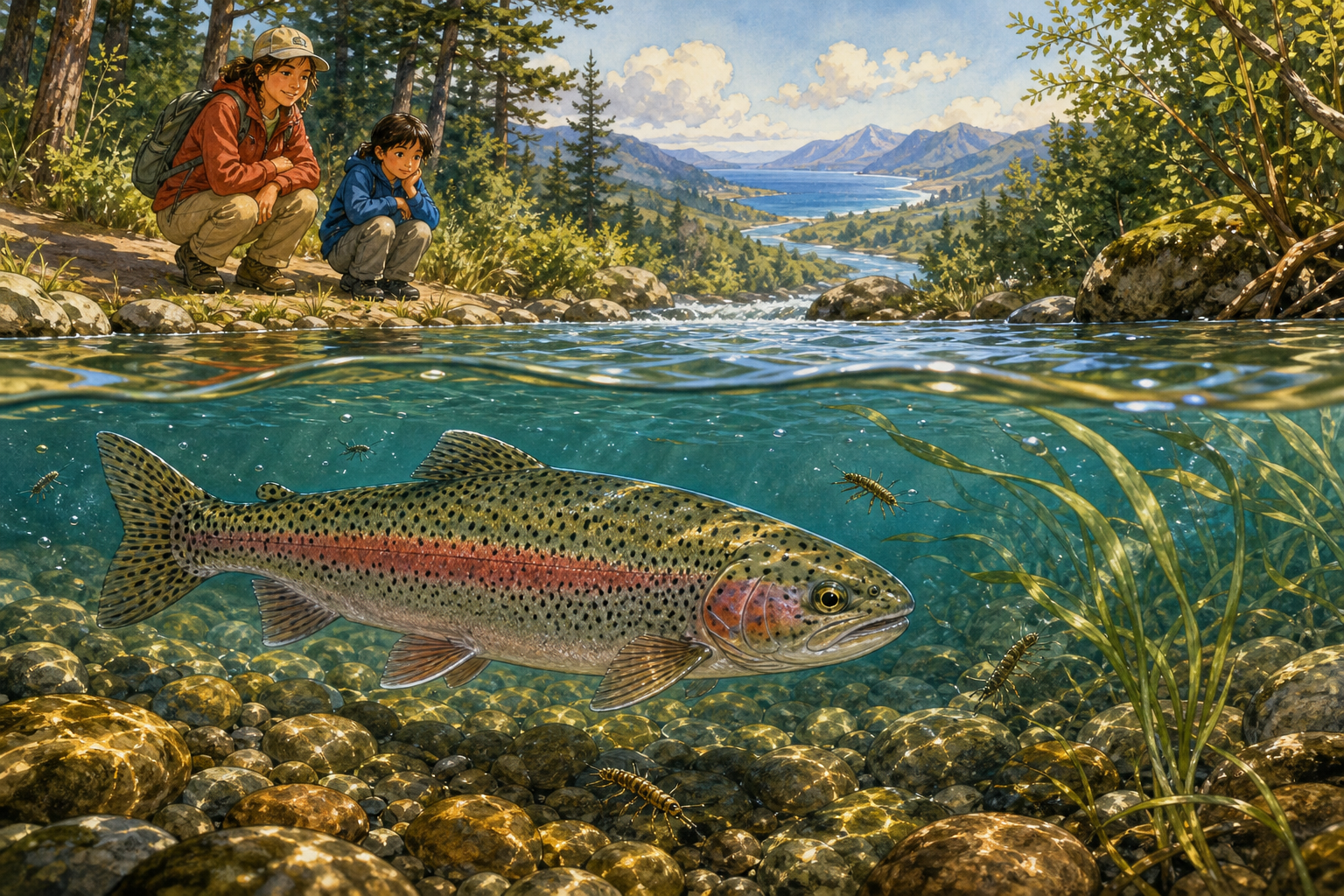
A rainbow trout does not really stand still—it swims with such careful control that it only looks that way. It can face upstream and use the current like a moving snack belt. Little bits of food drift by, and the trout darts out to catch them. Very efficient. If your lunch floated past your desk, you might suddenly become efficient too.
Rainbow trout hunt mainly by sight during the day. Their meals can include insect larvae and other aquatic invertebrates, crustaceans, crayfish, fish eggs, and small fish. They may also eat some algae. A young trout waiting mid-water for drifting prey does not need to rummage around the river bottom all day.
Adults are mostly solitary and may compete for a good patch of water, food, and space. It is less like a team sport and more like finding the best seat on a busy bus—except the bus is a river and everyone has fins.
Evidence: Animal Diversity Web, University of Michigan Museum of Zoology: Oncorhynchus mykiss (Coast rainbow trout); Wikipedia: Rainbow trout
River home, lake home, and one enormous detour
Rainbow trout live in cool freshwater rivers, streams, and lakes. When it is time to lay eggs, gravel beds matter: eggs are placed in nests among the stones. Fine sediment can smother or cover the spaces in gravel, which is one reason clean, well-cared-for waterways are so important.
Here comes the plot twist. Some rainbow trout are called steelhead. Steelhead begin in freshwater, travel out to the ocean as adults, and later return to freshwater to spawn. Not every rainbow trout makes this sea journey, so it is best to think of steelhead as the ocean-going form, not a separate adventure required of every trout.
How do they get back? The evidence tells us that steelhead return to their home streams to spawn. Picture a river as a long, watery road with a very important destination at the end. Dams and water diversions can block or interrupt that route for some local steelhead populations, making fish passage especially valuable.
Evidence: Animal Diversity Web, University of Michigan Museum of Zoology: Oncorhynchus mykiss (Coast rainbow trout); Wikipedia: Rainbow trout
From Pacific shores to faraway ponds
Rainbow trout are native to cold-water Pacific tributaries in North America and Asia, from the Kamchatka region of Russia down to northern Mexico. That is already a grand stretch of map. Yet people have also moved them to rivers and lakes around the world for angling, and they now occur on every continent except Antarctica.
A fish introduced to a new waterway is not automatically a harmless visitor. In some places, introduced rainbow trout can compete with native freshwater fish for food and space. That is a good reminder that a river is a neighbourhood, not an empty bathtub. Each waterway has its own residents and relationships.
In their native and introduced homes, rainbow trout are both hunters and hunted. They eat smaller animals in the water, while birds, mammals, and larger fish may eat them. That linking-up of lives is part of what makes a stream feel alive, even when we can see only the ripples at the surface.
Evidence: Animal Diversity Web, University of Michigan Museum of Zoology: Oncorhynchus mykiss (Coast rainbow trout); Wikipedia: Rainbow trout
Are rainbow trout safe? The answer has a careful wrinkle
Globally, rainbow trout are listed as Least Concern on the IUCN Red List. This means the species as a whole is not currently assessed as facing a high global risk of extinction. They are common and have a very wide range, including many places where people have introduced them.
But a global label is not the same as a report card for every river. Some steelhead populations in parts of the western United States are listed as threatened or endangered under United States law. Their journeys can be harmed when migration routes are cut off or when freshwater habitat is degraded.
So the hopeful lesson is: look close. A species can be doing all right around the world while particular local populations need real care. Protecting cool, clean water, gravel spawning places, and routes around barriers can help trout and many other river neighbours.
Evidence: IUCN Red List of Threatened Species: Oncorhynchus mykiss (Rainbow Trout) — Red List Assessment; Animal Diversity Web, University of Michigan Museum of Zoology: Oncorhynchus mykiss (Coast rainbow trout); Wikipedia: Rainbow trout
A stream-side detective mission
You do not need to catch a fish to become a rainbow trout fan. At a stream or lake, go with a responsible adult, stay on paths where possible, and watch quietly from the bank. Can you notice where water is fast, where it pools, and where gravel gathers? Those details are clues to the kinds of homes a fish might use.
Listen, too. A healthy-looking stream can sound like a crinkling packet, a soft roar, or a thousand tiny splashes. But looks are not the whole story: keeping litter, pollution, and loose soil out of waterways is a practical kindness to the creatures below the surface.
If you see a pink flash, let it remain a mystery for a moment. Was it truly a rainbow trout? Whatever it was, you have just practised the best skill of every outdoor explorer: paying attention.
Evidence: Animal Diversity Web, University of Michigan Museum of Zoology: Oncorhynchus mykiss (Coast rainbow trout); Wikipedia: Rainbow trout
Kind choices can ripple outward
A rainbow trout is not a shiny prize or a meal with a label. It is a living swimmer with a home, a route, and its own urgent business—such as catching a drifting insect before it disappears. Seeing animals as neighbours can help us choose gentler ways to share the planet.
At meals, families can explore colourful plant-based foods such as beans, lentils, vegetables, fruit, whole grains, nuts, seeds, and plant proteins. The World Health Organization describes healthy diets as varied and rich in foods including whole grains, vegetables, fruit, pulses, nuts, and seeds. Ask a trusted adult for help with any food choice that is new for you.
Choosing more plant-based meals can also be a planet-friendly act. The IPCC reports that shifts toward sustainable, healthy, more plant-based diets can reduce food-system emissions and pressure on land and biodiversity. No one has to be perfect. A chickpea wrap, a bean chilli, or a veggie pasta is one small, tasty way to practise care—for animals like the bright little river traveller and for the wider web of life.
Evidence: World Health Organization: Healthy diet; Intergovernmental Panel on Climate Change: Climate Change 2022: Mitigation of Climate Change — Chapter 7
Questions people ask
Why is it called a rainbow trout?
The fish is named for the broad pink to reddish stripe running along each side of its body. In the shifting light of water, it can look like a little ribbon of colour swimming by.
Evidence: Animal Diversity Web, University of Michigan Museum of Zoology: Oncorhynchus mykiss (Coast rainbow trout); Wikipedia: Rainbow trout
Is a steelhead a different fish?
Steelhead is the common name for the sea-run, or ocean-going, form of rainbow trout. These fish travel to the ocean and later return to freshwater to spawn.
Evidence: Animal Diversity Web, University of Michigan Museum of Zoology: Oncorhynchus mykiss (Coast rainbow trout); Wikipedia: Rainbow trout
What does a rainbow trout eat?
It eats aquatic insects and their larvae, crustaceans and other invertebrates, crayfish, fish eggs, small fish, and sometimes algae.
Evidence: Animal Diversity Web, University of Michigan Museum of Zoology: Oncorhynchus mykiss (Coast rainbow trout); Wikipedia: Rainbow trout
How long can rainbow trout live?
Wild rainbow trout often live about 6–8 years and may live up to about 11 years. Their size and lifespan can differ between river, lake, and ocean-going forms.
Evidence: Animal Diversity Web, University of Michigan Museum of Zoology: Oncorhynchus mykiss (Coast rainbow trout); Wikipedia: Rainbow trout
Read the evidence
Sources behind this story
- Oncorhynchus mykiss (Rainbow Trout) — Red List Assessment — IUCN Red List of Threatened Species
- Oncorhynchus mykiss (Coast rainbow trout) — Animal Diversity Web, University of Michigan Museum of Zoology
- Rainbow trout — Wikipedia
- Healthy diet — World Health Organization
- Climate Change 2022: Mitigation of Climate Change — Chapter 7 — Intergovernmental Panel on Climate Change
Health information is general education, not personal medical advice. Young readers should make food choices with a trusted adult and qualified health professional.