Today's animal friend · 21 November 2026
Raccoon Moonwalk: The Masked Night Explorer
A raccoon’s front paws can investigate a soggy snack with the focus of someone searching the bottom of a cereal bowl for the very last spoonful. Why does this masked mammal rub food in water, and how can it make a home from woods to towns?
A raccoon’s front paws can investigate a soggy snack with the focus of someone searching the bottom of a cereal bowl for the very last spoonful. Why does this masked mammal rub food in water, and how can it make a home from woods to towns?
Splash! Who is washing dinner in the dark?
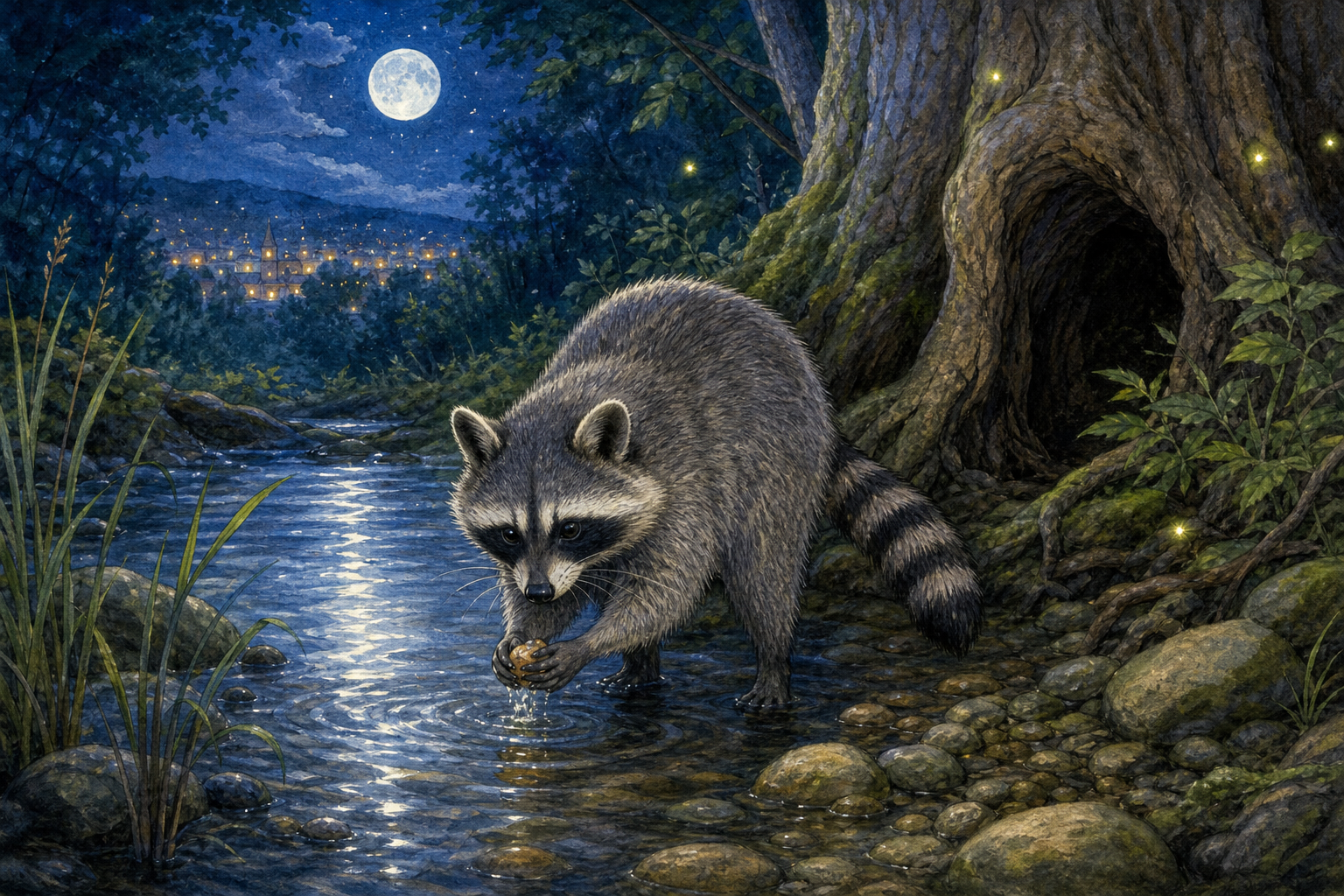
Picture a riverbank after sunset. The water makes soft shhh-shhh sounds against the mud. Something grey pads out from the shadows, bends over the edge, and—plop—dips a bite of food into the water. It rubs the food between its front paws as carefully as if it were checking a tiny treasure from a muddy puddle.
That little night explorer is a raccoon, also called the northern raccoon or common raccoon. Its scientific name is Procyon lotor. The word lotor means “washer,” a wonderfully fitting name for an animal often seen dipping and rubbing food near water.
But the raccoon is not really doing the dishes. Wet paws become especially sensitive, helping it feel what it is holding. In the dark, when eyes have less to tell, a raccoon’s paws can do extra detective work. Is this a tasty crayfish? A crunchy nut? Or just a soggy leaf pretending to be interesting?
Evidence: Animal Diversity Web, University of Michigan Museum of Zoology: Procyon lotor (northern raccoon); Wikipedia: Raccoon (Procyon lotor)
A mask, a striped tail, and paws that investigate everything
A raccoon can look like it is headed to a costume party. It has a dark mask across its eyes and a bushy tail marked with dark rings. Its furry body is greyish, and its front paws have long, flexible fingers. Those paws work a bit like little hands: feeling, grasping, turning, and exploring.
That does not mean a raccoon is a tiny person in a fur coat. It is a mammal in the family Procyonidae and the order Carnivora. Still, its skilled paws make it a brilliant finder of hidden things. Imagine trying to identify objects while wearing a blindfold, using only your fingers. A raccoon is built for that kind of puzzle.
Raccoons vary in size. They can be about as heavy as a small dog, though individuals differ a lot. Their bodies and tails together can stretch from roughly the length of a skateboard to longer than one. Even so, one quiet raccoon can vanish surprisingly fast into a tree, a dark nook, or behind a garden shed.
Evidence: Animal Diversity Web, University of Michigan Museum of Zoology: Procyon lotor (northern raccoon); Wikipedia: Raccoon (Procyon lotor); IUCN Red List of Threatened Species: Procyon lotor (Raccoon) — Red List Assessment
Where does the midnight adventure happen?
Raccoons are most active at night and around twilight, when daylight is fading or returning. That is why you might notice clues before you ever spot one: a rustle near a bin, pawprints beside a puddle, or a round silhouette wobbling along a fence like a very determined fuzzy tightrope walker.
They are highly adaptable. Moist woodland with water nearby suits them well, but so do wetlands, riverbanks, farmland, suburbs, and towns. A raccoon may rest in a tree den, but it can also use other sheltered places, including burrows, caves, and spaces in human-made structures.
The raccoon is native across much of North America. It has also been introduced to parts of Europe and Asia, where it now lives in some places. This wide spread is a reminder that wild animals belong in real habitats, not in our hands. The kindest view can be from a respectful distance, leaving the raccoon free to choose its own route home.
Evidence: Animal Diversity Web, University of Michigan Museum of Zoology: Procyon lotor (northern raccoon); Wikipedia: Raccoon (Procyon lotor); IUCN Red List of Threatened Species: Procyon lotor (Raccoon) — Red List Assessment
What is on a raccoon’s menu? Almost anything it can find
Raccoons are omnivores, which means they eat both plant and animal foods. Their menu can include fruit, nuts, insects, crayfish, eggs, and small animals. In some habitats, plant food makes up a large part of what they eat. A raccoon is not a fussy restaurant critic. It is an opportunity scout with whiskers.
That flexible appetite helps explain why raccoons can live in many different places. Along a stream, a raccoon may search for small water creatures. In woods, it may find fruit or nuts. Near people, it may find human-associated food. Yet food left out for raccoons can teach them to come close to people and pets, which is not a good bargain for anyone.
A better way to be a raccoon’s neighbour is simple: enjoy watching wildlife without offering snacks. Secure rubbish and pet food, and let wild animals keep their natural skills. After all, a raccoon already has a first-class nose, clever paws, and a whole nighttime world to investigate.
Evidence: Animal Diversity Web, University of Michigan Museum of Zoology: Procyon lotor (northern raccoon); Wikipedia: Raccoon (Procyon lotor); IUCN Red List of Threatened Species: Procyon lotor (Raccoon) — Red List Assessment
In spring, the den has tiny guests
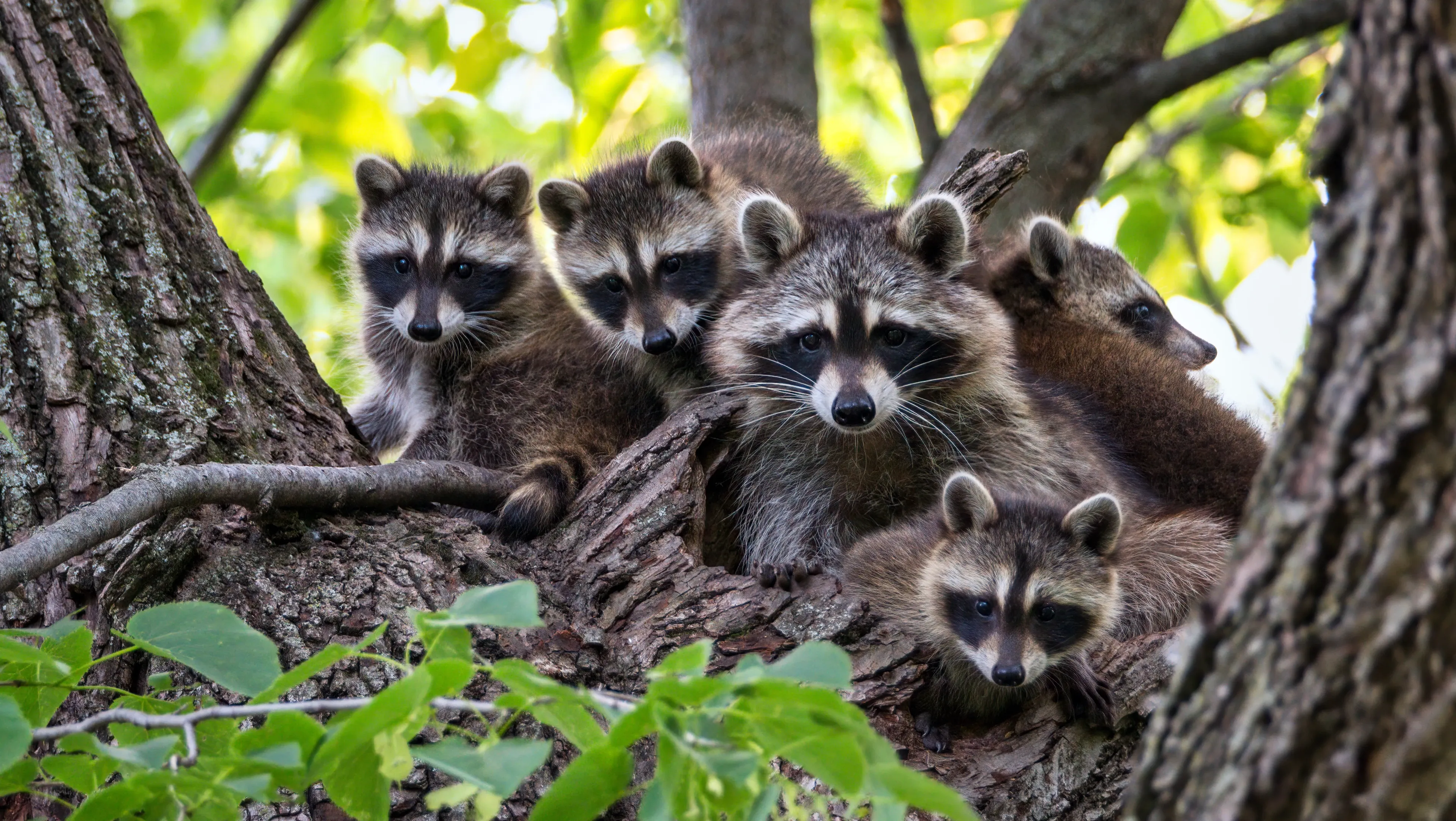
When spring arrives, a mother raccoon may have a litter of kits. About four kits is typical, and they are cared for together in a cosy den. At first, the young are tiny and dependent on their mother. Later, they begin the serious business of learning: where to climb, what to investigate, and how to follow safely through a world full of branches, puddles, and mysterious rustles.
Outside mother-and-young groups, raccoons are mostly solitary. So a kit’s early time with its mother matters. It is a season of close following, careful lessons, and growing confidence—rather like learning to navigate a giant playground where every log might hide a snack or a surprise.
If you ever see a young raccoon alone, resist the urge to scoop it up. Wild families can be nearby even when we cannot see them. Tell a trusted adult, who can contact an appropriate local wildlife professional if the animal seems injured or in immediate danger. Caring sometimes means giving space.
Evidence: Animal Diversity Web, University of Michigan Museum of Zoology: Procyon lotor (northern raccoon); Wikipedia: Raccoon (Procyon lotor); IUCN Red List of Threatened Species: Procyon lotor (Raccoon) — Red List Assessment
Good news, plus a neighbourly promise
The raccoon is listed as Least Concern on the IUCN Red List, and its overall population trend was recorded as increasing in the 2016 assessment. Mainland raccoons have expanded and adapted well to landscapes shaped by people. That is cheerful news: this masked explorer is still out there, pattering through many nighttime places.
But “doing well overall” does not mean an individual animal cannot face trouble. Vehicles, trapping, hunting, and disease can affect raccoons locally. The best promise we can make is not to treat a wild animal like a toy, a pet, or a rubbish-removal team. Give it room, keep food sources secure, and help grown-ups make outdoor spaces safer for wildlife.
Then, on a quiet evening, listen again. Maybe there will be a splash at the stream. Maybe there will be paws turning over a leaf. The raccoon’s superpower is curiosity—and perhaps it can lend us a little of it: look closely, leave kindly, and wonder what other lives are moving through the dark.
Evidence: IUCN Red List of Threatened Species: Procyon lotor (Raccoon) — Red List Assessment; Animal Diversity Web, University of Michigan Museum of Zoology: Procyon lotor (northern raccoon); Wikipedia: Raccoon (Procyon lotor)
One kind choice can ripple outward
A raccoon’s meal may include both plants and animals, because that is how this wild omnivore survives. We humans get to make choices with a bigger shopping basket and a bigger responsibility. A varied eating pattern rich in foods such as vegetables, fruit, whole grains, pulses, nuts, and seeds is part of WHO healthy-diet guidance. With a trusted adult, try a plant-powered snack or meal that sounds delicious—perhaps bean tacos, lentil soup, fruit with nut butter, or a crunchy seed topping.
Choosing more plant-based foods can be a gentle kindness to animals and to the living places they need. The IPCC reports that shifts toward sustainable, healthy, more plant-based diets can reduce food-system emissions and pressure on land and biodiversity. No one needs to be perfect to be thoughtful. Each colourful plate can be a small vote for a world with room for riverbanks, trees, insects, raccoons, and us.
Evidence: World Health Organization: Healthy diet; Intergovernmental Panel on Climate Change: Climate Change 2022: Mitigation of Climate Change — Chapter 7
Questions people ask
Why do raccoons put food in water?
Near water, raccoons often dip and rub food between their paws. This can make their wet paws more sensitive to touch, helping them explore what they have found.
Evidence: Animal Diversity Web, University of Michigan Museum of Zoology: Procyon lotor (northern raccoon); Wikipedia: Raccoon (Procyon lotor)
Are raccoons bears?
No. Raccoons are mammals in the family Procyonidae. Their dark eye mask and ringed tail make them easier to recognise than a bear in a tiny bandit costume.
Evidence: Animal Diversity Web, University of Michigan Museum of Zoology: Procyon lotor (northern raccoon); Wikipedia: Raccoon (Procyon lotor)
What are baby raccoons called?
Baby raccoons are called kits. A mother usually has about four in a spring litter and cares for them in a den.
Evidence: Animal Diversity Web, University of Michigan Museum of Zoology: Procyon lotor (northern raccoon); Wikipedia: Raccoon (Procyon lotor); IUCN Red List of Threatened Species: Procyon lotor (Raccoon) — Red List Assessment
Should I feed a raccoon I see outside?
No. Watching from a respectful distance is kinder. Leaving food out can make raccoons used to approaching people and pets; secure food and rubbish instead.
Evidence: Animal Diversity Web, University of Michigan Museum of Zoology: Procyon lotor (northern raccoon); IUCN Red List of Threatened Species: Procyon lotor (Raccoon) — Red List Assessment
Read the evidence
Sources behind this story
- Procyon lotor (Raccoon) — Red List Assessment — IUCN Red List of Threatened Species
- Procyon lotor (northern raccoon) — Animal Diversity Web, University of Michigan Museum of Zoology
- Raccoon (Procyon lotor) — Wikipedia
- Healthy diet — World Health Organization
- Climate Change 2022: Mitigation of Climate Change — Chapter 7 — Intergovernmental Panel on Climate Change
Health information is general education, not personal medical advice. Young readers should make food choices with a trusted adult and qualified health professional.