Today's animal friend · 22 September 2026
The Little Sailboat That Is Actually a Team
It may look like a jellyfish with a bright blue sail, but the Portuguese man o’ war is a floating colony with a surprising secret beneath the waves.
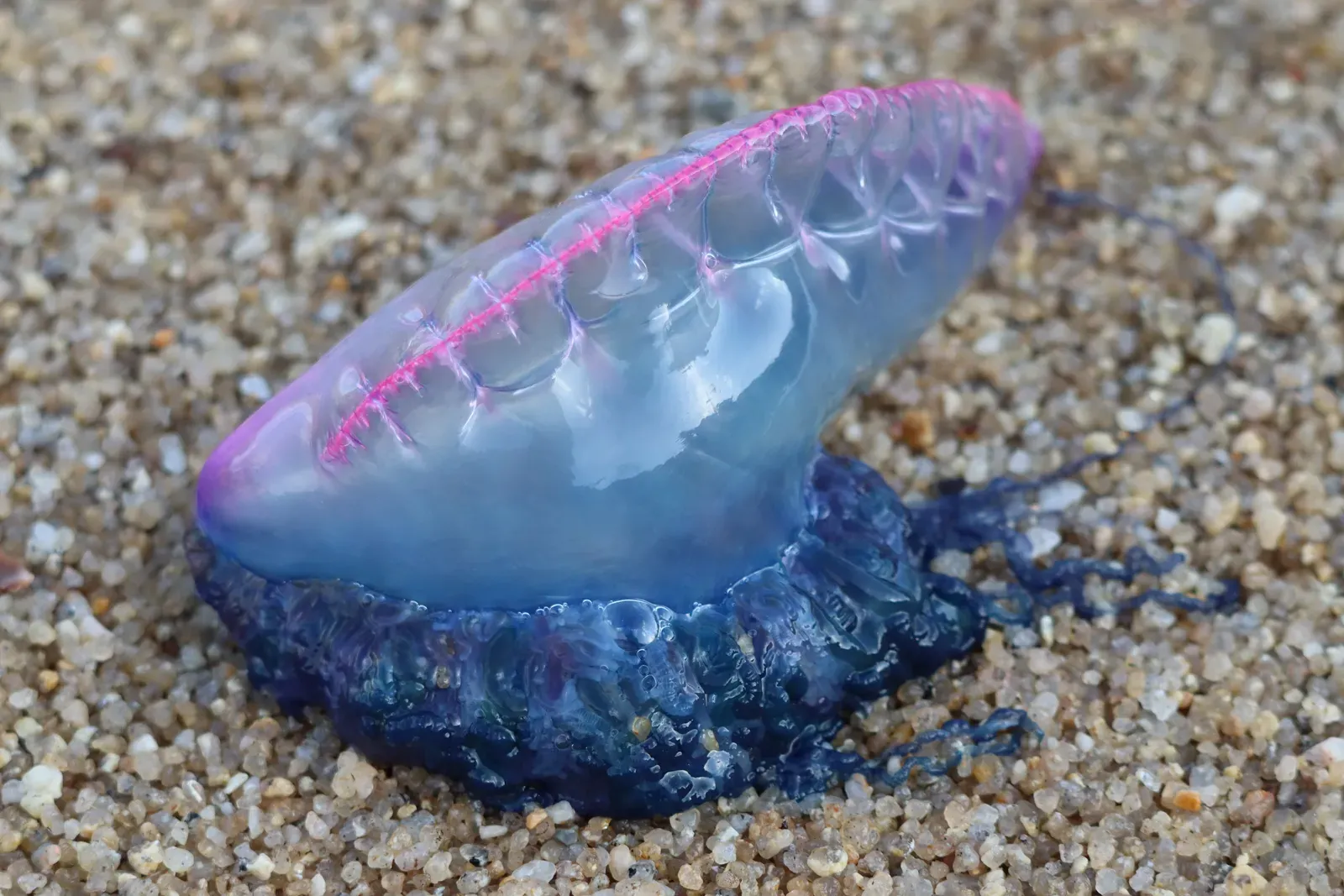
It may look like a jellyfish with a bright blue sail, but the Portuguese man o’ war is a floating colony with a surprising secret beneath the waves.
A blue sail bobs into view
Imagine standing at the edge of a warm, windy beach. The waves fizz around your feet, gulls squeak overhead, and there—rocking on the water—is a glossy blue-and-purple bubble. It looks a bit like someone dropped a tiny, crinkly party balloon into the sea. That surprising sailor is a Portuguese man o’ war, also called a man-of-war or bluebottle.
Before we go any farther, here is the biggest plot twist: it is not a true jellyfish. A Portuguese man o’ war is a colonial siphonophore, called Physalia physalis. In other words, what looks like one animal is actually a joined-together team of many tiny animals. It is less like one lone swimmer and more like a super-close crew in one floating boat.
Portuguese man o’ wars live at the surface of warm parts of the Atlantic, Indian, and Pacific Oceans. Their bright float breaks the water’s surface while the rest of the colony hangs beneath it, hidden in the blue-green world below.
Evidence: IUCN Red List of Threatened Species: Physalia physalis (Portuguese man o’ war) — conservation status; The Wildlife Trusts: Portuguese Man O’War (Physalia physalis) — species profile; Wikipedia: Portuguese man o’ war
One body, many tiny teammates
The colony’s tiny members are called zooids. They are not separate little passengers who can hop off and start their own adventures. They are specialised teammates, joined together and dependent on one another. Different zooids have different tasks, including helping the colony feed, float, and reproduce.
That makes the Portuguese man o’ war wonderfully strange. If an animal could be a school play, this would be it: everyone has an important role, but there is no single actor who can perform the whole show alone. Together, the zooids function as one organism.
Its name may sound like it belongs in an old sea adventure, and that fits. From above, the gas-filled float has a crest that acts like a sail. Yet this sailor has no steering wheel, no oars, and no swimming strokes. It cannot swim. Wind, currents, and tides carry it across the open ocean surface.
A gust can change its journey. A storm can sweep it toward shore. That is why people sometimes spot Portuguese man o’ wars on beaches after windy weather. A beach discovery can be exciting, but it is an adventure for eyes only—not hands.
Evidence: The Wildlife Trusts: Portuguese Man O’War (Physalia physalis) — species profile; Wikipedia: Portuguese man o’ war
What trails beneath the shiny float?
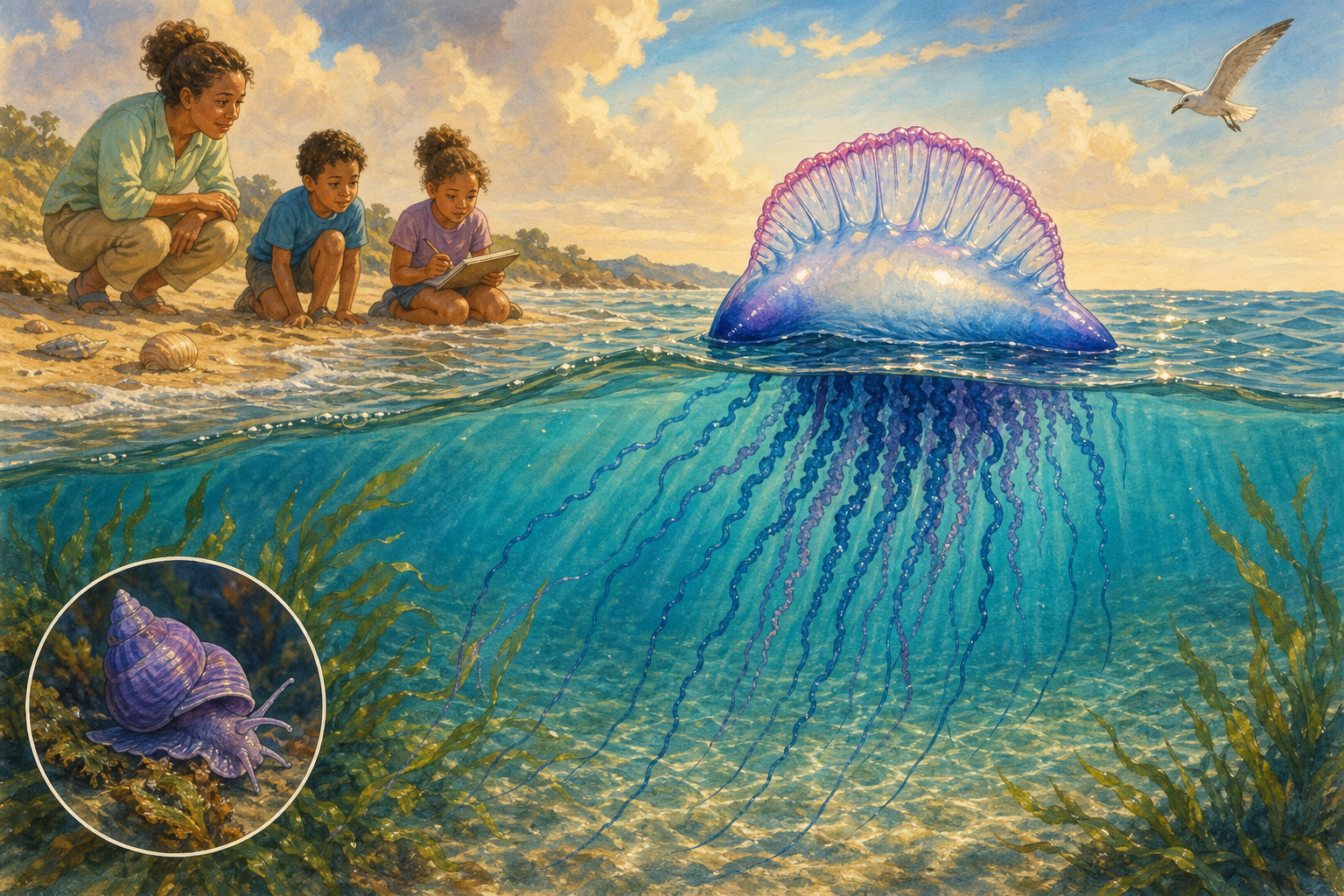
Below that cheerful-looking float, long tentacles trail through the water. They can extend many metres and may reach more than 30 metres—longer than many swimming pools are wide. From the shore, it is easy to miss just how much of the colony is below the surface.
Those tentacles help the colony catch food. Portuguese man o’ wars are carnivores, feeding on small fish, tiny crustaceans, molluscs, and zooplankton. Their tentacles are venomous and sting prey. That is clever for catching a meal, but it also means people should never touch one.
Here is the sensible beach rule: look, point, tell a grown-up or local wildlife group if appropriate, and give it lots of space. Do not poke it with a stick, scoop it up, or touch one washed onto sand. The tentacles can still sting after stranding or after the colony has died. Even a beautiful sea mystery needs respectful personal space.
Some fish may shelter among the tentacles, while other ocean animals can eat Portuguese man o’ wars. Violet sea snails are one example, and loggerhead turtles, blue sea slugs, and ocean sunfish are also reported predators. So this drifting colony is both hunter and part of a larger ocean food web.
Evidence: The Wildlife Trusts: Portuguese Man O’War (Physalia physalis) — species profile; Wikipedia: Portuguese man o’ war
A journey written by the wind
Most animals travel by walking, flying, wriggling, paddling, or swimming. The Portuguese man o’ war does something different: it drifts. It belongs to the ocean-surface community, with its float above water and its feeding parts below. Think of it as a living kite that has fallen sideways onto the sea.
Drifting does not mean doing nothing. The colony must stay together, catch food, and meet the changing conditions of a huge ocean. Its life is a reminder that the sea surface is not empty space. It is a busy border between air and water, full of creatures with unusual ways of living.
Portuguese man o’ wars are described as common across much of their range, although seeing one on some shores can be unusual. The species has not been evaluated on the IUCN Red List, so there is no IUCN global population trend to report. That uncertainty is a good reason to pay attention without making guesses: noticing wildlife carefully is one way people learn how to care for shared seas.
If you see one from a safe distance, try asking: Where might the wind have brought it from? What tiny creatures might be sheltering, hunting, or gliding nearby? A single bright float can turn an ordinary beach walk into a detective story.
Evidence: IUCN Red List of Threatened Species: Physalia physalis (Portuguese man o’ war) — conservation status; The Wildlife Trusts: Portuguese Man O’War (Physalia physalis) — species profile; Wikipedia: Portuguese man o’ war
Why this floating team matters
The Portuguese man o’ war does not need to be cuddly to be worth admiring. Its colony shows how wildly creative life can be: many specialised zooids acting as one, a gas-filled sail catching the wind, and trailing tentacles turning a surface drift into a feeding strategy.
It also invites us to practise a useful kind of kindness: curiosity with boundaries. We can be thrilled by a wild animal without needing to touch, trap, feed, or frighten it. A photograph from a safe place, a sketch in a notebook, or a careful report to a local wildlife organisation can be plenty.
The next time you see a blue shape on a beach, pause before deciding it is rubbish, a jellyfish, or a toy. It could be a whole tiny team, still carrying the story of wind and waves. Give it space, let adults know, and let the ocean keep some of its marvellous secrets.
Evidence: The Wildlife Trusts: Portuguese Man O’War (Physalia physalis) — species profile; Wikipedia: Portuguese man o’ war
A gentle choice for ocean neighbours
Caring about sea life can begin with small, cheerful choices: enjoying the shore without disturbing wild animals, wasting less food, and trying colourful meals built around vegetables, fruit, beans, peas, lentils, whole grains, nuts, and seeds. The World Health Organization describes these foods as part of healthy, varied eating patterns. Food choices are family choices, so children can explore new plant foods with a trusted adult rather than worrying about getting every meal perfect.
Choosing more plant-based foods can also be a kind gesture toward places where wildlife lives. The IPCC reports that shifts toward sustainable, healthy, more plant-based diets can help reduce food-system emissions and pressure on land and biodiversity. A bean burrito, lentil soup, or chickpea sandwich will not steer a Portuguese man o’ war through the waves—but thoughtful choices can help us live more gently alongside the astonishing animals of Earth and sea.
Evidence: World Health Organization: Healthy diet; Intergovernmental Panel on Climate Change: Climate Change 2022: Mitigation of Climate Change — Chapter 7
Questions people ask
Is a Portuguese man o’ war a jellyfish?
No. It is a siphonophore: a colony of many specialised zooids that work together as one organism. It may resemble a jellyfish at first glance, but its teamwork makes it very different.
Evidence: The Wildlife Trusts: Portuguese Man O’War (Physalia physalis) — species profile; Wikipedia: Portuguese man o’ war
Why does it have a sail?
Its gas-filled float sits above the water and has a crest that catches the wind. The colony cannot swim, so wind, currents, and tides move it across the sea.
Evidence: The Wildlife Trusts: Portuguese Man O’War (Physalia physalis) — species profile; Wikipedia: Portuguese man o’ war
What should I do if I find one on the beach?
Keep your distance and do not touch it, even if it looks stranded. Its tentacles can still sting. Tell a nearby adult, and follow local beach or wildlife guidance if it is available.
Evidence: The Wildlife Trusts: Portuguese Man O’War (Physalia physalis) — species profile; Wikipedia: Portuguese man o’ war
What does it eat?
It catches small fish and tiny ocean animals, including crustaceans, molluscs, and zooplankton, using its venomous tentacles.
Evidence: The Wildlife Trusts: Portuguese Man O’War (Physalia physalis) — species profile; Wikipedia: Portuguese man o’ war
Read the evidence
Sources behind this story
- Physalia physalis (Portuguese man o' war) — conservation status — IUCN Red List of Threatened Species
- Portuguese Man O'War (Physalia physalis) — species profile — The Wildlife Trusts
- Portuguese man o' war — Wikipedia
- Healthy diet — World Health Organization
- Climate Change 2022: Mitigation of Climate Change — Chapter 7 — Intergovernmental Panel on Climate Change
Health information is general education, not personal medical advice. Young readers should make food choices with a trusted adult and qualified health professional.