Today's animal friend · 2 September 2026
The Chameleon With Two-Way Eyes
Follow a panther chameleon through a sunny tangle of leaves and discover why its colours, swivelling eyes, and careful forest home deserve our attention.
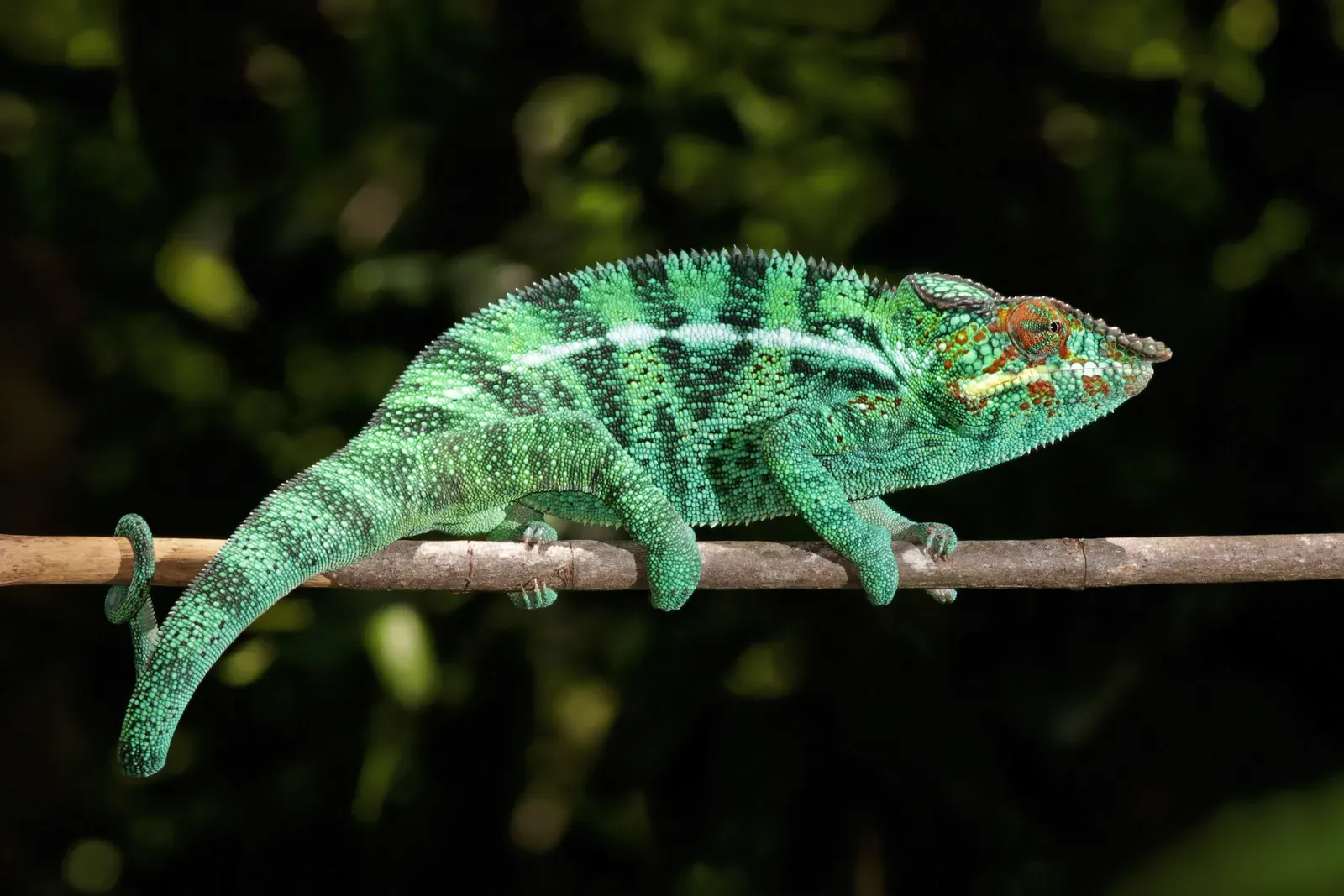
Follow a panther chameleon through a sunny tangle of leaves and discover why its colours, swivelling eyes, and careful forest home deserve our attention.
Wait—was that one lizard looking in two directions?
A twig gives the tiniest bounce in a warm Madagascan forest. A panther chameleon is moving across it: one slow, careful foot at a time, as if the branch were a wobbly tightrope. Then comes the surprising part. One of its eyes turns forward while the other scans behind. No head spin required!
A panther chameleon can move each eye independently, which lets it watch nearly all the way around its body without turning its head. Imagine trying to read a comic with one eye while the other checked whether someone was sneaking up with a silly hat. This lizard makes that seem perfectly ordinary.
Its name is Furcifer pardalis, and it is a chameleon—a kind of lizard in the family Chamaeleonidae. It is also called the Madagascar panther chameleon. Although “panther” may sound like it should stomp through the jungle in boots, this animal is a small, branch-climbing reptile with very patient manners.
Evidence: IUCN Red List of Threatened Species: Furcifer pardalis (Panther Chameleon) — Red List Assessment; Animal Diversity Web, University of Michigan Museum of Zoology: Furcifer pardalis; Wikipedia: Panther chameleon
A sunny explorer in Madagascar
Panther chameleons are native to Madagascar, the large island off Africa’s coast. Their homes include tropical forest, coastal forest, and shrubland. Picture layers of leaves, sunlit branches, scratchy bushes, and tiny insects humming or hopping nearby. That is a much more useful address for a chameleon than a street name.
These chameleons are active in the daytime. In daylight, they climb and hunt among plants. Their world is not a racetrack. A careful climb can be clever: a branch is both a path and a lookout point, and leaves can hide a snack or hint that something else is moving.
Adults are roughly 0.23 to 0.5 metres long. That means a larger one can be about as long as a school ruler and a half, though it is far less likely to help with homework. Their reported lifespan in the wild is often only a few years, so every safe patch of habitat matters.
Forest and shrubland are not just scenery behind a chameleon photo. They are places to climb, warm up, find insects, and carry on the busy business of being a chameleon. As an insect-eater living in the trees and bushes, the panther chameleon is part of Madagascar’s local insect food web.
Evidence: Animal Diversity Web, University of Michigan Museum of Zoology: Furcifer pardalis; Wikipedia: Panther chameleon
Colour is a message, not only a disguise
Here is another chameleon myth-buster: panther chameleons do not change colour only to vanish into the background. Their colour changes can show how they feel, help with territorial displays, and help them warm up in the sun. Colour can be a kind of body-language billboard.
Males can wear especially bright reds, greens, and blues. An excited male may show bold colours during a display to another male—as if saying, “Hello. Yes, I am very noticeable. Please respect this branch.” A chameleon has no need for a tiny sign that reads PRIVATE TREE.
That does not mean we should guess every feeling from a photo. Animals have their own signals and needs, and careful observers let them have space. The wonderful lesson is that a panther chameleon’s skin is active communication, not a magical costume button.
Their eyes help make the next move. A chameleon can survey with its eyes moving separately, then use both eyes to aim at prey. That change from wide watchfulness to careful focus is a brilliant hunting trick.
Evidence: Animal Diversity Web, University of Michigan Museum of Zoology: Furcifer pardalis; Wikipedia: Panther chameleon
The snack that never sees it coming
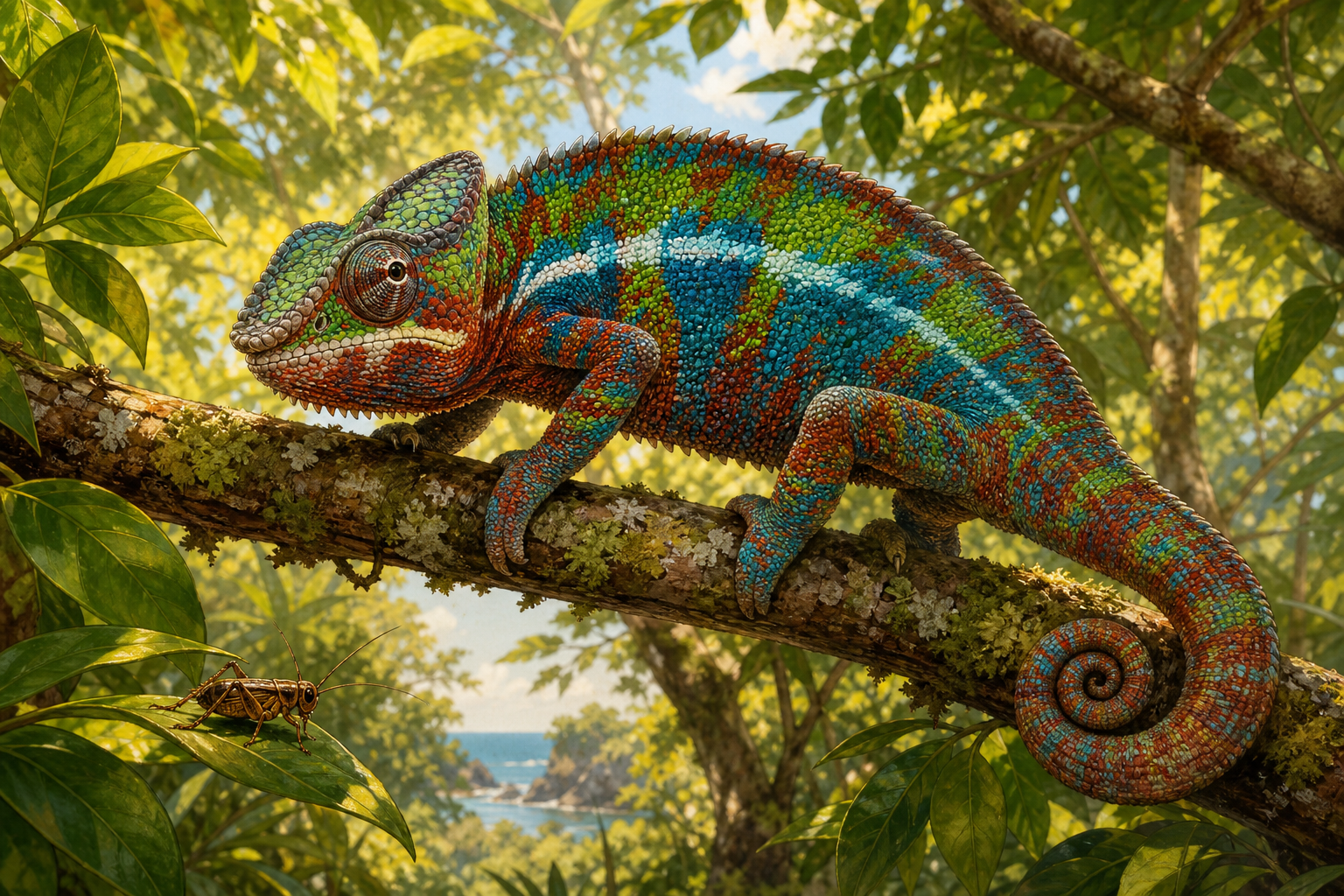
A fly buzzes. A cricket hops. A beetle creeps under a leaf. For a panther chameleon, these are not background noises; they are possible lunch. This species is insectivorous, eating insects including crickets, flies, grasshoppers, and beetles.
Once the chameleon has aimed, its sticky tongue can shoot out longer than its whole body and grab an insect in the blink of an eye. One moment: still as a leafy statue. Next moment: zip! The tongue is out and back before an onlooker has finished thinking, “Was that a tiny party streamer?”
This speedy tongue does not make the chameleon a frantic animal. Its hunting style combines waiting, watching, aiming, and a fast final flick. That mix is a reminder that being quiet is not the same as doing nothing. Sometimes the best preparation is paying attention.
The insects it catches are part of a larger web of life. Plants support many insects; chameleons feed on insects; and healthy habitats make room for all these connections. A forest can look peaceful while millions of small jobs are happening among the leaves.
Evidence: Animal Diversity Web, University of Michigan Museum of Zoology: Furcifer pardalis; Wikipedia: Panther chameleon
Good news, and a job still to do
The panther chameleon is listed as Least Concern on the IUCN Red List, using a 2011 assessment, and its population was described as stable. That is encouraging news. But “Least Concern” does not mean “nothing matters anymore” or “every chameleon is safe everywhere.”
Habitat loss and collection for the international pet trade are recorded pressures on the species. If forests, coastal forests, or shrublands are damaged, a chameleon loses more than a nice view. It can lose the climbing places and insect-rich hunting grounds that make life possible.
One helpful big-picture idea is to care about wild animals as wild neighbours, not decorations or souvenirs. Protecting Madagascar’s habitats and reducing pressure from collection help answer the chameleon’s quiet request: leave room for leaves, branches, insects, and lives that belong outdoors.
You do not have to travel across an ocean to practise that kind of care. You can notice insects without squashing them, value green places in your own community, ask thoughtful questions about where animals come from, and share the surprising truth that chameleons are more than colour-changing party tricks.
Evidence: IUCN Red List of Threatened Species: Furcifer pardalis (Panther Chameleon) — Red List Assessment; Animal Diversity Web, University of Michigan Museum of Zoology: Furcifer pardalis; Wikipedia: Panther chameleon
A kind choice can begin at the lunch table
Caring about a chameleon’s forest can connect to everyday choices, even far from Madagascar. The World Health Organization describes healthy diets in broad terms that include a variety of whole grains, vegetables, fruit, pulses, nuts, and seeds. With a trusted adult, exploring colourful plant-based meals can be one cheerful way to notice how much good food grows from plants.
The IPCC reports that shifts toward sustainable, healthy, more plant-based diets can lower food-system emissions and reduce pressure on land and biodiversity. So perhaps a bean taco, lentil soup, fruit snack, or seed-topped toast can be a small “hello, wild places” from your plate. No guilt, no perfection contest—just curiosity, kindness, and a chance to try something delicious.
Panther chameleons need their own insect meals, of course. We do not ask animals to copy our menus! But we can choose to be thoughtful humans: leave wildlife wild, support living habitats, and enjoy plant-rich foods that can be kinder to the shared planet.
Evidence: World Health Organization: Healthy diet; Intergovernmental Panel on Climate Change: Climate Change 2022: Mitigation of Climate Change — Chapter 7; IUCN Red List of Threatened Species: Furcifer pardalis (Panther Chameleon) — Red List Assessment
Questions people ask
Can a panther chameleon really look two ways at once?
Yes. Its eyes can move independently, allowing it to scan nearly around its body without turning its head. When hunting, it can bring both eyes into focus to aim at prey.
Evidence: Animal Diversity Web, University of Michigan Museum of Zoology: Furcifer pardalis; Wikipedia: Panther chameleon
Does it eat plants?
The supplied species information describes the panther chameleon as an insectivore. Its foods include crickets, flies, grasshoppers, beetles, and other insects.
Evidence: Animal Diversity Web, University of Michigan Museum of Zoology: Furcifer pardalis
Why does it change colour?
Colour change can be connected to mood, territorial displays, and warming up in sunlight. Hiding is not the only reason.
Evidence: Animal Diversity Web, University of Michigan Museum of Zoology: Furcifer pardalis; Wikipedia: Panther chameleon
Is “Least Concern” the same as “no worries”?
No. It is the species’ IUCN category from the 2011 assessment, with a stable population described there, but habitat loss and collection for the pet trade are still recorded pressures.
Evidence: IUCN Red List of Threatened Species: Furcifer pardalis (Panther Chameleon) — Red List Assessment; Wikipedia: Panther chameleon
Read the evidence
Sources behind this story
- Furcifer pardalis (Panther Chameleon) — Red List Assessment — IUCN Red List of Threatened Species
- Furcifer pardalis — Animal Diversity Web, University of Michigan Museum of Zoology
- Panther chameleon — Wikipedia
- Healthy diet — World Health Organization
- Climate Change 2022: Mitigation of Climate Change — Chapter 7 — Intergovernmental Panel on Climate Change
Health information is general education, not personal medical advice. Young readers should make food choices with a trusted adult and qualified health professional.