Today's animal friend · 14 July 2026
The Laughing Kookaburra: A Big Voice in the Treetops
Its call may sound like a burst of human laughter, but this clever bird is making a serious family-and-home announcement.
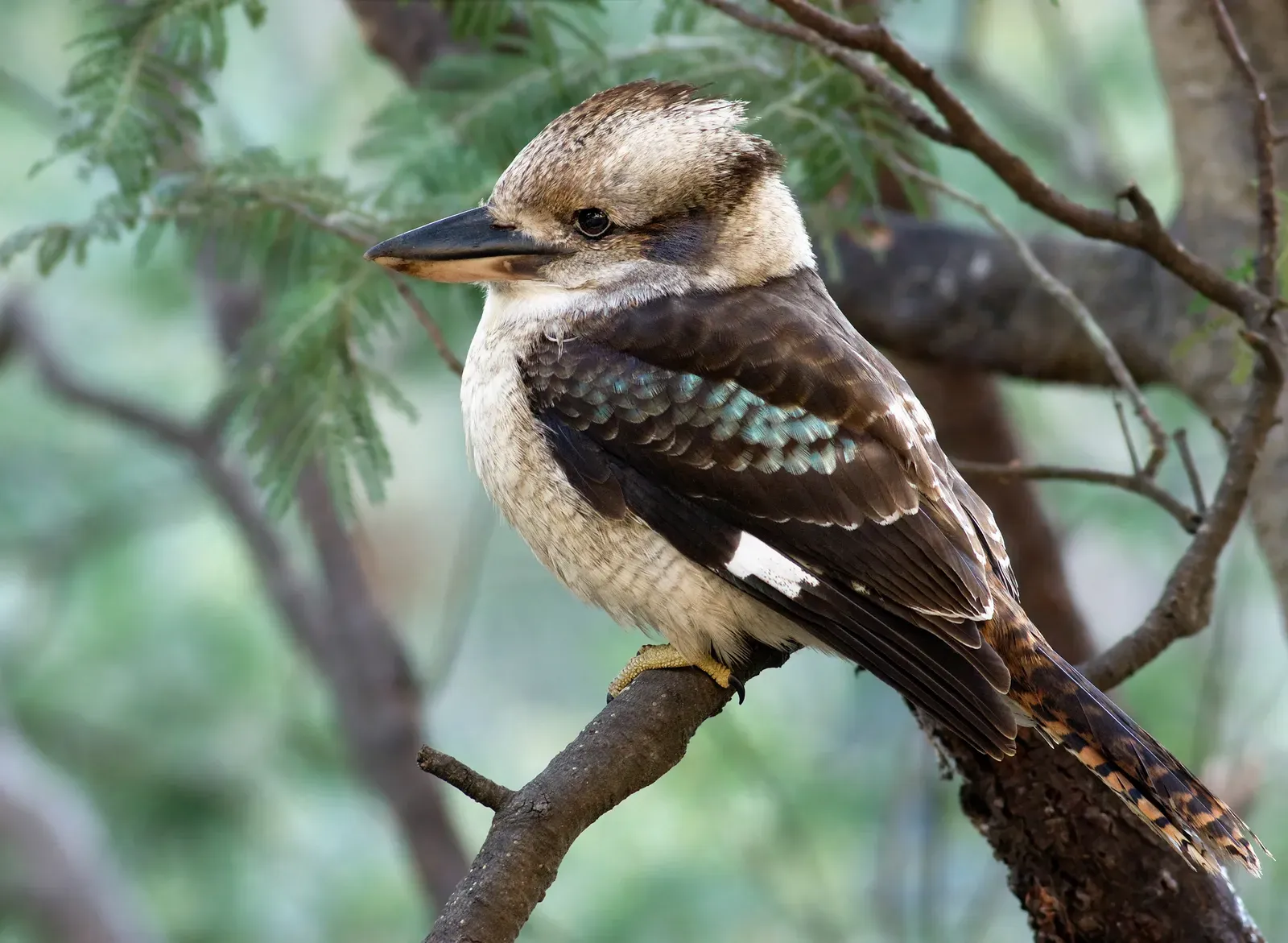
Its call may sound like a burst of human laughter, but this clever bird is making a serious family-and-home announcement.
First, listen: that “laugh” belongs to a bird
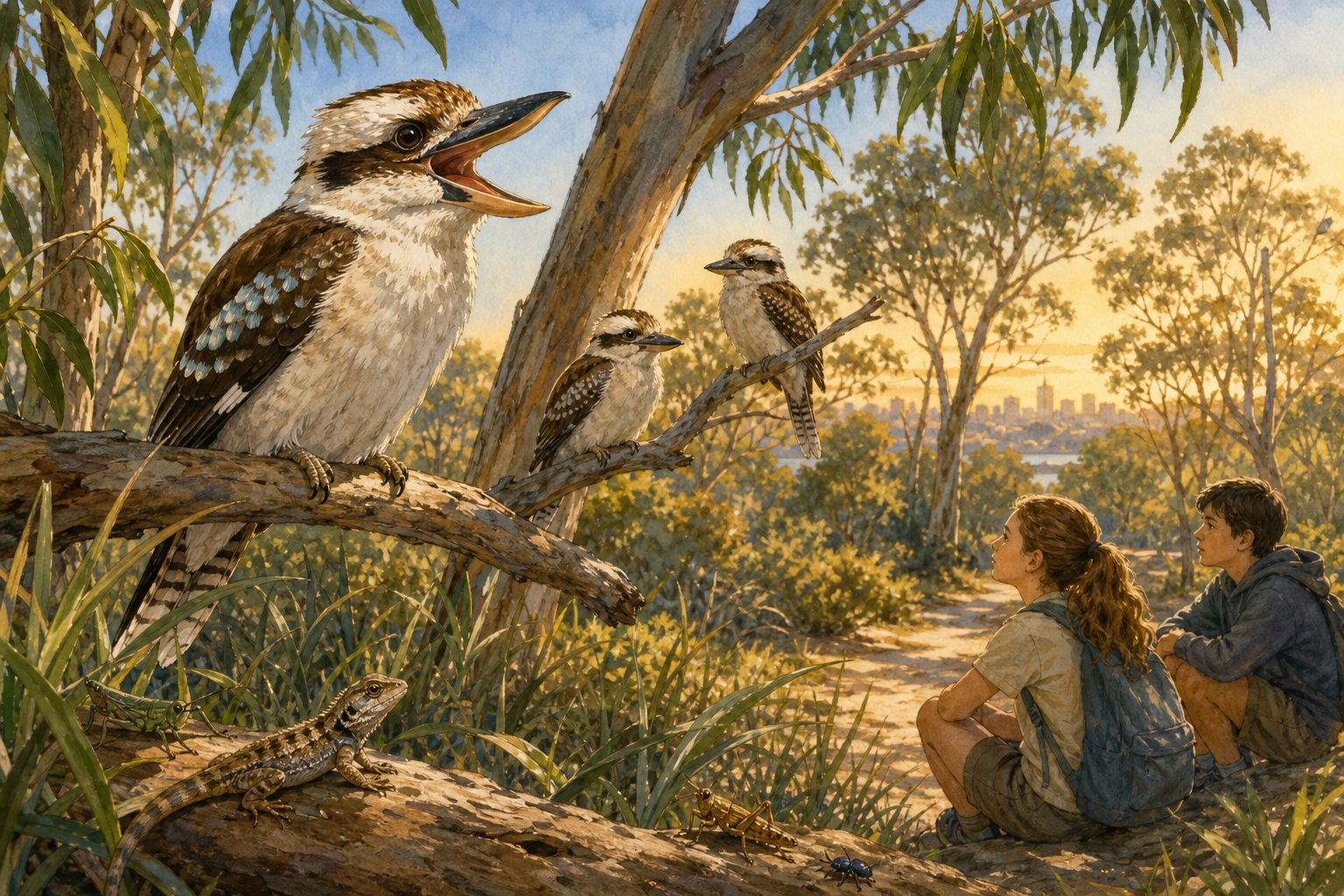
Imagine an early morning in a leafy park: the branches are still, then a soft chuckle rises into a wild, rolling chorus. It can sound so much like someone laughing out loud that a first-time listener might search for a hidden group of people. The voice belongs to the laughing kookaburra, Dacelo novaeguineae—also called simply the kookaburra, or sometimes the laughing jackass.
This chunky brown-and-white bird has a big head, a strong beak and an unforgettable call. Its laughter is not really a joke, of course. Kookaburras use loud group choruses to mark and defend their territory: in effect, a family announcement that says, “This place is our home.” Calls are especially noticeable around dawn and dusk, when they can carry through the treetops.
A laughing kookaburra is a daytime bird. That means young wildlife-watchers have a good chance of spotting one in daylight—if they slow down, look up, and listen before they speak. Sometimes the sound of an animal is the first clue that it is nearby.
Evidence: IUCN Red List of Threatened Species: Dacelo novaeguineae (Laughing Kookaburra) — Red List Assessment; Australian Museum: Laughing Kookaburra (Dacelo novaeguineae)
A kingfisher that prefers the ground below
Here is the kookaburra’s delightful surprise: it belongs to the kingfisher family, Alcedinidae, but it does not usually make its meals by catching fish. It is among the biggest kingfishers, yet it is a land hunter. From a perch, it watches the ground with patient attention, then swoops when it notices possible prey.
Its menu includes insects, worms, lizards, snakes and small mammals. This makes the laughing kookaburra a carnivore. The bird’s sturdy beak is an important tool for catching food, and a branch can serve as a lookout point before and after a hunt. A perch-and-pounce hunter does not need to race through the forest: it can wait, watch and act at the right moment.
There is a useful nature-watching lesson in that stillness. A bird may seem to be doing nothing while it sits quietly on a branch, but it may be carefully reading the busy world below: a rustle in leaves, a movement in grass, an insect crossing open ground. Wildlife is often full of hidden concentration.
Evidence: IUCN Red List of Threatened Species: Dacelo novaeguineae (Laughing Kookaburra) — Red List Assessment; Australian Museum: Laughing Kookaburra (Dacelo novaeguineae)
Big for a kingfisher, and built for an outdoor life
Laughing kookaburras measure about 40 to 47 centimetres from beak to tail, and their weight varies between individuals. They live in woodland and open forest, as well as places many people know well: parks and gardens. Across Australia and the wider Oceania region, a familiar laugh from the trees can turn an ordinary outdoor walk into a small wildlife encounter.
Their choice of habitats is a reminder that animal neighbours do not live only in faraway wilderness. A garden with trees, a local green space, or a patch of open woodland can be part of a bird’s daily world. When we share places with wildlife, quiet observation is a kind way to begin. Watch from a respectful distance, leave nests and young birds undisturbed, and let wild animals find their own food.
The laughing kookaburra may live for 10 to 20 years. That possible span makes each territory more than a temporary stop: it can be a long-running home base for a family group. A single ringing chorus may be only a few moments long, but the lives behind it can stretch across many seasons.
Evidence: IUCN Red List of Threatened Species: Dacelo novaeguineae (Laughing Kookaburra) — Red List Assessment; Australian Museum: Laughing Kookaburra (Dacelo novaeguineae)
The family chorus has helpers
Kookaburras live in close family groups, and older offspring can help their parents raise later chicks. Rather than immediately leaving to begin a separate life, older brothers and sisters may help feed the new baby birds. This is called cooperative breeding, and it turns a nest into a shared effort.
It is easy to hear a kookaburra chorus as a single huge laugh, but it is more like a group sound made by connected birds. Their shared territory, their calls and their care for young all point to the importance of family life for this species. The helpers are not tiny side characters; they are part of what supports the next generation.
For us, this offers a gentle thought rather than a rule: helping can matter. In human families, friendships, classrooms and neighbourhoods, people have different ways to lend a hand. A kookaburra family does it by bringing food and helping with the young. We might do it by sharing a task, making space for someone, or noticing when help is needed.
Evidence: IUCN Red List of Threatened Species: Dacelo novaeguineae (Laughing Kookaburra) — Red List Assessment; Australian Museum: Laughing Kookaburra (Dacelo novaeguineae)
A hopeful picture, with room for care
The laughing kookaburra is listed as Least Concern on the IUCN Red List, based on a 2016 assessment, and its population trend is recorded as stable. That is encouraging news. It does not mean people can stop caring; it means there is a hopeful opportunity to value a species that remains widespread and familiar.
Habitat loss and car strikes are among the pressures identified for laughing kookaburras. Practical kindness can be wonderfully ordinary: respect green spaces, keep an eye out for wildlife when travelling through places where animals cross, and encourage adults and community leaders to care for trees and habitat. Small everyday decisions can show that parks and gardens are shared homes, not just human backdrops.
No one needs to “rescue” every wild moment. Often the best friendship with a wild bird is respectful distance: listen to its call, enjoy the sight of it on a branch, and let it remain free to hunt, communicate and care for its family. A kookaburra’s laugh is brightest when it belongs to the living landscape around it.
Evidence: IUCN Red List of Threatened Species: Dacelo novaeguineae (Laughing Kookaburra) — Red List Assessment; Australian Museum: Laughing Kookaburra (Dacelo novaeguineae)
Let its laugh widen your circle of care
A kookaburra’s diet is its own wild way of surviving, not a menu for people to copy. Humans can make choices with many more options. One compassionate response to meeting a remarkable animal is to remember that other animals have their own lives, families and reasons to be here—not roles as products for us.
For people, the World Health Organization describes healthy diets in broad terms that include a variety of whole grains, vegetables, fruit, pulses, nuts and seeds. With a trusted adult and, when needed, a qualified health professional, young readers can explore enjoyable plant-forward meals that suit their family and needs. Think colourful bean tacos, a lentil soup, fruit with nut or seed butter, or a favourite vegetable dish shared at home.
Plant-based choices can also be a caring choice for the bigger home we all share. The IPCC reports that shifts toward sustainable, healthy, more plant-based diets can help reduce food-system emissions and pressure on land and biodiversity. You do not have to be perfect to be kind. A curious new meal, a meat-free favourite, or a thoughtful conversation can be a hopeful start.
Evidence: World Health Organization: Healthy diet; Intergovernmental Panel on Climate Change: Climate Change 2022: Mitigation of Climate Change — Chapter 7
A friendly choice for every shared home
The kookaburra’s family teamwork can inspire us to widen our own circle of kindness. Wild animals need their habitats and freedom; farmed animals also deserve thoughtful consideration. Choosing more plant-based foods is one practical, positive way to put empathy into action.
Healthy eating looks different for different people and families, so any food changes should be discussed with a trusted adult and, where useful, a qualified health professional. The World Health Organization includes vegetables, fruit, whole grains, pulses, nuts and seeds in its general healthy-diet guidance. The IPCC also finds that sustainable, healthy, more plant-based diets can reduce pressure on climate, land and biodiversity. A cheerful plant-based meal can be a small vote for a gentler world.
Evidence: World Health Organization: Healthy diet; Intergovernmental Panel on Climate Change: Climate Change 2022: Mitigation of Climate Change — Chapter 7
Questions people ask
Why do laughing kookaburras sound as if they are laughing?
Their loud chorus resembles human laughter, but it is a territorial call. Family groups use it to mark and defend the place where they live, particularly around dawn and dusk.
Evidence: Australian Museum: Laughing Kookaburra (Dacelo novaeguineae)
Does a laughing kookaburra eat fish?
Usually, no. Although it is a kingfisher, it is mainly a land hunter that eats animals such as insects, worms, lizards, snakes and small mammals.
Evidence: IUCN Red List of Threatened Species: Dacelo novaeguineae (Laughing Kookaburra) — Red List Assessment; Australian Museum: Laughing Kookaburra (Dacelo novaeguineae)
Where might I see one?
Look and listen in woodland, open forest, parks and gardens in its Oceania range. A quiet pause under trees is often more useful than rushing about.
Evidence: IUCN Red List of Threatened Species: Dacelo novaeguineae (Laughing Kookaburra) — Red List Assessment; Australian Museum: Laughing Kookaburra (Dacelo novaeguineae)
Are laughing kookaburras endangered?
They are listed as Least Concern by the IUCN, with a stable population trend in its 2016 assessment. Habitat loss and car strikes still give us good reasons to care for wildlife spaces.
Evidence: IUCN Red List of Threatened Species: Dacelo novaeguineae (Laughing Kookaburra) — Red List Assessment; Australian Museum: Laughing Kookaburra (Dacelo novaeguineae)
Read the evidence
Sources behind this story
- Dacelo novaeguineae (Laughing Kookaburra) — Red List Assessment — IUCN Red List of Threatened Species
- Laughing Kookaburra (Dacelo novaeguineae) — Australian Museum
- Healthy diet — World Health Organization
- Climate Change 2022: Mitigation of Climate Change — Chapter 7 — Intergovernmental Panel on Climate Change
Health information is general education, not personal medical advice. Young readers should make food choices with a trusted adult and qualified health professional.