Today's animal friend · 1 November 2026
Jaguar: The Riverbank Shadow with a Turtle-Cracking Bite
A jaguar can slip through a forest like a golden, spotty secret—then splash straight into a river. Meet this powerful wild neighbour and discover why its home matters.

A jaguar can slip through a forest like a golden, spotty secret—then splash straight into a river. Meet this powerful wild neighbour and discover why its home matters.
A splash, a swish, and… a cat?
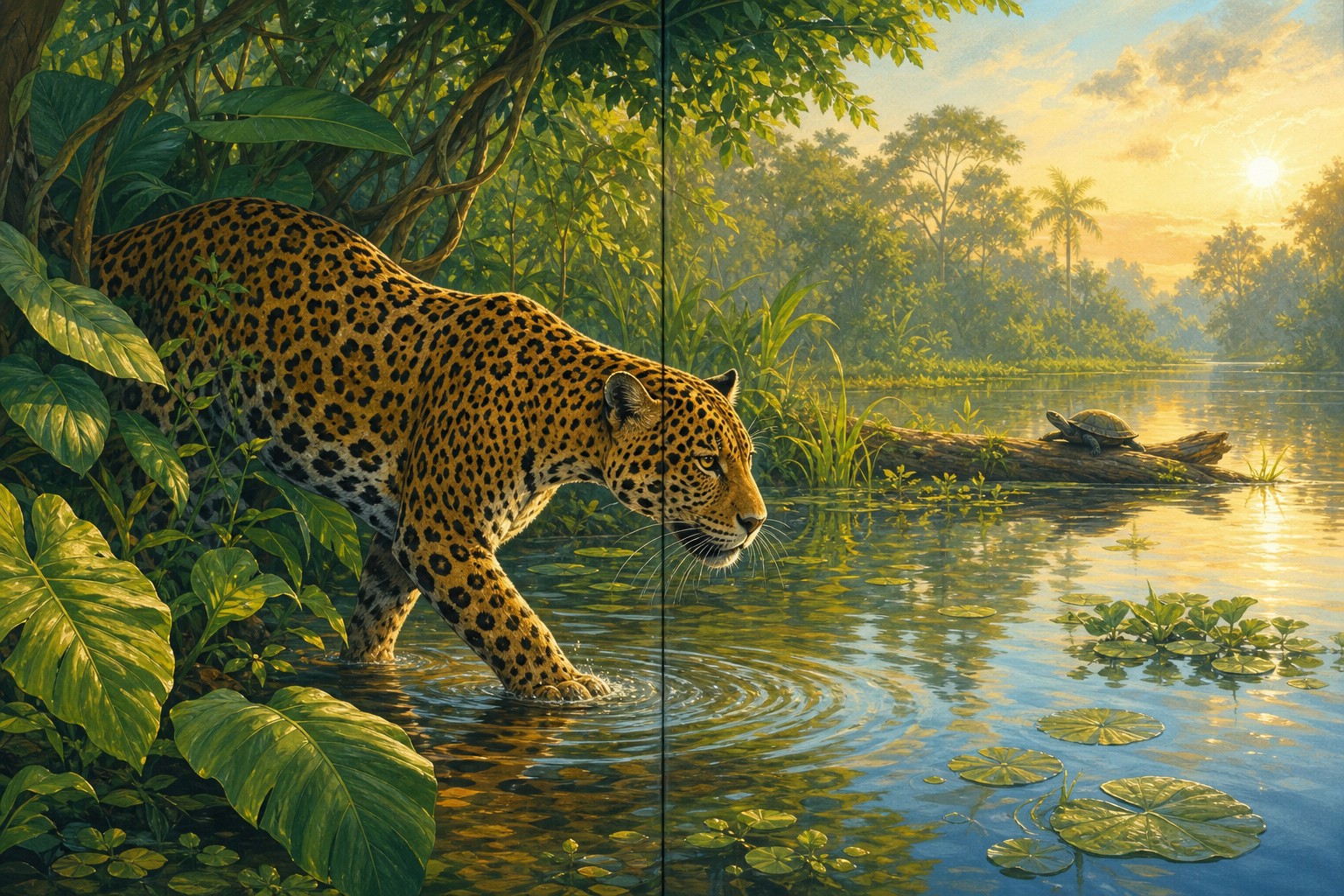
Picture a warm, green wetland in the Americas. Leaves brush together overhead. Mud squishes at the river’s edge. Then something large moves through the plants—so quietly that the water may make more noise than its paws do.
It is a jaguar, Panthera onca. This cat is the biggest in all the Americas and the third biggest cat in the world, after tigers and lions. An adult can have a body up to about 1.85 metres long—longer than many sofas—and may weigh up to about 158 kilograms. That is a lot of cat to misplace behind a curtain of leaves.
Jaguars live from Mexico through Central America and into much of South America. Their homes include tropical and subtropical forests, wetlands, riversides, swamps, and other places with thick cover near water. If a rainforest were a busy green city, a jaguar would be one of its quietest, strongest residents.
Evidence: IUCN Red List of Threatened Species: Panthera onca (Jaguar) — Red List Assessment; World Wide Fund for Nature (WWF): Jaguar; Wikipedia (English): Jaguar
The coat with secret little rings
A jaguar’s golden coat is scattered with dark markings. Many are rosettes: ring-shaped spots that look a bit like tiny flower outlines, or like someone stamped the fur with uneven doughnut shapes. They help break up the animal’s outline among shade, branches, and plants.
Not every jaguar looks golden from a distance. Some are born with coats so dark that they seem almost black. People may call them “black panthers,” but they are still jaguars—not a separate species. In the right light, their hidden rosettes can still be seen. Imagine drawing spots with black pencil on very dark brown paper: they have not vanished; they are simply shy.
The jaguar is also called el tigre in some places. But its own scientific name, Panthera onca, reminds us that this animal belongs to the big-cat family. It is the only living Panthera species native to the Americas.
Evidence: IUCN Red List of Threatened Species: Panthera onca (Jaguar) — Red List Assessment; World Wide Fund for Nature (WWF): Jaguar; Wikipedia (English): Jaguar
Why would a big cat choose the water?
Many of us might expect a cat to eye a puddle suspiciously, as if it has personally offended them. Jaguars do not follow that joke. They are capable swimmers and are often found near rivers, lakes, swamps, and wetlands.
Water is part of the jaguar’s neighbourhood, not a barrier at the edge of it. A jaguar can wade or swim through watery places while moving around its home. Dense plants nearby offer cover, too. That combination—water and shelter—helps explain why wetlands and forests can be such important places for jaguars.
Adult jaguars generally live alone, except when mating or when a mother is caring for dependent cubs. So the riverbank may look empty to us, even when a jaguar has passed through it. Outdoors is full of mysteries like that: an empty-looking path can still belong to somebody.
Evidence: World Wide Fund for Nature (WWF): Jaguar; Wikipedia (English): Jaguar
A jaw built for a very tricky dinner
Jaguars are carnivores. Their prey can include capybara, deer, caiman, turtles, and giant anteaters. They usually hunt alone, using careful, quiet movement rather than a noisy group chase.
Here is the astonishing part: a jaguar’s bite is strong enough to pierce turtle or tortoise shells. A turtle shell is not a snack wrapper; it is tough armour. Yet the jaguar has one of the strongest bites among cats. This does not make a jaguar “mean.” It means it is superbly adapted to finding food in its own wild home, just as a beaver has teeth for wood and an owl has wings for silent flight.
Jaguars are top predators in these forest and wetland communities. Scientists discuss exactly how strongly they shape everything around them, but there is no doubt that a jaguar is an important part of the living web: water, plants, prey animals, insects, birds, and people all share the wider landscape.
Evidence: World Wide Fund for Nature (WWF): Jaguar; Wikipedia (English): Jaguar
When the forest becomes little islands
A jaguar needs more than one beautiful patch of trees. As forests are cut down and broken into smaller pieces, jaguars can lose habitat and safe routes between places. Think of trying to visit friends when every pavement between your homes suddenly turns into a roaring road: the journey becomes harder and riskier.
Jaguar numbers are decreasing, and the IUCN has listed the species as Near Threatened since 2002. Habitat loss and deforestation are major pressures. Jaguars can also be killed after conflict involving livestock, and their body parts may be taken for illegal trade. These are serious problems, but they are not the end of the story.
People can help by protecting forest and wetland habitat, keeping travel corridors connected between jaguar areas, reducing conflict so people and jaguars can live more safely side by side, and curbing illegal trade. A corridor is like a wildlife hallway between rooms: it gives animals a better chance to move through a changing landscape.
Evidence: IUCN Red List of Threatened Species: Panthera onca (Jaguar) — Red List Assessment; World Wide Fund for Nature (WWF): Jaguar; Wikipedia (English): Jaguar
Be a brilliant jaguar detective
You do not need to travel to a rainforest tomorrow—or wear a spotted cape, though no one can stop your imagination—to care about jaguars today. Start by noticing connections. Where does water go after rain? Which creatures need trees, cover, or a safe place to cross? A wetland near you will have its own busy cast of neighbours.
When you read about a jaguar, ask: Is this claim about one individual, or the whole species? Is a dark-coated jaguar really a different animal, or is it a jaguar whose rosettes are harder to see? Asking careful questions is a kind of wildlife superpower.
And remember the riverbank scene. Somewhere in the forests and wetlands of the Americas, a jaguar may be moving through shadow and sunlight, carrying its rosettes like a map. Protecting its home means protecting a richly shared place—not just one magnificent cat.
Evidence: IUCN Red List of Threatened Species: Panthera onca (Jaguar) — Red List Assessment; World Wide Fund for Nature (WWF): Jaguar; Wikipedia (English): Jaguar
A kind choice can begin at the dinner table
Caring about jaguars can also mean caring about the land and living things around them. Meals built around vegetables, fruit, whole grains, pulses, nuts, and seeds can be colourful, tasty, and full of possibilities—think bean tacos, lentil soup, or a crunchy rainbow sandwich. The World Health Organization describes these foods as parts of healthy eating patterns.
The IPCC reports that shifts toward sustainable, healthy, more plant-based diets can reduce food-system emissions and pressure on land and biodiversity. You do not have to solve everything with one lunch. Perhaps try a plant-based meal with your family, help choose a recipe, and talk with a trusted adult if you are thinking about bigger food changes. Small, caring choices can be one way of saying: there is room on Earth for jaguars and all their wild neighbours.
Evidence: World Health Organization: Healthy diet; Intergovernmental Panel on Climate Change: Climate Change 2022: Mitigation of Climate Change — Chapter 7
Questions people ask
Are jaguars the same as leopards?
No. They are different big-cat species. Jaguars are Panthera onca and are native to the Americas. Their rosettes are a well-known part of their coat pattern, but a close look at where an animal lives and its other features matters too.
Evidence: World Wide Fund for Nature (WWF): Jaguar; Wikipedia (English): Jaguar
Is a black panther a separate kind of animal?
Often, “black panther” is a name used for a jaguar with a very dark coat. Its spots are still present and may show in the right light.
Evidence: World Wide Fund for Nature (WWF): Jaguar; Wikipedia (English): Jaguar
Why do jaguars need connected forests?
When habitat is broken into isolated patches, moving between places becomes more difficult. Protecting habitat and travel corridors can support jaguars across their remaining range.
Evidence: World Wide Fund for Nature (WWF): Jaguar; Wikipedia (English): Jaguar
Read the evidence
Sources behind this story
- Panthera onca (Jaguar) — Red List Assessment — IUCN Red List of Threatened Species
- Jaguar — World Wide Fund for Nature (WWF)
- Jaguar — Wikipedia (English)
- Healthy diet — World Health Organization
- Climate Change 2022: Mitigation of Climate Change — Chapter 7 — Intergovernmental Panel on Climate Change
Health information is general education, not personal medical advice. Young readers should make food choices with a trusted adult and qualified health professional.