Today's animal friend · 14 July 2026
Great White Sharks: The Ocean’s Powerful, Misunderstood Neighbours
Great white sharks are not movie monsters. They are long-lived wild animals with finely tuned bodies, important ocean homes, and a real need for our care.
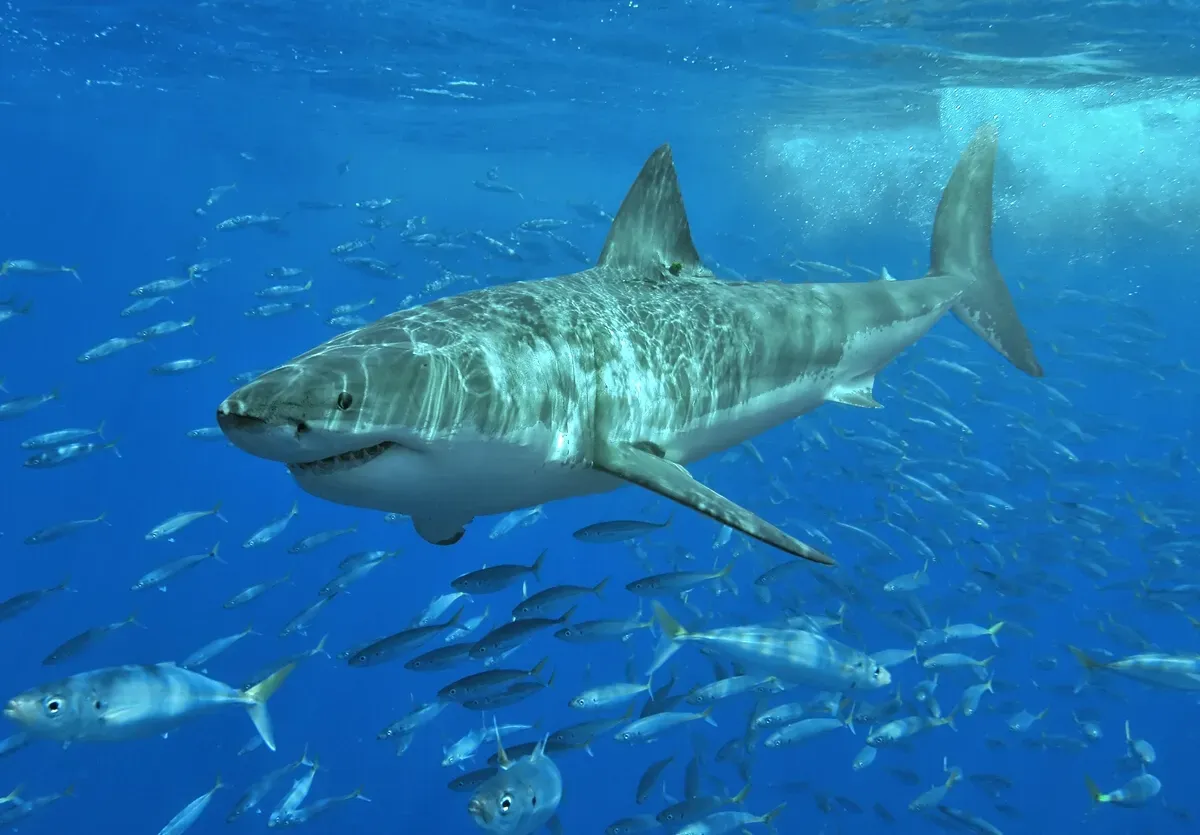
Great white sharks are not movie monsters. They are long-lived wild animals with finely tuned bodies, important ocean homes, and a real need for our care.
Meet the great white: a shark with a famous name and a private life
The great white shark, also called the white shark or white pointer, has one of the most recognisable names in the ocean. Its scientific name is Carcharodon carcharias. Yet, for all its fame, a great white is not a villain waiting beneath the waves. It is a wild fish making its way through an enormous, changing sea—swimming, sensing, resting, feeding, and avoiding danger just as other animals do.
Great whites belong to a group called cartilaginous fishes. Unlike people, seabirds, or seals, they do not have skeletons made of bone; their bodies are supported by cartilage. They are among the largest hunting fish in the sea. Many are about 4–6 metres long, and their weight can vary widely, roughly from 500 to 2,000 kilograms. That is a lot of shark, but size is only one part of their story.
Their familiar colouring is useful in open water: a greyish back can blend with the darker water above, while a pale belly can be harder to spot from below. It is a quiet kind of ocean camouflage, not a costume for a monster. When we look past scary stories, we can see an alert, capable animal shaped by life in the sea.
Evidence: IUCN Red List of Threatened Species: Carcharodon carcharias (Great White Shark) — Red List Assessment; Florida Museum of Natural History, University of Florida: White Shark (Carcharodon carcharias) — Species Profile; Monterey Bay Aquarium: White Shark — Animal Guide
Their secret superpower is staying warm enough to move fast
The ocean can be chilly, even on a sunny day at the shore. A great white has an extraordinary advantage in cooler water: it can keep parts of its body warmer than the sea around it. This helps its muscles work well and supports fast, powerful swimming.
Imagine dipping your hands into cold water and then trying to move them quickly. Great whites have a different challenge, but their warmer muscles help them make sudden bursts of speed. This is especially useful when they are travelling through cool seas or pursuing quick-moving prey.
Great whites are active during the day and around twilight. Their journeys can take them through coastal waters as well as the open sea. They occur across the Pacific, Atlantic, Indian, and Southern oceans. A shoreline may look like the edge of the world from land, but for a shark it can be one part of a vast connected home.
Evidence: Florida Museum of Natural History, University of Florida: White Shark (Carcharodon carcharias) — Species Profile; Monterey Bay Aquarium: White Shark — Animal Guide; IUCN Red List of Threatened Species: Carcharodon carcharias (Great White Shark) — Red List Assessment
A great white notices clues that people cannot detect
Water can be cloudy, dark, or full of drifting sand. To navigate it, great whites rely on more than eyesight. They can detect tiny electrical fields made by other animals, including animals that may be hidden. Special sensing organs on the snout, called ampullae of Lorenzini, help them pick up these faint signals.
This sense is hard for humans to imagine. We might listen for a rustle behind a hedge or follow the smell of toast from another room. A great white receives a different sort of clue: a tiny electric buzz in the water. Along with its sense of smell, that ability helps it investigate its surroundings.
Its mouth holds another astonishing feature. Behind the front teeth are replacement teeth ready to move forward when a tooth is lost. Rather than having one permanent set like ours, a shark continually renews its working teeth. It is a practical solution for an animal whose teeth have a demanding job.
These abilities do not make a shark ‘mean.’ They show how carefully its body is adapted to an underwater world that asks animals to find food, travel safely, and respond quickly to what is around them.
Evidence: Florida Museum of Natural History, University of Florida: White Shark (Carcharodon carcharias) — Species Profile; Monterey Bay Aquarium: White Shark — Animal Guide; IUCN Red List of Threatened Species: Carcharodon carcharias (Great White Shark) — Red List Assessment
What great whites eat changes as they grow
Great white sharks are carnivores. Their food can include fish and rays, and larger individuals may eat seals and sea lions. Their diet can shift as they grow. They may also scavenge from a whale carcass—an important reminder that ocean animals make use of food opportunities in many ways.
It is easy to let one meal define an animal, especially a predator. But a great white is more than its diet. It is also a traveller, a sensor of the sea, and a living neighbour in marine ecosystems. Predators are part of nature’s complicated food webs, where every animal has needs and faces risks of its own.
A shark’s life can be long. Great whites may live for around 70 years, though scientists are still working to understand exactly how long they live and how many exist worldwide. That uncertainty is a reason for curiosity and care, not for giving up. Learning about an animal is one way to begin protecting its future.
Evidence: Florida Museum of Natural History, University of Florida: White Shark (Carcharodon carcharias) — Species Profile; Monterey Bay Aquarium: White Shark — Animal Guide; IUCN Red List of Threatened Species: Carcharodon carcharias (Great White Shark) — Red List Assessment
Great whites need safer seas
The IUCN Red List assessment classifies the great white shark as Vulnerable, with a decreasing population trend. This means the species faces a high risk of trouble in the wild if threats are not reduced. Fishing pressure, accidental capture in nets, and habitat disturbance are among the dangers it faces.
Accidental capture is especially sad because it shows that an animal can be harmed even when it was not the intended catch. For a long-lived species, losses can matter greatly. Protecting ocean habitats and reducing harmful fishing impacts can give sharks and many other marine animals more room to live their lives.
Hope is not pretending everything is fine. Hope is noticing what needs attention and choosing to care. Scientists, coastal communities, and conservation groups can all help build knowledge and protections. Young people can help too: by asking good questions, treating ocean animals with respect, and sharing the truth that a great white is a fellow creature—not a fearsome cartoon character.
Evidence: IUCN Red List of Threatened Species: Carcharodon carcharias (Great White Shark) — Red List Assessment; Florida Museum of Natural History, University of Florida: White Shark (Carcharodon carcharias) — Species Profile; Monterey Bay Aquarium: White Shark — Animal Guide
The kind choice can begin on your plate
Caring about sharks can lead to a bigger thought: the ocean is full of individuals trying to survive, and our choices connect us to other animals and to the planet. A gentle way to put that care into practice is to explore more plant-based meals—perhaps a bean burrito, lentil pasta sauce, chickpea curry, vegetable stir-fry, or fruit and nut snack—alongside a trusted adult.
The World Health Organization describes healthy diets in broad terms that include a variety of whole grains, vegetables, fruits, pulses, nuts, and seeds. The IPCC reports that shifts toward sustainable, healthy, more plant-based diets can help reduce food-system emissions and pressure on land and biodiversity. These are inviting ideas, not a rulebook: every family, culture, budget, and body is different.
If you want to make food changes, talk with a parent, carer, or qualified health professional who knows your needs. For now, even trying one colourful plant-forward meal can be a small act of friendship toward animals and the living world they share with us. A great white may never know your name, but care can travel outward in surprising ways.
Evidence: World Health Organization: Healthy diet; Intergovernmental Panel on Climate Change: Climate Change 2022: Mitigation of Climate Change — Chapter 7
A small promise to the sea
Next time you picture a great white, picture a living animal moving through cool blue water, using senses we can barely imagine. It does not need us to be afraid of it. It needs us to understand that its home matters.
Choosing more meals built around vegetables, fruit, grains, pulses, nuts, and seeds can be one warm-hearted way to think about animals and the wider planet. Public-health guidance includes these foods in varied healthy diets, while climate research finds that more plant-based, sustainable dietary shifts can ease pressure from food systems on climate, land, and biodiversity.
No one has to be perfect to be kind. Try a new plant-based dish with your family, celebrate the animals you care about, and let curiosity guide you toward choices that leave more room for wild lives—in the ocean and beyond.
Evidence: World Health Organization: Healthy diet; Intergovernmental Panel on Climate Change: Climate Change 2022: Mitigation of Climate Change — Chapter 7
Questions people ask
Are great white sharks really white?
Their backs are generally grey and their undersides are pale or white. This colouring can help them blend into the ocean when seen from above or below.
Evidence: Florida Museum of Natural History, University of Florida: White Shark (Carcharodon carcharias) — Species Profile; Monterey Bay Aquarium: White Shark — Animal Guide
Where do great white sharks live?
They occur in ocean waters around the world, including the Pacific, Atlantic, Indian, and Southern oceans. They use coastal waters and the open sea.
Evidence: Florida Museum of Natural History, University of Florida: White Shark (Carcharodon carcharias) — Species Profile; Monterey Bay Aquarium: White Shark — Animal Guide; IUCN Red List of Threatened Species: Carcharodon carcharias (Great White Shark) — Red List Assessment
How do they find animals in murky water?
Great whites can detect tiny electrical fields from other animals with specialised sensing organs on their snouts. Their sense of smell also helps them investigate their surroundings.
Evidence: Florida Museum of Natural History, University of Florida: White Shark (Carcharodon carcharias) — Species Profile; Monterey Bay Aquarium: White Shark — Animal Guide
Do great white sharks run out of teeth?
No. Replacement teeth wait behind the front ones and can move forward when a tooth is lost.
Evidence: Florida Museum of Natural History, University of Florida: White Shark (Carcharodon carcharias) — Species Profile; Monterey Bay Aquarium: White Shark — Animal Guide
Why is the great white shark considered vulnerable?
The IUCN lists it as Vulnerable with a decreasing population trend. Fishing pressure, accidental capture in nets, and habitat disturbance are important threats.
Read the evidence
Sources behind this story
- Carcharodon carcharias (Great White Shark) — Red List Assessment — IUCN Red List of Threatened Species
- White Shark (Carcharodon carcharias) — Species Profile — Florida Museum of Natural History, University of Florida
- White Shark — Animal Guide — Monterey Bay Aquarium
- Healthy diet — World Health Organization
- Climate Change 2022: Mitigation of Climate Change — Chapter 7 — Intergovernmental Panel on Climate Change
Health information is general education, not personal medical advice. Young readers should make food choices with a trusted adult and qualified health professional.