Today's animal friend · 30 September 2026
The Sunshine Frog with a Forest-Floor Secret
In Colombia’s rainy Chocó forests, a frog about thumb-length can glow like a dropped bit of sunshine. Its bright suit says “look, but don’t touch,” and its shrinking home needs caring friends.
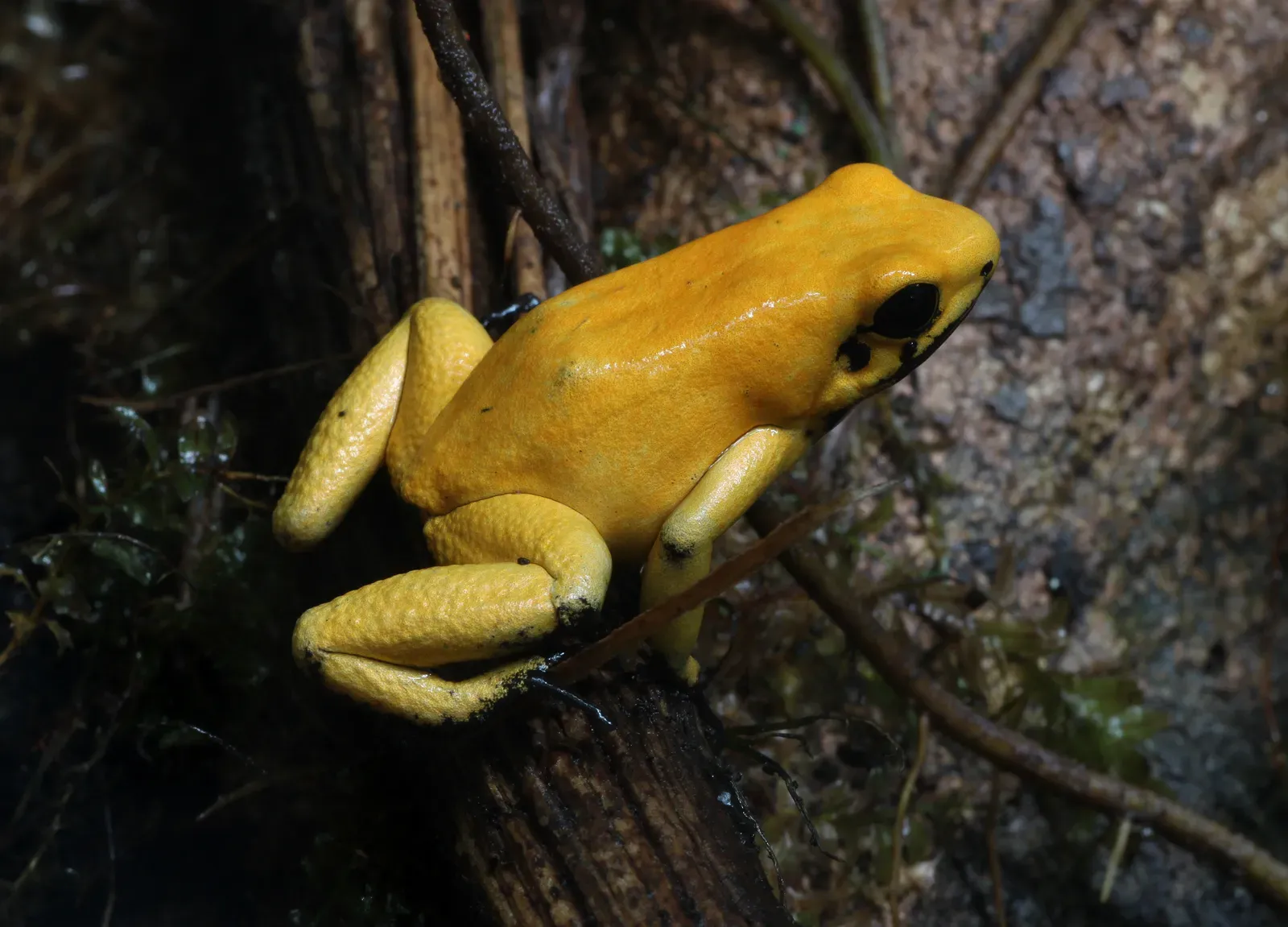
In Colombia’s rainy Chocó forests, a frog about thumb-length can glow like a dropped bit of sunshine. Its bright suit says “look, but don’t touch,” and its shrinking home needs caring friends.
A flash of yellow in the soggy leaves
Imagine walking through a rainforest after rain. Leaves squish softly under your boots. Water taps from high branches. Then—blink!—a tiny yellow frog sits out in the open on the dark forest floor, bright as a dab of paint.
This is the golden poison frog, or Phyllobates terribilis. It is an amphibian from the poison-dart frog family, and it lives in humid rainforest in a small part of Colombia, South America. You may also hear it called the golden dart frog or golden poison arrow frog.
An adult is only about 5–6 centimetres long: around the length of a thumb. Yet this little animal is one of the largest poison-dart frogs. Small body, enormous “whoa” factor.
Golden poison frogs can be sunny yellow, orange, or even minty green. On a brown, leafy forest floor, those colours are not meant to help them hide. They are meant to be noticed.
Evidence: IUCN Red List of Threatened Species: Phyllobates terribilis (Golden Poison Frog) — IUCN Red List status (Endangered); Animal Diversity Web, University of Michigan Museum of Zoology: Phyllobates terribilis (Golden Poison Frog); Wikipedia: Golden poison frog
Why would a frog want to be so easy to spot?
The colour is a warning flag. It tells would-be predators something like: “Please do not make me your lunch.” Scientists call warning colouring aposematic colouration, but “nature’s keep-out sign” is a pretty good way to remember it.
The frog’s skin contains a powerful defensive poison. It is not a creature looking for a quarrel, though. If people and other animals leave it alone, it leaves them alone too. Looking carefully from a respectful distance is the forest-friendly choice.
Here comes the surprising twist: the frog’s protection is connected to what it eats in the wild. It hunts tiny insects, especially ants, along with termites, small beetles, and other little invertebrates. Frogs raised away from that wild menu, on different food, grow up harmless.
So this dazzling frog is a reminder that a rainforest is not just trees with a roof of leaves. It is a bustling neighbourhood of insects, plants, puddles, fungi, frogs, and countless connections. Change one part, and other parts may feel it too.
Evidence: Animal Diversity Web, University of Michigan Museum of Zoology: Phyllobates terribilis (Golden Poison Frog); Wikipedia: Golden poison frog; IUCN Red List of Threatened Species: Phyllobates terribilis (Golden Poison Frog) — IUCN Red List status (Endangered)
A daytime bug hunter, not a midnight mystery
Many people picture frogs appearing only after dark. The golden poison frog flips that idea with a cheerful little hop: it is active during the day. It moves across the ground and leaf litter of the rainforest, searching for its next tiny snack.
A leaf pile can look like a messy old blanket to us. To this frog, it is a hunting ground packed with hiding places. An ant may be only a crumb-sized meal, but plenty of small bites can make a meal for an insect-eater.
Males call with a trill to attract mates. In the thick, rainy forest, sound can travel where a frog may be hard to see—although this particular frog is certainly not trying very hard to blend in.
Golden poison frogs are mostly terrestrial, meaning they spend their time on land rather than swimming about in ponds. Still, water is important when the next generation is growing. That is when the grown-ups become transport experts.
Evidence: Animal Diversity Web, University of Michigan Museum of Zoology: Phyllobates terribilis (Golden Poison Frog); Wikipedia: Golden poison frog; IUCN Red List of Threatened Species: Phyllobates terribilis (Golden Poison Frog) — IUCN Red List status (Endangered)
The tadpole taxi service
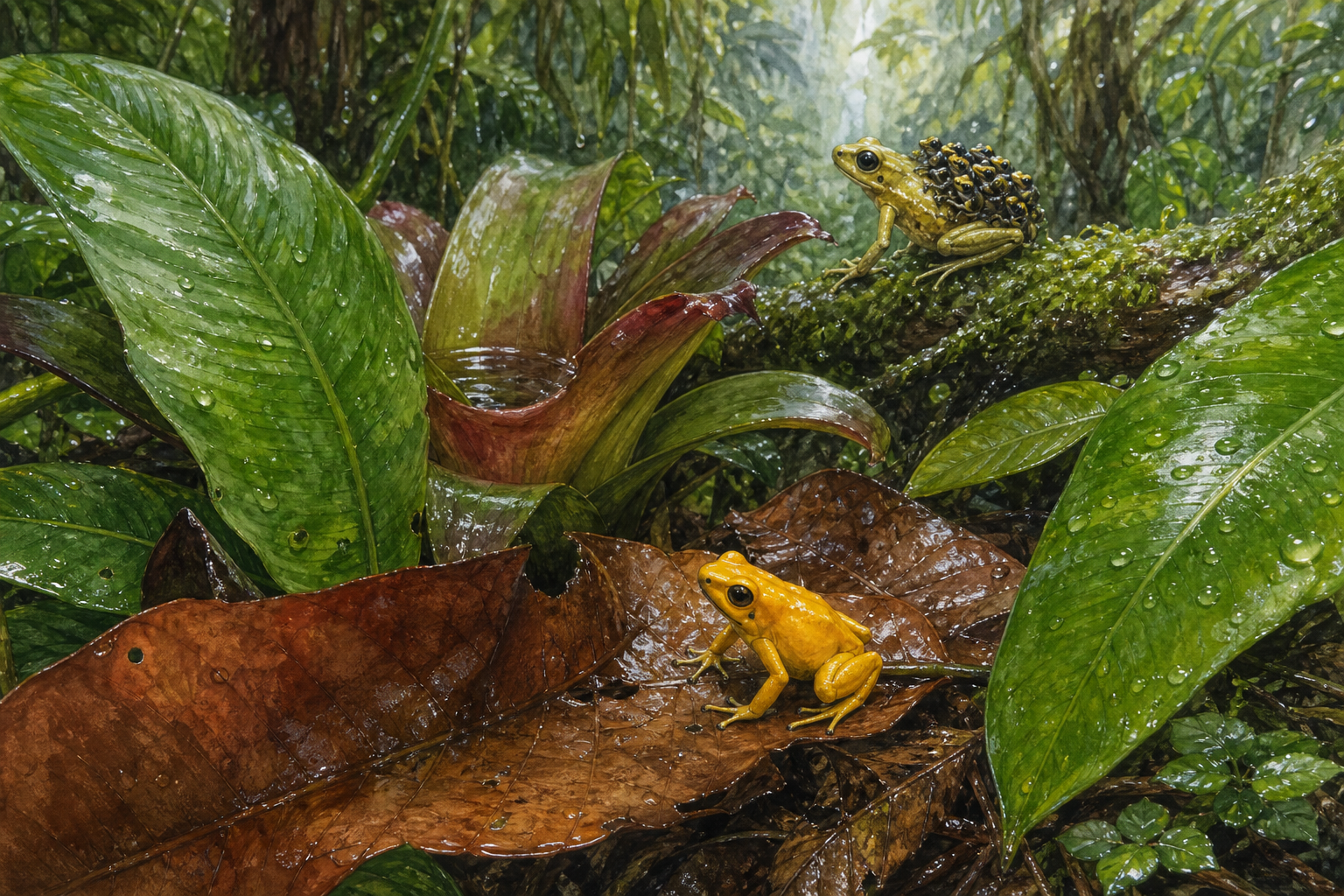
After eggs hatch on the forest floor, the wriggly tadpoles climb onto a parent’s back. Picture a very serious taxi driver wearing several very tiny, wiggly backpacks.
The parent carries them to little pools of water tucked into plants, including water-holding bromeliads, or to other small water-filled spaces. There, the tadpoles can continue growing. In a world of giant raindrops and towering leaves, a careful ride can make a big difference.
This family journey is one reason it helps to think of frogs as more than colourful forest decorations. Each one has places to travel, food to find, calls to make, and young to care for. A frog’s life is busy—even when it fits in your hand’s shadow.
But hands are for helping, not handling. Wild animals need their space, and the safest, kindest frog encounter is one where the frog can choose exactly where to hop next.
Evidence: Animal Diversity Web, University of Michigan Museum of Zoology: Phyllobates terribilis (Golden Poison Frog); Wikipedia: Golden poison frog; IUCN Red List of Threatened Species: Phyllobates terribilis (Golden Poison Frog) — IUCN Red List status (Endangered)
A small home makes a big worry
Golden poison frogs are found only in a very small area of rainforest on Colombia’s Pacific coast. Their home includes wet lowland forest and its leaf litter, where rain and shade help keep the ground humid.
The species is listed as Endangered on the IUCN Red List, and its population trend is decreasing. The biggest documented problem is habitat loss: when rainforest is cleared, the frogs lose the damp, connected places they need for hunting, resting, breeding, and raising tadpoles.
A tiny range means there are not many backup neighbourhoods to move into. If a favourite patch of forest disappears, the frogs cannot simply catch a bus to a new continent. Even the best frog jump is not that good.
There is hope in protecting the remaining Chocó rainforest and in reducing pressure to take frogs from the wild. Legal captive breeding can help supply the pet trade instead of collecting wild frogs, but a protected living forest is something no cage can replace. The real golden treasure is the rainforest home itself.
Evidence: IUCN Red List of Threatened Species: Phyllobates terribilis (Golden Poison Frog) — IUCN Red List status (Endangered); Animal Diversity Web, University of Michigan Museum of Zoology: Phyllobates terribilis (Golden Poison Frog); Wikipedia: Golden poison frog
What can a faraway friend do?
You do not have to visit Colombia to care about a frog there. Start by staying curious about local nature: notice insects on a walk, keep litter out of streams, and ask how parks and forests near you are protected. Caring close to home builds the habit of caring far away.
At meals, plant foods can be one gentle way to think about other living things and the places they need. The World Health Organization describes healthy eating patterns that include foods such as vegetables, fruit, whole grains, pulses, nuts, and seeds. The IPCC reports that shifts toward sustainable, healthy, more plant-based diets can reduce pressure on land and biodiversity as well as food-system emissions.
That does not mean one child has to fix everything with one sandwich. Food choices belong in kind conversations with families and trusted adults, especially when someone is growing. But trying a bean chilli, lentil soup, or a fruit-and-nut snack can be a small, cheerful vote for a world with room for wildlife.
The golden poison frog does not need us to be perfect. It needs people to notice that a thumb-sized neighbour, glowing among wet leaves, is worth a whole forest of care.
Evidence: IUCN Red List of Threatened Species: Phyllobates terribilis (Golden Poison Frog) — IUCN Red List status (Endangered); Animal Diversity Web, University of Michigan Museum of Zoology: Phyllobates terribilis (Golden Poison Frog); World Health Organization: Healthy diet; Intergovernmental Panel on Climate Change: Climate Change 2022: Mitigation of Climate Change — Chapter 7
A kinder plate, a roomier world
A golden poison frog needs a living rainforest, from its insect snacks to its damp leaf-litter pathways. We can practise the same caring idea at our own tables: enjoy delicious plant foods and remember that meals connect to land, water, animals, and habitats.
The World Health Organization includes vegetables, fruits, whole grains, pulses, nuts, and seeds in healthy eating guidance. The IPCC finds that sustainable, healthy diets with more plant-based foods can lower pressure on land and biodiversity and reduce food-system emissions. With a trusted adult, choosing a plant-based meal now and then can be a hopeful, tasty way to make room for more wild neighbours.
Evidence: World Health Organization: Healthy diet; Intergovernmental Panel on Climate Change: Climate Change 2022: Mitigation of Climate Change — Chapter 7
Questions people ask
Is the golden poison frog really golden?
Often, yes: many are bright yellow, but individuals may also be orange or minty green. Their bold colours act as a warning to predators.
Evidence: Animal Diversity Web, University of Michigan Museum of Zoology: Phyllobates terribilis (Golden Poison Frog); Wikipedia: Golden poison frog
Should anyone touch one?
No. Its bright colour warns that its skin has a powerful defence, and wild animals should be left undisturbed. Watch from a respectful distance instead.
Evidence: Animal Diversity Web, University of Michigan Museum of Zoology: Phyllobates terribilis (Golden Poison Frog); Wikipedia: Golden poison frog
Why are captive-raised frogs harmless?
The defensive poison is linked to the tiny wild insects the frogs eat. When frogs are raised on different food, they do not develop that same toxicity.
Evidence: Animal Diversity Web, University of Michigan Museum of Zoology: Phyllobates terribilis (Golden Poison Frog); Wikipedia: Golden poison frog
What is the biggest danger to these frogs?
Loss of their humid Colombian rainforest habitat is the main documented threat. Because their range is very small, losing forest can affect the species especially strongly.
Evidence: IUCN Red List of Threatened Species: Phyllobates terribilis (Golden Poison Frog) — IUCN Red List status (Endangered); Animal Diversity Web, University of Michigan Museum of Zoology: Phyllobates terribilis (Golden Poison Frog); Wikipedia: Golden poison frog
Read the evidence
Sources behind this story
- Phyllobates terribilis (Golden Poison Frog) — IUCN Red List status (Endangered) — IUCN Red List of Threatened Species
- Phyllobates terribilis (Golden Poison Frog) — Animal Diversity Web, University of Michigan Museum of Zoology
- Golden poison frog — Wikipedia
- Healthy diet — World Health Organization
- Climate Change 2022: Mitigation of Climate Change — Chapter 7 — Intergovernmental Panel on Climate Change
Health information is general education, not personal medical advice. Young readers should make food choices with a trusted adult and qualified health professional.