Today's animal friend · 28 September 2026
Giant Manta Ray: The Ocean’s Flying Carpet Has a Cleaning Appointment
It may stretch about seven metres across, yet this Endangered ocean wanderer dines on some of the tiniest creatures in the sea.
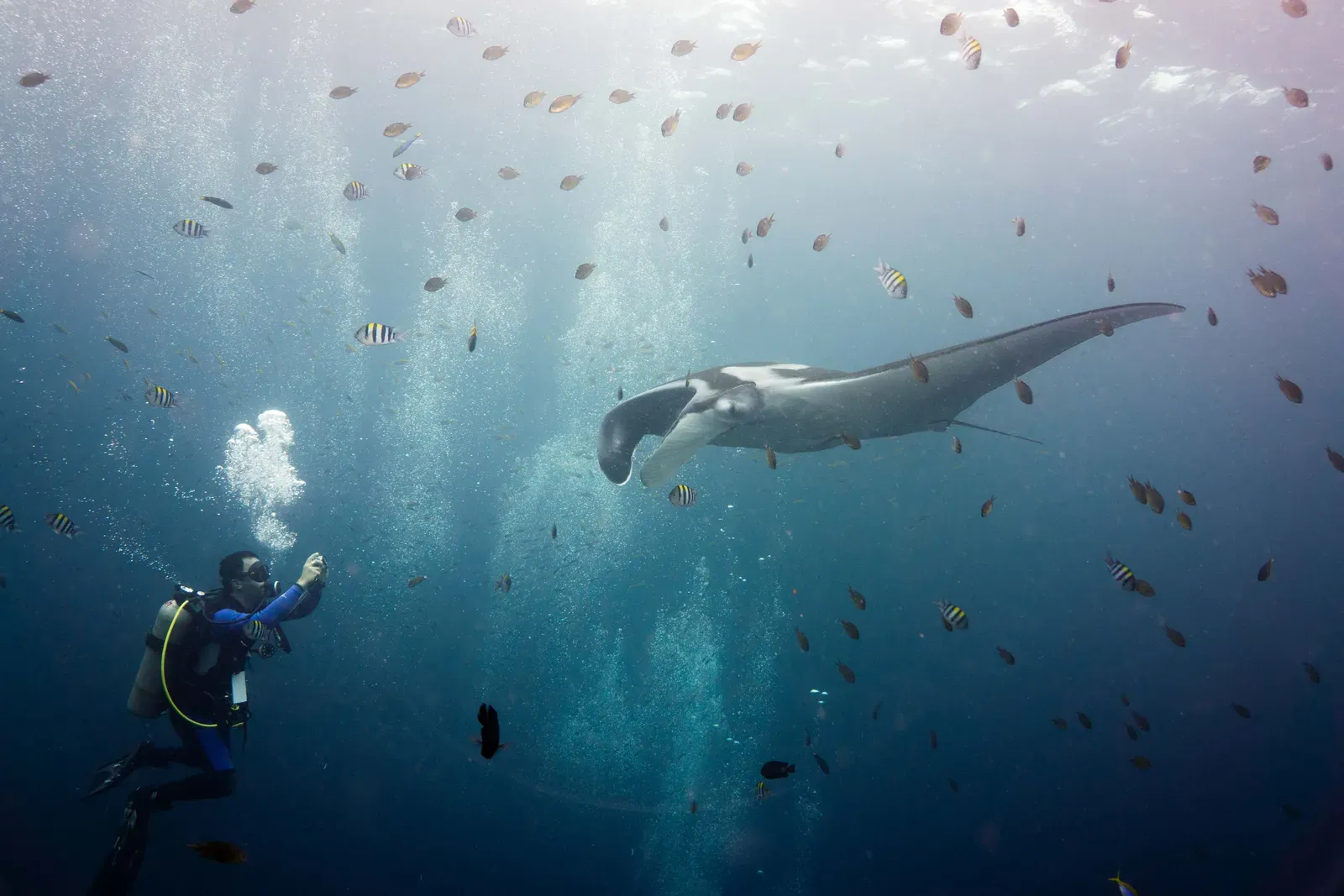
It may stretch about seven metres across, yet this Endangered ocean wanderer dines on some of the tiniest creatures in the sea.
A shadow with wings—except it is a fish
Picture blue water brightening above a coral reef. Then a dark diamond shape slides overhead, its wide fins rising and falling as smoothly as a kite drifting on a breezy day. It is not a bird and not a mysterious sea spaceship. It is a giant manta ray, also called the giant oceanic manta ray: Mobula birostris.
This animal is the largest ray in the world. From one wing-like fin tip to the other, a particularly large giant manta can reach about seven metres across—wider than a car is long. That sounds like the sort of size needed for a superhero cape, but the manta’s giant “wings” are really fins. Its body is made of cartilage, the springy stuff in your nose and ears, rather than bone.
Giant manta rays live in tropical, subtropical, and some temperate seas around the world. They spend much of their time in the open ocean, often near oceanic islands, but may visit coastal waters and coral reefs. A reef visit can be rather like stopping at a favourite service station—only much wetter, and with no petrol snacks.
Evidence: IUCN Red List of Threatened Species: Mobula birostris (Giant Manta Ray) — Red List Assessment; Animal Diversity Web, University of Michigan Museum of Zoology: Mobula birostris (giant manta ray); Wikipedia: Giant oceanic manta ray
How can such a giant eat such tiny snacks?
Here is the deliciously odd bit: a giant manta ray is a filter-feeder. Instead of chasing large prey, it eats zooplankton and other small creatures, including copepods, tiny shrimp, krill, larval crustaceans, and small fish. Imagine being as broad as a small bus but getting excited about a drifting cloud of specks.
When food is gathered in the water, the manta swims forward with its mouth open. Two curled fins near its mouth help guide the meal inside. Special gill-raker plates act like a sieve, keeping food particles while water flows out. This is called ram-filtering: the manta powers through its own floating buffet.
Mantas can herd plankton into thicker patches before swooping through. So the graceful gliding is not simply showing off—though it does look extremely show-offy. It is a clever way to collect enough tiny mouthfuls in a huge sea.
Evidence: Animal Diversity Web, University of Michigan Museum of Zoology: Mobula birostris (giant manta ray); Wikipedia: Giant oceanic manta ray
The little-fish spa, no bathrobe required
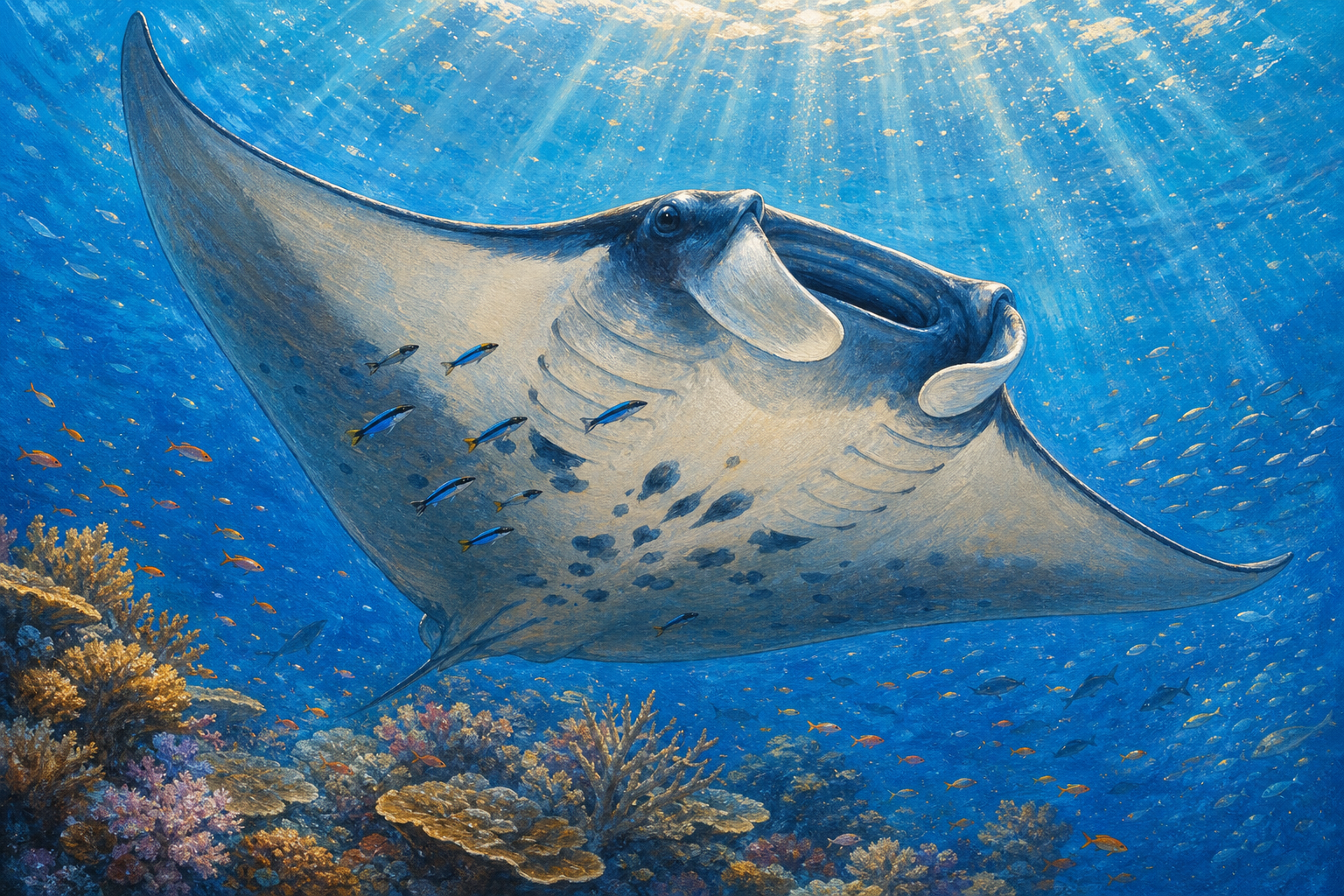
At certain coral-reef spots, giant manta rays visit cleaning stations. A manta hovers or circles while much smaller cleaner fish pick parasites and other unwanted bits from its skin. The fish get a meal; the manta gets a tidy-up. Everyone leaves happy, and nobody has to book a Tuesday afternoon slot.
Cleaning stations remind us that an ocean is full of connections. A huge ray and a tiny fish can matter to one another. The manta is mostly an offshore traveller, not an animal that lives only on reefs, but these coastal stops can be important places in its busy life.
Giant mantas are continuous swimmers and do not settle on the seabed to rest. They may travel alone or gather where food is plentiful or during mating. Scientists have also found that mantas have unusually large brains for fish, so researchers continue to explore their intelligence and behaviour. There is still plenty for us to learn—which is one reason careful observation matters.
Evidence: Animal Diversity Web, University of Michigan Museum of Zoology: Mobula birostris (giant manta ray); Wikipedia: Giant oceanic manta ray
One pup is a very big deal
A giant manta ray grows slowly and usually has one pup after a long pregnancy of around 12 to 13 months. Females reproduce only every few years. That means each young manta is especially important: a population cannot quickly replace adults that are lost.
This slow family rhythm helps explain why a mighty animal can still be vulnerable. Being enormous does not make a creature safe. Giant manta rays may look like ocean giants, yet they depend on enough food, safe travelling routes, and time for new generations to grow.
Their wide-ranging journeys also connect faraway places. A manta might feed in open water, approach an island, and visit a reef cleaning station. Protecting the sea is not only about one pretty patch of coral; it can mean caring for the watery pathways between places, too.
Evidence: IUCN Red List of Threatened Species: Mobula birostris (Giant Manta Ray) — Red List Assessment; Animal Diversity Web, University of Michigan Museum of Zoology: Mobula birostris (giant manta ray); Wikipedia: Giant oceanic manta ray
Why does this gentle giant need help?
The giant manta ray is listed as Endangered on the IUCN Red List, with a decreasing population trend. Its biggest documented dangers include targeted fishing and accidental capture in fishing gear, especially gillnets. Gill rakers—the filtering structures that help mantas eat tiny prey—have been traded, putting added pressure on the species.
Accidental capture is a sad reminder that a net meant for one animal can trap another. Because giant mantas mature slowly and usually have single pups, recovery can take time. In some regions, pollution and microplastics are additional concerns, too.
There is hope, and it comes from practical teamwork. Reducing targeted catch and bycatch, following trade controls, protecting known feeding and cleaning sites, and learning more through monitoring can all help. Wonder is useful when it turns into care: people who know a manta is out there, gliding beyond the surf, can help make choices that leave room for it in the ocean.
Evidence: IUCN Red List of Threatened Species: Mobula birostris (Giant Manta Ray) — Red List Assessment; Wikipedia: Giant oceanic manta ray
A friend-shaped question to take to the shore
Next time you see a gust lift a kite, or watch a sheet billow on a washing line, think of the giant manta ray moving through seawater. Its fins do not flap exactly like wings, but they give it that floating, flying look. Beneath the surface, a seven-metre-wide ray may be following invisible patches of plankton or heading toward a miniature cleaning crew.
We do not have to meet a manta ray to be on its side. We can stay curious about the ocean, share accurate stories, and support efforts that keep marine places healthy. The sea can feel impossibly large. Yet every giant manta begins as a single pup, and every caring action begins with someone deciding that another living creature matters.
Evidence: IUCN Red List of Threatened Species: Mobula birostris (Giant Manta Ray) — Red List Assessment; Animal Diversity Web, University of Michigan Museum of Zoology: Mobula birostris (giant manta ray); Wikipedia: Giant oceanic manta ray
A kind choice can ripple outward
Caring about manta rays can start with noticing that they are not objects in the sea; they are animals with their own journeys, meals, and tiny-fish cleaning appointments. One gentle everyday way to care for ocean life is to explore plant-forward meals with your family—perhaps beans, lentils, vegetables, grains, nuts, seeds, and fruit. The World Health Organization describes these foods as useful parts of varied, healthy eating patterns. If your family is considering bigger food changes, chat with a trusted adult and a qualified health professional.
Plant-based choices can be a planet-friendly ripple, too. The IPCC reports that shifts toward sustainable, healthy diets with more plant-based foods can reduce food-system emissions and lessen pressure on land and biodiversity. No one meal has to be perfect. A colourful plant-based lunch, a new bean recipe, or simply asking where food comes from can be a small vote for a world where wild animals—including giant mantas—have room to glide.
Evidence: World Health Organization: Healthy diet; Intergovernmental Panel on Climate Change: Climate Change 2022: Mitigation of Climate Change — Chapter 7
Questions people ask
Is a giant manta ray a shark?
No. Giant manta rays and sharks are both cartilaginous fish, but a manta ray belongs to the ray family Mobulidae. Its body is broad and flattened, with large wing-like fins.
Evidence: IUCN Red List of Threatened Species: Mobula birostris (Giant Manta Ray) — Red List Assessment; Animal Diversity Web, University of Michigan Museum of Zoology: Mobula birostris (giant manta ray); Wikipedia: Giant oceanic manta ray
Do giant manta rays eat people?
No. They are filter-feeders that eat zooplankton and other tiny animals, plus small fish. Their enormous open mouth is for sweeping up small prey from the water, not for hunting people.
Evidence: Animal Diversity Web, University of Michigan Museum of Zoology: Mobula birostris (giant manta ray); Wikipedia: Giant oceanic manta ray
Where might a giant manta ray be found?
It is an ocean-going animal found across warm and some temperate parts of the Pacific, Atlantic, and Indian Oceans. It often lives offshore but can visit coastal reefs and oceanic islands.
Evidence: Animal Diversity Web, University of Michigan Museum of Zoology: Mobula birostris (giant manta ray); Wikipedia: Giant oceanic manta ray
Why are cleaning stations important?
They are places where cleaner fish remove parasites and other material from a manta’s skin. These reef stops show why protecting connected ocean habitats matters.
Evidence: Animal Diversity Web, University of Michigan Museum of Zoology: Mobula birostris (giant manta ray); Wikipedia: Giant oceanic manta ray
Read the evidence
Sources behind this story
- Mobula birostris (Giant Manta Ray) — Red List Assessment — IUCN Red List of Threatened Species
- Mobula birostris (giant manta ray) — Animal Diversity Web, University of Michigan Museum of Zoology
- Giant oceanic manta ray — Wikipedia
- Healthy diet — World Health Organization
- Climate Change 2022: Mitigation of Climate Change — Chapter 7 — Intergovernmental Panel on Climate Change
Health information is general education, not personal medical advice. Young readers should make food choices with a trusted adult and qualified health professional.