Today's animal friend · 27 September 2026
The Giant Anteater’s Super-Slurp Adventure
This remarkable mammal carries a baby like a stripy backpack, has no teeth at all, and needs safe, connected wild places to keep roaming.
This remarkable mammal carries a baby like a stripy backpack, has no teeth at all, and needs safe, connected wild places to keep roaming.
A nose in the grass, a tail like a feather duster
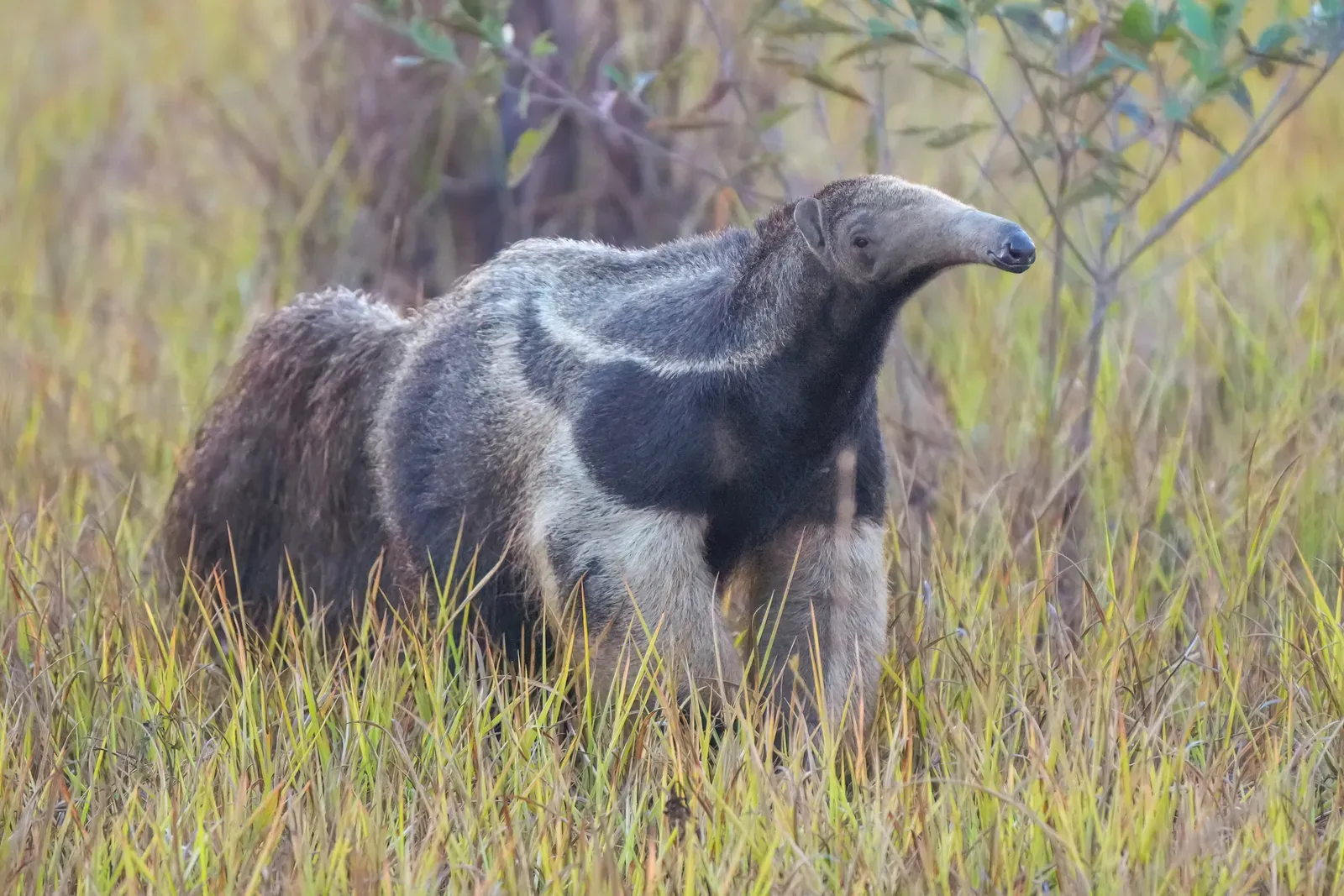
Imagine walking through a warm, rustly grassland. The grass brushes your knees. Somewhere nearby, there is a soft snuffle, snuffle. Then a long-nosed animal steps from the stems, its huge bushy tail sweeping behind it like an extra-fancy feather duster.
Meet the giant anteater, or Myrmecophaga tridactyla. It is a mammal from Central and South America, and it uses grasslands, savannas and tropical forests. Its name makes it sound as though it might gobble up a whole houseful of ants in one gulp. Its meals are tiny, but its tools are wonderfully oversized.
A giant anteater’s head-and-body length is about 1 to 1.2 metres, and it weighs about 18 to 39 kilograms. That is a lot of animal to be searching for creatures smaller than a fingernail. Yet this curious hunter has solved a brilliant food puzzle: how can a large mammal make a meal from ants, termites and a few grubs?
The answer begins with sniffing. Giant anteaters may be active in daytime or at night, travelling with their noses close to the ground. They are usually solitary, so one wandering anteater may have a patch of savanna, grassland, or forest floor to itself—except, of course, for all the bustling insect colonies underfoot.
Its bold coat, long narrow snout, powerful front legs and flowing tail make it look unlike almost any other mammal. Calling it an “ant bear” is an old alternative name, but it is not a bear. It belongs to the anteater family, Myrmecophagidae, in the mammal order Pilosa.
Evidence: IUCN Red List of Threatened Species: Myrmecophaga tridactyla (Giant Anteater) — Red List Assessment; Animal Diversity Web, University of Michigan Museum of Zoology: Myrmecophaga tridactyla (giant anteater); Wikipedia: Giant anteater
The tongue trick: about two school rulers long
If you think spaghetti is slippery, wait until you hear about a giant anteater’s tongue. Its sticky tongue can be about 60 centimetres long—about as long as two school rulers placed end to end. It flicks in and out rapidly, gathering ants and termites from their nests.
First come the foreclaws. Giant anteaters have strong front legs and big curved claws for opening an ant or termite nest. Then comes the speedy tongue: in, out, in, out. A quick scoop of insects, a swallow, and off the anteater goes to search again.
Why not settle at one nest for a giant all-day snack? Brief visits mean the nest is not wrecked. The anteater samples from many colonies instead. In this way, its insect-hunting life is woven into the larger food webs of grasslands and forests. Tiny insects and a shaggy mammal are neighbours in the same busy world.
Here is the extra-surprising bit: giant anteaters have no teeth at all. None! They swallow their small prey whole after collecting it with that sticky tongue. No crunchy chewing and no tooth brushing after dinner—although an anteater toothbrush would be a very odd thing to find in a shop.
This does not mean an anteater is careless with its claws. Those claws are important tools, not toys. They help it reach food hidden in tough nests, then the animal can carry on through its habitat, snuffling for the next promising smell.
Evidence: Animal Diversity Web, University of Michigan Museum of Zoology: Myrmecophaga tridactyla (giant anteater); Wikipedia: Giant anteater
A baby in perfect disguise
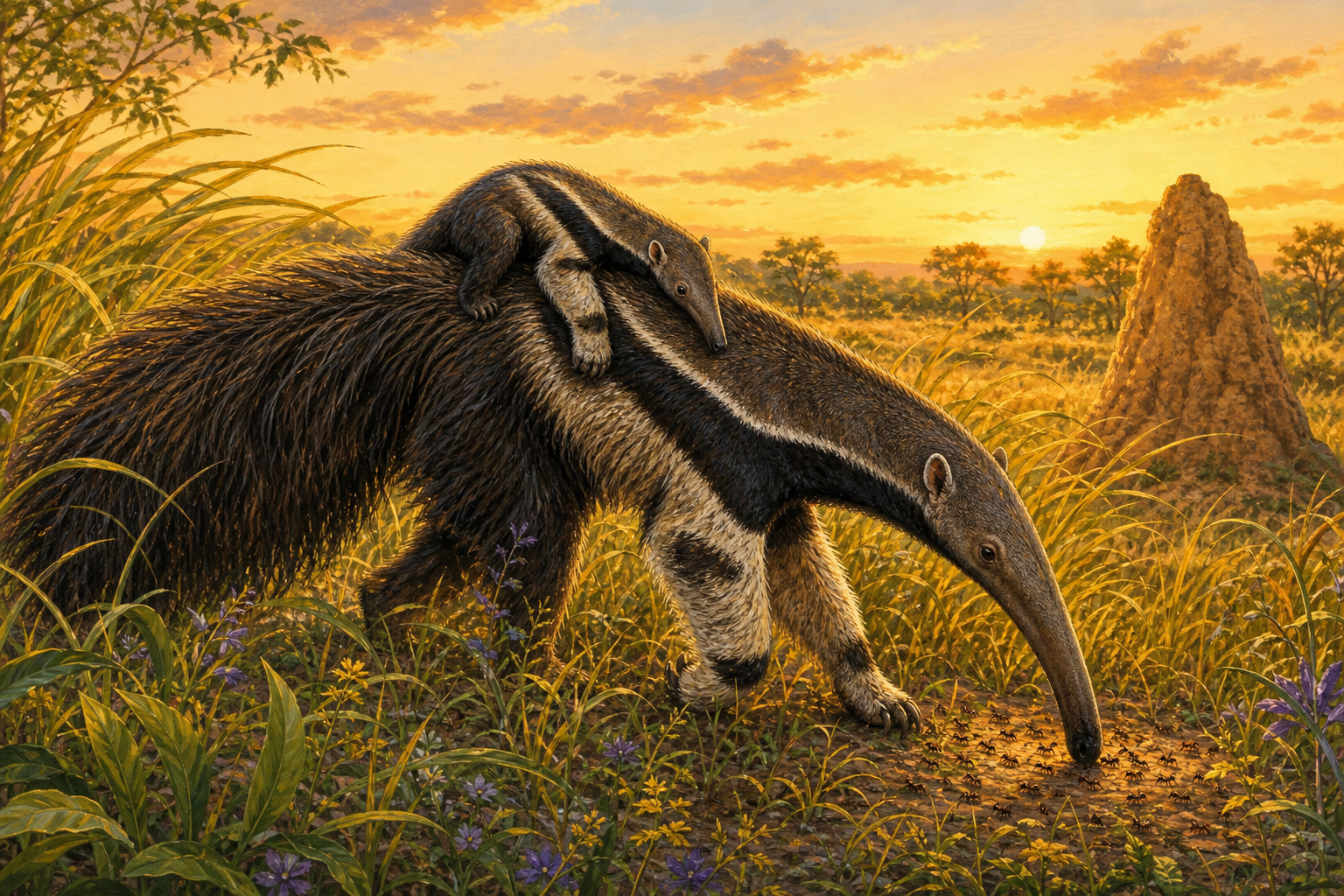
Now picture a mother giant anteater setting off through the grass with a small passenger clinging to her back. A single pup rides there for many months after birth. It is a cosy lift, but it is also a clever disappearing act.
Both mother and baby have bold markings. When the pup lies across her back, its striped fur lines up with hers, making the youngster difficult to spot. From a distance, the pair can look less like two animals and more like one splendidly shaggy shape strolling along.
It is the sort of wildlife scene that rewards a second look. Nature is packed with patterns that can help animals blend in: leaf-like insects, speckled eggs, dappled deer coats, and a baby anteater whose markings match its mother’s. A journey on Mum’s back becomes transport and hide-and-seek at once.
Giant anteaters can seem comical at first glance, with their very long faces and swooshy tails. But this mother-and-pup partnership shows another side: close, careful, and quietly ingenious. The pup is not a miniature pet or a toy backpack; it is a young wild animal learning the routes and rhythms of its home.
As it grows, it will need the same things its mother needs: room to travel, insect colonies to feed from, and places where grass, forest and savanna still offer shelter.
Evidence: Animal Diversity Web, University of Michigan Museum of Zoology: Myrmecophaga tridactyla (giant anteater); Wikipedia: Giant anteater
Why this quiet wanderer needs room
A giant anteater needs more than a good supply of ants and termites. It needs places to travel: grasslands, savannas and forests where it can sniff, dig briefly, feed, and move on. Giant anteaters are listed as Vulnerable on the IUCN Red List, and their population trend is decreasing.
Habitat loss can shrink the wild spaces they use. Grassland fires can be dangerous, and roads can be risky when an anteater crosses between patches of habitat. In parts of their historical range, giant anteaters have already disappeared. A map may show green spaces, but an animal needs those spaces to be safe and connected enough to use.
There are hopeful ways to help. Parks and reserves can protect habitat. Keeping grassland and forest areas connected can give wildlife more room to move. Efforts to reduce danger from roads and fires matter too. Giant anteaters are also included in CITES Appendix II, which helps regulate international trade.
You do not have to be a park ranger to care about a quiet wild neighbour. Learning an animal’s story is a real beginning. When people notice that a grassland is a home rather than an empty blank on a map, it becomes easier to understand why it deserves thoughtful protection.
The giant anteater does not ask for applause. It just needs enough peaceful ground to follow its nose, visit insect nests, carry a pup, and keep being one of the most extraordinary mammals in the Americas.
Evidence: IUCN Red List of Threatened Species: Myrmecophaga tridactyla (Giant Anteater) — Red List Assessment; Animal Diversity Web, University of Michigan Museum of Zoology: Myrmecophaga tridactyla (giant anteater); Wikipedia: Giant anteater
A kind choice at the kitchen table
The giant anteater’s dinner is definitely not for most people: ants, termites and grubs, served straight from the nest. But its life can still invite us to think kindly about animals. Each creature has its own needs, family life and clever way of belonging in the world.
For people, the World Health Organization describes healthy eating patterns as including a variety of foods such as whole grains, vegetables, fruit, pulses, nuts and seeds. With a trusted adult, families might enjoy exploring plant-forward meals: bean tacos, lentil soup, veggie noodles, or fruit with nut or seed butter.
Plant-rich choices can also be one way to care for wild places. The IPCC reports that shifts toward sustainable, healthy, more plant-based diets can reduce pressure from food systems on climate, land and biodiversity. That does not mean every family eats exactly alike, or that anyone has to be perfect. It means a cheerful plant-based meal can be one small, thoughtful choice.
Perhaps that is the giant anteater’s quiet message: look closely, waste little, and remember that forests and grasslands are somebody’s home—perhaps even a long-nosed, tail-swooshing somebody’s.
Evidence: World Health Organization: Healthy diet; Intergovernmental Panel on Climate Change: Climate Change 2022: Mitigation of Climate Change — Chapter 7
Try a “wild-neighbour” meal
Next time you help choose a meal or snack with a trusted adult, see whether you can add a plant-powered ingredient: beans in a wrap, chickpeas in a salad, oats at breakfast, or seeds sprinkled over fruit. The goal is curiosity, not perfection.
The World Health Organization includes foods such as vegetables, fruit, whole grains, pulses, nuts and seeds in healthy dietary patterns. The IPCC also finds that sustainable, healthy, more plant-based diets can ease pressure on climate, land and biodiversity. It is one kind way to remember that forests and grasslands are somebody’s home.
Evidence: World Health Organization: Healthy diet; Intergovernmental Panel on Climate Change: Climate Change 2022: Mitigation of Climate Change — Chapter 7
Questions people ask
Do giant anteaters really have no teeth?
Yes. Giant anteaters have no teeth. They gather tiny insect prey with their sticky tongues and swallow it whole.
Evidence: Animal Diversity Web, University of Michigan Museum of Zoology: Myrmecophaga tridactyla (giant anteater); Wikipedia: Giant anteater
Where do giant anteaters live?
They live in Central and South America, using grasslands, savannas and tropical forests where ants and termites are available.
Evidence: IUCN Red List of Threatened Species: Myrmecophaga tridactyla (Giant Anteater) — Red List Assessment; Animal Diversity Web, University of Michigan Museum of Zoology: Myrmecophaga tridactyla (giant anteater); Wikipedia: Giant anteater
Why does a baby ride on its mother’s back?
A pup rides with its mother for many months. Its markings align with hers, helping the baby blend into her striped coat.
Evidence: Animal Diversity Web, University of Michigan Museum of Zoology: Myrmecophaga tridactyla (giant anteater); Wikipedia: Giant anteater
Are giant anteaters safe from extinction?
They are listed as Vulnerable, with a decreasing population trend. Protecting habitat and reducing risks from fires and roads can help them.
Evidence: IUCN Red List of Threatened Species: Myrmecophaga tridactyla (Giant Anteater) — Red List Assessment; Animal Diversity Web, University of Michigan Museum of Zoology: Myrmecophaga tridactyla (giant anteater); Wikipedia: Giant anteater
Read the evidence
Sources behind this story
- Myrmecophaga tridactyla (Giant Anteater) — Red List Assessment — IUCN Red List of Threatened Species
- Myrmecophaga tridactyla (giant anteater) — Animal Diversity Web, University of Michigan Museum of Zoology
- Giant anteater — Wikipedia
- Healthy diet — World Health Organization
- Climate Change 2022: Mitigation of Climate Change — Chapter 7 — Intergovernmental Panel on Climate Change
Health information is general education, not personal medical advice. Young readers should make food choices with a trusted adult and qualified health professional.