Today's animal friend · 24 September 2026
The Tiny Tunnel Singer: Meet the Field Cricket
Follow the chirp through dry grass and heathland to discover a two-centimetre insect with a big voice, a private tunnel, and a journey made entirely on foot.
Follow the chirp through dry grass and heathland to discover a two-centimetre insect with a big voice, a private tunnel, and a journey made entirely on foot.
Listen—there’s a song under the grass
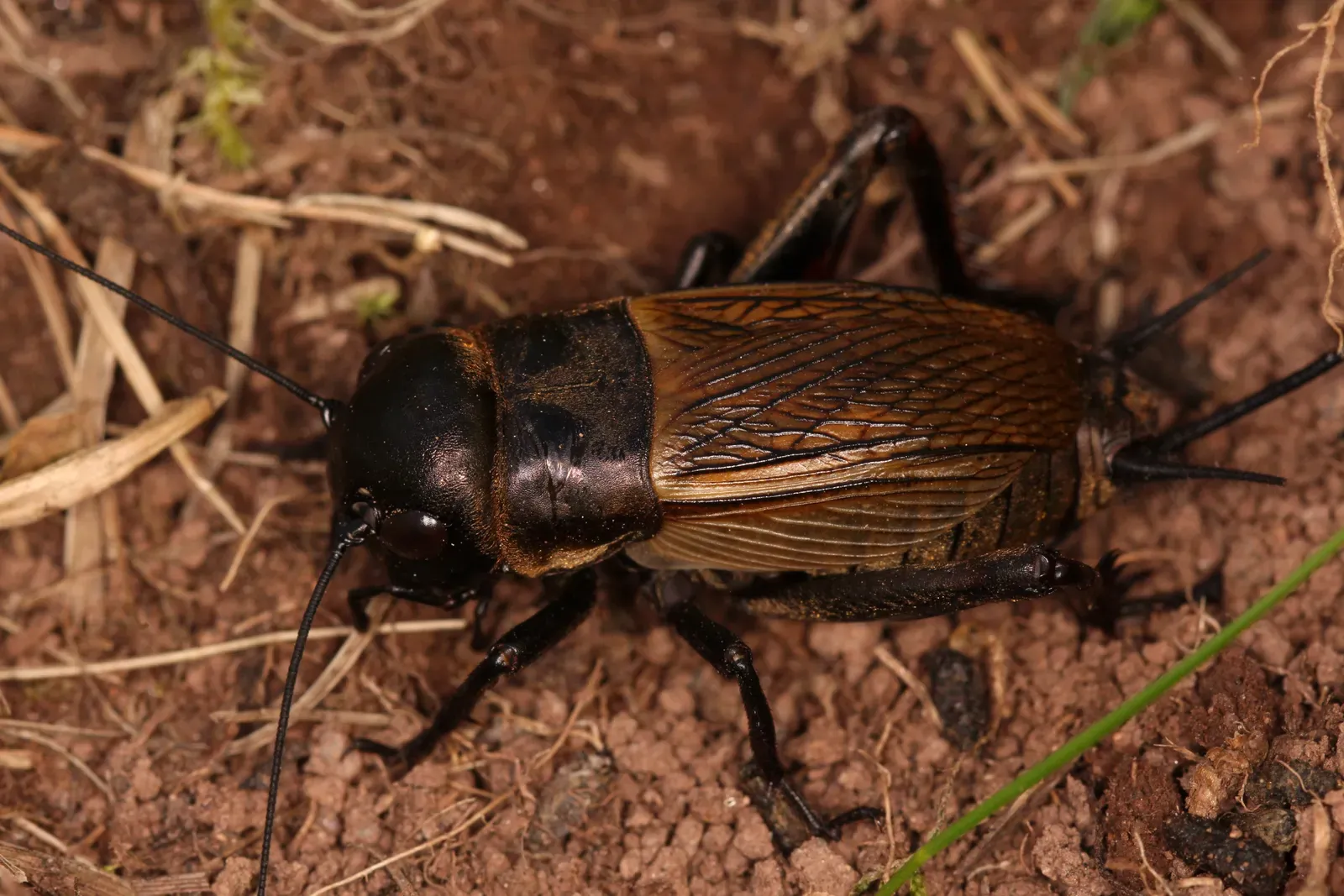
Imagine kneeling beside a sunny patch of short grass. The ground feels warm. Dry stems tickle your ankles. Then: chirp, chirp, chirp! It sounds as if someone has hidden a tiny squeaky toy beneath the meadow. Follow the sound carefully and you may be listening to a male field cricket, Gryllus campestris.
Here is the surprising bit: he is not singing with a mouth. A male field cricket rubs special ridges on his wings together to make his chirp. Think of running a thumb along the teeth of a comb—except this comb-player has six legs and lives in a tunnel.
Field crickets are also called European field crickets. They are insects in the cricket family, Gryllidae, and they live in parts of Europe. A field cricket is about two centimetres long: roughly thumbnail-sized, but with enough musical confidence to fill a warm day or the first part of the night with sound.
Evidence: IUCN Red List of Threatened Species: Gryllus campestris (Field Cricket) — Red List Assessment; Animal Diversity Web, University of Michigan Museum of Zoology: Gryllus campestris (Field Cricket); Wikipedia: Gryllus campestris
One cricket, one burrow, one very important doorway
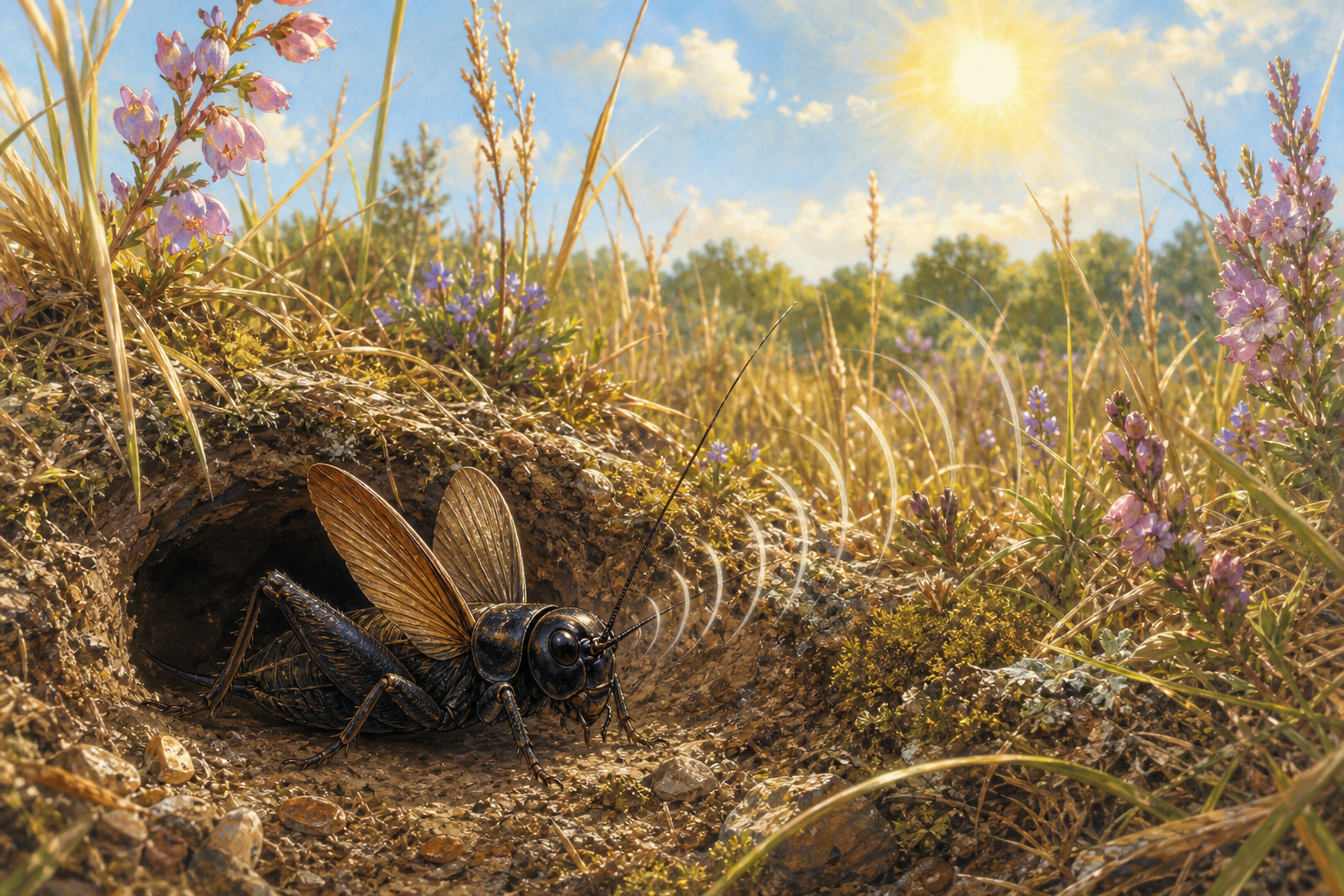
A male field cricket is a little bit like a musician with his own front porch. He digs an individual burrow—a small tunnel in the ground—and can make it in only a few minutes. At its entrance is a platform, and this is where he sits to chirp. The burrow is not a cricket apartment block; males make and defend their own spaces.
Why sing from the doorway? The chirp is a call for a mate. Female field crickets move through the grass listening for singing males, then head toward the sound. So that busy little entrance is a stage, a listening post, and a doorway all at once. No ticket required; grasshoppers may be nearby, but they are not necessarily invited.
On warm days and early at night, when temperatures are well above about 13°C, the concert can begin. If you ever hear insect sounds in a meadow, pause before rushing on. The ground may be full of small lives sending messages we cannot understand—yet can still appreciate.
Evidence: Wikipedia: Gryllus campestris; Animal Diversity Web, University of Michigan Museum of Zoology: Gryllus campestris (Field Cricket)
Wings for music, not for flying
Field crickets have wings, but they cannot fly. Their wings help make their famous song instead. That means every trip is made the old-fashioned way: walking through the grass. A field cricket can travel up to about 100 metres in a day. For an animal about the length of a thumbnail, that is a grand expedition—rather like you walking many, many body-lengths across a huge field.
Being unable to fly makes connected habitat especially valuable. A patch of dry grassland may look small from above, but to a walking cricket it can be a whole world of stems, open soil, hiding places, songs, and pathways. If suitable places are separated by roads, buildings, or very different land, getting from one to another is much harder.
This is a lovely reminder that “nearby” depends on who is travelling. A few steps for us can be a serious trek for a cricket with no bicycle, no bus pass, and no wings for a quick shortcut.
Evidence: Wikipedia: Gryllus campestris; IUCN Red List of Threatened Species: Gryllus campestris (Field Cricket) — Red List Assessment
What is on a cricket’s picnic blanket?
Field crickets are omnivores. In simple terms, they eat both plant and animal foods. Their menu can include grasses and leaves, along with small insects. That may sound like a strange picnic to us, but a cricket is not trying to build the perfect sandwich. It is finding what is available in its grassy home.
They live in dry, sunny grasslands and heathlands with short vegetation; meadows can be part of their world too. These places may seem quiet until you look low. There are stems to climb past, bare bits of ground, other small creatures, and the rustle of countless tiny feet.
A field cricket is part of this busy outdoor neighbourhood. It is itself prey for animals that eat insects, while its own feeding and movement belong to the everyday bustle of the grassland. Even a small creature can matter in a place full of connections.
Evidence: IUCN Red List of Threatened Species: Gryllus campestris (Field Cricket) — Red List Assessment; Wikipedia: Gryllus campestris
A cheerful status, and a reason to care
Globally, the field cricket is listed by the IUCN as Least Concern, based on a 2016 assessment. That is encouraging news. But it does not mean every local cricket population is safe and booming. In parts of its range, including the United Kingdom, field crickets have been rare or threatened.
One challenge is habitat loss: when the dry grassland or heathland a cricket needs disappears. Another is fragmentation, when good habitat remains but is broken into isolated pieces. For a flightless animal that walks rather than flies, separated patches can be difficult to reach.
There is hope in the practical kind of caring: restoring suitable dry grassland and heathland, and, in places where crickets have become rare, carefully managed local projects that move or reintroduce them. Protecting a sunny patch of short grass may also protect the hidden singer whose whole journey happens at ankle height.
Evidence: IUCN Red List of Threatened Species: Gryllus campestris (Field Cricket) — Red List Assessment; Wikipedia: Gryllus campestris
Try a cricket-sized adventure
Next time you visit a meadow, heathland, or other open grassy place, slow down. You do not need to catch a cricket—or even find one—to be a good neighbour. Stand still. Listen for repeated chirps on a warm day or early evening. Look at the ground without poking into holes. A burrow is somebody’s home, not a mystery cupboard to open.
You could draw a map from a cricket’s point of view: a towering grass stem, a sunny bare patch, a tunnel entrance, then a long route to the next clump of grass. It is a fun way to notice that wild places are not empty spaces between bigger things. They are cities of tiny, determined travellers.
The field cricket’s song asks us to pay attention. Not loudly, not with a giant banner—just chirp by chirp. And once you have heard it, a patch of grass may never seem ordinary again.
Evidence: Wikipedia: Gryllus campestris; IUCN Red List of Threatened Species: Gryllus campestris (Field Cricket) — Red List Assessment
Kind choices can make room for more wild songs
Caring about a field cricket can begin with a simple thought: this tiny singer is a somebody in its own small world, not just background noise. We can choose to notice animals gently, leave their homes undisturbed, and cheer for healthy meadows, heaths, and other shared wild spaces.
Our food choices connect to habitats far beyond our plates. The World Health Organization describes healthy eating patterns that can include plenty of whole grains, vegetables, fruit, pulses, nuts, and seeds. With a trusted adult, exploring tasty plant-based meals can be a kind way to enjoy foods made from plants.
The IPCC reports that shifts toward sustainable, healthy, more plant-based diets can help reduce food-system emissions and pressure on land and biodiversity. Nobody has to be perfect to be helpful. A bean burrito, lentil soup, or chickpea sandwich can be one cheerful choice that says: let’s leave more room for grasslands, crickets, and all our animal neighbours.
Evidence: World Health Organization: Healthy diet; Intergovernmental Panel on Climate Change: Climate Change 2022: Mitigation of Climate Change — Chapter 7
Questions people ask
Why does a field cricket chirp?
A male chirps to attract a female. He makes the sound by rubbing special ridges on his wings together, often from the entrance of his burrow.
Evidence: Wikipedia: Gryllus campestris
Can field crickets fly?
No. Field crickets are flightless, so they walk through their habitat instead of flying between places.
Evidence: Wikipedia: Gryllus campestris
Where might a field cricket live?
Look for the kind of habitat it prefers: dry, sunny grassland or heathland with short vegetation. It occurs in Europe.
Evidence: IUCN Red List of Threatened Species: Gryllus campestris (Field Cricket) — Red List Assessment; Wikipedia: Gryllus campestris
Is Least Concern the same as “nothing to worry about”?
Not quite. It means the species has that global IUCN status, but local groups can still struggle when their grassland and heathland homes are lost or split apart.
Evidence: IUCN Red List of Threatened Species: Gryllus campestris (Field Cricket) — Red List Assessment; Wikipedia: Gryllus campestris
Read the evidence
Sources behind this story
- Gryllus campestris (Field Cricket) — Red List Assessment — IUCN Red List of Threatened Species
- Gryllus campestris (Field Cricket) — Animal Diversity Web, University of Michigan Museum of Zoology
- Gryllus campestris — Wikipedia
- Healthy diet — World Health Organization
- Climate Change 2022: Mitigation of Climate Change — Chapter 7 — Intergovernmental Panel on Climate Change
Health information is general education, not personal medical advice. Young readers should make food choices with a trusted adult and qualified health professional.