Today's animal friend · 23 August 2026
The Octopus Who Wears a Rock Costume
A common octopus may look like a floating bundle of arms, but this coastal neighbour is a master of hiding, exploring and making its way through a busy underwater world.
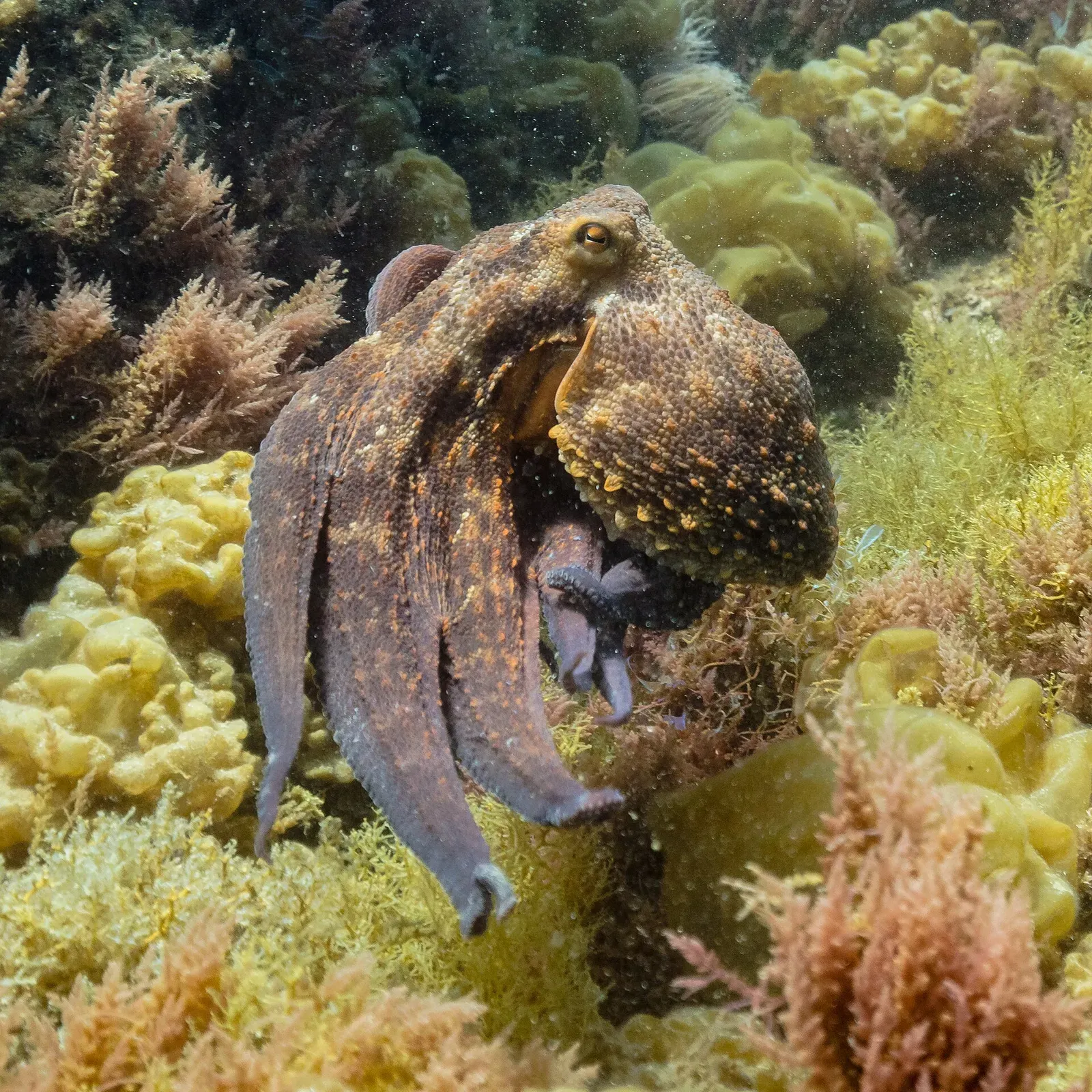
A common octopus may look like a floating bundle of arms, but this coastal neighbour is a master of hiding, exploring and making its way through a busy underwater world.
A rock moves. Or does it?
The water is turning dusky over a rocky coast. Sand shifts in little puffs. A crab sidles sideways beneath a ledge. Then one of the rocks seems to breathe, stretch an arm, and glide away. Surprise! It is a common octopus, Octopus vulgaris, beginning a twilight adventure.
This animal can change not only the colour of its skin but its texture, too. It can look smoother or bumpier to blend with sand, coral, or rock. That is quite a costume trick for someone with no wardrobe and no pockets. When hiding works, the octopus can stay wonderfully hard to spot.
Common octopuses are cephalopod molluscs: sea animals in the same big group as squids and cuttlefish. They live on the sea floor in coastal places, including rocky shores and reefs, using sheltered spots as dens. The common octopus is especially well established in the Mediterranean and eastern Atlantic, though scientists are careful because similar-looking octopuses were once all given the same name.
Evidence: IUCN Red List of Threatened Species: Octopus vulgaris (Common Octopus) — Red List Assessment; Monterey Bay Aquarium: Giant Pacific and common octopus — species profile; University of Michigan Museum of Zoology: Octopus vulgaris — Animal Diversity Web; Marine Life Information Network, Marine Biological Association: Common octopus (Octopus vulgaris) — Species profile
Eight arms, eight tiny taste-testers
Imagine exploring your room with eight super-curious arms, each able to taste what it touches. A common octopus can do something like that. Its arms investigate the seabed as it searches among crevices, shells, and stones. For this hunter, touching is part of discovering.
Dinner may include crabs, clams, snails, and small fish. More broadly, common octopuses prey especially on crustaceans, bivalves such as clams, and gastropods such as snails. An octopus may leave opened shells around its den, rather like clues after a very splashy picnic.
It is not a villain in an underwater story. It is one player in a coastal neighbourhood. By eating shellfish and other prey, and by becoming food for bigger marine predators, an octopus helps move energy through the ecosystem. Every reef and seabed community is made of these linked lives.
Evidence: University of Michigan Museum of Zoology: Octopus vulgaris — Animal Diversity Web; IUCN Red List of Threatened Species: Octopus vulgaris (Common Octopus) — Red List Assessment; Monterey Bay Aquarium: Giant Pacific and common octopus — species profile; Marine Life Information Network, Marine Biological Association: Common octopus (Octopus vulgaris) — Species profile
Three hearts and blood the colour of a blue crayon
Here is a fact worth telling someone at breakfast: a common octopus has three hearts and blue blood. Its soft body has no bones, giving it a bendy, flowing shape as it travels over the bottom. Common octopuses can reach about 1.3 metres in total length, though individuals vary greatly.
At dusk or during the night, an octopus may leave its den to forage. It might stay near one den for a while or move to another nearby shelter. Most adults live alone and defend their own small area, rather than joining an octopus club with matching hats.
If danger comes too close, camouflage is only one option. An octopus can release dark ink and use jet propulsion to make a speedy exit. Picture a sudden underwater whoosh: first there is an octopus, then a dark cloud, then—where did it go? A clever escape does not need a cape.
Evidence: University of Michigan Museum of Zoology: Octopus vulgaris — Animal Diversity Web; Monterey Bay Aquarium: Giant Pacific and common octopus — species profile; Marine Life Information Network, Marine Biological Association: Common octopus (Octopus vulgaris) — Species profile; IUCN Red List of Threatened Species: Octopus vulgaris (Common Octopus) — Red List Assessment
A short life full of important work
The life of a common octopus is brief, commonly around one to two years. That makes its time under the waves feel even more precious. Adults come together to mate, but they do not form lasting social groups. A female broods her eggs alone.
A mother octopus guards her eggs carefully. She stays with them through the long wait, and females die after brooding. When the young hatch, they drift away to begin their own lives in the sea. It is a quiet, determined kind of care—no applause, no audience, just a parent doing an enormous job.
Knowing this can change the way we look at an octopus. It is not a strange sea decoration or a dinner-shaped creature. It is an individual animal making choices: seeking shelter, finding food, avoiding danger, and caring for young. The more closely we look, the more a rocky shore feels like a neighbourhood.
Evidence: University of Michigan Museum of Zoology: Octopus vulgaris — Animal Diversity Web; Monterey Bay Aquarium: Giant Pacific and common octopus — species profile; IUCN Red List of Threatened Species: Octopus vulgaris (Common Octopus) — Red List Assessment; Marine Life Information Network, Marine Biological Association: Common octopus (Octopus vulgaris) — Species profile
What does “Least Concern” really mean?
The IUCN assessed the common octopus as Least Concern in 2018. That is encouraging, but it is not a permission slip to stop caring. The overall population trend is recorded as unknown, and the name Octopus vulgaris has been used for a complicated group of similar animals. Scientists still have questions about which records belong to this exact species in different places.
Fishing pressure and disturbance of coastal habitat can be serious local problems. Rocky crevices, reefs, seagrass, sand, and other structured parts of the seabed are not empty space. They are places where an octopus can find a den and where many other animals live, hide, hunt, and grow.
There is hopeful work to do: careful, species-correct monitoring; catch controls suited to a region; and protection for coastal den habitat can help reduce pressure. You do not have to be a marine scientist to care. Wonder is a beginning. When we notice that a “rock” might be a living neighbour, we are more likely to protect the coast it calls home.
Evidence: IUCN Red List of Threatened Species: Octopus vulgaris (Common Octopus) — Red List Assessment; University of Michigan Museum of Zoology: Octopus vulgaris — Animal Diversity Web; Marine Life Information Network, Marine Biological Association: Common octopus (Octopus vulgaris) — Species profile; Monterey Bay Aquarium: Giant Pacific and common octopus — species profile
Try an octopus-style noticing walk
Next time you visit a shore, aquarium, or even look at photos of tide pools, practise slow noticing. Where could a small animal tuck itself away? Which surfaces are smooth, rough, sandy, or full of cracks? Do not poke or collect animals; give wild neighbours room to carry on with their important business.
Ask a grown-up whether you can learn about local coastal projects, beach litter clean-ups, or rules that protect marine places. Small actions can be a way of saying, “I see that this place matters.” And if you draw an octopus, remember its most magical feature may be the one you almost cannot see: a body that can become part of the background in a blink.
The common octopus invites a splendid question: what else have we missed because we hurried past? Slow down, look twice, and let the sea surprise you. There may be a living rock nearby, wearing its finest rock costume.
Evidence: IUCN Red List of Threatened Species: Octopus vulgaris (Common Octopus) — Red List Assessment; Monterey Bay Aquarium: Giant Pacific and common octopus — species profile; University of Michigan Museum of Zoology: Octopus vulgaris — Animal Diversity Web; Marine Life Information Network, Marine Biological Association: Common octopus (Octopus vulgaris) — Species profile
A kind choice can begin on your plate
After meeting an octopus through its secret dens, tasting arms, and devoted parenting, it can feel natural to see this animal as someone rather than something. One gentle way to put that feeling into practice is to explore delicious plant-based foods with your family: perhaps a bean taco, chickpea stew, lentil pasta, crunchy vegetables, fruit, nuts, seeds, or a favourite grain bowl.
The World Health Organization describes healthy diets as varied and rich in foods such as whole grains, vegetables, fruit, pulses, nuts, and seeds. Food needs differ from person to person, so children should make food changes with a trusted adult and, when needed, a qualified health professional—not by following a rule from a story.
Choosing more plant-based meals can also be a caring choice for the wider living world. The IPCC reports that shifts toward sustainable, healthy, more plant-based diets can reduce food-system emissions and pressure on land and biodiversity. No one needs to be perfect. Every curious, kind meal is a chance to practise caring for animals like the octopus and the habitats that hold their hidden homes.
Evidence: World Health Organization: Healthy diet; Intergovernmental Panel on Climate Change: Climate Change 2022: Mitigation of Climate Change — Chapter 7
Questions people ask
Does a common octopus really have three hearts?
Yes. It has three hearts and blue blood—one of the many true facts that makes this soft-bodied coastal animal so surprising.
Evidence: IUCN Red List of Threatened Species: Octopus vulgaris (Common Octopus) — Red List Assessment; Monterey Bay Aquarium: Giant Pacific and common octopus — species profile; University of Michigan Museum of Zoology: Octopus vulgaris — Animal Diversity Web; Marine Life Information Network, Marine Biological Association: Common octopus (Octopus vulgaris) — Species profile
Where does it spend its time?
It is a bottom-dwelling coastal animal that uses places such as rocky shores, reefs, sand, seagrass, and other structured seabed areas with shelter for dens.
Evidence: University of Michigan Museum of Zoology: Octopus vulgaris — Animal Diversity Web; Marine Life Information Network, Marine Biological Association: Common octopus (Octopus vulgaris) — Species profile
Is the common octopus social?
Usually, no. Adults are generally solitary and territorial. They come together to mate, while females brood their eggs alone.
Evidence: University of Michigan Museum of Zoology: Octopus vulgaris — Animal Diversity Web
How can people help octopuses?
Protecting coastal habitat, supporting careful local fishing management, and treating sea animals as fellow living beings all help build a kinder future for coastal ecosystems.
Evidence: IUCN Red List of Threatened Species: Octopus vulgaris (Common Octopus) — Red List Assessment; University of Michigan Museum of Zoology: Octopus vulgaris — Animal Diversity Web
Read the evidence
Sources behind this story
- Octopus vulgaris (Common Octopus) — Red List Assessment — IUCN Red List of Threatened Species
- Giant Pacific and common octopus — species profile — Monterey Bay Aquarium
- Octopus vulgaris — Animal Diversity Web — University of Michigan Museum of Zoology
- Common octopus (Octopus vulgaris) — Species profile — Marine Life Information Network, Marine Biological Association
- Healthy diet — World Health Organization
- Climate Change 2022: Mitigation of Climate Change — Chapter 7 — Intergovernmental Panel on Climate Change
Health information is general education, not personal medical advice. Young readers should make food choices with a trusted adult and qualified health professional.