Today's animal friend · 11 October 2026
Moonlight’s Palm Thief: Meet the Coconut Crab
A coconut crab may look as if it stepped out of a pirate tale, but this powerful nighttime island explorer is real, remarkable, and in need of care.
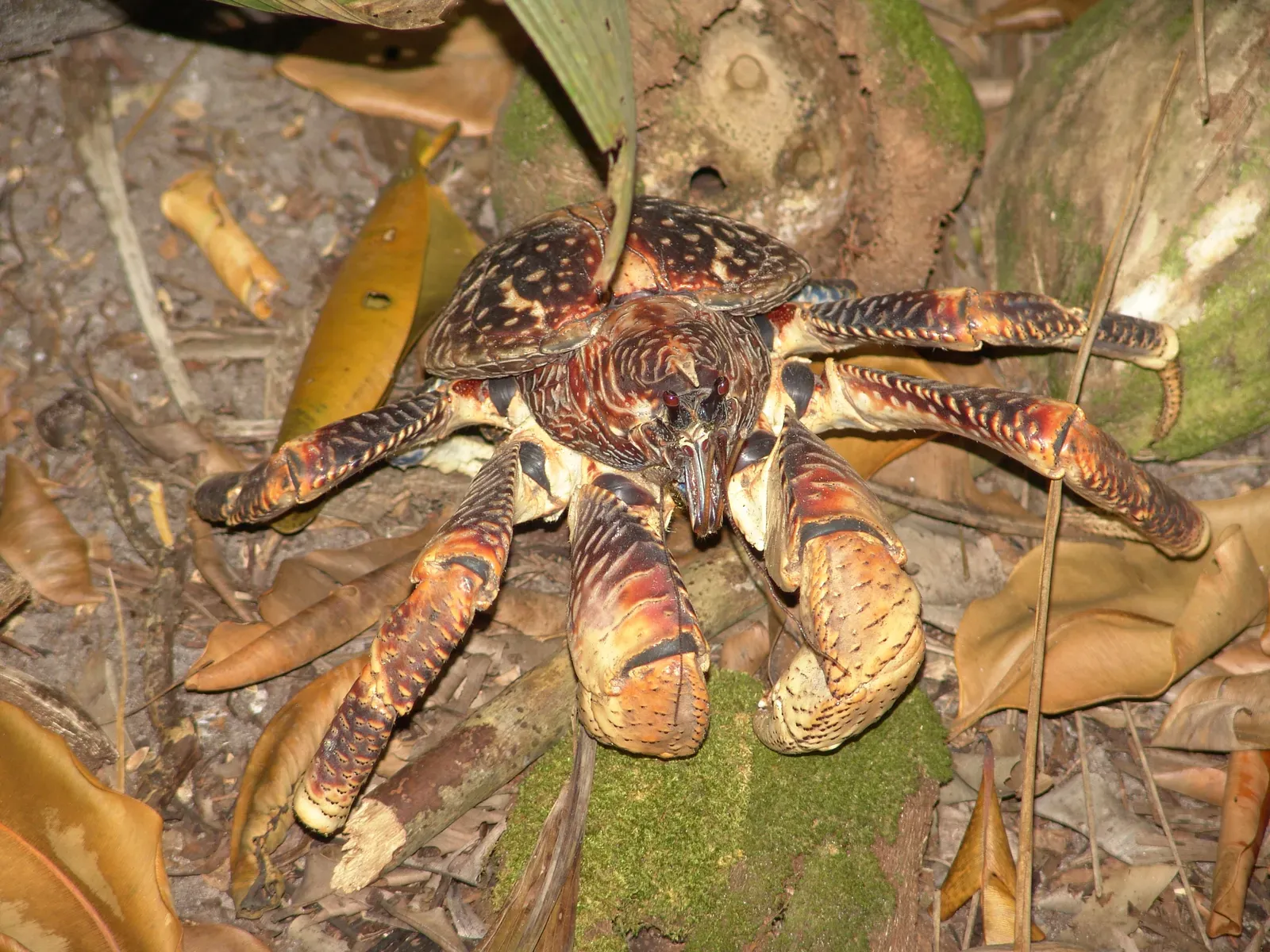
A coconut crab may look as if it stepped out of a pirate tale, but this powerful nighttime island explorer is real, remarkable, and in need of care.
A rustle under the palms
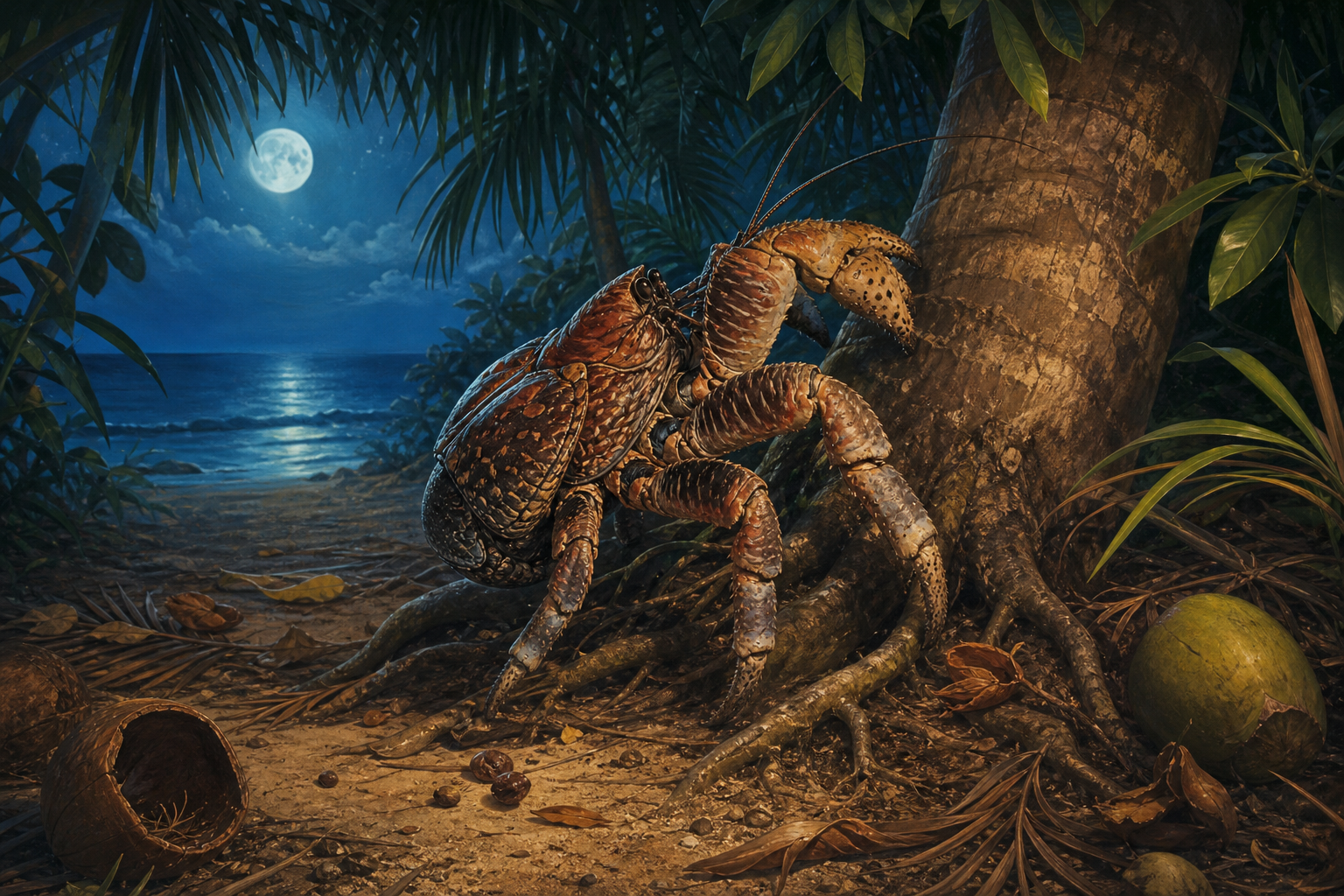
Imagine a tropical island path after sunset. The sand is cooling, palm leaves whisper overhead, and then—scritch, scritch, scritch—something large moves beside a tree root. It is not a little shore crab hurrying toward the waves. It is a coconut crab, also called a robber crab or palm thief.
Coconut crabs are the largest arthropods living on land. Arthropods are animals with jointed legs and a hard outer covering; the group includes crabs, spiders, and insects. A very large coconut crab can weigh up to about 4.1 kilograms, roughly the weight of a small pet cat. Its legs may spread close to a metre from tip to tip—about as wide as a child’s outstretched arms.
Its scientific name is Birgus latro. It belongs to the hermit-crab family, which is a wonderful surprise when you look at its sturdy, shell-free body. Young coconut crabs use borrowed snail shells, but adults develop a hardened abdomen and stop carrying one. No house-moving required.
Evidence: IUCN Red List of Threatened Species: Birgus latro (Coconut Crab) — Red List Assessment; Animal Diversity Web, University of Michigan Museum of Zoology: Birgus latro (coconut crab); Wikipedia: Coconut crab
A crab that chooses dry land?
Here is the twist: coconut crabs begin life connected to the sea, yet adult crabs live on land. They make their homes on tropical islands across the Indian and Pacific Oceans. From coastal ground into nearby forest, they may shelter in burrows in soil or sand, or tuck themselves among rocks and tangled roots.
Adults cannot remain underwater for long. Instead of spending their days in tide pools, they roam their island neighbourhood on powerful pointed legs. They can climb tree trunks to reach food or get away from danger; climbs of around two metres have been recorded, about the height of a tall doorway.
They are mainly active at night. A burrow or shady hiding place helps a crab rest through the heat of the day. After dark, one crab may set off alone on a food search. Coconut crabs are mostly solitary, though several may arrive at a good food find. Picture a midnight snack queue—with no chatting, but quite a lot of clicking feet.
Evidence: Animal Diversity Web, University of Michigan Museum of Zoology: Birgus latro (coconut crab); Wikipedia: Coconut crab
The name says coconut. The menu says “many things.”
Do coconut crabs eat coconuts every day? Not usually. Their name comes from their connection with coconut-palm islands, not from a coconut-only menu. They are omnivorous scavengers, eating fallen fruit, nuts, seeds, plant pith, and dead animals they find.
That makes them busy members of an island ecosystem. A dropped fruit does not simply sit and soften on the forest floor. A coconut crab may feed on it, carry it away, or leave seeds in another spot. This can help seeds move around, a small but useful service in a place where plants and animals share limited space.
Their claws are strong tools for handling food, but wild crabs should always be admired from a respectful distance. Never try to touch, feed, or pick one up. A nighttime forager has its own plans, and giving it space is part of being a good visitor.
Evidence: Animal Diversity Web, University of Michigan Museum of Zoology: Birgus latro (coconut crab); Wikipedia: Coconut crab
An armoured animal with a tender moment
Coconut crabs grow slowly. They can take roughly 40 to 60 years to reach their greatest size, so a population cannot quickly replace many large adults if they disappear. Patience is part of this crab’s life story.
Like other crabs, a coconut crab must moult as it grows. It leaves its old hard outer covering behind and waits for a new one to harden. During this vulnerable time, it can retreat underground for a long while. Imagine needing a safe, quiet room while you trade an outgrown winter coat for a brand-new coat that covers your whole body.
That hidden part of crab life is worth remembering. Even an animal that looks like a tiny tank needs safety, shelter, and time. Coconut crabs are not decorations, dares, or prizes. They are individual island neighbours with long, secret lives.
Evidence: Animal Diversity Web, University of Michigan Museum of Zoology: Birgus latro (coconut crab); Wikipedia: Coconut crab
Why does this midnight walker need help?
The IUCN Red List assessed the coconut crab as Vulnerable in 2018, with a decreasing population trend. Hunting for food and the loss of coastal habitat are major pressures. In some heavily settled places, coconut crabs have disappeared even though coconut palms still grow there.
Their slow growth makes heavy hunting especially difficult for local populations. Coastal forests, sandy burrows, root tangles, and quiet places are not just scenery; they are parts of a crab’s home. When those places are changed or lost, the nighttime path becomes harder to travel.
There is hope in careful protection. Different islands may use protected areas, seasonal rules, size limits, or strict limits on catching and trading coconut crabs. These approaches can give crabs more time to grow, moult, find food, and produce the next generation. Protecting one famous crab also helps protect its whole moonlit neighbourhood.
Evidence: IUCN Red List of Threatened Species: Birgus latro (Coconut Crab) — Red List Assessment; Animal Diversity Web, University of Michigan Museum of Zoology: Birgus latro (coconut crab); Wikipedia: Coconut crab
How to be a far-away crab friend
You do not have to live beside the Indian or Pacific Ocean to care about coconut crabs. Start with curiosity. When you see a wildlife photo or video, ask whether the animal has room to move away and whether people are treating it gently. Wild animals are not props for a close-up.
If you ever visit a place where coconut crabs live, follow local wildlife rules, keep your distance, and stay on paths where possible. Watch quietly and leave food where it belongs. The finest souvenir may be a memory: moonlit sand, a palm-leaf rustle, and a remarkable crab heading somewhere important.
Coconut crabs show how a creature can be both bold-looking and easy to overlook. Their work happens after dark, among fallen fruit and roots. Looking after their habitats helps make sure that rustling sound remains part of island nights.
Evidence: IUCN Red List of Threatened Species: Birgus latro (Coconut Crab) — Red List Assessment; Animal Diversity Web, University of Michigan Museum of Zoology: Birgus latro (coconut crab); Wikipedia: Coconut crab
A kind choice can begin at the dinner table
Coconut crabs are living island neighbours, not a challenge meal. Choosing plant-based foods more often can be one gentle way to practise the idea that wonderful animals deserve to remain in the wild. The World Health Organization includes vegetables, fruit, whole grains, pulses such as beans and lentils, nuts, and seeds in guidance about healthy diets.
Our meals connect to places beyond our plates. The IPCC reports that shifts toward sustainable, healthy, more plant-based diets can reduce food-system emissions and pressure on land and biodiversity. No one has to solve everything at once: perhaps share bean tacos, lentil soup, or a fruit-and-nut snack with your family, while the coconut crab keeps its own island supper. For personal food needs, speak with a trusted adult and a qualified health professional.
Evidence: World Health Organization: Healthy diet; Intergovernmental Panel on Climate Change: Climate Change 2022: Mitigation of Climate Change — Chapter 7
Questions people ask
Can a coconut crab really climb a tree?
Yes. Coconut crabs use their powerful pointed legs to climb trunks, perhaps to reach food or escape danger. Climbs of around two metres have been recorded, although they spend much of their time near ground shelters and burrows.
Evidence: Animal Diversity Web, University of Michigan Museum of Zoology: Birgus latro (coconut crab); Wikipedia: Coconut crab
Why are they called palm thieves?
“Palm thief” and “robber crab” are alternative names for coconut crabs. The dramatic names fit a large crab wandering under palms at night, but the crab is simply searching for food in its home.
Evidence: IUCN Red List of Threatened Species: Birgus latro (Coconut Crab) — Red List Assessment; Animal Diversity Web, University of Michigan Museum of Zoology: Birgus latro (coconut crab); Wikipedia: Coconut crab
Are coconut crabs important to their islands?
Yes. By eating fallen fruit and other organic material, they help process the forest-floor leftovers. When they carry fruit and leave seeds elsewhere, they can also help seeds move through their habitat.
Evidence: Animal Diversity Web, University of Michigan Museum of Zoology: Birgus latro (coconut crab)
Read the evidence
Sources behind this story
- Birgus latro (Coconut Crab) — Red List Assessment — IUCN Red List of Threatened Species
- Birgus latro (coconut crab) — Animal Diversity Web, University of Michigan Museum of Zoology
- Coconut crab — Wikipedia
- Healthy diet — World Health Organization
- Climate Change 2022: Mitigation of Climate Change — Chapter 7 — Intergovernmental Panel on Climate Change
Health information is general education, not personal medical advice. Young readers should make food choices with a trusted adult and qualified health professional.