Today's animal friend · 19 October 2026
The Rainforest’s Green-Coated Tree Traveller
High in humid forests from southern Central America through much of South America, a brown-throated sloth hangs, munches, naps, and sometimes wears a dusting of green algae like a leafy disguise.
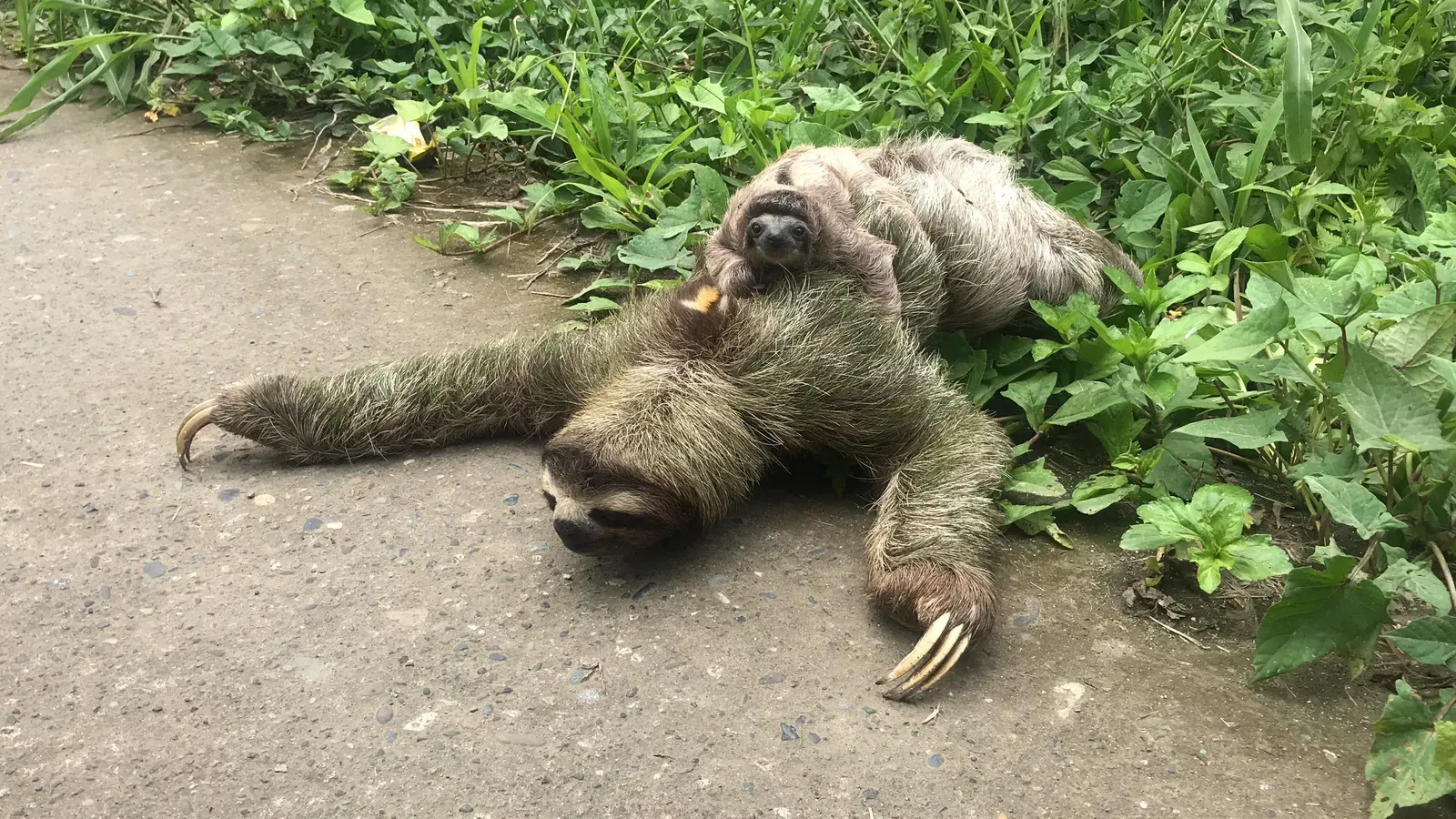
High in humid forests from southern Central America through much of South America, a brown-throated sloth hangs, munches, naps, and sometimes wears a dusting of green algae like a leafy disguise.
A greenish shadow in the leaves
Imagine looking up through a rainforest canopy after rain. Leaves drip. Branches creak softly. Somewhere above, what looks like a small, fuzzy clump of greenish leaves gives the tiniest stretch. Surprise: it is a brown-throated sloth, Bradypus variegatus.
This sloth is a mammal and one of the three-toed sloths. It lives high in tropical rainforests and other humid forests from southern Central America through much of tropical South America. Its world is a leafy roof over the forest floor, full of branches to cling to and food trees to visit.
A brown-throated sloth is about as long as a large school ruler—roughly 50 to 60 centimetres—and adults weigh about 3.5 to 5.2 kilograms. But its size is not the first thing you would notice. Its superpower is taking its time.
Evidence: IUCN Red List of Threatened Species: Bradypus variegatus (Brown-throated Three-toed Sloth) — Red List Assessment; Animal Diversity Web, University of Michigan Museum of Zoology: Bradypus variegatus (brown-throated three-toed sloth); Wikipedia: Brown-throated sloth
Why hurry when lunch is leaves?
Sloths are herbivores, which means they eat plants rather than animals. Brown-throated sloths nibble young leaves, flowers, and fruit, especially leaves from Cecropia trees. A leaf lunch is not packed with quick energy, so a slow lifestyle helps a sloth save what it has.
Rather than racing around like a squirrel late for a meeting, this animal moves and feeds slowly among the branches. It can be active in short stretches during both day and night, and it sleeps for much of each day. In the rainforest, being slow is not a failure to be fast. It is a clever match for its menu.
Its curved claws and long arms help it hang in the canopy. A sloth may spend a long time in one favourite tree, then make an unhurried journey to another. The treetops are its road system—only there are no traffic lights, just branches.
Evidence: Animal Diversity Web, University of Michigan Museum of Zoology: Bradypus variegatus (brown-throated three-toed sloth); Wikipedia: Brown-throated sloth
Is that fur… wearing a garden?
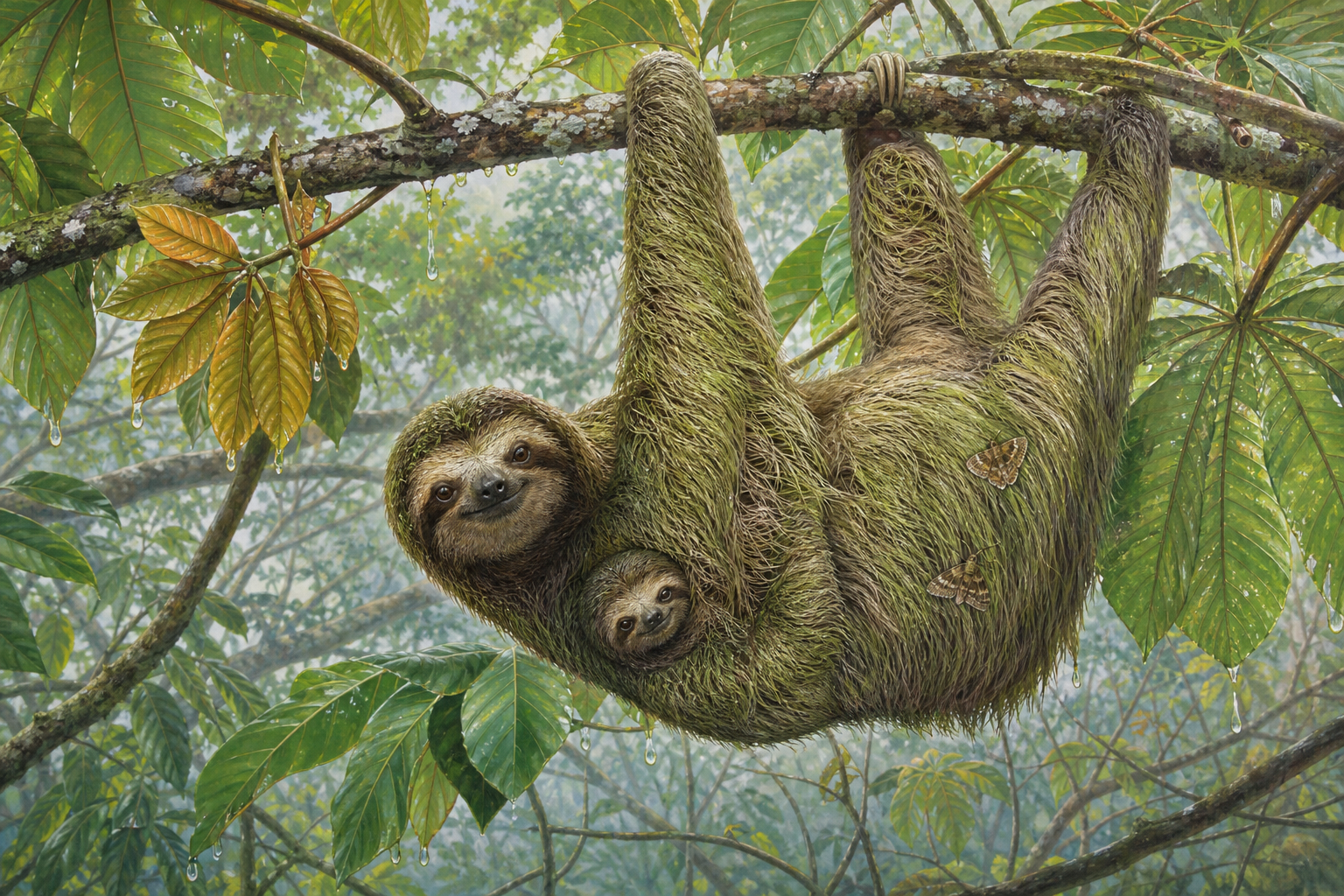
Yes, in a way! Because a sloth moves slowly and can stay still for long periods, tiny algae can grow in its shaggy fur. The algae may give the coat a greenish tint, helping the sloth blend with leaves and making it harder to spot among the canopy shadows.
That fur is more than a coat; it can be a little living neighbourhood. Sloth moths may live there too. Scientists describe this as a specialised small community connected to the sloth’s fur. It is a lovely reminder that one quiet animal can be a whole world to even tinier creatures.
Camouflage does not make a sloth invisible, of course. It simply helps it look less like an obvious animal in a place full of bark, mossy colours, and leaves. Next time you see a patch of green in a tree, you might wonder: leaf, lichen, or a sloth having an exceptionally still day?
Evidence: Animal Diversity Web, University of Michigan Museum of Zoology: Bradypus variegatus (brown-throated three-toed sloth); Wikipedia: Brown-throated sloth
The baby who rides tummy-side down
Brown-throated sloths are usually solitary as adults, but a mother and baby make a close travelling team. A single baby is born high in the trees with fur and claws already present. It clings to its mother’s underside, holding on as she moves through the branches.
For the first months of life, the baby rides along and begins learning about its forest home, including which food trees to use. Picture riding with your most trusted grown-up—except your bus is a furry, upside-down rainforest explorer.
This family time matters because the canopy is not a simple place. It is a high, tangled map of branches, leaves, and gaps. A young sloth has much to learn before setting out on its own. Even the gentlest-looking forest resident needs skills for life in the trees.
Evidence: Animal Diversity Web, University of Michigan Museum of Zoology: Bradypus variegatus (brown-throated three-toed sloth); Wikipedia: Brown-throated sloth
One careful trip to the forest floor
Most of the time, a brown-throated sloth stays in the treetops. About once a week, it usually climbs down to the ground to defecate, then makes the careful journey back upward. For an animal built around life in branches, the ground is an unusual stop on the itinerary.
This is why connected, tall forest is so important. A sloth needs plenty of suitable food trees and canopy space. When rainforest is cleared or broken into separate pieces, local sloth populations can be affected because their leafy pathways and homes are lost or divided.
The species is listed by the IUCN as Least Concern, which is encouraging. Still, “Least Concern” is not the same as “nothing matters.” Protecting standing rainforest helps keep the canopy home that brown-throated sloths need, along with homes for many other forest neighbours.
Evidence: IUCN Red List of Threatened Species: Bradypus variegatus (Brown-throated Three-toed Sloth) — Red List Assessment; Animal Diversity Web, University of Michigan Museum of Zoology: Bradypus variegatus (brown-throated three-toed sloth); Wikipedia: Brown-throated sloth
A small choice that says, “I see you”
Caring about sloths can begin with noticing that their lives matter to them: a baby needs its mother, an adult needs safe branches, and a whole rainforest needs room to stay a rainforest. We can cheer for forests, learn where food comes from, and choose kindness in everyday ways.
At meals, you might explore plant-based foods with your family—perhaps beans, lentils, vegetables, fruit, whole grains, nuts, or seeds. The World Health Organization includes these foods in guidance about varied healthy diets. Food needs are personal, so children can talk with a trusted adult and a qualified health professional about what is right for them.
Choosing more plant-based meals can be a gentle way to care for animals and habitats. The IPCC reports that shifts toward sustainable, healthy, more plant-based diets can reduce food-system emissions and pressure on land and biodiversity. No one has to be perfect to be a thoughtful friend of a rainforest sloth.
Evidence: World Health Organization: Healthy diet; Intergovernmental Panel on Climate Change: Climate Change 2022: Mitigation of Climate Change — Chapter 7
Be a rainforest ally, one curious choice at a time
A brown-throated sloth is not a decoration in a tree. It is an individual animal with a home, a food route, and—sometimes—a baby clinging close. Let that thought make your next walk outdoors a little more observant: whose home might this tree be?
With your family, try celebrating plants on the plate: colourful fruit, crunchy vegetables, beans, lentils, grains, nuts, and seeds can all be part of varied meals. World Health Organization guidance includes these foods in healthy dietary patterns, while personal food decisions should be made with trusted adults and qualified health professionals.
More plant-based, sustainable diets can also help reduce pressure from food systems on climate, land, and biodiversity, according to the IPCC. That is a hopeful connection: a caring choice at home can fit into a bigger promise to leave room for wild neighbours in the treetops.
Evidence: World Health Organization: Healthy diet; Intergovernmental Panel on Climate Change: Climate Change 2022: Mitigation of Climate Change — Chapter 7
Questions people ask
What does a brown-throated sloth eat?
It is a strict herbivore. Its food includes young leaves, Cecropia leaves, flowers, and fruit.
Evidence: Animal Diversity Web, University of Michigan Museum of Zoology: Bradypus variegatus (brown-throated three-toed sloth); Wikipedia: Brown-throated sloth
Does every brown-throated sloth look green?
Not exactly. Algae can grow in the fur and give it a greenish tint, which can help the sloth blend with leafy surroundings.
Evidence: Animal Diversity Web, University of Michigan Museum of Zoology: Bradypus variegatus (brown-throated three-toed sloth); Wikipedia: Brown-throated sloth
How often does it come down from the trees?
It typically descends only about once a week to defecate. The rest of its life is mainly spent in the canopy.
Evidence: Animal Diversity Web, University of Michigan Museum of Zoology: Bradypus variegatus (brown-throated three-toed sloth); Wikipedia: Brown-throated sloth
Are brown-throated sloths endangered?
The IUCN lists the species as Least Concern. However, protecting tall, connected rainforest still matters because local clearing and fragmentation can damage sloth habitat.
Evidence: IUCN Red List of Threatened Species: Bradypus variegatus (Brown-throated Three-toed Sloth) — Red List Assessment; Animal Diversity Web, University of Michigan Museum of Zoology: Bradypus variegatus (brown-throated three-toed sloth); Wikipedia: Brown-throated sloth
Read the evidence
Sources behind this story
- Bradypus variegatus (Brown-throated Three-toed Sloth) — Red List Assessment — IUCN Red List of Threatened Species
- Bradypus variegatus (brown-throated three-toed sloth) — Animal Diversity Web, University of Michigan Museum of Zoology
- Brown-throated sloth — Wikipedia
- Healthy diet — World Health Organization
- Climate Change 2022: Mitigation of Climate Change — Chapter 7 — Intergovernmental Panel on Climate Change
Health information is general education, not personal medical advice. Young readers should make food choices with a trusted adult and qualified health professional.