Today's animal friend · 8 October 2026
Barramundi: The Fish with Two Water Worlds
This big Indo-West Pacific fish can travel between fresh and salty water—and its life story holds a spectacular surprise.
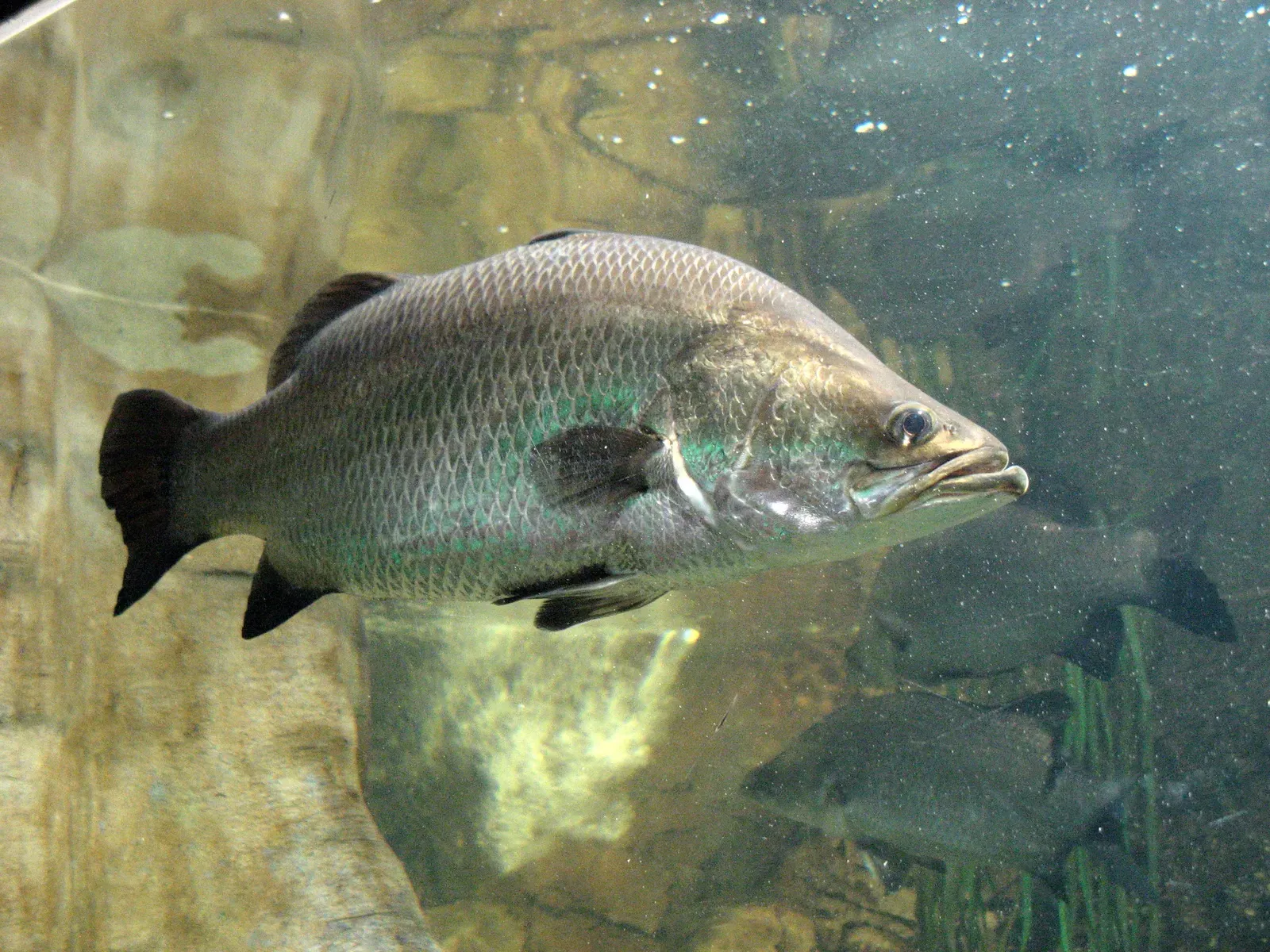
This big Indo-West Pacific fish can travel between fresh and salty water—and its life story holds a spectacular surprise.
A silver flash where the river tastes like sea
Picture standing beside a warm tropical river. The water nudges past muddy banks and tangled mangrove roots. Somewhere below the ripples, a broad, silvery fish glides by with a wide mouth and shiny scales. It is a barramundi—also called an Asian sea bass or giant sea perch—and it may be heading toward water that tastes completely different.
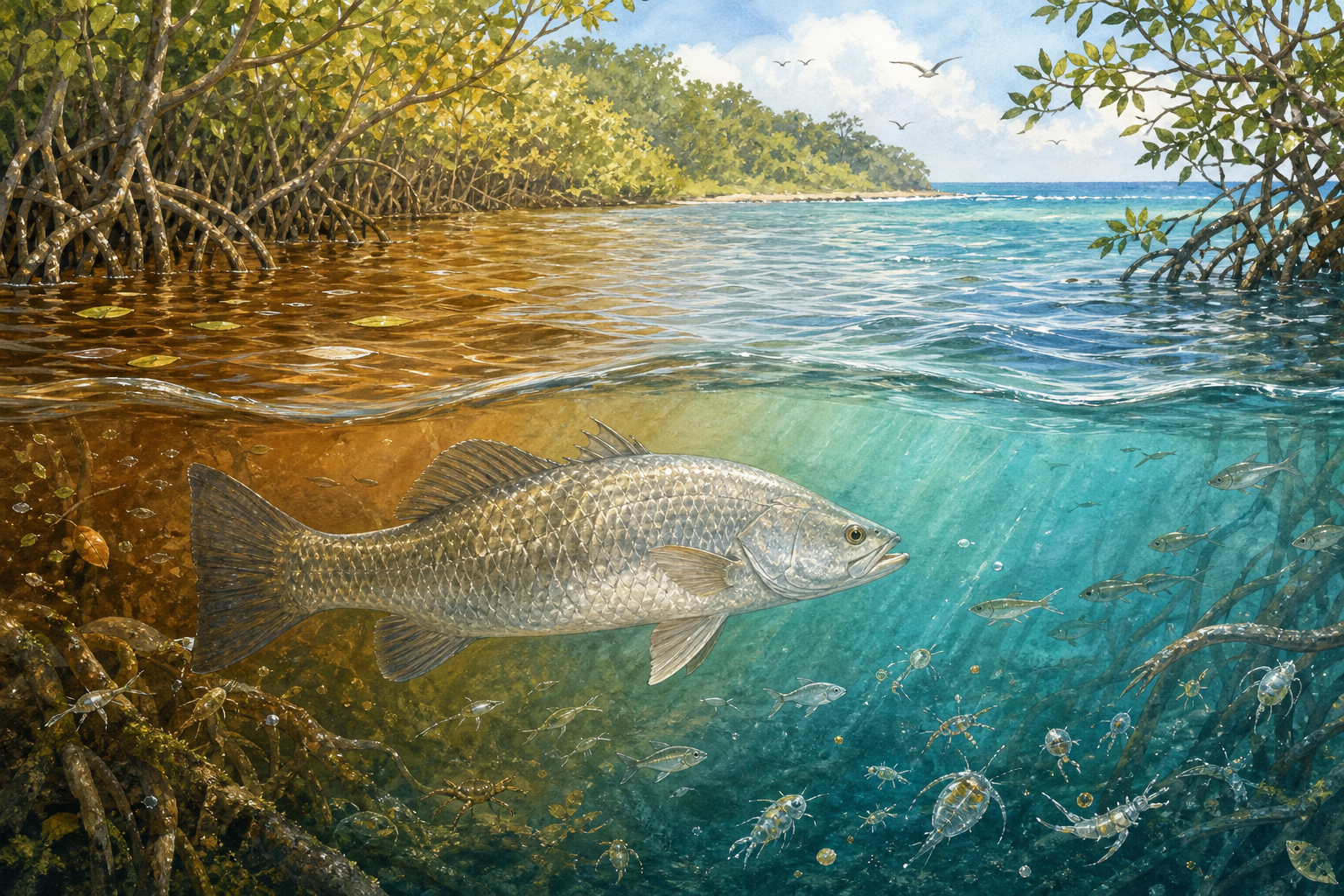
Barramundi live a double-water life. They use freshwater rivers and floodplain lagoons, but also mangrove estuaries, shallow coastal water, and lagoons. An estuary is the meeting place where river water and seawater mix: a watery swish of two worlds. Not many animals can feel at home across that salty-to-freshwater changing room.
Their home range stretches through the tropical Indo-West Pacific, including northern Australia, Indonesia, Southeast Asia, and west toward coastal India. That is a huge watery neighbourhood—but each fish still needs connected places to swim through on its own journey.
Evidence: Animal Diversity Web, University of Michigan Museum of Zoology: Lates calcarifer (Asian seabass); Fishes of Australia, Museums Victoria: Lates calcarifer; Wikipedia: Barramundi
Why would a river fish visit the sea?
Here is the brilliant twist: barramundi can move from freshwater toward estuaries and shallow coastal waters to spawn. In other words, their family story depends on a route between river and sea. Think of it like needing both your home street and the bridge that leads to the town park. If the bridge disappears, the trip becomes much harder.
This travel pattern is often called semi-catadromous. That is a very long word for a simple big idea: barramundi use different connected habitats during their lives. Some individuals may spend more time in freshwater than others, so there is no single timetable that fits every barramundi.
Mangroves, wetlands, floodplains, rivers, and estuaries are not separate dots on a map to a travelling fish. They are linked rooms in one enormous watery house. A healthy path between them helps barramundi reach the places they use for feeding, growing, and spawning.
Evidence: Animal Diversity Web, University of Michigan Museum of Zoology: Lates calcarifer (Asian seabass); Fishes of Australia, Museums Victoria: Lates calcarifer; Wikipedia: Barramundi
The growing-up surprise
Barramundi have one of the most surprising life stories in the fish world. Many begin life as males and later change to females as they grow older, often between roughly three and eight years of age. Some may not make that change, so nature does not run every life in exactly the same way.
You might imagine a barramundi’s life as a story with a remarkable new chapter, not as a mistake or a magic trick. It is a natural part of this species’ biology. The changes make barramundi a wonderful reminder that living things can have life patterns far more varied than we first expect.
And they can become seriously big. Many adults people encounter are around 0.6 to 1.2 metres long—about as long as a child is tall, or longer. Reports of exceptional barramundi reaching around 1.8 metres exist, but such giant sizes are not well evidenced. Either way, meeting one underwater would feel a bit like spotting a silver canoe with fins.
Evidence: Animal Diversity Web, University of Michigan Museum of Zoology: Lates calcarifer (Asian seabass); Fishes of Australia, Museums Victoria: Lates calcarifer; Wikipedia: Barramundi
What is on the barramundi menu?
A barramundi is a predator, which means it hunts other animals. Young barramundi begin with tiny drifting animals called zooplankton. As they grow, they take on larger meals: smaller fish, crustaceans such as prawns and crabs, and molluscs, the group that includes many shell-bearing animals.
That changing menu makes sense. A tiny young fish cannot gulp down the same meal as a large adult, just as a toddler is not handed a whole watermelon and told, “Good luck!” As barramundi grow, their food changes with them.
By eating smaller fish and invertebrates across rivers, floodplains, estuaries, and coastal waters, barramundi are part of the food webs in all those places. A food web is a map of who eats what—and it is never just a list. It is a web because every living thing is connected to others, including the plants and habitats that help small animals survive.
Evidence: Animal Diversity Web, University of Michigan Museum of Zoology: Lates calcarifer (Asian seabass); Fishes of Australia, Museums Victoria: Lates calcarifer; Wikipedia: Barramundi
A fish worth cheering for, carefully
Globally, the barramundi is listed as Least Concern on the IUCN Red List. That is encouraging news. But it does not mean every river, wetland, or local group of barramundi is automatically doing equally well. The available sources do not give a verified global population trend, and local places can face different challenges.
Because barramundi need connected waters, looking after river flows, migration routes, floodplains, mangroves, spawning estuaries, and sensible fishing limits is a hopeful, practical way to care for them. It is less like protecting one favourite puddle and more like protecting the whole route of a grand swimming adventure.
You do not have to live near a tropical estuary to care. Notice waterways where you live. Ask what animals might need from them: clean water, safe edges, plants, and room to move. Curiosity is often where protection begins.
Evidence: IUCN Red List of Threatened Species: Lates calcarifer (Barramundi) — Red List Assessment; Fishes of Australia, Museums Victoria: Lates calcarifer; Wikipedia: Barramundi
Try a barramundi-sized imagination game
Next time you see a stream flowing into a larger river, imagine it continuing all the way to a mangrove-lined estuary and then the sea. Where would a fish rest? Where might tiny food drift? Which stretches would be tricky to cross? You are thinking like a habitat detective.
Barramundi are not simply “river fish” or “sea fish.” They are travellers whose lives join both. Their silvery bodies carry a message from the water: wild places work best when their connections remain open.
That is worth leaning over a railing for, listening to the splash and rustle, and wondering: who might be on the move beneath the surface? Maybe not a barramundi in every country—but always some neighbour with a journey of its own.
Evidence: Animal Diversity Web, University of Michigan Museum of Zoology: Lates calcarifer (Asian seabass); Fishes of Australia, Museums Victoria: Lates calcarifer; Wikipedia: Barramundi
Kind choices can ripple outward
Barramundi are lively wild animals with journeys, changing life stages, and homes that stretch from rivers to the sea. One gentle way to honour animals like them is to see them as neighbours, not just as something on a plate.
Families can explore colourful plant-forward meals together—perhaps beans, lentils, peas, whole grains, vegetables, fruit, nuts, and seeds—with a trusted adult helping choose what works for everyone. The World Health Organization describes these foods as part of varied healthy diets, while the IPCC reports that shifts toward sustainable, healthy, more plant-based diets can reduce pressure from food systems on climate, land, and biodiversity. A chickpea curry or a bean burrito may not swim like a barramundi, but it can be one small, tasty vote for a kinder shared world.
Evidence: World Health Organization: Healthy diet; Intergovernmental Panel on Climate Change: Climate Change 2022: Mitigation of Climate Change — Chapter 7
Questions people ask
Can barramundi live in fresh water and salt water?
Yes. Barramundi use freshwater rivers and floodplain lagoons as well as estuaries, coastal water, and lagoons. Their ability to move through these connected habitats is a key part of their life cycle.
Evidence: Animal Diversity Web, University of Michigan Museum of Zoology: Lates calcarifer (Asian seabass); Fishes of Australia, Museums Victoria: Lates calcarifer; Wikipedia: Barramundi
Do all barramundi change from male to female?
Many do, but not every individual follows exactly the same pathway. The sources describe barramundi as commonly changing from male to female as they age.
Evidence: Animal Diversity Web, University of Michigan Museum of Zoology: Lates calcarifer (Asian seabass); Fishes of Australia, Museums Victoria: Lates calcarifer; Wikipedia: Barramundi
Are barramundi endangered?
The species is listed globally as Least Concern by the IUCN. Still, caring for local river, wetland, mangrove, and estuary connections remains important.
Evidence: IUCN Red List of Threatened Species: Lates calcarifer (Barramundi) — Red List Assessment; Fishes of Australia, Museums Victoria: Lates calcarifer; Wikipedia: Barramundi
Read the evidence
Sources behind this story
- Lates calcarifer (Barramundi) — Red List Assessment — IUCN Red List of Threatened Species
- Lates calcarifer (Asian seabass) — Animal Diversity Web, University of Michigan Museum of Zoology
- Barramundi — Wikipedia
- Lates calcarifer — Fishes of Australia, Museums Victoria
- Healthy diet — World Health Organization
- Climate Change 2022: Mitigation of Climate Change — Chapter 7 — Intergovernmental Panel on Climate Change
Health information is general education, not personal medical advice. Young readers should make food choices with a trusted adult and qualified health professional.