 ← All animals
 worm · Riftia pachyptila
Giant tube worm
Gallery
1 photo Real photograph Why we love them
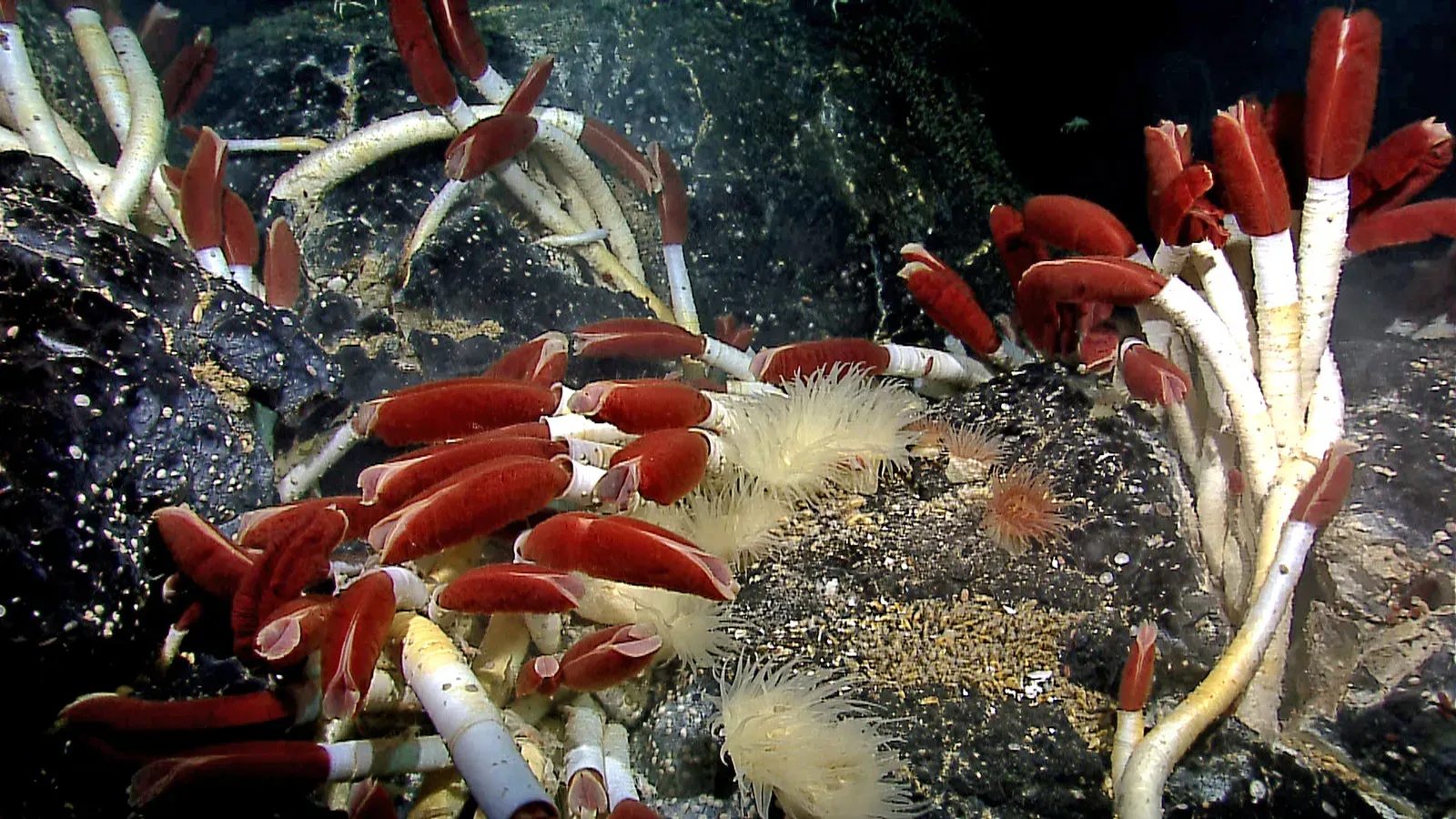
The giant tube worm is one of the most astonishing creatures in the whole ocean. It lives deep, deep down on the seafloor, far below where any sunlight can reach, in a world of total darkness. There it grows inside a long white tube, standing tall like a strange undersea plant — but it is truly an animal, a giant relative of the earthworms in your garden.
These worms cluster around hydrothermal vents, which are like hot springs on the bottom of the sea. Warm, mineral-rich water bubbles up from cracks in the ocean floor, and the tube worms gather right where it flows. They live around vents in the Pacific Ocean, near places like the Galapagos Islands and the East Pacific Rise, sometimes in patches many metres wide.
Here comes the most amazing part: a grown giant tube worm has no mouth and no stomach at all. So how does it eat? Living inside its body are billions of tiny helpful bacteria. The worm gathers chemicals from the vent water, passes them to the bacteria, and the bacteria make food and share it back. It is a perfect partnership, and it lets the worm feed without ever taking a bite.
At the top of each white tube waves a soft, feathery plume, and it is a beautiful bright red — red for the very same reason our own blood is red. The worm uses this plume to soak up the chemicals its bacteria need. When something drifts too close, the worm can quickly tuck its plume safely back inside its tube.
Giant tube worms were only discovered in 1977, when scientists in a tiny submarine explored the deep sea near the Galapagos and found a garden of them glowing red in the dark. They grow faster than any other animal on the seafloor. Living so deep, they have never been given a conservation rating, but they remain one of the most wonderful surprises the ocean has ever shown us.
My home
Deep sea, hydrothermal vent, ocean floor
Where I live
South America, Pacific Ocean
What I eat
Nutrients from bacteria living inside its body
How long I am
3 m
The giant tube worm has no mouth and no stomach at all — instead, tiny helpful bacteria live inside its body and make food for it out of the chemicals from the vents.
It can grow up to 3 metres tall inside its white tube and is tipped with a soft, bright red feathery plume, which is red for the very same reason our blood is.
First discovered in 1977 near the Galapagos Islands, the giant tube worm grows faster than any other seafloor animal scientists know of.
Every giant tube worm can feel happy, scared and loved — just like you.
Looking after my friends
How many are there?
At productive East Pacific hydrothermal vents, dense patches can hold up to about 3,500 giant tube worms per square metre.
This is a maximum density in favourable vent habitat, not an average or a worldwide count.
Estimate source: The metatrochophore of a deep-sea hydrothermal vent vestimentiferan
How are they doing?
No global assessmentThis animal does not have a global extinction-risk assessment recorded in this system.
You can help by learning their names, keeping wild places clean, and telling someone why this animal matters.
Where this came from
- Riftia pachyptila (Giant Tube Worm) — conservation status — IUCN Red List of Threatened Species
- Riftia Tubeworms — Smithsonian Ocean (Smithsonian National Museum of Natural History)
- Riftia pachyptila — Wikipedia
- The metatrochophore of a deep-sea hydrothermal vent vestimentiferan — PLOS ONE