Today's animal friend · 14 July 2026
Western Honey Bees: The Flower-Finding Friends of the Hive
A western honey bee may be tiny, but her day can include visiting flowers, sharing a map through movement, and helping flowering plants along the way. Come close—gently—and discover the hive’s remarkable neighbours.
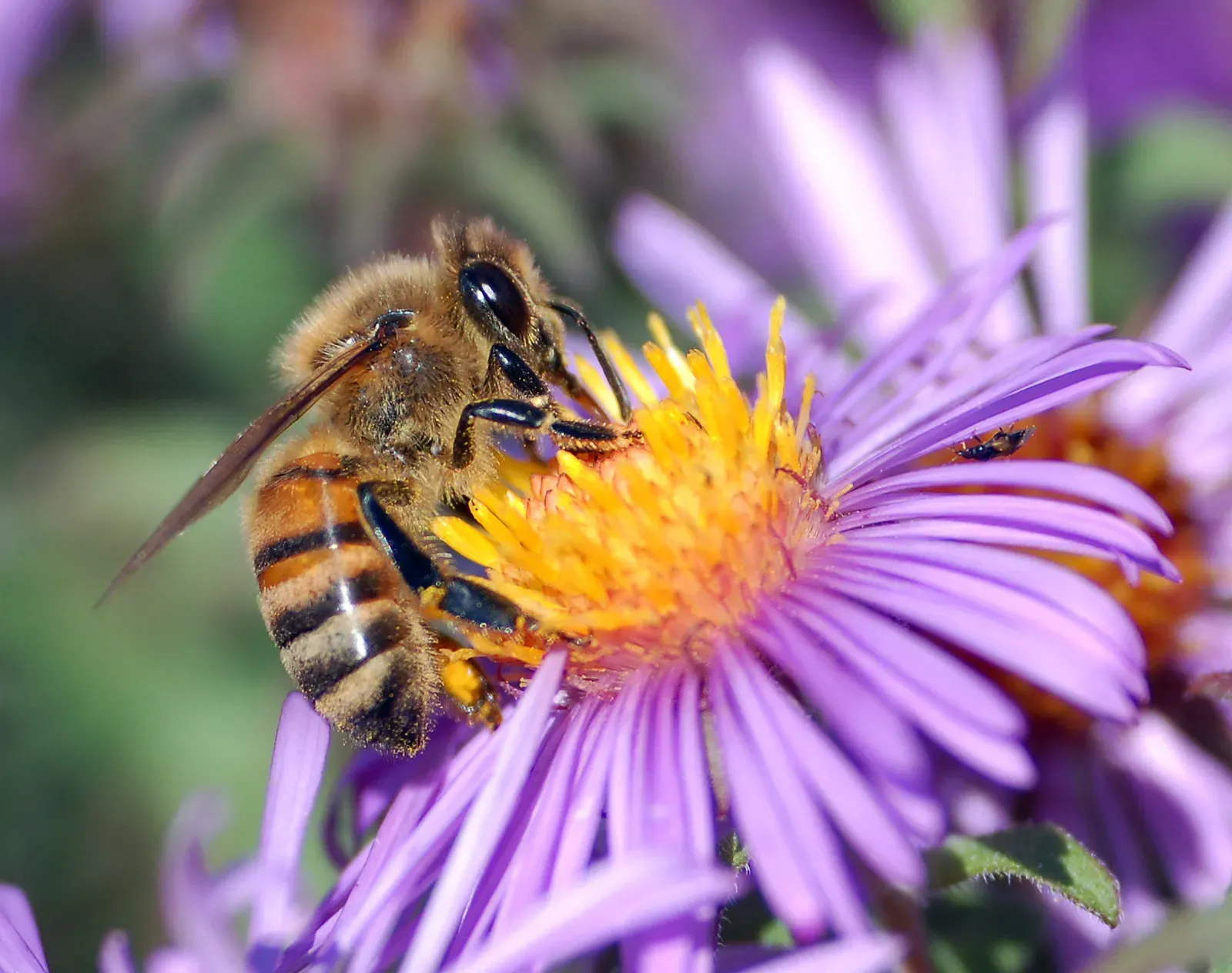
A western honey bee may be tiny, but her day can include visiting flowers, sharing a map through movement, and helping flowering plants along the way. Come close—gently—and discover the hive’s remarkable neighbours.
A western honey bee is a small insect with a very big community
The western honey bee, also called the European honey bee, has the scientific name Apis mellifera. It is an insect in the bee family, Apidae, and it is easy to picture: a small, fuzzy body, golden-and-brown stripes, and four clear wings. Yet one bee is only part of the story. Honey bees live in colonies, where many individuals share one home and a great deal of work.
A hive in summer can hold tens of thousands of bees. Inside are jobs that help the colony run: some bees clean, some care for young bees, some guard the entrance, and some fly out to search for flowers. One queen is the mother of nearly every bee in the hive. Rather than thinking of a colony as a crowd, imagine it as a constantly changing neighbourhood, full of tiny lives and busy tasks.
Western honey bees are found in parts of Africa, Asia, and Europe, and people also keep them in many places beyond that range. They may use habitats including meadows, gardens, woodlands, and farmland. Wherever flowers open in the daytime, a bee may be on the move, following the changing patchwork of blooms.
Evidence: IUCN Red List of Threatened Species: Apis mellifera (Western Honey Bee) — European Red List of Bees assessment; USDA Agricultural Research Service: Honey Bees — Bee Research and Pollination; Natural History Museum, London: What is a honey bee? — Natural History Museum
Flowers provide nectar and pollen, and the hive turns nectar into stored food
Western honey bees feed on nectar and pollen from flowers. Nectar is a sweet liquid, while pollen is the dusty material that can cling to a bee as she visits blooms. A foraging bee may travel from flower to flower, gathering these plant-made foods and carrying them back to her colony.
At the hive, bees turn nectar into honey and store it inside. For the colony, honey is food saved for times when flowers are scarce. That is a useful reminder that the familiar jar on a shop shelf begins as a carefully gathered store belonging to a bee community. Watching bees visit flowers can help us notice the quiet effort behind every drop.
Honey bees are active by day. On a warm day, a garden can seem still until you pause beside a flowering plant. Then you may see the careful landings, the quick take-offs, and pollen dusting a bee’s legs. The best way to be a good observer is to give bees room: look closely, but do not trap, chase, or swat them.
Evidence: USDA Agricultural Research Service: Honey Bees — Bee Research and Pollination; Natural History Museum, London: What is a honey bee? — Natural History Museum; IUCN Red List of Threatened Species: Apis mellifera (Western Honey Bee) — European Red List of Bees assessment
The waggle dance helps foragers share a flower map
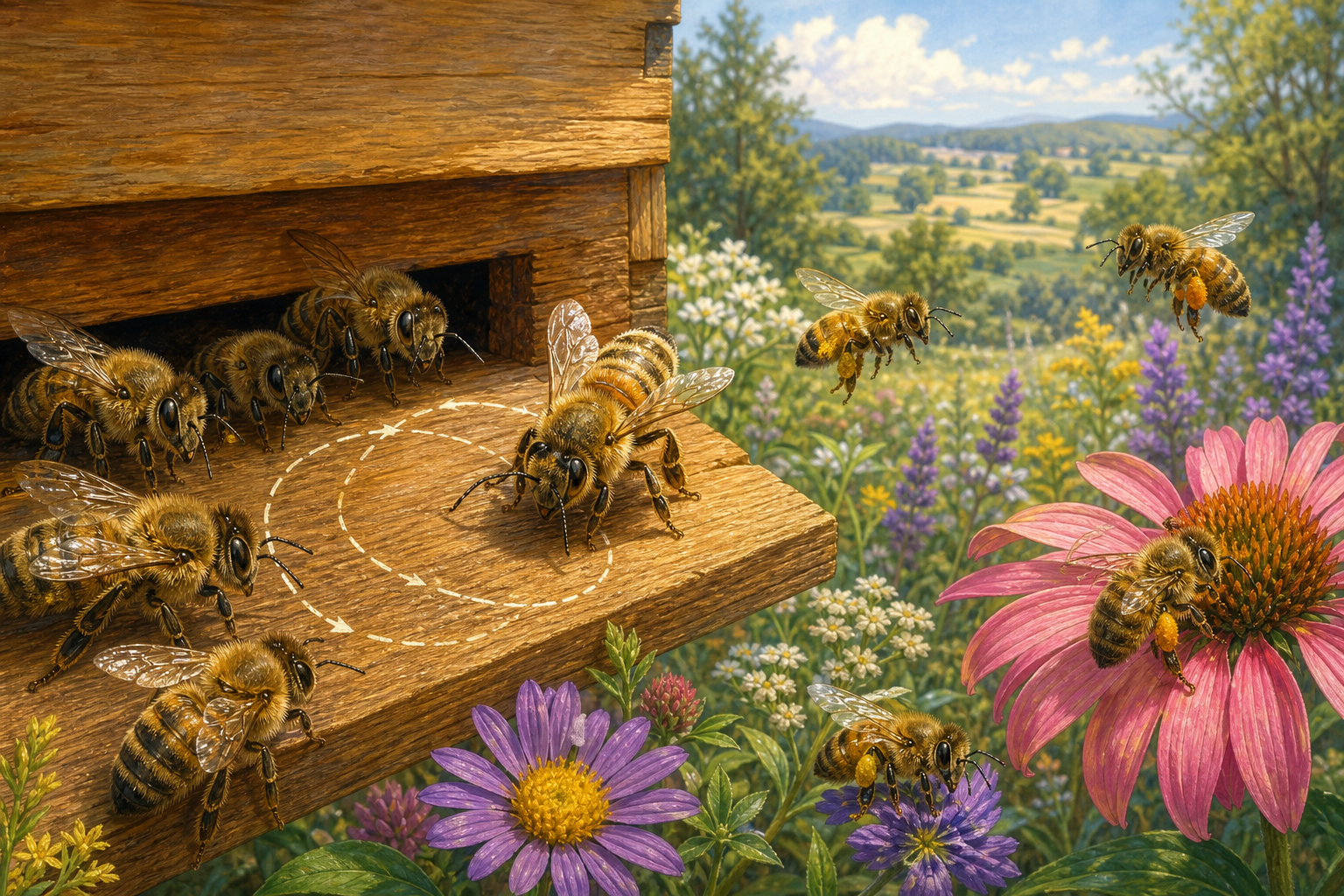
How does one bee tell another where good flowers are? Honey bees have an extraordinary answer: movement. When a forager finds a useful patch of flowers, she can perform a waggle dance for other bees. Her special waggling shares information about the direction and distance of the flowers.
It is tempting to call this a dance map, because it turns a discovery outside the hive into a message inside it. The returning bee does not need a spoken sentence. Her moving body carries the news, and other bees can use that information before setting out. In a world that often celebrates loud announcements, the honey bee offers a different kind of cleverness: close attention, shared signals, and cooperation.
A bee colony is not a tiny factory. It is a living gathering of insects responding to weather, seasons, food, and one another. The waggle dance is one memorable glimpse of that shared life—and a reason to see a buzzing visitor not as a nuisance, but as a neighbour on an important journey.
Evidence: Natural History Museum, London: What is a honey bee? — Natural History Museum; USDA Agricultural Research Service: Honey Bees — Bee Research and Pollination
By moving among blooms, honey bees help many flowering plants
When honey bees travel from flower to flower, they carry pollen with them. This pollination helps many flowering plants make seeds and fruit. Honey bees pollinate many flowering plants and food crops, so their journeys can connect a garden or field with the foods and plants people enjoy later on.
That does not mean every flower depends on one kind of bee. Nature is full of different pollinators and different ways plants reproduce. Still, a honey bee’s ordinary search for nectar and pollen can have an effect far beyond her next meal. A visit to one bloom can become part of a much larger story of seeds, fruit, and future flowers.
If you have access to a garden, park, or window box, take a few quiet minutes to notice which flowers draw visitors. You do not need to identify every insect to appreciate the pattern. A welcoming patch of flowers can become a small viewing gallery for the relationships between plants and animals.
Evidence: USDA Agricultural Research Service: Honey Bees — Bee Research and Pollination; Natural History Museum, London: What is a honey bee? — Natural History Museum
A bee’s size and lifespan depend on her role and season
Honey bees are small: workers are roughly 12 millimetres long, while queens are roughly 18 to 20 millimetres long. Size can differ among worker bees, queens, drones, and subspecies, so these figures are helpful guides rather than a rule for every bee you might see.
Their lifespans differ, too. Summer workers commonly live about five to six weeks, while a queen can live for two to five years. Winter workers can live longer than summer workers. These differences make sense within colony life: individual bees do not all have the same role, timetable, or seasonal conditions.
Small does not mean simple. A worker bee’s life may be brief compared with ours, but it includes learning routes, finding food, responding to her colony, and helping with work that supports many other bees. Looking at a bee resting on a flower, we can remember that she is not merely passing through our view. She has somewhere to go, and a colony waiting for her return.
Evidence: USDA Agricultural Research Service: Honey Bees — Bee Research and Pollination; Natural History Museum, London: What is a honey bee? — Natural History Museum
We still need to learn more about wild western honey bee populations
The western honey bee is listed as Data Deficient in the 2014 European Red List of Bees assessment. “Data Deficient” does not mean that scientists have decided the species is safe or in danger. It means there is too little information about wild populations to judge its extinction risk properly. In particular, the number and stability of truly wild, unmanaged colonies are not well known.
This is an invitation to learn, not a reason to lose hope. The species faces concerns including habitat loss, pesticides, disease, and parasites, while scientists continue to build a clearer picture of wild honey bee populations. Careful research matters because managed colonies and genuinely wild colonies are not the same thing, and good protection begins with understanding what is happening.
Young nature-watchers can help create a kinder local world without needing to solve everything at once. Protect flowering plants where you can, leave insects space to feed, and share what you notice with a trusted adult, gardening group, or school. Curiosity is one of conservation’s most useful tools: it teaches us to see animals as fellow residents of a shared place.
Evidence: IUCN Red List of Threatened Species: Apis mellifera (Western Honey Bee) — European Red List of Bees assessment; USDA Agricultural Research Service: Honey Bees — Bee Research and Pollination; Natural History Museum, London: What is a honey bee? — Natural History Museum
A bee-kind choice can begin with seeing honey as the colony’s food
Honey is made by bees from flower nectar and stored in the hive as food for the colony. Remembering that can encourage a gentle question at snack time: what choices let us enjoy sweetness while leaving bees’ hard-won stores for them? Fruit, or plant-based sweet ingredients used in family cooking, can be kind options to explore together.
More broadly, meals built around vegetables, fruits, whole grains, pulses, nuts, and seeds can be part of a healthy, varied diet. The World Health Organization gives general guidance on these foods, but every child and family is different. If your family is considering a major food change, talk it through with a trusted adult and a qualified health professional.
Choosing more plant-based foods can also be a hopeful way to care about the wider world. The IPCC reports that shifts toward sustainable, healthy, more plant-based diets can reduce food-system emissions and pressure on land and biodiversity. No one needs to be perfect. A curious new meal, a bee-friendly plant, and a little more empathy can all be meaningful steps.
Evidence: Natural History Museum, London: What is a honey bee? — Natural History Museum; World Health Organization: Healthy diet; Intergovernmental Panel on Climate Change: Climate Change 2022: Mitigation of Climate Change — Chapter 7
Questions people ask
Why do honey bees dance?
A forager bee can use a waggle dance to tell other bees the direction and distance of a good flower patch. It is a remarkable way for colony members to share information through movement.
Evidence: Natural History Museum, London: What is a honey bee? — Natural History Museum
Do all honey bees live for the same length of time?
No. Summer workers commonly live around five to six weeks, while queens can live two to five years. Winter workers may live longer than summer workers, so season and role both matter.
Evidence: USDA Agricultural Research Service: Honey Bees — Bee Research and Pollination; Natural History Museum, London: What is a honey bee? — Natural History Museum
What does “Data Deficient” mean for western honey bees?
It means there is not enough information about wild populations to assess extinction risk properly. It is not a prediction; it is a sign that more careful research is needed.
Read the evidence
Sources behind this story
- Apis mellifera (Western Honey Bee) — European Red List of Bees assessment — IUCN Red List of Threatened Species
- Honey Bees — Bee Research and Pollination — USDA Agricultural Research Service
- What is a honey bee? — Natural History Museum — Natural History Museum, London
- Healthy diet — World Health Organization
- Climate Change 2022: Mitigation of Climate Change — Chapter 7 — Intergovernmental Panel on Climate Change
Health information is general education, not personal medical advice. Young readers should make food choices with a trusted adult and qualified health professional.