Today's animal friend · 5 October 2026
The Wandering Albatross and the Three-Metre Wing Hug
Far out over cold, rolling waves, one remarkable bird turns wind into a road. Let’s follow its flight—and discover how our choices can help keep that road safe.

Far out over cold, rolling waves, one remarkable bird turns wind into a road. Let’s follow its flight—and discover how our choices can help keep that road safe.
A white shape skims the wave tops
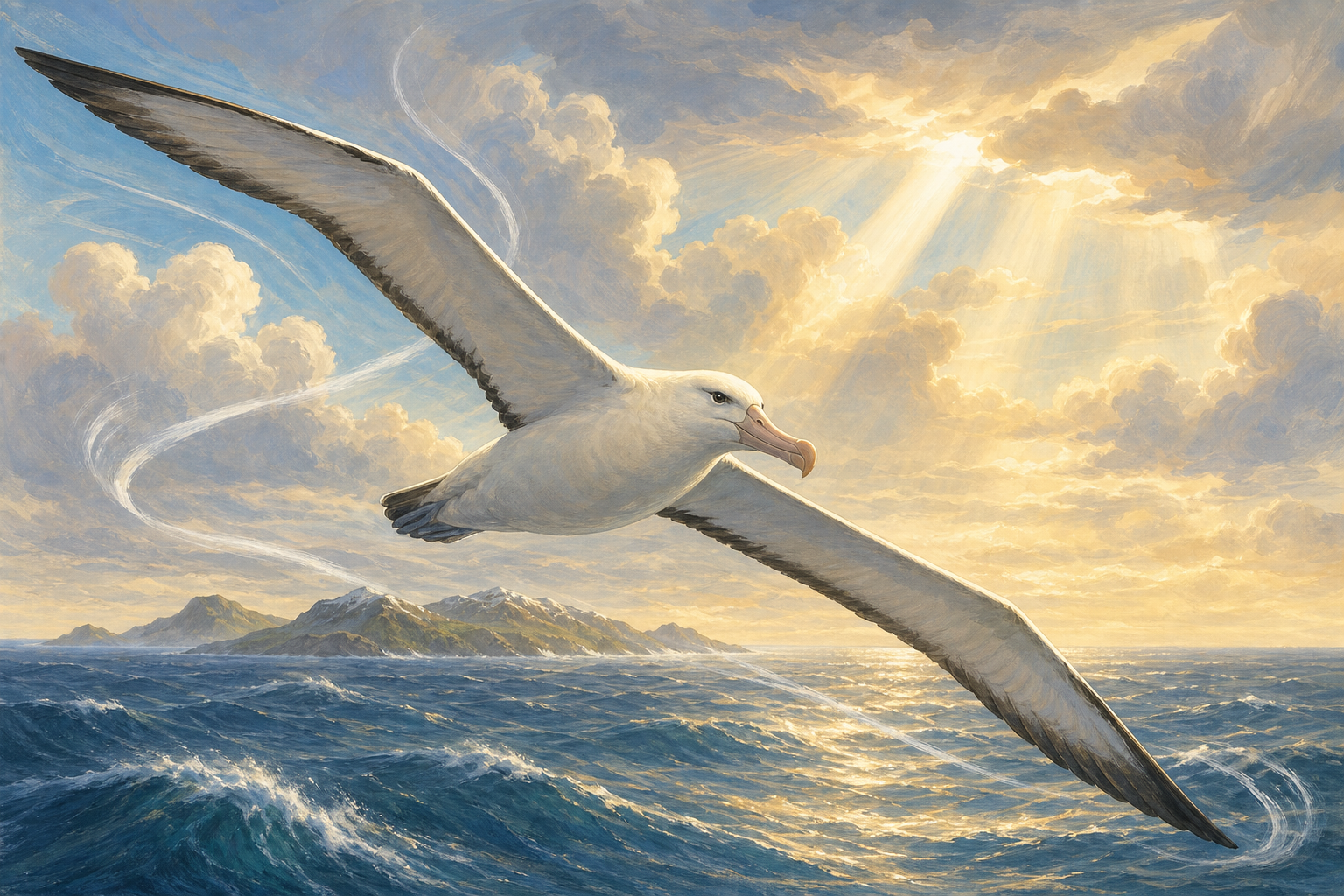
Imagine standing on a windy beach in a coat zipped to your chin. Now imagine a bird sailing past with wings stretched about three metres from tip to tip—wider than a small car is long. That bird is the wandering albatross, also called the snowy albatross or white-winged albatross. Its scientific name is Diomedea exulans, but “wandering” suits it beautifully.
This is not a bird that merely pops out for a quick flap around the pond. It belongs to the open Southern Ocean, the huge, chilly belt of water around Antarctica. There, waves can roll and winds can hurry along without many buildings, trees, or hills getting in their way. For an albatross, that gusty world is less like bad weather and more like a moving walkway in the sky.
A wandering albatross is a large seabird, about 1.1 to 1.35 metres long. Yet its most jaw-dropping feature is the wingspan: the largest of any bird alive today. Seeing one glide must feel a little like spotting a white sail that has decided to become a bird.
Evidence: BirdLife International (IUCN Red List Authority for birds): Diomedea exulans (Wandering Albatross) — Species Factsheet; Animal Diversity Web, University of Michigan Museum of Zoology: Diomedea exulans (wandering albatross); Wikipedia: Snowy albatross (Wandering albatross)
How does it fly so far without flapping itself silly?
Here is the albatross’s great trick: it is an expert glider. Instead of beating its wings again and again like a frantic pigeon chasing a chip, it uses the wind above the ocean. By tilting, turning, and sweeping through different layers of moving air, it can soar for hours with very little flapping.
This way of travelling helps wandering albatrosses cross vast stretches of ocean. They may travel across whole oceans between visits to land. Their long, narrow wings are built for this kind of journey, helping them turn wind into forward motion. The sea beneath is never exactly still, and the wind is always offering a new invisible ramp.
Why wander so widely? Food is spread across a gigantic watery world. An albatross may search over open water during both day and night, following the chances of finding a meal. It can also settle on the sea to rest or feed, bobbing among the waves before taking off again when the wind helps. A runway? Not necessary. Just bring weather.
Evidence: Animal Diversity Web, University of Michigan Museum of Zoology: Diomedea exulans (wandering albatross); Wikipedia: Snowy albatross (Wandering albatross); BirdLife International (IUCN Red List Authority for birds): Diomedea exulans (Wandering Albatross) — Species Factsheet
What is on an ocean traveller’s menu?
Wandering albatrosses are carnivores. Their meals include squid, fish, other cephalopods, and crustaceans. “Cephalopod” may sound like a robot’s name, but it is a group that includes animals such as squid. A crustacean is an animal with a hard outer covering, like a tiny ocean relative of a crab.
Out on the water, the bird picks up food near the surface. It is a wide-ranging predator and scavenger in the Southern Ocean food web, linking the open sea to the faraway islands where it breeds. That is a big job for one bird with a very big commute.
It is tempting to picture the ocean as empty blue space. But to an albatross it is a busy neighbourhood of currents, waves, prey, and weather. Each long glide is part travel, part treasure hunt. Where might the next squid be? The albatross is already on the case.
Evidence: Wikipedia: Snowy albatross (Wandering albatross); Animal Diversity Web, University of Michigan Museum of Zoology: Diomedea exulans (wandering albatross)
Land is for the most important family work
For much of its life, a wandering albatross is out at sea. But it returns to sub-Antarctic islands to breed. These lonely islands are places where breeding birds gather in colonies, while the broad ocean is their feeding ground.
Wandering albatrosses form long-term breeding pairs. Raising a chick takes a great deal of time and care, and a pair typically raises one chick every two years. One chick may not sound like much, but think of all the long flights needed to find food in the open ocean and bring care back to the nest. Growing up as an albatross is no speedy two-minute noodle situation.
These birds can live for a very long time—sometimes more than 60 years. That means a single bird may experience decades of windy journeys and many nesting seasons. It also means every adult is precious. When a species raises chicks slowly, losing adults can be especially difficult for the population to replace.
Evidence: Animal Diversity Web, University of Michigan Museum of Zoology: Diomedea exulans (wandering albatross); Wikipedia: Snowy albatross (Wandering albatross); BirdLife International (IUCN Red List Authority for birds): Diomedea exulans (Wandering Albatross) — Species Factsheet
A brilliant traveller needs safer seas
The wandering albatross is listed as Vulnerable on the IUCN Red List, and its population trend is decreasing. One major danger is longline fishing: birds may try to take bait from fishing lines and become caught on hooks. Plastic pollution is another pressure in the ocean they depend on.
This is serious, but it is not a story without hope. Seabird-safe fishing practices can help reduce the chance of albatrosses being caught on longlines. Protecting their sub-Antarctic breeding islands matters too. Clever human choices can make a real difference when they are designed with wildlife in mind.
You do not have to sail the Southern Ocean to be part of the caring team. You can notice litter and help keep it out of waterways, talk about ocean animals with your family, and support grown-ups who choose wildlife-friendly actions. Small acts are not magic feathers—but many small acts can travel surprisingly far.
Evidence: BirdLife International (IUCN Red List Authority for birds): Diomedea exulans (Wandering Albatross) — Species Factsheet; Wikipedia: Snowy albatross (Wandering albatross)
Keep wondering with the wind
The wandering albatross reminds us that an animal can be both enormous and graceful, both tough enough for ocean storms and dependent on safe places to feed and nest. Its story begins with a wing wider than a car, but it leads to an even bigger idea: the world’s farthest wild places are connected to everyday choices.
Next time wind tugs at your hood, pause for a second. Somewhere over the Southern Ocean, an albatross may be leaning into a gust and gliding onward—no engine, no map in its feathers that we can see, just a life shaped by sea and sky. What other invisible journeys are happening above the waves?
Evidence: Animal Diversity Web, University of Michigan Museum of Zoology: Diomedea exulans (wandering albatross); Wikipedia: Snowy albatross (Wandering albatross); BirdLife International (IUCN Red List Authority for birds): Diomedea exulans (Wandering Albatross) — Species Factsheet
A kind plate can be part of an ocean-sized thank-you
The albatross’s meals are wild ocean animals, and its home is an ocean web where every creature is part of somebody else’s story. We can meet that thought with kindness instead of taking the sea for granted. Choosing more plant-based meals—perhaps beans in a burrito, lentils in a soup, or chickpeas in a crunchy snack—can be one positive way families care about animals and the planet.
The World Health Organization describes healthy diets as varied and rich in foods such as whole grains, vegetables, fruit, pulses, nuts, and seeds. The IPCC reports that shifts toward sustainable, healthy, more plant-based diets can reduce food-system emissions and pressure on land and biodiversity. Food is personal, so children should talk with a trusted adult and qualified health professional about what is right for them. No guilt, no perfect-score chart: just room for curious, compassionate choices.
Evidence: World Health Organization: Healthy diet; Intergovernmental Panel on Climate Change: Climate Change 2022: Mitigation of Climate Change — Chapter 7
Questions people ask
Is a wandering albatross really the biggest bird?
Not in every way. It is famous for having the largest wingspan of any living bird. Its body length is about 1.1 to 1.35 metres, while its wings can stretch about three metres across.
Evidence: Animal Diversity Web, University of Michigan Museum of Zoology: Diomedea exulans (wandering albatross); Wikipedia: Snowy albatross (Wandering albatross)
Does it live in Antarctica?
It ranges over the Southern Ocean around Antarctica and breeds on sub-Antarctic islands. Much of its time is spent far out over open water rather than on land.
Evidence: BirdLife International (IUCN Red List Authority for birds): Diomedea exulans (Wandering Albatross) — Species Factsheet; Wikipedia: Snowy albatross (Wandering albatross)
Why can’t it just flap away from danger?
Its flying skill cannot protect it from every human-made hazard. When an albatross tries to grab bait from a long fishing line, it can become caught on a hook. That is why safer fishing practices are so important.
Evidence: BirdLife International (IUCN Red List Authority for birds): Diomedea exulans (Wandering Albatross) — Species Factsheet; Wikipedia: Snowy albatross (Wandering albatross)
What can I do for an ocean bird that lives far away?
Care starts with noticing connections. Help keep plastic litter out of nature, learn about wildlife-friendly fishing, and share the albatross’s story. Kind choices can help people remember that the ocean is home to extraordinary animals.
Evidence: BirdLife International (IUCN Red List Authority for birds): Diomedea exulans (Wandering Albatross) — Species Factsheet; Wikipedia: Snowy albatross (Wandering albatross)
Read the evidence
Sources behind this story
- Diomedea exulans (Wandering Albatross) — Species Factsheet — BirdLife International (IUCN Red List Authority for birds)
- Diomedea exulans (wandering albatross) — Animal Diversity Web, University of Michigan Museum of Zoology
- Snowy albatross (Wandering albatross) — Wikipedia
- Healthy diet — World Health Organization
- Climate Change 2022: Mitigation of Climate Change — Chapter 7 — Intergovernmental Panel on Climate Change
Health information is general education, not personal medical advice. Young readers should make food choices with a trusted adult and qualified health professional.