Today's animal friend · 30 August 2026
Tokay Gecko: The Night Caller in Polka Dots
In warm forests and moonlit buildings across Asia, a blue-grey gecko with fiery spots climbs, calls, hunts, and reminds us that every wild neighbour deserves a safe home.
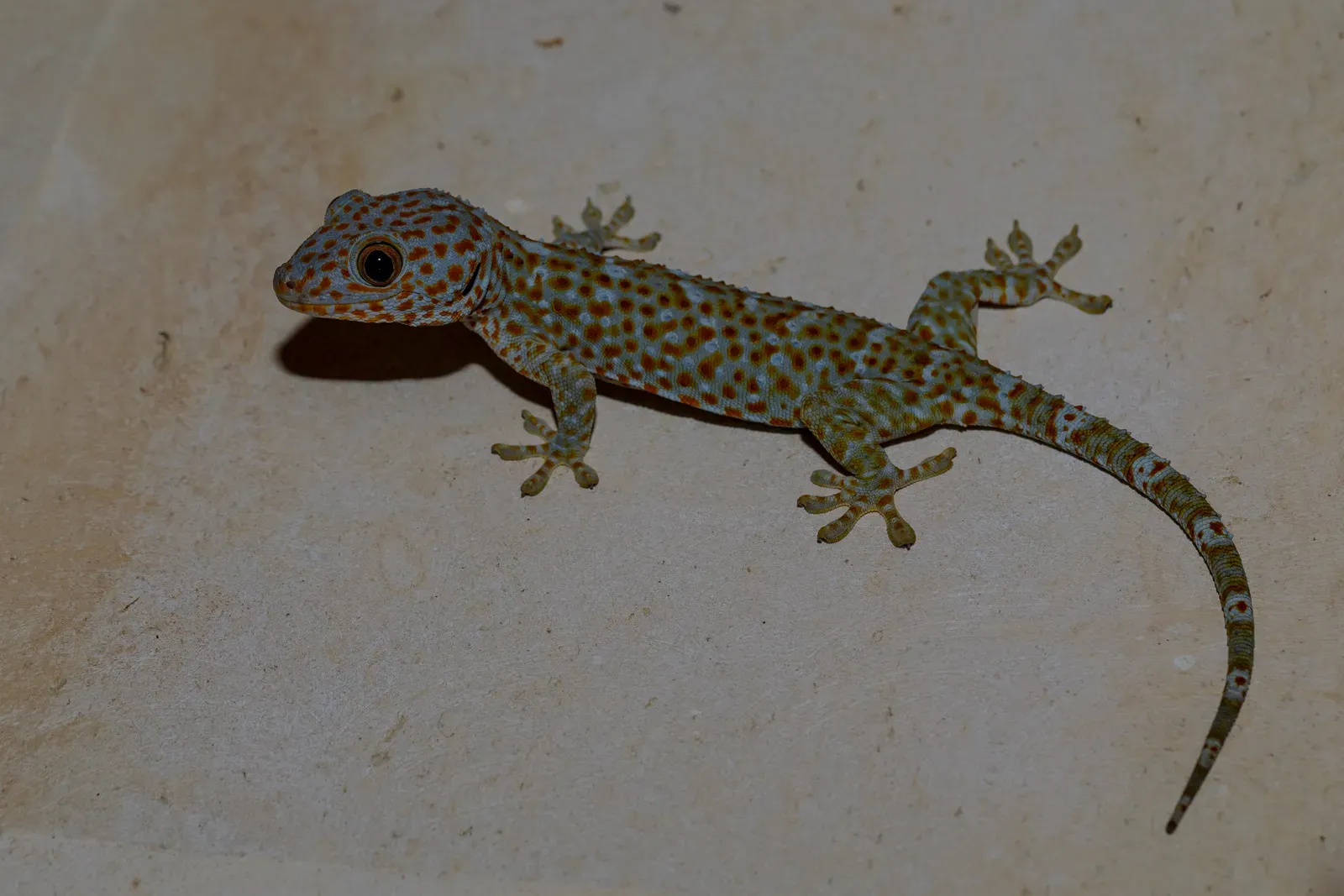
In warm forests and moonlit buildings across Asia, a blue-grey gecko with fiery spots climbs, calls, hunts, and reminds us that every wild neighbour deserves a safe home.
“To-kay! To-kay!” Who is calling in the dark?
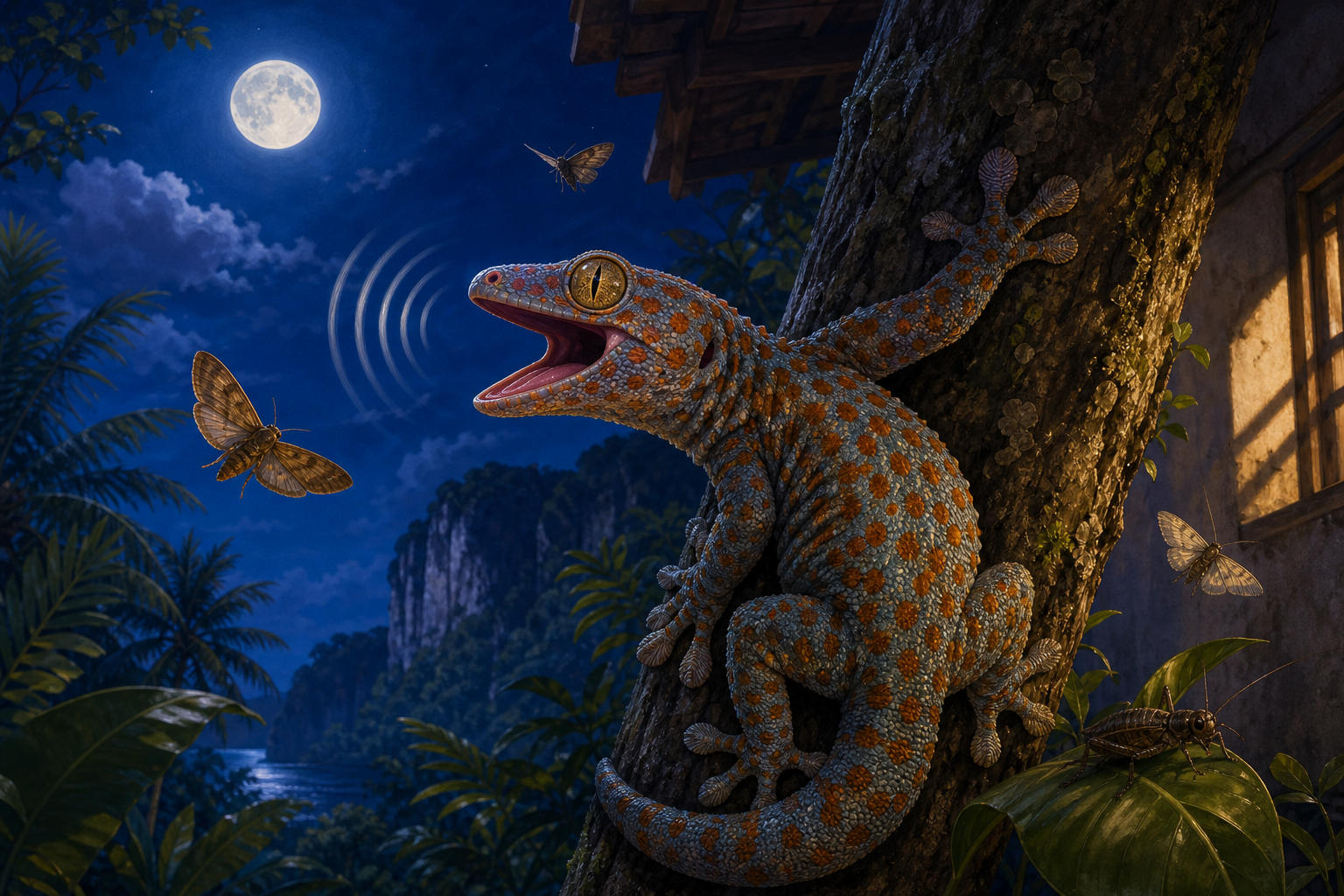
Imagine a warm night in Asia. Leaves rustle overhead, shadows pool along a wall, and then a loud call rings out: “to-kay! to-kay!” It is so clear that it can sound as though the darkness has found a tiny megaphone.
The caller is the tokay gecko, Gekko gecko. This lizard is named after its famous call. Males make the bold sound as part of breeding and territorial life, so a gecko hidden high on a trunk or ledge can still make itself known.
Tokays are geckos, a family of lizards built for climbing. They are nocturnal, which means night is their busy time. While people are settling down indoors, a tokay may be starting its careful patrol of bark, rock, or wall. The night is never as empty as it first seems.
Evidence: IUCN Red List of Threatened Species: Gekko gecko (Tokay Gecko) — Red List status; Animal Diversity Web, University of Michigan Museum of Zoology: Gekko gecko (Tokay Gecko); Wikipedia, the free encyclopedia: Tokay gecko
A gecko dressed for a moonlit party
A tokay gecko is hard to mistake for an ordinary brown lizard. Its blue-grey skin is scattered with orange to red spots, like glowing planets on a stormy sky. Its skin has a soft, granular texture—less like a shiny plastic toy and more like very fine velvet-covered sand.
It is among the world’s larger geckos. Adults are commonly around 25 to 30 centimetres long, and especially large individuals can reach about 40 centimetres. That is about the length of a school ruler, sometimes with a little extra tail-to-toe stretch.
A tokay can gradually lighten or darken its colour, helping it blend with a tree trunk, cliff, or shadowy wall. This is no instant costume swap. Think of it as slowly turning the brightness down on a screen.
Adhesive toe pads help this gecko travel up trees, cliffs, and walls. Around buildings within its range, a wall is not just a wall: for a tokay, it is a vertical adventure path full of cracks, ledges, hiding places, and possibly supper.
Evidence: Animal Diversity Web, University of Michigan Museum of Zoology: Gekko gecko (Tokay Gecko); Wikipedia, the free encyclopedia: Tokay gecko
A forest climber with a town-side address
Tokay geckos occur across a broad part of South and Southeast Asia. Their world includes tropical rainforest, trees, and cliffs. They can also live around human buildings, where walls and sheltered spaces may offer places to climb and hide.
Picture their forest route at night. Branches overlap like ladders. Bark becomes a bumpy road. Rock faces hold dark little nooks. Tokays are arboreal climbers, meaning they spend much of their time above the ground, moving through a world that looks very different from ours.
Seeing a gecko near a home can feel like receiving a surprise visit from the wild. But a wild tokay is not a petting opportunity. The kindest hello is a quiet look from a respectful distance, without grabbing, chasing, or trying to take it home.
Tokays do not form lasting social packs. Their calls matter in territorial and breeding life, but a calling gecko is not conducting a matching-uniform gecko choir. It is an individual animal doing the important business of being a gecko.
Evidence: Animal Diversity Web, University of Michigan Museum of Zoology: Gekko gecko (Tokay Gecko); Wikipedia, the free encyclopedia: Tokay gecko
What is on the midnight menu?
When darkness arrives, a tokay gecko hunts. It eats insects and other small invertebrates, including crickets, grasshoppers, cockroaches, and moths. Now and then, it may also catch a small lizard.
A fluttering moth near a wall or a cricket creeping through leaves can become part of the night’s chase. For a hungry tokay, a buzzing insect can be rather like room service—except the gecko still has to do the climbing, spotting, and catching.
This hunting links tokays to the lively food webs of forests and places at the edges of human homes. Yet a tokay is not valuable only because it catches insects. It matters because it is a living part of its own habitat: a bright-spotted climber, a night caller, and one thread in a much bigger web of life.
Its after-dark routine is a lovely reminder to look closer. A wall that seems still to us may be a busy landscape of tiny feet, fluttering wings, watchful eyes, and patient hunters.
Evidence: Animal Diversity Web, University of Michigan Museum of Zoology: Gekko gecko (Tokay Gecko); Wikipedia, the free encyclopedia: Tokay gecko
Least Concern does not mean “no concern”
The tokay gecko is listed as Least Concern on the IUCN Red List, which is encouraging: it remains widespread. But that label is not a magic shield. Some accounts describe a decreasing population trend, and tokays face pressure from habitat loss and heavy collection for the pet trade and traditional medicine.
A gecko on a forest tree or a night-time wall has its own places to explore, food to find, and calls to make. When wild animals are removed in large numbers, local populations can be harmed even when the species is still found across a wide region.
There is a hopeful protection tool. Tokay geckos are included in CITES Appendix II, so international trade is monitored to help prevent it from threatening the species’ survival. Rules may sound less thrilling than a moonlit gecko chase, but they can give wildlife important breathing room.
We can help by enjoying wildlife where it belongs and never encouraging the capture of wild geckos. Questions matter too: where did an animal come from, and was it taken from the wild? Caring can begin with a simple, respectful choice to let a beautiful creature stay wild.
Evidence: IUCN Red List of Threatened Species: Gekko gecko (Tokay Gecko) — Red List status; Animal Diversity Web, University of Michigan Museum of Zoology: Gekko gecko (Tokay Gecko); Wikipedia, the free encyclopedia: Tokay gecko
Listen closely: a wild world is speaking
The next time you hear a strange sound at dusk, pause and wonder who is sharing the evening with you. It may not be a tokay—tokays live in Asia—but perhaps it is a frog, bat, bird, or insect. Every call can be a clue.
Tokay geckos show that remarkable animals do not need to be enormous. A gecko can climb a tall wall on adhesive toes, wear fiery spots in deep shadow, and announce itself with a call that sounds like its own name.
They are worth protecting not merely for their spectacular colour or their insect-hunting skill. They are worth protecting because they are tokays: lively, ancient-looking, loud-voiced members of the night world. “To-kay! To-kay!” is a small wild voice saying, in its own gecko way, that it is here.
Evidence: Animal Diversity Web, University of Michigan Museum of Zoology: Gekko gecko (Tokay Gecko); Wikipedia, the free encyclopedia: Tokay gecko
A kind choice can ripple from your plate to a gecko’s treetop
Tokay geckos are insect hunters, not salad eaters. People, though, can choose from many foods. The World Health Organization describes healthy eating patterns that include a variety of vegetables, fruits, whole grains, pulses, nuts, and seeds. With a trusted adult, exploring more plant-based meals can be a tasty experiment rather than a rulebook contest.
The IPCC reports that shifts toward sustainable, healthy, more plant-based diets can lower food-system emissions and reduce pressure on land and biodiversity. That can matter to wild homes everywhere, from a tokay’s rainforest tree to places we may never see.
Nobody has to be perfect. Perhaps try a bean taco, lentil soup, or a fruit-and-nut snack with your family. Curiosity, care, and small kind choices can all belong at the same table.
Evidence: World Health Organization: Healthy diet; Intergovernmental Panel on Climate Change: Climate Change 2022: Mitigation of Climate Change — Chapter 7
Questions people ask
Why is it called a tokay gecko?
Its name copies the loud, distinctive “to-kay! to-kay!” call made by males as part of breeding and territorial life.
Evidence: Animal Diversity Web, University of Michigan Museum of Zoology: Gekko gecko (Tokay Gecko); Wikipedia, the free encyclopedia: Tokay gecko
How big can a tokay gecko get?
Adults are commonly about 25 to 30 centimetres long, while especially large individuals can reach about 40 centimetres.
Evidence: Animal Diversity Web, University of Michigan Museum of Zoology: Gekko gecko (Tokay Gecko); Wikipedia, the free encyclopedia: Tokay gecko
Do tokay geckos live only in forests?
No. They use tropical rainforest, trees, and cliffs, and can also live around human buildings within their Asian range.
Evidence: Animal Diversity Web, University of Michigan Museum of Zoology: Gekko gecko (Tokay Gecko); Wikipedia, the free encyclopedia: Tokay gecko
Should a wild tokay gecko be taken home as a pet?
No. It is kinder to leave wild geckos undisturbed. Collection for trade pressures tokays, and trade monitoring aims to reduce risks to wild populations.
Evidence: IUCN Red List of Threatened Species: Gekko gecko (Tokay Gecko) — Red List status; Animal Diversity Web, University of Michigan Museum of Zoology: Gekko gecko (Tokay Gecko); Wikipedia, the free encyclopedia: Tokay gecko
Read the evidence
Sources behind this story
- Gekko gecko (Tokay Gecko) — Red List status — IUCN Red List of Threatened Species
- Gekko gecko (Tokay Gecko) — Animal Diversity Web, University of Michigan Museum of Zoology
- Tokay gecko — Wikipedia, the free encyclopedia
- Healthy diet — World Health Organization
- Climate Change 2022: Mitigation of Climate Change — Chapter 7 — Intergovernmental Panel on Climate Change
Health information is general education, not personal medical advice. Young readers should make food choices with a trusted adult and qualified health professional.