Today's animal friend · 4 October 2026
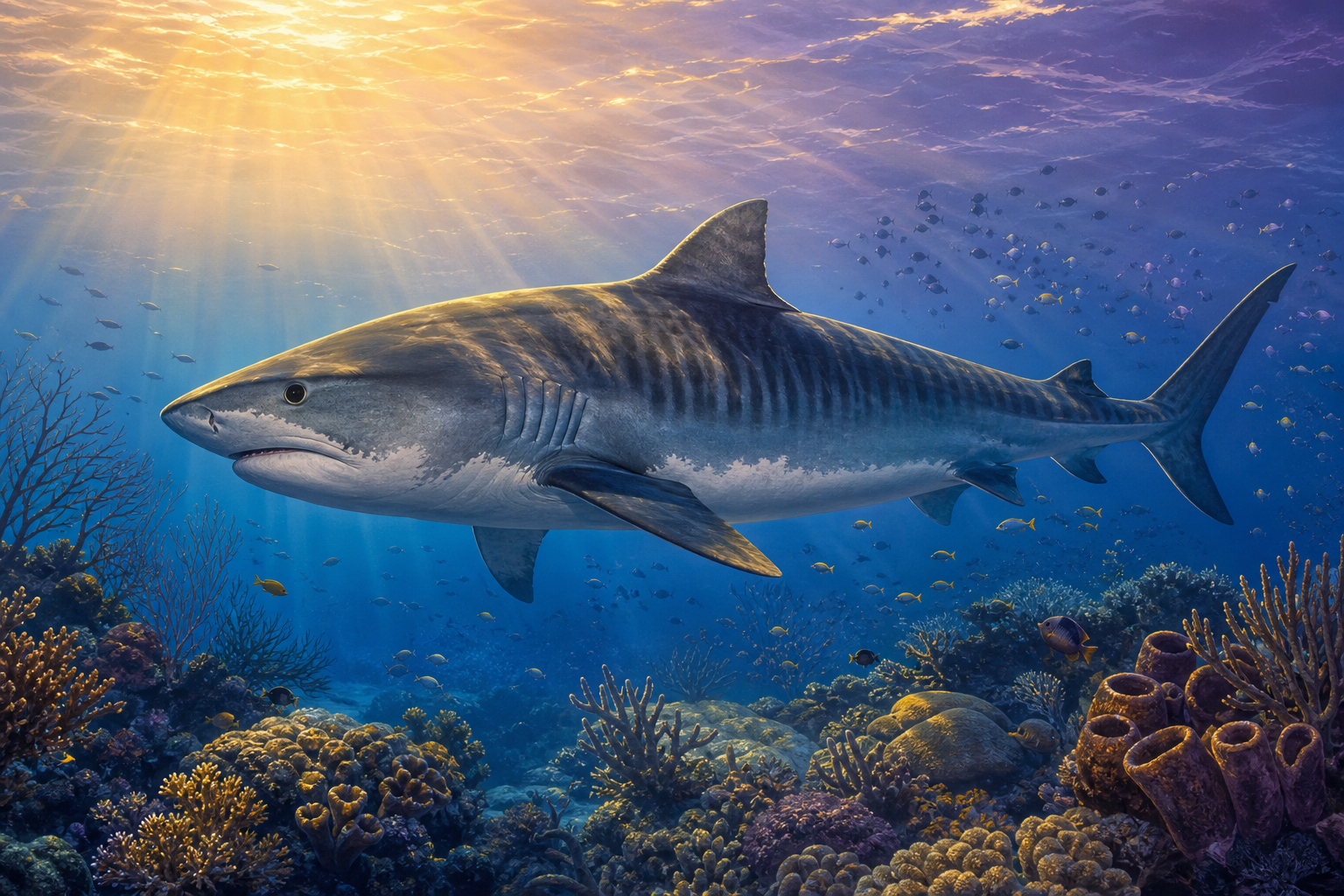
Tiger Shark: The Striped Shadow on the Night Shift
As daylight fades over a coral reef, a tiger shark glides through the blue—part explorer, part night-shift neighbour, and entirely worth protecting.

As daylight fades over a coral reef, a tiger shark glides through the blue—part explorer, part night-shift neighbour, and entirely worth protecting.
A stripe slips past the reef
Picture the sea at twilight. The sun is sinking, the water turns dusky blue, and reef fish tuck themselves into their hiding places. Then a large shape glides by with slow, confident swishes of its tail. Along its side are dark marks, like the faded brushstrokes of a tiger’s coat. This is a tiger shark: Galeocerdo cuvier, sometimes called a sea tiger.
Its stripes are not just a fancy costume. Young tiger sharks have the clearest dark stripes and spots on their sides, and the markings gradually fade as they grow. It is a wonderful reminder that an animal can change its look while still being completely itself—rather like outgrowing a favourite striped jumper, except this jumper is built in.
Tiger sharks live in warm waters of the Pacific, Atlantic, and Indian Oceans. They may travel around coral reefs, coastal waters, and the open ocean. They do not need an invitation, a suitcase, or even a map—just a wide blue world and a powerful tail.
Evidence: IUCN Red List of Threatened Species: Galeocerdo cuvier (Tiger Shark) — Red List Assessment; Animal Diversity Web, University of Michigan Museum of Zoology: Galeocerdo cuvier (tiger shark); Wikipedia: Tiger shark
How big is “whoa, that is big”?
Tiger sharks are among the ocean’s largest sharks. Many are about 3.5 to 5 metres long. A very large female can grow beyond 5 metres—longer than a small car and a half parked nose to tail. Large individuals can weigh hundreds of kilograms, too. That is a lot of shark cruising quietly through the sea.
Yet a tiger shark is not a noisy, splashy giant. It moves with a smooth, steady glide. Imagine a huge underwater kite, except this one has a tail, a mouth, and absolutely no interest in being flown at the park.
Females can be larger than males. Tiger sharks generally live for decades, so a grown shark has had plenty of time to explore changing currents, reefs, and coastlines. Seeing one would be like meeting a traveller with a very long ocean diary—if that traveller had no hands to hold a pen.
Evidence: IUCN Red List of Threatened Species: Galeocerdo cuvier (Tiger Shark) — Red List Assessment; Animal Diversity Web, University of Michigan Museum of Zoology: Galeocerdo cuvier (tiger shark); Wikipedia: Tiger shark
Why does it prefer the evening?
Tiger sharks are often active around twilight and at night. They may come nearer shore to feed when it is dark, then spend more time in deeper water during the day. The sea is never truly empty after sunset; it simply starts a different shift.
This makes sense when you imagine the underwater neighbourhood. Daytime creatures are winding down, night-time creatures are waking up, and the tiger shark is on the move. It usually lives a solitary life rather than travelling in a stable family group. One shark, one wide ocean, one excellent sense of where to go next.
A large wild predator deserves space and respect. Tiger sharks generally keep away from people and go about their own lives. The smartest way to admire any shark is from a safe, respectful distance, with local safety guidance in mind. Wild animals are not villains or pets; they are neighbours with different needs.
Evidence: Animal Diversity Web, University of Michigan Museum of Zoology: Galeocerdo cuvier (tiger shark); Wikipedia: Tiger shark
What is on a tiger shark’s dinner menu?
Tiger sharks are carnivores with a varied menu. Their food can include fish, squid, crustaceans, sea turtles, seabirds, and sea snakes. Instead of calling this shark an animal that “eats anything,” it is more accurate—and more interesting—to say it can make use of many kinds of marine prey.
That broad appetite matters in the busy ocean community. As a large predator and scavenger, a tiger shark can influence the animals around it where tiger sharks are common. Nature is full of connections: a swimmer’s path, a fish’s hiding place, and a reef’s food web can all be part of one giant watery story.
Some fish called remoras may even travel alongside large sharks. They are not tiny tiger-shark friends in the way children have friends, but their association is another clue that a shark can be a moving part of a whole little ecosystem. The ocean has more partnerships than a group project—though hopefully with less arguing about whose turn it is.
Evidence: Animal Diversity Web, University of Michigan Museum of Zoology: Galeocerdo cuvier (tiger shark); Wikipedia: Tiger shark
A magnificent shark needs help
The tiger shark is listed as Near Threatened on the IUCN Red List, and its population trend is decreasing. That means this powerful swimmer needs careful attention before its situation becomes more serious.
Fishing is a major pressure. Tiger sharks can be caught deliberately, trapped accidentally in nets, or harmed by demand connected to the shark-fin trade. Because they range through coastal and offshore waters, helping them is not a one-beach job. It takes thoughtful fishing practices, less accidental catch, and care for the coastal habitats they use.
Hope is not pretending a problem is tiny. Hope is noticing what can be done. People can support shark-friendly conservation, learn about local ocean protections, and remember that a living shark has a place in the sea that no fin, photo, or souvenir could ever replace. Protecting a tiger shark means protecting a piece of the ocean’s night shift.
Evidence: IUCN Red List of Threatened Species: Galeocerdo cuvier (Tiger Shark) — Red List Assessment; Animal Diversity Web, University of Michigan Museum of Zoology: Galeocerdo cuvier (tiger shark); Wikipedia: Tiger shark
A kind choice can ripple outward
Caring about a tiger shark can begin far from the shore. It can mean being curious about where food comes from, wasting less, and choosing meals that show kindness to animals and the living planet. A colourful plate built around vegetables, fruit, whole grains, pulses such as beans and lentils, nuts, and seeds can be a delicious place to start. If you are thinking about changing what you eat, chat with a trusted adult and a qualified health professional so your meals suit you.
Plant-forward choices can also be a quiet ocean-friendly habit. Global health guidance describes healthy diets as varied and rich in plant foods, while climate scientists report that shifts toward sustainable, healthy, more plant-based diets can reduce food-system emissions and pressure on land and biodiversity. No one meal has to carry the whole world on its plate. But kind choices, repeated often, can travel outward like ripples.
Perhaps that is the tiger shark’s invitation: look closely, respect wild lives, and choose compassion where you can. Somewhere in warm water at dusk, a striped shadow is still gliding forward.
Evidence: World Health Organization: Healthy diet; Intergovernmental Panel on Climate Change: Climate Change 2022: Mitigation of Climate Change — Chapter 7
Small kindnesses for a big blue world
A tiger shark is not a monster from a scary story. It is an individual wild animal, travelling through an ocean home shared with turtles, fish, birds, and people. Choosing empathy means giving sea creatures room to be themselves and caring about the pressures they face.
At home, a family can explore more plant-based meals—perhaps bean tacos, lentil soup, vegetable pasta, or a fruit-and-nut snack—without making food feel like a test. The World Health Organization includes whole grains, vegetables, fruit, pulses, nuts, and seeds in its guidance for healthy diets. The IPCC also finds that sustainable, healthy, more plant-based dietary shifts can ease climate pollution and pressure on nature. Every compassionate choice is a small vote for a lively, thriving ocean.
Evidence: World Health Organization: Healthy diet; Intergovernmental Panel on Climate Change: Climate Change 2022: Mitigation of Climate Change — Chapter 7
Questions people ask
Are tiger sharks really striped?
Yes. Young tiger sharks have dark stripes and spots along their sides, which inspired their name. The markings usually become less clear as the sharks grow older.
Evidence: Wikipedia: Tiger shark; Animal Diversity Web, University of Michigan Museum of Zoology: Galeocerdo cuvier (tiger shark)
Where might a tiger shark swim?
In suitable warm waters, tiger sharks occur across the Pacific, Atlantic, and Indian Oceans. They use coral reefs, coastal waters, and the open ocean.
Evidence: IUCN Red List of Threatened Species: Galeocerdo cuvier (Tiger Shark) — Red List Assessment; Animal Diversity Web, University of Michigan Museum of Zoology: Galeocerdo cuvier (tiger shark); Wikipedia: Tiger shark
What can people do for tiger sharks?
Support efforts that reduce targeted shark fishing and accidental capture, protect coastal habitats, and treat sharks as living wild animals rather than products.
Evidence: IUCN Red List of Threatened Species: Galeocerdo cuvier (Tiger Shark) — Red List Assessment; Animal Diversity Web, University of Michigan Museum of Zoology: Galeocerdo cuvier (tiger shark); Wikipedia: Tiger shark
Read the evidence
Sources behind this story
- Galeocerdo cuvier (Tiger Shark) — Red List Assessment — IUCN Red List of Threatened Species
- Galeocerdo cuvier (tiger shark) — Animal Diversity Web, University of Michigan Museum of Zoology
- Tiger shark — Wikipedia
- Healthy diet — World Health Organization
- Climate Change 2022: Mitigation of Climate Change — Chapter 7 — Intergovernmental Panel on Climate Change
Health information is general education, not personal medical advice. Young readers should make food choices with a trusted adult and qualified health professional.