Today's animal friend · 7 October 2026
Tasmanian Devil: The Night-Time Cleaner with a Thunderous Voice
It may sound like a tiny dragon at dinner, but the Tasmanian devil is a shy island scavenger, a pouch-carrying parent, and an animal that needs our help.

It may sound like a tiny dragon at dinner, but the Tasmanian devil is a shy island scavenger, a pouch-carrying parent, and an animal that needs our help.
Listen—was that a growl, a squeal, or a very cross kettle?
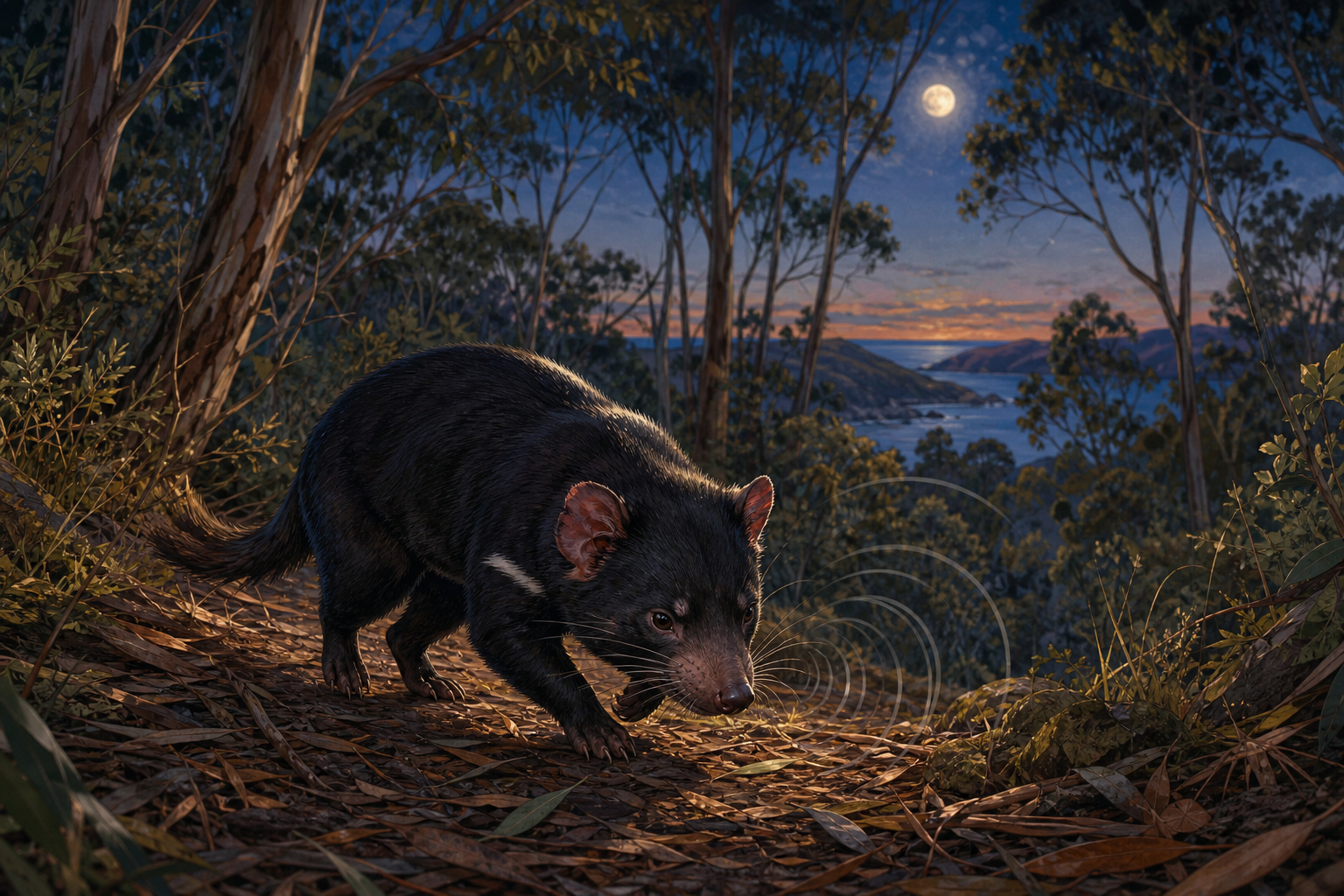
The forest is dimming in Tasmania, the island south of Australia. Leaves rustle. A small, sturdy animal pads out from its daytime shelter, nose low, sniffing the ground. Then comes a startling screech—the sort of sound that could make you check whether a grumpy goblin has moved into the bushes. It is a Tasmanian devil, also called a Tassie devil, beginning its night-time search for food.
Despite its dramatic name and noisy voice, a devil is not a monster. Sarcophilus harrisii is a carnivorous marsupial: a mammal with a pouch. It is the largest meat-eating marsupial alive today, yet it is only around the size of a small dog. Imagine a chunky little dog in a black coat, with an important clean-up job and a soundtrack turned all the way up.
Tasmanian devils live nowhere wild except Tasmania. Forests, woodlands, and coastal scrub are their outdoor neighbourhoods. During the day they shelter in dens; at twilight and through the night, they roam. So if you were looking for one at lunchtime, you would probably be staring at an empty patch of bush while the devil was sensibly tucked away.
Evidence: IUCN Red List of Threatened Species: Sarcophilus harrisii (Tasmanian Devil) — Red List Assessment; Animal Diversity Web, University of Michigan Museum of Zoology: Sarcophilus harrisii (Tasmanian devil); Wikipedia (English): Tasmanian devil
Small-dog size, giant-dinner attitude
An adult Tasmanian devil measures about 52 to 80 centimetres from end to end and can weigh about 4 to 12 kilograms. That is not enormous—but its jaws are mighty for its body size. They can crunch tough tissue and bone, helping the animal make use of remains that other creatures leave behind. Nothing fancy is required: the devil’s supper is often already waiting.
Devils are mainly scavengers. Carrion means an animal that has already died, and a scavenger is nature’s clean-up helper. Devils also eat living prey such as small mammals, birds, and insects. Wombats and wallabies can be among the animals whose remains they eat. By clearing carrion and consuming tough leftovers, devils play a useful part in Tasmania’s food webs.
Sometimes several devils arrive at the same meal. This is when their famous screeches and quarrels can burst out. The noise sounds fierce, but it is mostly a food-time display between animals competing over a shared find—not a sign that devils spend every minute picking fights. Usually, they forage alone. Think of a normally quiet neighbour who becomes very loud when the last slice of pizza appears.
Evidence: Animal Diversity Web, University of Michigan Museum of Zoology: Sarcophilus harrisii (Tasmanian devil); Wikipedia (English): Tasmanian devil
A pouch is a baby devil’s first little room
Here is a wonderful marsupial secret: a mother Tasmanian devil carries her babies, called joeys, in a pouch on her tummy while they grow. A newborn joey is astonishingly tiny, then develops safely with its mother’s milk and care. Later, young devils remain dependent before becoming independent explorers themselves.
A marsupial family is not quite like a human family, and a devil is not a dog, even if its size makes that comparison handy. Tasmanian devils belong to the family Dasyuridae and the order Dasyuromorphia. Their closest everyday lesson is simpler: animals have all kinds of clever ways to give babies a safe start.
Devils are generally solitary foragers, which means they usually look for food by themselves. But being solitary does not mean being unimportant or unfriendly. A devil mother’s pouch care, a youngster learning to manage on its own, and brief gatherings at a carcass are all parts of a life shaped by the Tasmanian bush. Each devil is an individual traveller with places to shelter, smells to investigate, and nights to explore.
Evidence: Animal Diversity Web, University of Michigan Museum of Zoology: Sarcophilus harrisii (Tasmanian devil); Wikipedia (English): Tasmanian devil
Why does a helpful cleaner need help?
Tasmanian devils are listed as Endangered on the IUCN Red List, and their population trend is decreasing. The biggest danger has been Devil Facial Tumour Disease, often shortened to DFTD. This disease has caused a major decline in devils. Vehicle collisions and habitat loss add more pressure to an animal that already has a tough challenge.
That can feel heavy, especially after meeting such a lively, loud little night-walker. But there is hope worth holding onto. Researchers monitor devils and study the disease. Conservation work has also supported disease-free insurance populations in managed places and on islands. An insurance population is a bit like keeping a carefully protected back-up team—living animals cared for so the species has a better chance if trouble continues in the wild.
Protecting a species is not only about saving a name on a list. It means protecting real animals: a mother with joeys in her pouch, a devil sniffing along a forest trail, and another crunching leftovers that would otherwise stay in the landscape. It also means caring for the forests, woodlands, and coastal scrub that make up their home.
Evidence: IUCN Red List of Threatened Species: Sarcophilus harrisii (Tasmanian Devil) — Red List Assessment; Animal Diversity Web, University of Michigan Museum of Zoology: Sarcophilus harrisii (Tasmanian devil); Wikipedia (English): Tasmanian devil
What can a faraway animal friend do?
You do not need to live in Tasmania to practise noticing animals as neighbours rather than props. When you learn about a devil, you can share its real story: it is a marsupial, a night-time scavenger, and an endangered wild animal—not simply a cartoon troublemaker with a shouty name. Ask a library for books about Tasmania’s wildlife, make artwork that shows devils in their real habitat, or tell someone why road safety and habitat protection matter for wildlife.
There is another kind choice on your own plate. Tasmanian devils themselves are carnivores, and they need the foods suited to their bodies. People have different choices. The World Health Organization describes healthy diets in general as including a variety of foods such as whole grains, vegetables, fruit, pulses, nuts, and seeds. With a trusted adult, you might enjoy trying a plant-based meal or snack and discovering a new favourite bean, fruit, or crunchy seed.
Plant-forward choices can be a quiet way to care about more than one kind of neighbour. The IPCC reports that shifts toward sustainable, healthy, more plant-based diets can reduce food-system emissions and pressure on land and biodiversity. No guilt trips, please—curiosity is better. Maybe tonight’s adventure is simply asking, ‘Could we try a colourful plant-powered meal together?’ while remembering a black-furred scavenger crunching bones beneath Tasmanian moonlight.
Evidence: Animal Diversity Web, University of Michigan Museum of Zoology: Sarcophilus harrisii (Tasmanian devil); Wikipedia (English): Tasmanian devil; World Health Organization: Healthy diet; Intergovernmental Panel on Climate Change: Climate Change 2022: Mitigation of Climate Change — Chapter 7
A kind choice can begin with one curious question
Animals are not ingredients in a story; they are fellow travellers with their own needs. A Tasmanian devil needs to be a carnivore in its wild home, while people can explore delicious plant-forward foods with care and help from trusted adults. WHO guidance includes whole grains, vegetables, fruit, pulses, nuts, and seeds as parts of varied healthy diets.
Choosing more plant-based meals can be a gentle vote for a world with less pressure on land, biodiversity, and the climate. The IPCC identifies shifts toward sustainable, healthy, more plant-based diets as one way to reduce food-system emissions and pressure on nature. Start small, stay curious, and make kindness feel tasty.
Evidence: World Health Organization: Healthy diet; Intergovernmental Panel on Climate Change: Climate Change 2022: Mitigation of Climate Change — Chapter 7
Questions people ask
Are Tasmanian devils really dangerous little monsters?
No. Their screeches and food-time squabbles can sound alarming, but Tasmanian devils are shy, mostly solitary wild marsupials. Their powerful jaws are useful for eating carrion, bone, and tough tissue.
Evidence: Animal Diversity Web, University of Michigan Museum of Zoology: Sarcophilus harrisii (Tasmanian devil); Wikipedia (English): Tasmanian devil
Why are they called devils?
The name fits their loud, fierce-sounding screeches and quarrels around food. It does not mean they are magical or wicked; they are real animals doing the work of surviving in the Tasmanian bush.
Evidence: Animal Diversity Web, University of Michigan Museum of Zoology: Sarcophilus harrisii (Tasmanian devil); Wikipedia (English): Tasmanian devil
Where do Tasmanian devils live?
Wild Tasmanian devils are restricted to the island of Tasmania, Australia. They use forests, woodlands, and coastal scrub, sheltering by day and foraging at night.
Evidence: Animal Diversity Web, University of Michigan Museum of Zoology: Sarcophilus harrisii (Tasmanian devil); Wikipedia (English): Tasmanian devil
What is being done to help them?
Conservation efforts include disease research and monitoring, plus disease-free insurance populations in managed or island settings. These actions support the recovery of wild and managed devils.
Evidence: Animal Diversity Web, University of Michigan Museum of Zoology: Sarcophilus harrisii (Tasmanian devil); Wikipedia (English): Tasmanian devil
Read the evidence
Sources behind this story
- Sarcophilus harrisii (Tasmanian Devil) — Red List Assessment — IUCN Red List of Threatened Species
- Sarcophilus harrisii (Tasmanian devil) — Animal Diversity Web, University of Michigan Museum of Zoology
- Tasmanian devil — Wikipedia (English)
- Healthy diet — World Health Organization
- Climate Change 2022: Mitigation of Climate Change — Chapter 7 — Intergovernmental Panel on Climate Change
Health information is general education, not personal medical advice. Young readers should make food choices with a trusted adult and qualified health professional.