Today's animal friend · 28 July 2026
The Shark With a Compass in Its Head
From coral reefs to open water, this Critically Endangered shark uses its unusual head to hunt, navigate, and join enormous daytime gatherings.
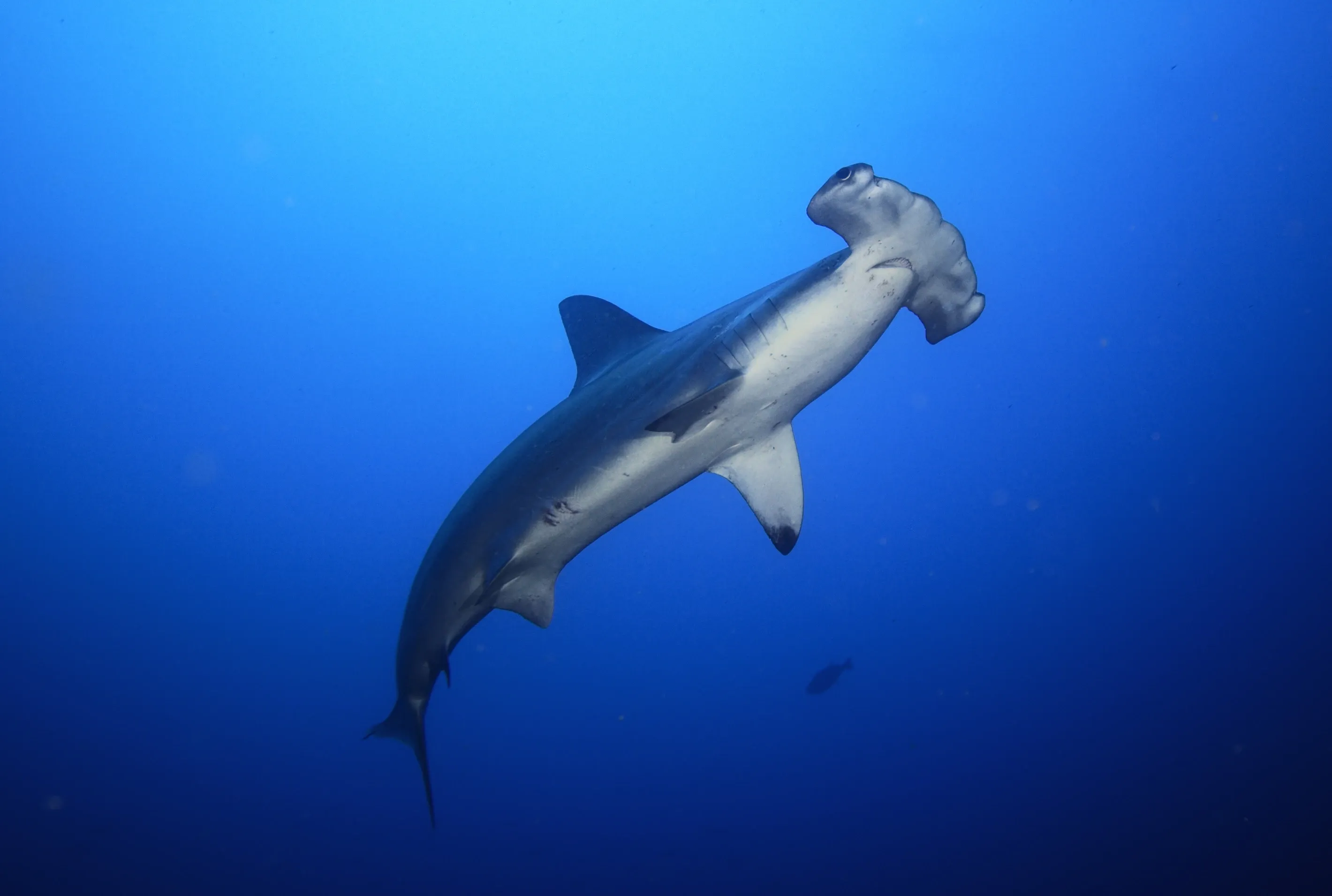
From coral reefs to open water, this Critically Endangered shark uses its unusual head to hunt, navigate, and join enormous daytime gatherings.
A shadow with a very surprising silhouette
Imagine you are floating above a coral reef. Blue water stretches in every direction, bright as a swimming pool with the sides taken away. Then a shadow glides below. It has a tall fin, a swishing tail, and a head shaped a little like a very wide, wiggly hammer.
Meet the scalloped hammerhead shark, or Sphyrna lewini. Its head is broad and flat, with eyes set far apart at the ends. Along the front are gentle bumps and dips, like the scalloped edge of a shell or a pie crust. That scalloped outline is how it got its name.
This is not a costume or a joke played by the ocean. That extraordinary head is part of a clever set of tools. A scalloped hammerhead can grow much longer than a grown-up is tall; the largest documented individuals reach about 4.3 metres. Yet this big shark is often shy around people and generally swims away when left alone.
So, if a hammerhead seems to vanish into the blue, it may simply be doing what a careful wild animal does best: keeping its own space.
Evidence: IUCN Red List of Threatened Species: Sphyrna lewini (Scalloped Hammerhead) — Red List Assessment; Animal Diversity Web, University of Michigan Museum of Zoology: Sphyrna lewini (scalloped hammerhead shark); Wikipedia: Scalloped hammerhead
Why carry a hammer-shaped head?
Here is the marvelous answer: the hammerhead’s head is packed with tiny sensors. They can detect faint signals from other animals, including prey tucked beneath sand. Picture trying to find a coin hidden under a blanket without lifting the blanket. The shark’s sensors help it notice clues that our eyes would miss.
Its wide head also helps with direction-finding. The sensors can detect the Earth’s magnetic field, which helps the shark navigate—a bit like having a compass built in, except this compass does not need a pocket or a spinning needle.
That makes a scalloped hammerhead more than a dramatic outline. It is a moving detective: sweeping over the seafloor, sensing, steering, and investigating. The ocean can look empty to us, but to a hammerhead it may be full of quiet messages.
When it is time to eat, this carnivorous shark may hunt fish such as sardines and mackerel, along with squid, octopus, rays, smaller sharks, and other marine animals. Its menu tells us that it belongs in busy food webs linking reefs, coastal water, and the open ocean.
Evidence: Animal Diversity Web, University of Michigan Museum of Zoology: Sphyrna lewini (scalloped hammerhead shark); Wikipedia: Scalloped hammerhead
The daytime gathering that looks like an underwater parade
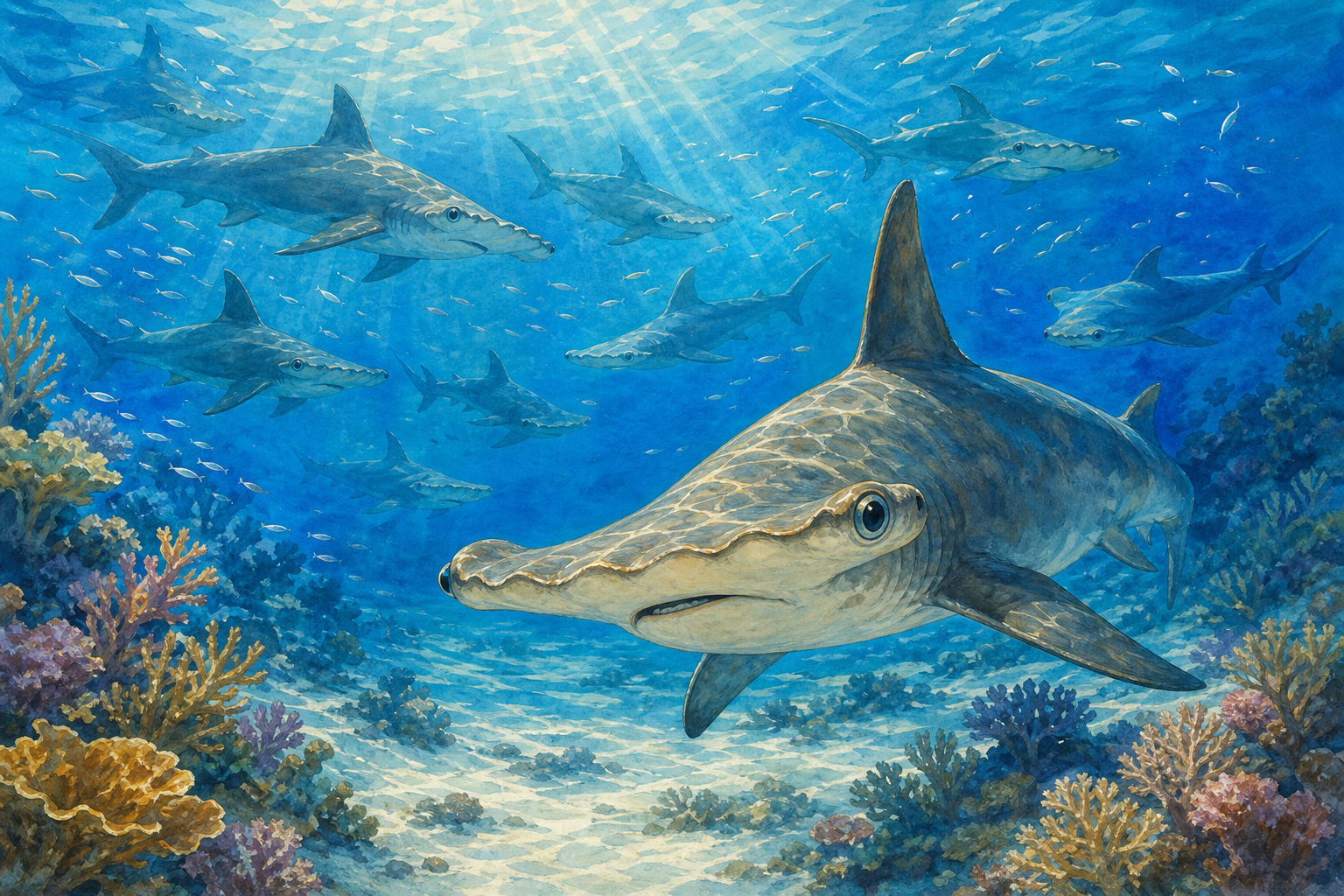
Sharks are often shown as lonely cruisers in movies. Scalloped hammerheads politely ignore that script. During the day, they often gather in schools. Sometimes hundreds of sharks swim over the same place in the sea.
Try to picture it: not a noisy school hallway, thankfully—there are no lockers underwater—but a calm procession of sleek bodies gliding together. Seeing a large school of scalloped hammerheads is one of the ocean’s great surprises. Their pale undersides flash, their wide heads tilt, and the group seems to float rather than swim.
Later, they spread out to forage. These sharks can be active by day and night, using coastal waters, coral reefs, and open ocean habitats. They live across tropical and warm seas in the Pacific, Atlantic, and Indian Oceans.
Why gather at all? Scientists can observe that they form these daytime schools, but the most important thing for us to notice is simple: a shark is not just a single fin in a scary story. It can be part of a crowd, sharing an ocean neighborhood with many other animals.
Evidence: Animal Diversity Web, University of Michigan Museum of Zoology: Sphyrna lewini (scalloped hammerhead shark); Wikipedia: Scalloped hammerhead; IUCN Red List of Threatened Species: Sphyrna lewini (Scalloped Hammerhead) — Red List Assessment
A shark’s job in a busy blue neighborhood
Every meal in the sea connects to another life. By eating fish, squid, octopus, rays, and other animals, scalloped hammerheads are mid-to-large predators in coastal and open-water food webs. They are one thread in a vast living net that includes reefs, sandy bottoms, schooling fish, and deep blue water.
That does not mean a hammerhead is a villain or the boss of everything. Nature is more interesting than that. A predator needs a healthy home and enough prey; it is also affected by bigger animals, fishing activity, changing places, and the choices people make. The shark is part of the neighborhood, not the owner of it.
Its varied diet also shows why different habitats matter. A sandy patch can hide prey. A reef can shelter many small animals. Open water can become a broad traveling route. Protecting ocean life means caring about all these connected places, not only the most colorful reef postcard.
Next time you see a shark drawing, look past the teeth. Notice the whole animal: the steering tail, the watchful eyes, the sensor-filled head, and a body built to glide through a world we are still learning to understand.
Evidence: Animal Diversity Web, University of Michigan Museum of Zoology: Sphyrna lewini (scalloped hammerhead shark); Wikipedia: Scalloped hammerhead
The worrying part of the story—and the hopeful part
The scalloped hammerhead is listed as Critically Endangered on the IUCN Red List, with a decreasing global population. That is a serious warning: this remarkable shark is at very high risk of disappearing from the wild if people do not reduce the pressures it faces.
Overfishing, accidental capture in nets and other fishing gear, and the shark-fin trade have driven steep declines. A shark caught by accident is still a shark in trouble, which is why reducing bycatch matters so much. Scalloped hammerheads are also included in CITES Appendix II, an international trade listing.
Hope is not pretending a problem is tiny. Hope is choosing useful actions while the animal is still here. Stronger controls on shark fishing and fin trade, ways to reduce accidental catches, and protection for coastal habitats used by young sharks can all support recovery.
Children are not expected to solve the ocean’s problems alone. But curiosity grows into care. Share a true hammerhead fact, support an aquarium or ocean group that teaches conservation responsibly, ask grown-ups where seafood comes from, and keep learning. A creature with a compass in its head deserves a future with somewhere safe to steer.
Evidence: IUCN Red List of Threatened Species: Sphyrna lewini (Scalloped Hammerhead) — Red List Assessment; Animal Diversity Web, University of Michigan Museum of Zoology: Sphyrna lewini (scalloped hammerhead shark); Wikipedia: Scalloped hammerhead
A small kindness that reaches the sea
Caring about hammerheads can begin at the dinner table without turning meals into a lecture. The World Health Organization describes healthy eating patterns that include a variety of foods such as vegetables, fruits, whole grains, pulses, nuts, and seeds. The IPCC also finds that shifts toward sustainable, healthy, more plant-based diets can reduce pressure from food systems on climate, land, and biodiversity.
That can look wonderfully ordinary: bean tacos, lentil soup, vegetable noodles, chickpea sandwiches, or a snack of fruit and nuts when they are safe for you to eat. Choosing plant-based meals more often is a gentle way to practice the idea that animals are friends, not ingredients.
Everybody’s needs and family traditions differ, so talk with a trusted adult if you are making food changes. No one needs to be perfect. One curious, kind choice at a time can help us build meals that leave more room for wild lives—perhaps even for a school of hammerheads gliding through clear blue water.
Evidence: World Health Organization: Healthy diet; Intergovernmental Panel on Climate Change: Climate Change 2022: Mitigation of Climate Change — Chapter 7
Kind choices, wide horizons
A hammerhead’s wide head helps it sense a huge underwater world. We can widen our own circle of care, too. Plant-rich meals built around vegetables, fruit, whole grains, pulses, nuts, and seeds can be part of a healthy varied diet, according to the World Health Organization.
The IPCC reports that more sustainable, healthy, plant-based dietary shifts can lower food-system emissions and reduce pressure on land and biodiversity. Trying a favorite plant-based meal with your family is not about blame; it is a friendly vote for a world where ocean animals have more space to thrive.
Evidence: World Health Organization: Healthy diet; Intergovernmental Panel on Climate Change: Climate Change 2022: Mitigation of Climate Change — Chapter 7
Questions people ask
Is a scalloped hammerhead dangerous to swimmers?
It is generally shy around people and is not thought to be dangerous to swimmers. Wild animals still need space, so the best rule is to watch respectfully and never try to touch or chase one.
Evidence: Animal Diversity Web, University of Michigan Museum of Zoology: Sphyrna lewini (scalloped hammerhead shark); Wikipedia: Scalloped hammerhead
Why are its eyes so far apart?
Its eyes sit at the ends of its wide head. That head also carries sensors that help it detect prey hidden in sand and sense Earth’s magnetic field for navigation.
Evidence: Animal Diversity Web, University of Michigan Museum of Zoology: Sphyrna lewini (scalloped hammerhead shark); Wikipedia: Scalloped hammerhead
What does Critically Endangered mean?
It is the IUCN Red List’s most serious warning category before a species is lost from the wild. Scalloped hammerhead populations are decreasing because of fishing pressures, accidental capture, and the fin trade.
Evidence: IUCN Red List of Threatened Species: Sphyrna lewini (Scalloped Hammerhead) — Red List Assessment; Wikipedia: Scalloped hammerhead
Read the evidence
Sources behind this story
- Sphyrna lewini (Scalloped Hammerhead) — Red List Assessment — IUCN Red List of Threatened Species
- Sphyrna lewini (scalloped hammerhead shark) — Animal Diversity Web, University of Michigan Museum of Zoology
- Scalloped hammerhead — Wikipedia
- Healthy diet — World Health Organization
- Climate Change 2022: Mitigation of Climate Change — Chapter 7 — Intergovernmental Panel on Climate Change
Health information is general education, not personal medical advice. Young readers should make food choices with a trusted adult and qualified health professional.