Today's animal friend · 10 September 2026
Meet the Regal Jumper: The Tiny Spider with a Safety Rope
Look closely at a garden wall or tree trunk in the southeastern United States or Caribbean, and you might spot a small hunter planning a leap—with silk as its backup plan.
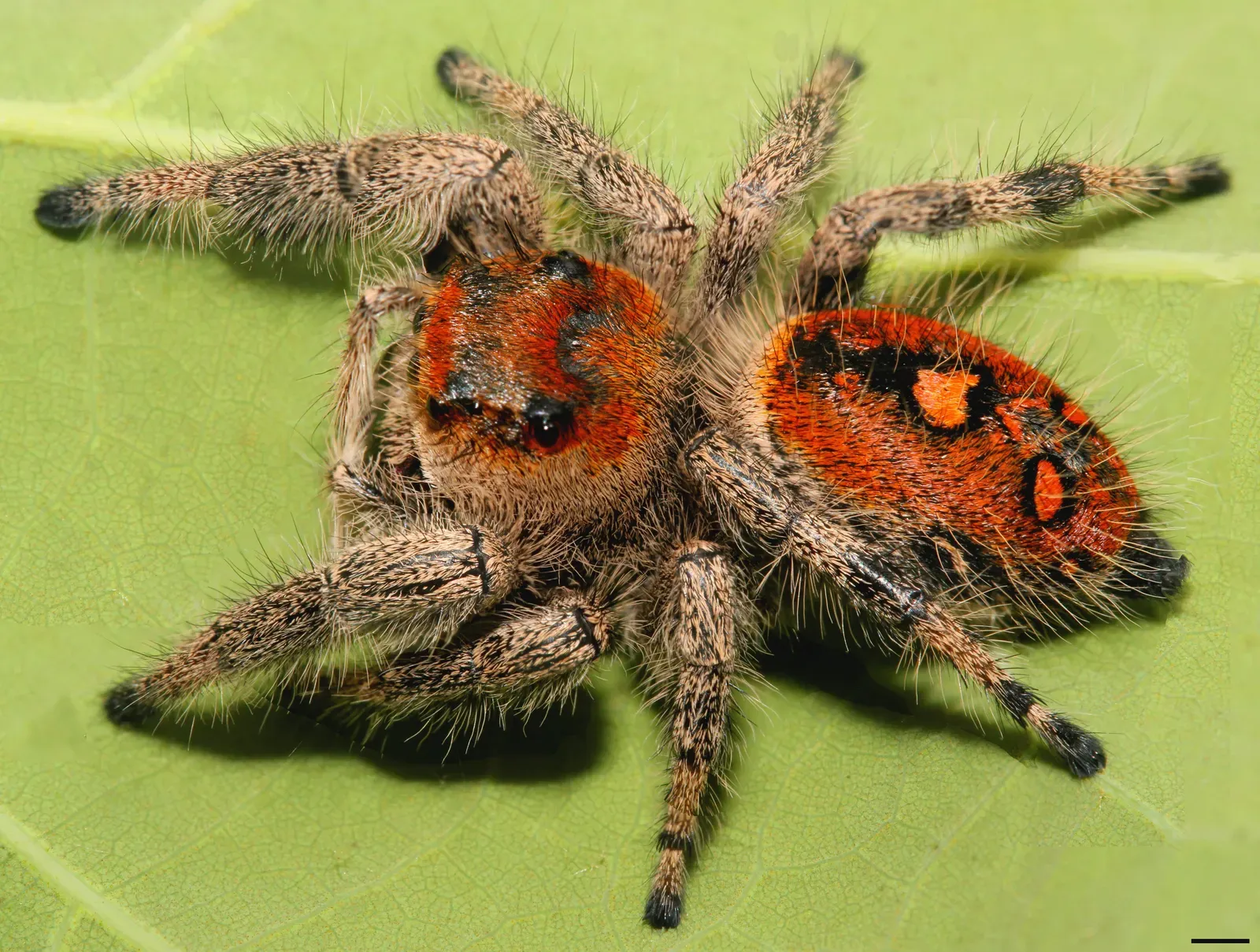
Look closely at a garden wall or tree trunk in the southeastern United States or Caribbean, and you might spot a small hunter planning a leap—with silk as its backup plan.
A tiny pause … then BOING!
Imagine a warm garden morning. A leaf trembles in the breeze, a fence rail feels hot from the sun, and something small pauses as if it is thinking very hard. Then—boing!—a regal jumping spider springs toward its next snack.
The regal jumping spider, or regal jumper, is called Phidippus regius by scientists. It is one of the largest jumping spiders in eastern North America, but “large” is a very relative word here. An adult female can reach about 22 millimetres in body length: still small enough to rest on the tip of a finger.
That is part of its magic. A creature smaller than a crayon’s width can turn an ordinary wall, tree trunk, or patch of garden into a high-stakes climbing adventure. Its world may look familiar to us, but it is explored at spider scale: one leaf can be a roof, one crack can be a canyon, and one careless gust can make everything wobble.
Evidence: IUCN Red List of Threatened Species: Phidippus regius — Red List category; Animal Diversity Web, University of Michigan Museum of Zoology: Phidippus regius; Wikipedia: Phidippus regius
Those big eyes are doing serious detective work
Why does a regal jumper look so different from the picture of a spider that might pop into your head? Start with the eyes. It has eight altogether, including two enlarged eyes facing forward. Those important front eyes help it see sharply enough to spot tiny prey and work out a jump.
A web-building spider may wait for a vibration to announce dinner. A regal jumper is more like a daytime detective. It looks, creeps nearer, pauses, and chooses its moment. No magnifying glass, no tiny detective hat—although that would be excellent.
This visual way of hunting means the spider is active during the day. If you are respectfully looking for one, bright daylight is the time to notice a small spider exploring a surface rather than sitting in a prey-catching web. Looking closely is not the same as grabbing, though. Let the little explorer choose where it goes.
Evidence: Animal Diversity Web, University of Michigan Museum of Zoology: Phidippus regius; Wikipedia: Phidippus regius
A hunter without a dinner net
Here is the regal jumper’s surprising plan: it does not spin a web to catch its food. Instead, it hunts insects and other small arthropods, including other spiders. It stalks prey and pounces.
Before each leap, it trails a fine silk dragline behind it. Think of it as a climbing safety rope. If a jump does not go as planned, that silk line can help the spider climb back up instead of simply dropping away. Even a bold little jumper has a sensible backup plan.
This is a good reminder that silk is not only for big round webs. For a jumping spider, silk can be travel gear. The regal jumper’s hunting style is active, watchful, and wonderfully different from the classic “wait in a web” spider story.
Evidence: Animal Diversity Web, University of Michigan Museum of Zoology: Phidippus regius; Wikipedia: Phidippus regius
Where might this little athlete live?
Regal jumping spiders live in the southeastern United States and the Greater Antilles, part of the Caribbean. Within that range, they can be found in open or partly open places such as woodland edges, fields, and gardens.
A tree trunk, a wall, a fence, or vegetation can become a hunting route. To us, a fence may be just a fence: useful for keeping a ball out of the neighbour’s yard. To a regal jumper, it can be a sunny lookout, a climbing trail, and a place where small prey might appear.
They are solitary hunters outside brief reproductive encounters, so a single spider is generally out on its own. That makes each sighting feel a little like meeting a miniature traveller: no backpack, no map, just sharp vision, nimble legs, and a silk line ready to go.
Evidence: Animal Diversity Web, University of Michigan Museum of Zoology: Phidippus regius; Wikipedia: Phidippus regius
A garden neighbour worth noticing
Because regal jumping spiders hunt insects and other small arthropods, they are part of the busy food web in gardens and open habitats. Their role is modest but real: a small predator can help regulate the creatures it hunts nearby.
That does not mean a garden needs to become a spider theme park—although the ticket booth would be very tiny. It means that living places are full of connections. Plants offer surfaces and shelter. Small creatures move among them. Predators such as jumping spiders search, stalk, and pounce.
When we notice these connections, gardens stop being merely tidy spaces and become neighbourhoods shared with many kinds of life. A spider is not “just” a spider when it is navigating a leaf jungle and making careful decisions about every leap.
Evidence: Wikipedia: Phidippus regius
What do we know about its future?
The regal jumping spider has not been evaluated for the IUCN Red List. In other words, it does not yet have an IUCN global extinction-risk category. The available sources do not provide a population estimate, population trend, or a formal threat list for this species.
That uncertainty is not a reason to shrug. It is a reason to stay curious. Small animals can be easy to overlook, even when they live close to people. Watching wildlife carefully, recording observations with trusted community-science projects when an adult helps, and learning from naturalists can all make the small world more visible.
For now, the kindest approach is simple: value the gardens, fields, woodland edges, and other living places where invertebrates belong. We do not need to know every answer before choosing to be thoughtful neighbours.
Evidence: IUCN Red List of Threatened Species: Phidippus regius — Red List category; Wikipedia: Phidippus regius
How to be a calm spider spotter
If you see a regal jumper, try the superhero skill of stillness. Pause a respectful distance away. Watch where it turns and walks. Notice the surface beneath it. Is it on bark, a wall, a leaf, or a fence? You might see it pause before a leap, but never poke it to make it jump.
Avoid collecting or carrying wild spiders. Their small bodies and chosen hiding places deserve care. If one is indoors, ask a trusted adult to help it move safely outside rather than treating it as a scary surprise.
Then tell someone what you noticed. A spider’s adventure can begin with one small question: “Where do you think it is going?” The answer may be food, shelter, or simply the next sunny ledge. Either way, the regal jumper has made an everyday place more interesting.
Evidence: IUCN Red List of Threatened Species: Phidippus regius — Red List category; Wikipedia: Phidippus regius
Kind choices can ripple outward
Caring about a tiny jumping spider can lead to a big thought: other animals share our world, even when they are easy to miss. We can make room for them by treating gardens and wild corners with respect, observing rather than disturbing, and choosing curiosity over an automatic “ew!”
Our food choices can be another gentle way to care about living things and their homes. The World Health Organization describes healthy eating patterns as including foods such as vegetables, fruit, whole grains, pulses, nuts, and seeds. With a trusted adult and, when needed, a qualified health professional, families can explore tasty plant-forward meals that suit them.
Choosing more plant-based foods can also be a planet-kind action. The IPCC reports that shifts toward sustainable, healthy, more plant-based diets can reduce food-system emissions and pressure on land and biodiversity. Maybe your next kindness begins with a bean taco, a fruit snack, or noticing one small spider’s brave leap.
Evidence: World Health Organization: Healthy diet; Intergovernmental Panel on Climate Change: Climate Change 2022: Mitigation of Climate Change — Chapter 7
Questions people ask
Is a regal jumping spider really one of the biggest jumping spiders?
Yes—within eastern North America, it is described as one of the largest jumping spiders. Even so, an adult female reaching about 22 millimetres is still a very small animal in our much bigger world.
Evidence: Wikipedia: Phidippus regius
Does it make a web?
It makes silk, but not a prey-catching web for its meals. It stalks and pounces on insects and other small arthropods, using a silk dragline as a safety line during jumps.
Evidence: Wikipedia: Phidippus regius
Where can regal jumping spiders be found?
Their range includes the southeastern United States and the Greater Antilles in the Caribbean. They use places such as gardens, fields, woodland edges, vegetation, trunks, walls, and fences.
Evidence: Wikipedia: Phidippus regius
Is the species globally assessed as threatened?
No IUCN Red List assessment is available for the regal jumping spider, so it is recorded as Not Evaluated. That means a global risk category, population trend, and formal threat list have not been established in the supplied sources.
Evidence: IUCN Red List of Threatened Species: Phidippus regius — Red List category; Wikipedia: Phidippus regius

Read the evidence
Sources behind this story
- Phidippus regius — Red List category — IUCN Red List of Threatened Species
- Phidippus regius — Animal Diversity Web, University of Michigan Museum of Zoology
- Phidippus regius — Wikipedia
- Healthy diet — World Health Organization
- Climate Change 2022: Mitigation of Climate Change — Chapter 7 — Intergovernmental Panel on Climate Change
Health information is general education, not personal medical advice. Young readers should make food choices with a trusted adult and qualified health professional.