Today's animal friend · 23 November 2026
Red Lionfish: The Reef’s Stripey Twilight Wanderer
It looks like a swimming flower wearing zebra stripes—but this quiet hunter has a prickly way of saying, “Please give me space.”
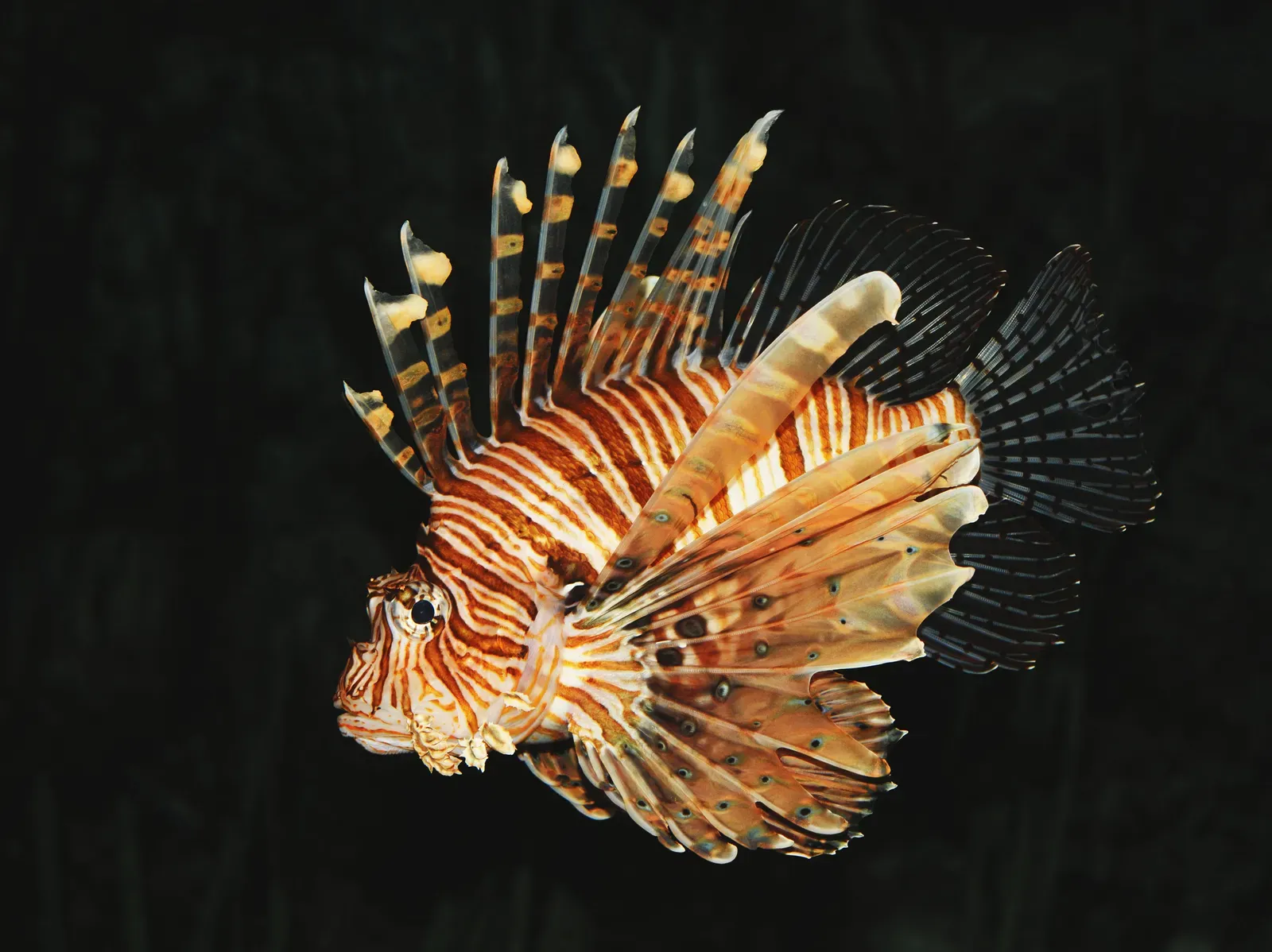
It looks like a swimming flower wearing zebra stripes—but this quiet hunter has a prickly way of saying, “Please give me space.”
A flower moves in the blue
Imagine peering beneath a warm, rippling sea. A reddish-brown and white shape glides from a shadowy reef crack. Its long fins float around it like ribbons in a slow underwater dance. For one startled second, you might think a fancy flower has learned to swim.
Then the “flower” turns, and its striped body and mane-like fin rays reveal the truth: hello, red lionfish! Its scientific name is Pterois volitans, though it is also called a firefish, turkeyfish, or butterfly cod. “Lionfish” fits especially well, because those spreading fins can look a little like a lion’s grand, shaggy mane.
A red lionfish does not need to race to be noticed. It drifts with the sort of calm confidence of someone who knows they are wearing the most dramatic costume at the reef party. But those beautiful fins are not just for showing off. They help make this fish a remarkable hunter and a creature worth understanding with care.
Evidence: IUCN Red List of Threatened Species: Pterois volitans (Red Lionfish) — Red List Assessment; Animal Diversity Web, University of Michigan Museum of Zoology: Pterois volitans (Red firefish); Wikipedia: Red lionfish
Where does the daytime adventurer hide?
Red lionfish are creatures of the in-between hours. During daylight, they often rest in sheltered places among coral or rocky reefs: a cave, a crevice, or beneath a ledge. Picture finding the coolest little hideout in a playground, except this playground is full of corals, rocks, and swishing seawater.
As dusk arrives, the lionfish becomes more active. It moves over reef structure at twilight and at night, when the water can seem hushed and mysterious. It is found in warm seas associated with coral reefs and rocky reefs, and it is also reported from lagoons and other shallow tropical marine habitats.
Its original home is the tropical Indo-Pacific—the huge connected region of warm ocean around the Indian and Pacific Oceans. There, the lionfish is one colourful part of a busy reef neighbourhood. Reefs are not merely pretty underwater scenery; they are living homes where many animals find shelter, food, and places to grow.
Evidence: Animal Diversity Web, University of Michigan Museum of Zoology: Pterois volitans (Red firefish); Wikipedia: Red lionfish; IUCN Red List of Threatened Species: Pterois volitans (Red Lionfish) — Red List Assessment
What’s for supper? A very patient ambush
When a red lionfish goes looking for a meal, it is a carnivore. Its menu includes small fishes and crustaceans such as shrimp and crabs. No tiny fork or napkin required—just a careful stalk and a quick gulp.
The fish can spread its broad pectoral fins as it approaches prey. These fins may help herd a small animal into a tighter space or make the lionfish’s approach harder to read. That is quite a trick: like using two enormous umbrellas to guide a runaway ping-pong ball, only much quieter and much more serious.
This hunting role matters on reefs. In its native range, the red lionfish is a predator of smaller fishes and invertebrates. Every animal has a place in the web of reef life, even one with a menu that makes us cheer for the shrimp. Caring about animals means noticing the whole complicated neighbourhood, not only the creatures that eat seaweed.
Evidence: Animal Diversity Web, University of Michigan Museum of Zoology: Pterois volitans (Red firefish); Wikipedia: Red lionfish
Those spines say “space, please”
Now for the lionfish’s most important safety rule: admire from a distance. Along its back are thin, sharp spines containing venom. The lionfish uses these spines mainly for defence, turning them toward something that comes too close.
That does not make the fish a villain. Think of the spines as a very serious personal-space sign. A red lionfish is not built for speedy getaways like some fish, so its defences help it avoid becoming someone else’s dinner. Beautiful animals can have boundaries, and those boundaries deserve respect.
If you ever see a lionfish while swimming, snorkelling, or visiting an aquarium, do not touch it. Give it room and let a trained adult or local wildlife expert handle any situation that needs help. Watching quietly is often the kindest kind of wildlife adventure—and it lets the lionfish keep doing its slow-motion fin ballet.
Evidence: Animal Diversity Web, University of Michigan Museum of Zoology: Pterois volitans (Red firefish); Wikipedia: Red lionfish
How can one fish belong in one sea and trouble another?
Here is the twist in the red lionfish story. The species is native to the Indo-Pacific, but it has also become established in the western Atlantic, Gulf of Mexico, and Caribbean. In these newer waters, it is considered invasive: it did not naturally live on those reefs before.
Why does that matter? An introduced lionfish can eat local prey and compete with local predators. That can put extra pressure on native reef communities. The same stripy hunter that is part of the natural food web in its home region can upset the balance in a different place. Nature is full of relationships, and moving one animal far from its usual neighbours can change many of them.
Scientists list red lionfish globally as Least Concern because they remain widespread and common in their native Indo-Pacific range. That label does not mean reefs never need care. Reef degradation and loss of prey can be long-term concerns in the native range, while Atlantic communities need help dealing with invasive lionfish. In some invaded places, organised removal efforts are used to lower local lionfish numbers.
Evidence: IUCN Red List of Threatened Species: Pterois volitans (Red Lionfish) — Red List Assessment; Animal Diversity Web, University of Michigan Museum of Zoology: Pterois volitans (Red firefish); Wikipedia: Red lionfish
A reef friend, not a decoration
It can be tempting to look at a red lionfish and think only, “Wow, those stripes!” But looking closer brings better questions. Where did this animal come from? What does it need? Which other reef creatures share its home? Curiosity is the beginning of respect.
Red lionfish are sometimes seen alone as adults, though young fish may gather in small groups. Adults are largely solitary except around courting and spawning. Their lives are not a human-style adventure story, yet each fish is an animal navigating shelter, food, danger, and the changing water world around it.
You do not have to travel across an ocean to practise reef-friendly caring. Learn about animals without touching them. Keep beaches and waterways free of litter. Share accurate facts instead of frightening rumours. And when you spot a creature with fancy fins or ordinary scales, remember: it is not scenery. It is somebody living its whole life in a world we are lucky to glimpse.
Evidence: Animal Diversity Web, University of Michigan Museum of Zoology: Pterois volitans (Red firefish); Wikipedia: Red lionfish
A kind choice can ripple farther than we see
The lionfish story reminds us that ocean life is connected: reefs, little fish, crabs, predators, and people all affect one another. One gentle way to care is to choose meals that celebrate plants more often—colourful vegetables, fruit, beans and lentils, whole grains, nuts, and seeds—with a trusted adult helping make choices that suit your family.
The World Health Organization describes healthy eating patterns as varied and rich in foods such as whole grains, vegetables, fruit, pulses, nuts, and seeds. The IPCC also reports that shifts toward sustainable, healthy, more plant-based diets can reduce pressure from food systems on the climate, land, and biodiversity. No one needs to be perfect to be kind: trying a bean taco, lentil soup, or a crunchy seed-and-fruit snack can be a small, cheerful vote for a world with room for wild animals.
And when it comes to lionfish themselves, kindness means seeing more than a meal or a photo opportunity. It means respecting their space, learning why reefs need balance, and remembering that every striped swimmer is a living neighbour in the sea.
Evidence: World Health Organization: Healthy diet; Intergovernmental Panel on Climate Change: Climate Change 2022: Mitigation of Climate Change — Chapter 7; Animal Diversity Web, University of Michigan Museum of Zoology: Pterois volitans (Red firefish); Wikipedia: Red lionfish
Questions people ask
How big is a red lionfish?
Adults reach several tens of centimetres in length. One source reports a maximum around 38 centimetres, while other accounts report larger maximum lengths. That is roughly the length of a school ruler—or a bit more—for a fish with such enormous-looking fins.
Evidence: Animal Diversity Web, University of Michigan Museum of Zoology: Pterois volitans (Red firefish); Wikipedia: Red lionfish
Are red lionfish dangerous?
Their dorsal spines contain venom and are mainly defensive, so they should never be touched. A lionfish is safest, and people are safest, when everyone gets plenty of space.
Evidence: Animal Diversity Web, University of Michigan Museum of Zoology: Pterois volitans (Red firefish); Wikipedia: Red lionfish
Why are lionfish removed in some places?
In parts of the Atlantic, Caribbean, and Gulf of Mexico where lionfish are invasive, organised removals can reduce local numbers and help limit pressure on native reef fish.
Evidence: Wikipedia: Red lionfish
Read the evidence
Sources behind this story
- Pterois volitans (Red Lionfish) — Red List Assessment — IUCN Red List of Threatened Species
- Pterois volitans (Red firefish) — Animal Diversity Web, University of Michigan Museum of Zoology
- Red lionfish — Wikipedia
- Healthy diet — World Health Organization
- Climate Change 2022: Mitigation of Climate Change — Chapter 7 — Intergovernmental Panel on Climate Change
Health information is general education, not personal medical advice. Young readers should make food choices with a trusted adult and qualified health professional.