Today's animal friend · 30 July 2026
The Frog With the Pop-Out Ruby Eyes
Follow Agalychnis callidryas from its leafy daytime hideout to a pond-side nursery, and discover kind ways to help rainforest neighbours far away.
Follow Agalychnis callidryas from its leafy daytime hideout to a pond-side nursery, and discover kind ways to help rainforest neighbours far away.
Shhh—was that leaf just looking at us?
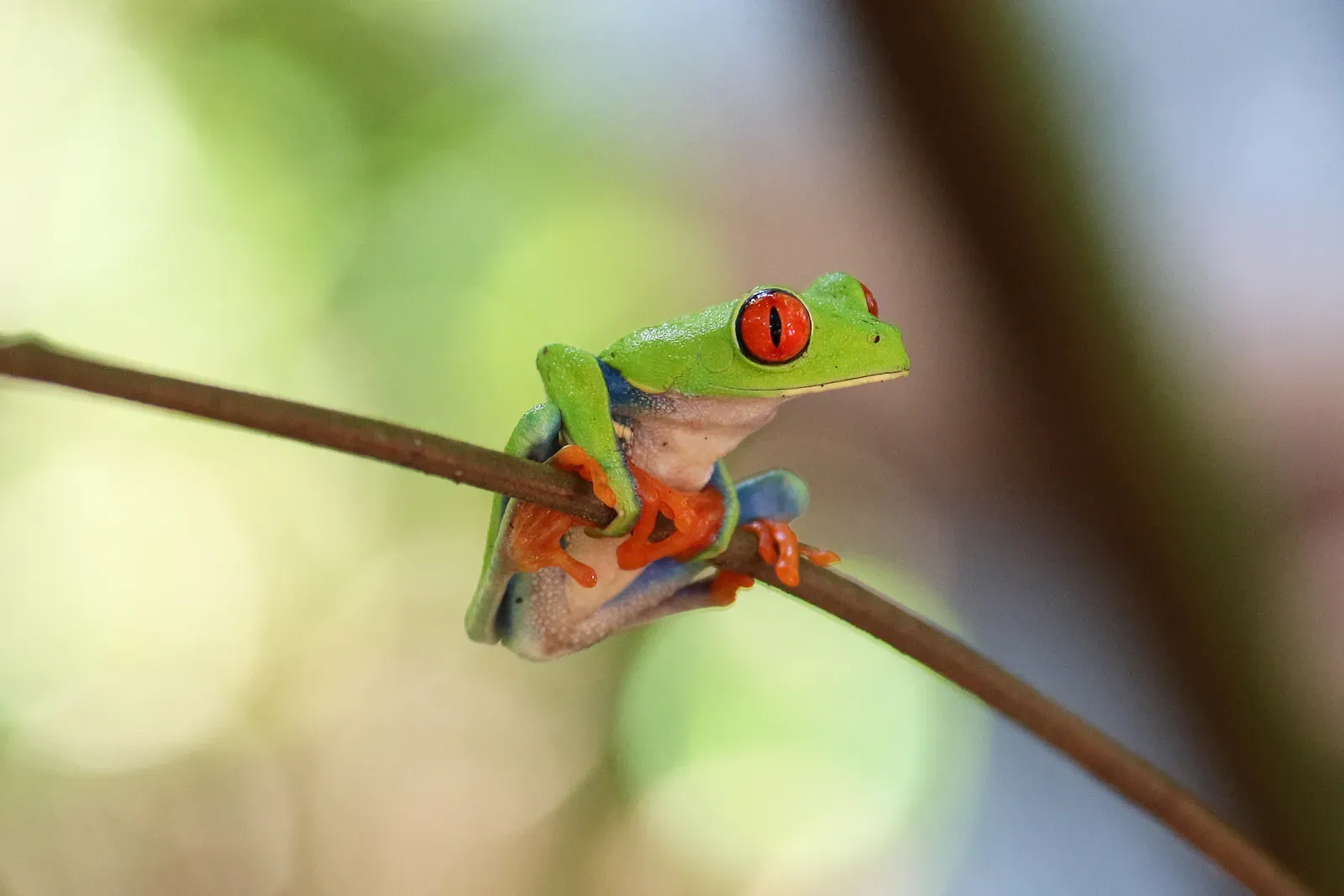
Imagine walking beneath a rainforest canopy after dark. The air feels damp, leaves shine with rain, and somewhere a small frog is getting ready for its night shift. At first it may look exactly like a green leaf taking a nap. Then—POP!—two huge red eyes open. Hello, surprise!
Meet the red-eyed tree frog, or red-eyed leaf frog. Its scientific name is Agalychnis callidryas, and it is an amphibian in the tree-frog family Phyllomedusidae. It lives from Mexico through Central America, in rainforest places near fresh water, including wetlands and ponds.
This is not a giant jungle beast. Adult males are commonly up to about two inches long, while females can reach about three inches. That means even a frog with movie-star eyes can be small enough to sit on a leaf. A rainforest can hold enormous trees and tiny dramas at the very same time.
Evidence: Animal Diversity Web, University of Michigan Museum of Zoology: Agalychnis callidryas (Red-eyed tree frog); Rainforest Alliance: Red-Eyed Tree Frog (Agalychnis callidryas); Wikipedia: Agalychnis callidryas
Why hide bright colours behind green?
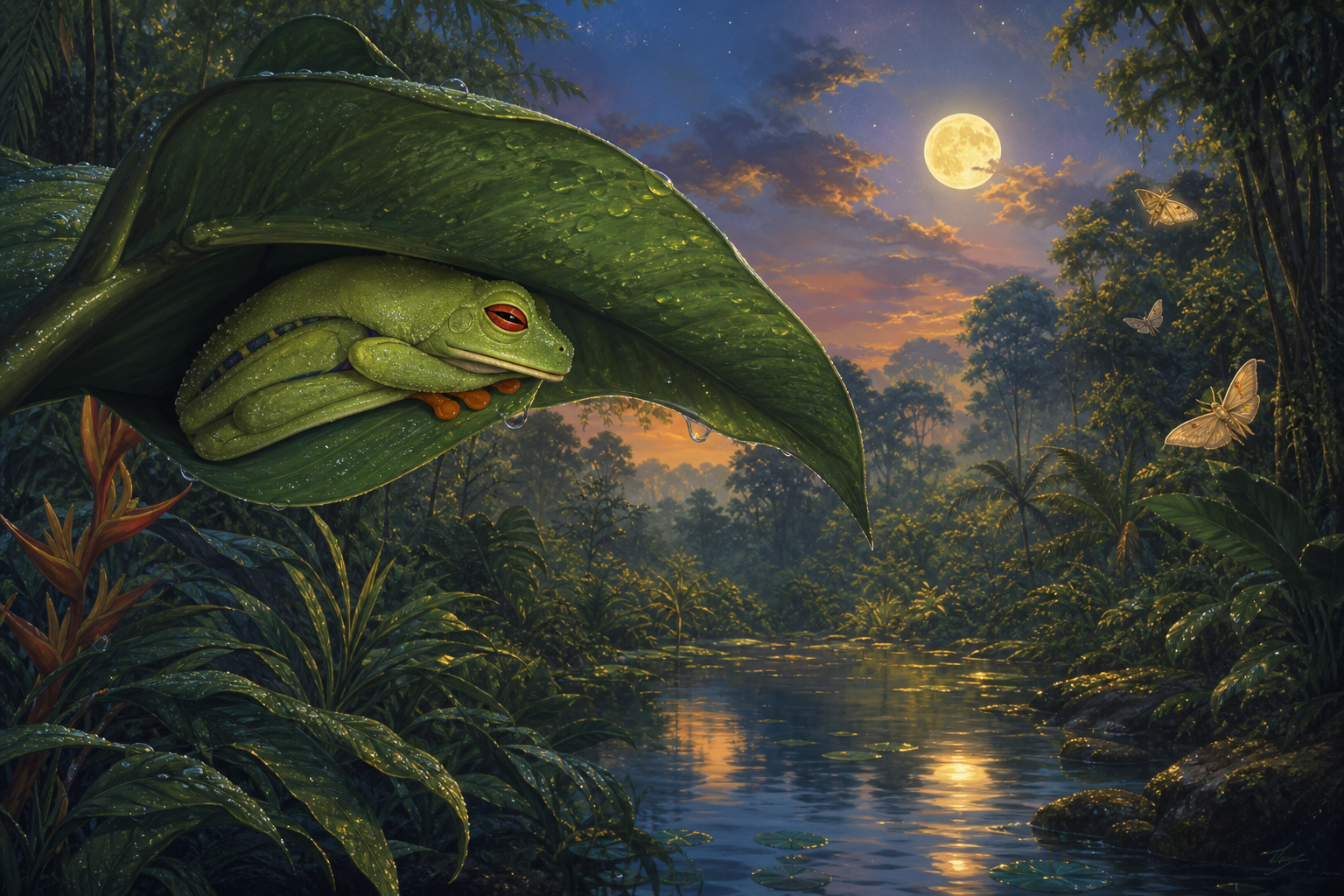
In daytime, this frog rests. It folds itself into a leaf-like pose and keeps its bright colours tucked away behind green eyelids. A passing animal may see a green shape among green leaves and carry on. In the rainforest, blending in can be a very useful superpower.
But what if someone creeps much too close? The frog can suddenly open its startling red eyes. That unexpected flash may give the startled visitor a moment of confusion—just enough time for the frog to flee. It is a clever escape trick, not a sign that the frog is poisonous. Think of it as shouting “Boo!” with your face, then making a quick exit.
At night, the frog becomes active. It hunts insects such as crickets, flies, moths, and grasshoppers, and it may also eat other small prey, including small frogs. By eating insects and also being food for larger animals, it takes part in the busy rainforest food web. Even a small neighbour has a place in the big, leafy puzzle.
Evidence: Animal Diversity Web, University of Michigan Museum of Zoology: Agalychnis callidryas (Red-eyed tree frog); Rainforest Alliance: Red-Eyed Tree Frog (Agalychnis callidryas)
A nursery with a splash landing
Where would you put frog eggs if you wanted the babies to begin life in water—but did not want to lay them directly in the pond? A red-eyed tree frog mother has an answer: choose the underside of a leaf hanging above the water.
She lays her eggs there, above a pond. When the tadpoles hatch, they wriggle free and drop down into the water below. It sounds like the ending of a very tiny waterslide ride: wiggle, wiggle, splash!
This breeding story helps explain why forest and fresh water belong together for these frogs. A leafy place near a pond is more than a pretty view. It is a resting place, a hunting place, and a beginning place for young frogs. When we picture a rainforest, it is worth picturing its puddles, wetlands, and pond edges too—not only its towering trees.
Evidence: Wikipedia: Agalychnis callidryas; Animal Diversity Web, University of Michigan Museum of Zoology: Agalychnis callidryas (Red-eyed tree frog)
“Least Concern” does not mean “no worries”
The IUCN assessed the red-eyed tree frog as Least Concern in 2016. That means the species was not then considered globally at the highest risk of extinction. It has a wide range, and it can tolerate some habitat change. Those are encouraging facts.
Yet this is not an excuse to stop caring. Many populations are decreasing, and different places can face different problems. Deforestation and habitat loss can remove the rainforest and breeding areas frogs need. Development, pollution, and illnesses including chytrid fungus are also documented pressures. A frog cannot pack a suitcase and rebuild a pond somewhere else.
The hopeful part is that caring for remaining rainforest habitat near ponds matches what these frogs need. Protecting forests, water, and the connected leafy routes between them gives wild animals more room to live their own remarkable lives. The ruby-eyed leaf on a branch is not just colourful—it is a neighbour with a home worth defending.
Evidence: IUCN Red List of Threatened Species: Agalychnis callidryas (Red-eyed Tree Frog) — Red List Assessment; Animal Diversity Web, University of Michigan Museum of Zoology: Agalychnis callidryas (Red-eyed tree frog); Wikipedia: Agalychnis callidryas; Rainforest Alliance: Red-Eyed Tree Frog (Agalychnis callidryas)
Try a frog-sized way of noticing
You do not have to travel to Central America to practise rainforest respect. Next time you are outdoors, pause beside a pond, under a tree, or near a patch of plants. Listen before you speak. Look carefully without grabbing animals. Ask yourself: where might a small creature rest, find water, or look for dinner?
If you spot a frog or other wild animal, give it space. Wild animals are not toys, and their homes are not obstacle courses. A quiet observer can see far more than a noisy explorer—although a quiet explorer may still make one accidental twig-crunch. It happens.
The red-eyed tree frog invites us to notice hidden lives. A green leaf might be a leaf. Or, in the right rainforest after sunset, it might be a small night-walker with red eyes, a careful plan, and somewhere important to hop.
Evidence: Rainforest Alliance: Red-Eyed Tree Frog (Agalychnis callidryas); Animal Diversity Web, University of Michigan Museum of Zoology: Agalychnis callidryas (Red-eyed tree frog); IUCN Red List of Threatened Species: Agalychnis callidryas (Red-eyed Tree Frog) — Red List Assessment
A kind choice can begin on your plate
The frog’s rainforest story is also a reminder that every animal wants a safe place to live. We can make choices that leave more room for wild neighbours: waste less, appreciate plants, and speak up for forests and clean water with the adults in our lives.
One gentle family idea is to explore more plant-based meals together—perhaps beans, lentils, vegetables, fruit, whole grains, nuts, and seeds, in ways that suit your family. The World Health Organization describes varied diets built around these foods as part of healthy eating guidance. The IPCC reports that shifts toward sustainable, healthy, more plant-based diets can lower food-system emissions and reduce pressure on land and biodiversity.
No one needs to be perfect to be kind. A new plant-based snack, a colourful bean meal, or curiosity about where food comes from can be a small vote for a world with forests, ponds, insects, and ruby-eyed frogs. For personal food advice, children can talk with a trusted adult and a qualified health professional.
Evidence: World Health Organization: Healthy diet; Intergovernmental Panel on Climate Change: Climate Change 2022: Mitigation of Climate Change — Chapter 7
Questions people ask
Are red-eyed tree frogs really bright red all the time?
Their famous red eyes can be hidden when they rest. Green eyelids and a leaf-like posture help the frog blend in, then the eyes can flash open when danger is close.
Evidence: Animal Diversity Web, University of Michigan Museum of Zoology: Agalychnis callidryas (Red-eyed tree frog); Rainforest Alliance: Red-Eyed Tree Frog (Agalychnis callidryas)
Where do they live?
They occur from Mexico through Central America, in rainforests near fresh water such as wetlands and ponds. They are not frogs found throughout the United States.
Evidence: Animal Diversity Web, University of Michigan Museum of Zoology: Agalychnis callidryas (Red-eyed tree frog); Rainforest Alliance: Red-Eyed Tree Frog (Agalychnis callidryas)
What do they eat after dark?
They eat insects including crickets, flies, moths, and grasshoppers, and may take other small prey, including small frogs.
Evidence: Rainforest Alliance: Red-Eyed Tree Frog (Agalychnis callidryas)
Should we stop caring because they are called Least Concern?
No. Least Concern was their global IUCN status in 2016, but many populations are decreasing. Habitat loss and disease are among the pressures recorded for the species, so protecting rainforest places still matters.
Evidence: IUCN Red List of Threatened Species: Agalychnis callidryas (Red-eyed Tree Frog) — Red List Assessment; Wikipedia: Agalychnis callidryas
Read the evidence
Sources behind this story
- Agalychnis callidryas (Red-eyed Tree Frog) — Red List Assessment — IUCN Red List of Threatened Species
- Agalychnis callidryas (Red-eyed tree frog) — Animal Diversity Web, University of Michigan Museum of Zoology
- Red-Eyed Tree Frog (Agalychnis callidryas) — Rainforest Alliance
- Agalychnis callidryas — Wikipedia
- Healthy diet — World Health Organization
- Climate Change 2022: Mitigation of Climate Change — Chapter 7 — Intergovernmental Panel on Climate Change
Health information is general education, not personal medical advice. Young readers should make food choices with a trusted adult and qualified health professional.