Today's animal friend · 23 September 2026
The Pūkeko with a Snack in Its Foot
In the reeds and damp grass of Aotearoa New Zealand, a pūkeko strides, calls, shares chick-care with its neighbours, and sometimes eats like a parrot.

In the reeds and damp grass of Aotearoa New Zealand, a pūkeko strides, calls, shares chick-care with its neighbours, and sometimes eats like a parrot.
A red-beaked surprise beside the reeds
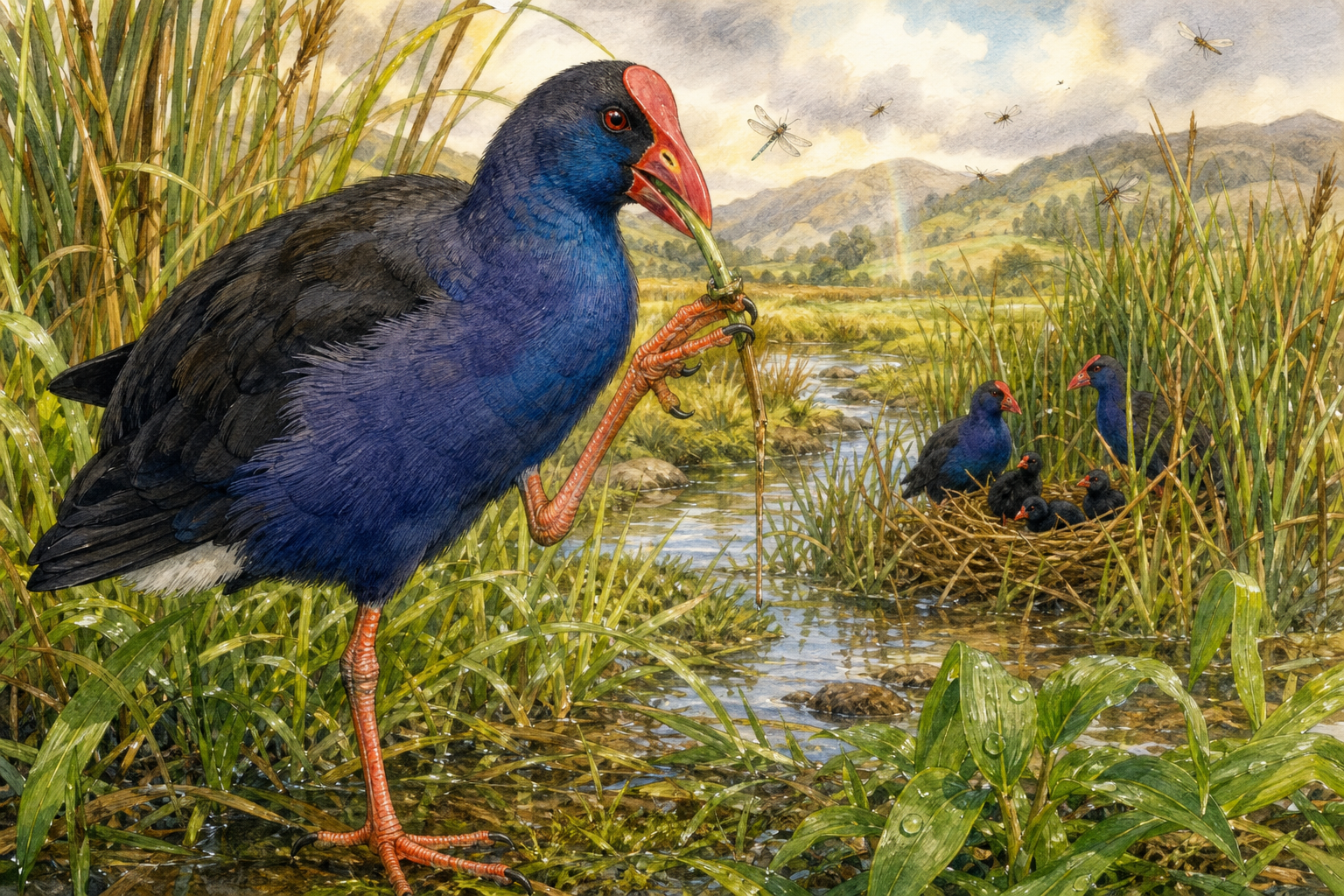
Picture a damp paddock after rain. The grass is shiny, the ditch is full, and there—walking as if it owns the whole place—is a pūkeko. Its long legs step through the wet ground with great purpose. Then it lifts a green stem in one foot and nibbles it with its bright red beak. Lunch, served paw-free! Or rather, foot-first.
The pūkeko, also called the Australasian swamphen, is Porphyrio melanotus: a member of the rail family. In Aotearoa New Zealand, its deep blue-violet breast, dark back, orange legs, red eyes, and bright red bill make it wonderfully hard to mistake. Above the bill sits a red patch of skin called a frontal shield. It is like the bird has put on a tiny red helmet before beginning its day.
A pūkeko is not a miniature bird. It can be 38 to 50 centimetres long—about as long as a school ruler plus a pencil. Yet it often seems even bigger when it is striding through the grass, making sure everyone notices it has arrived.
Evidence: IUCN Red List of Threatened Species / BirdLife International (Red List Authority for birds): Porphyrio melanotus (Australasian Swamphen) — Red List Assessment; New Zealand Birds Online (Te Papa / Ornithological Society of New Zealand): Pūkeko | Pukeko — Porphyrio melanotus; Wikipedia: Australasian swamphen
Where does this wet-footed walker wander?
Pūkeko live around sheltered wetlands: swamps, streams, lagoons, and freshwater or brackish edges. They also explore nearby grassland, pasture, roadside ditches, and the borders of scrub or forest. If a place has damp ground for walking and leafy food nearby, it may suit a pūkeko very nicely.
They are found throughout much of New Zealand, though they are less common in drier regions. The species also belongs to a wider south-west Pacific swamphen family of neighbours. In daylight, you may spot one foraging in an open paddock or slipping into cover when something bothers it.
Why the long legs? They help a pūkeko move through wet, uneven places where your shoes might make a loud squelch. Pūkeko prefer to run or hide when disturbed, but they can fly and swim strongly too. So this bird has several escape plans tucked under its feathers.
Evidence: IUCN Red List of Threatened Species / BirdLife International (Red List Authority for birds): Porphyrio melanotus (Australasian Swamphen) — Red List Assessment; New Zealand Birds Online (Te Papa / Ornithological Society of New Zealand): Pūkeko | Pukeko — Porphyrio melanotus; Wikipedia: Australasian swamphen
The parrot-style picnic
What is on a pūkeko menu? Mostly plant food. It eats grass stems, shoots, leaves, and seeds, including plants such as sedges, rushes, and clover. It also takes small animal foods such as insects, spiders, and earthworms. That makes it an omnivore: a creature that eats both plant and animal foods.
Its most entertaining table manner is the foot-to-bill move. A pūkeko can grip a stem or leaf with one foot, raise it up, and bite pieces off with its bill. It looks a little like a parrot holding a snack, except the dining room may be a muddy field with a puddle for company.
This busy foraging matters because pūkeko are part of wetland and pasture life. They search among plants and soil, and their strong beaks and feet are built for a day of investigating. The next time you see grass trembling beside a ditch, it is worth wondering: wind—or a hungry blue bird at work?
Evidence: IUCN Red List of Threatened Species / BirdLife International (Red List Authority for birds): Porphyrio melanotus (Australasian Swamphen) — Red List Assessment; New Zealand Birds Online (Te Papa / Ornithological Society of New Zealand): Pūkeko | Pukeko — Porphyrio melanotus; Wikipedia: Australasian swamphen
One nest, many helpful grown-ups
Pūkeko families can be full of teamwork. They often live in permanent cooperative groups that share a territory. Several adults may share one nest, and group members help care for the chicks. Imagine a family project where everybody takes a turn watching, feeding, and guarding the little ones. That is a lot more helpful than one person saying, “I’ll do it later!”
Their social lives are not all quiet nest-sitting. Pūkeko are highly vocal and territorial. Neighbouring groups may perform displays or sometimes fight. A wetland can be a busy neighbourhood, and a pūkeko is certainly not too shy to announce its opinion.
Young pūkeko have many watchful helpers in these groups. This shared care is one reason their family life is so fascinating: it reminds us that looking after others can be a team effort, whether you have feathers, boots, or muddy socks.
Evidence: IUCN Red List of Threatened Species / BirdLife International (Red List Authority for birds): Porphyrio melanotus (Australasian Swamphen) — Red List Assessment; New Zealand Birds Online (Te Papa / Ornithological Society of New Zealand): Pūkeko | Pukeko — Porphyrio melanotus; Wikipedia: Australasian swamphen
Doing well is not the same as “nothing to do”
The pūkeko is listed as Least Concern globally, and as Not Threatened in New Zealand. It is abundant and widespread, which is happy news. It does not need to be rare for it to be worth noticing, admiring, and protecting.
Healthy wetlands and grassy margins give pūkeko places to feed, shelter, and raise chicks. Wetlands are not useless soggy leftovers. They are lively homes full of reeds, water, insects, plants, birds, and surprises. Keeping these places healthy helps pūkeko and many other creatures that share their splashy world.
Sometimes pūkeko can nibble garden or crop plants, which can frustrate people. A practical answer can be to protect vulnerable seedlings with cloches, rather than treating a curious bird as a villain. Sharing space takes patience. After all, the pūkeko was looking for lunch, not plotting a vegetable heist.
Evidence: IUCN Red List of Threatened Species / BirdLife International (Red List Authority for birds): Porphyrio melanotus (Australasian Swamphen) — Red List Assessment; New Zealand Birds Online (Te Papa / Ornithological Society of New Zealand): Pūkeko | Pukeko — Porphyrio melanotus; Wikipedia: Australasian swamphen
Try a puddle-side detective walk
You do not need to chase a pūkeko to enjoy one. If you visit a wetland path, stream edge, or open grassy place with a trusted adult, pause quietly. Look for a tall dark bird with a blue-violet front, a red bill, and long warm-coloured legs. Listen too: pūkeko can be very vocal.
Give wildlife plenty of room. Stay on paths where possible, keep dogs under the rules for the area, and never try to feed or touch a wild bird. The best detective is patient. A still body and curious eyes may reveal far more than rushing about ever will.
If you are lucky enough to see the foot-to-bill snack trick, remember that you have watched a small everyday miracle: a wetland bird using its foot like a hand. It is proof that an ordinary ditch or paddock can hold a splendid story.
Evidence: IUCN Red List of Threatened Species / BirdLife International (Red List Authority for birds): Porphyrio melanotus (Australasian Swamphen) — Red List Assessment; New Zealand Birds Online (Te Papa / Ornithological Society of New Zealand): Pūkeko | Pukeko — Porphyrio melanotus; Wikipedia: Australasian swamphen
A kind lunch choice for lively wetland neighbours
Watching a pūkeko lift a leafy snack in its foot can make us think about plant foods in a fresh way. Beans, lentils, whole grains, vegetables, fruit, nuts, and seeds can all be part of varied, healthy eating patterns. Food needs are personal, so children can explore new meals with a parent, caregiver, and qualified health professional if needed.
Choosing more plant-based meals can be a gentle kindness to animals and to the wild places they need. The IPCC says shifts toward sustainable, healthy, more plant-based diets can lower food-system emissions and reduce pressure on land and biodiversity. Perhaps your next family meal could include a colourful bean dish, crunchy seeds, or a favourite vegetable—an ordinary choice with room for care.
Evidence: World Health Organization: Healthy diet; Intergovernmental Panel on Climate Change: Climate Change 2022: Mitigation of Climate Change — Chapter 7
Questions people ask
Is a pūkeko the same as a takahē?
No. Both are in the genus Porphyrio, so they are relatives, but the pūkeko in this story is Porphyrio melanotus. The takahē is a different species, Porphyrio hochstetteri.
Evidence: New Zealand Birds Online (Te Papa / Ornithological Society of New Zealand): Pūkeko | Pukeko — Porphyrio melanotus; Wikipedia: Australasian swamphen
Can pūkeko fly?
Yes. They often choose to run or hide when startled, but they can fly and swim strongly.
Why does a pūkeko have a red shield on its forehead?
The red frontal shield is a patch of skin above its bill and is part of the bird’s bold, recognisable face.
Evidence: New Zealand Birds Online (Te Papa / Ornithological Society of New Zealand): Pūkeko | Pukeko — Porphyrio melanotus; Wikipedia: Australasian swamphen
Are pūkeko endangered?
No. They are listed as Least Concern globally and Not Threatened in New Zealand. Looking after wetlands remains a kind way to support the places they live.
Evidence: IUCN Red List of Threatened Species / BirdLife International (Red List Authority for birds): Porphyrio melanotus (Australasian Swamphen) — Red List Assessment; New Zealand Birds Online (Te Papa / Ornithological Society of New Zealand): Pūkeko | Pukeko — Porphyrio melanotus; Wikipedia: Australasian swamphen
Read the evidence
Sources behind this story
- Porphyrio melanotus (Australasian Swamphen) — Red List Assessment — IUCN Red List of Threatened Species / BirdLife International (Red List Authority for birds)
- Pūkeko | Pukeko — Porphyrio melanotus — New Zealand Birds Online (Te Papa / Ornithological Society of New Zealand)
- Australasian swamphen — Wikipedia
- Healthy diet — World Health Organization
- Climate Change 2022: Mitigation of Climate Change — Chapter 7 — Intergovernmental Panel on Climate Change
Health information is general education, not personal medical advice. Young readers should make food choices with a trusted adult and qualified health professional.