Today's animal friend · 19 November 2026
The Pīwakawaka Who Followed the Footsteps
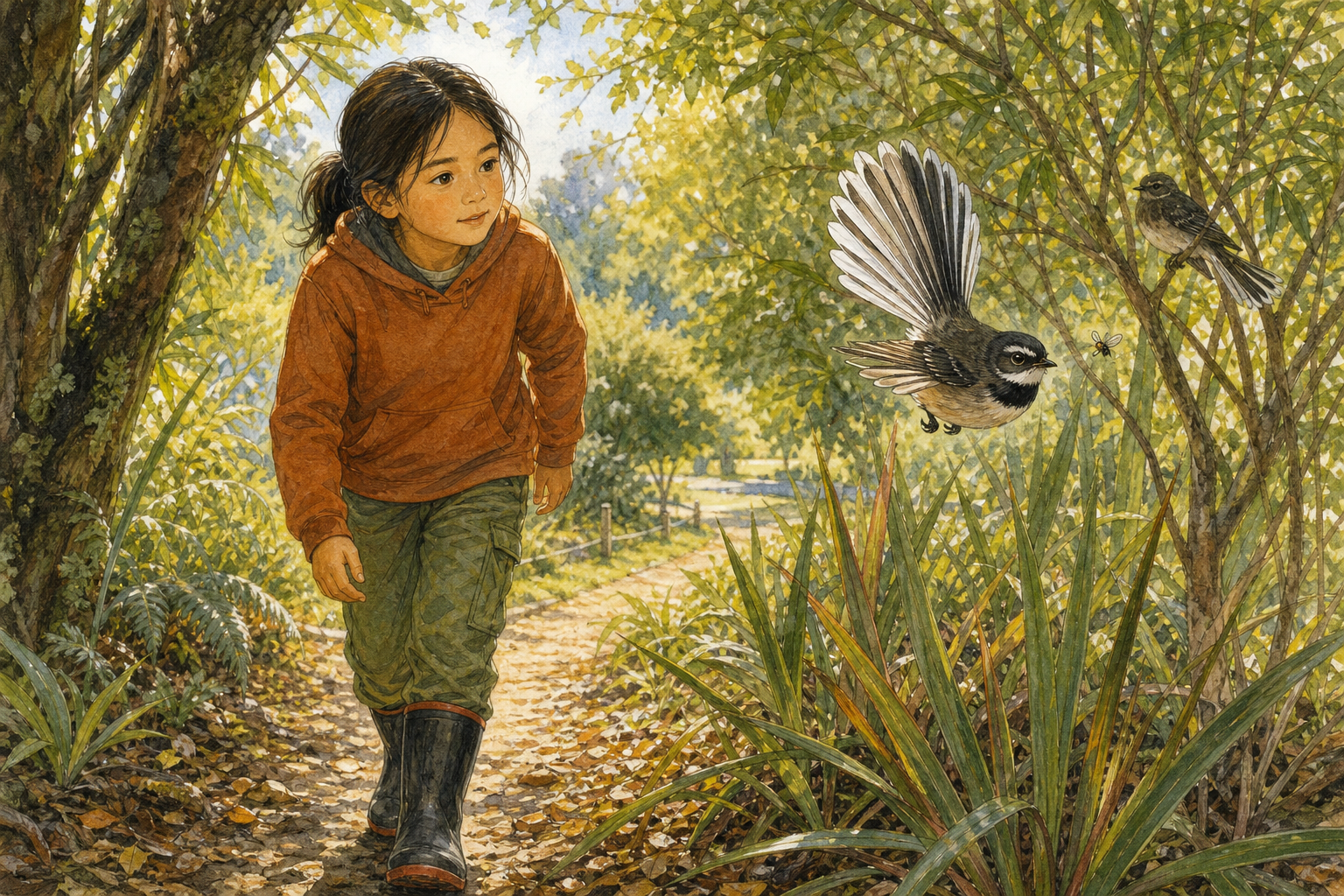
A walk through a leafy path can turn into a flying-insect treasure hunt when a pīwakawaka is nearby.
A walk through a leafy path can turn into a flying-insect treasure hunt when a pīwakawaka is nearby.
A small shadow with a very big tail
Crunch, swish, step. Imagine walking along a forest path in Aotearoa New Zealand, with leaves brushing your shoes and a breeze tickling the branches. Then—flick!—a little bird appears almost beside you. It loops from twig to twig, opens a tail shaped like a tiny hand fan, and seems to be saying, “Excuse me, did you happen to stir up any snacks?”
That lively neighbour is the New Zealand fantail, called pīwakawaka or tīrairaka in te reo Māori. Its scientific name is Rhipidura fuliginosa. It belongs to the bird family Rhipiduridae, but it is easier to remember it as the bird that makes an ordinary walk feel like a fast-paced game of tag.
Pīwakawaka can come within a metre or two of walkers. This is not because they want a piggyback—though that would be a very funny commute. As people walk, or as someone digs in a garden, tiny insects can be disturbed from leaves and plants. The fantail darts after those insects in mid-air.
Evidence: IUCN Red List of Threatened Species / BirdLife International (Red List Authority for birds): Rhipidura fuliginosa (New Zealand Fantail) — Red List Assessment; New Zealand Birds Online (Te Papa / Ornithological Society of New Zealand): New Zealand fantail | Pīwakawaka — Rhipidura fuliginosa; Wikipedia: New Zealand fantail
Why is it always doing zoomies?
While it is awake in daytime, a fantail is almost never still. One second it is on a perch; the next it twists, turns, and zips to another branch. Its fanned tail is part of the wonderful fluttery picture as it hunts.
The reason for all this busyness is dinner. Pīwakawaka are insectivores: animals that mainly eat insects and other small invertebrates. Their menu includes flying insects such as moths and flies, along with small creatures found among foliage. A flying insect is a tricky target, so a fantail’s day is more like playing a never-ending game of catch than sitting down for a sandwich.
By catching small invertebrates in forests, shrublands, and gardens, fantails play a useful part in the web of life. A food web is like a huge neighbourhood of eaters and eaten things, with every creature linked in some way. The pīwakawaka is one small, bright-moving thread in that neighbourhood.
Evidence: New Zealand Birds Online (Te Papa / Ornithological Society of New Zealand): New Zealand fantail | Pīwakawaka — Rhipidura fuliginosa; Wikipedia: New Zealand fantail
Tiny body, spectacular fan
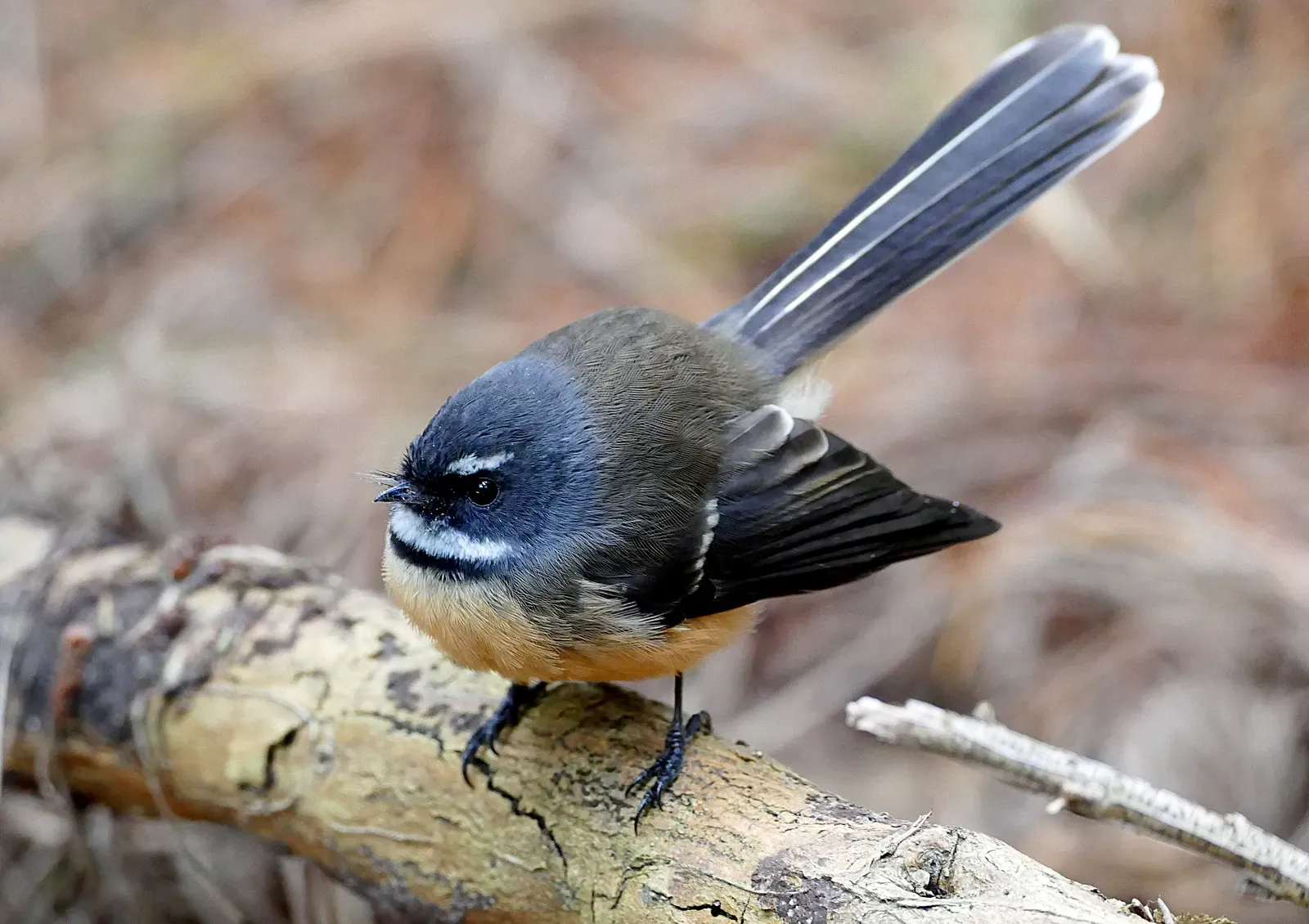
An adult New Zealand fantail is about 16 centimetres long and weighs about 8 grams. That is light enough to make a small handful of paper clips seem hefty by comparison. Remarkably, roughly half of its length is its tail when that tail is included.
Most pīwakawaka are the familiar pied colour form. Yet there is also a darker form. In the South Island, dark fantails make up about 5 in every 100 birds, so spotting one can feel like finding the surprise colour in a packet of crayons.
Their tail is not just a fancy decoration for a bird fashion show. As fantails flit through branches and chase flying prey, the wide fan makes them especially easy to recognise. If you see a small bird making lively little flights and flashing a spread tail, pause quietly: you may have met one.
Evidence: New Zealand Birds Online (Te Papa / Ornithological Society of New Zealand): New Zealand fantail | Pīwakawaka — Rhipidura fuliginosa; Wikipedia: New Zealand fantail
Where might a pīwakawaka pop up?
This bird is endemic to Aotearoa New Zealand, meaning it belongs naturally there and nowhere else in the world as a species. It lives from Northland to Stewart Island, with subspecies on the Chatham Islands too. That makes every respectful sighting feel a bit special: this is a home-grown bird story.
Pīwakawaka use many places with trees or leafy cover. They can be found in native and exotic forest, shrubland, plantations, orchards, parks, and gardens. A grand wild forest is splendid, but a garden with cover can matter too. To a tiny insect hunter, a branchy place full of small creatures is a promising café.
If you hope to watch one, move gently and keep your distance. Let the bird choose whether to come closer. Listen for leaf rustles, watch the edges of paths, and remember that a “still” birdwatcher is much less likely to scare wildlife than a noisy one pretending to be a tree.
Evidence: New Zealand Birds Online (Te Papa / Ornithological Society of New Zealand): New Zealand fantail | Pīwakawaka — Rhipidura fuliginosa; Wikipedia: New Zealand fantail
A family team in a twiggy world
Fantails are not only speedy hunters. During breeding, pairs are monogamous and share important work: building the nest, incubating eggs, and caring for chicks. That is a proper family team effort, with no tiny bird getting to say, “Sorry, I have a meeting,” and flying off forever.
Outside the breeding season, young fantails may gather in loose flocks. In cold weather, they may roost communally. Roosting means resting or sleeping, and doing it together can be a sensible response when the weather feels chilly.
A fantail’s maximum recorded life for North Island birds is about five years. That is why every season of safe places, food, and shelter matters. A small bird’s life is full of quick decisions: where to perch, what to catch, when to shelter, and whom to trust.
Evidence: New Zealand Birds Online (Te Papa / Ornithological Society of New Zealand): New Zealand fantail | Pīwakawaka — Rhipidura fuliginosa; Wikipedia: New Zealand fantail
Good news—and reasons to be a good neighbour
The New Zealand fantail is listed as Least Concern globally by the IUCN, and it is classified as Not Threatened overall in New Zealand. Its ability to live in different kinds of treed habitats is encouraging. Still, “not threatened overall” does not mean “nothing can hurt them.” Individual nests, eggs, chicks, and adults can be vulnerable.
Introduced mammals, especially ship rats, can prey on nests. Prolonged cold or wet weather can also be hard on fantails, with local declines recorded after difficult conditions. Caring about common wildlife is worthwhile precisely because we want it to stay common—not become a memory that grown-ups tell children about.
Helpful actions can be wonderfully ordinary: protect and grow leafy habitat, plant native cover where suitable, and support careful local efforts to control nest predators. In a park or garden, we can also watch from a respectful distance and leave nests alone. The best wildlife welcome sign is often a safe, calm place with plenty of plants.
Evidence: IUCN Red List of Threatened Species / BirdLife International (Red List Authority for birds): Rhipidura fuliginosa (New Zealand Fantail) — Red List Assessment; New Zealand Birds Online (Te Papa / Ornithological Society of New Zealand): New Zealand fantail | Pīwakawaka — Rhipidura fuliginosa; Wikipedia: New Zealand fantail
A kind choice can ripple outward
Watching a pīwakawaka chase tiny insects can remind us that each animal is busy being somebody, not something. This one has a route through the branches, a meal to catch, and perhaps a partner or chicks depending on it. That is a good reason to practise gentleness with animals wherever we meet them.
Our food choices are part of the bigger outdoors story too. The World Health Organization describes healthy eating patterns as including a variety of vegetables, fruit, whole grains, pulses, nuts, and seeds. With a trusted adult, exploring more plant-based meals can be a cheerful, tasty way to show care for animals and the living places they need.
Plant-forward diets can also help reduce food-system emissions and pressure on land and biodiversity, according to the IPCC. Nobody has to be perfect to be kind. A bean-filled wrap, lentil soup, fruit snack, or veggie dinner can be one small choice in a much larger team effort for a flourishing planet—and more rustly, insecty places for birds to explore.
Evidence: World Health Organization: Healthy diet; Intergovernmental Panel on Climate Change: Climate Change 2022: Mitigation of Climate Change — Chapter 7
One small friend, many caring choices
The pīwakawaka’s quick flights are a reminder that animals have lives full of their own plans: finding food, sheltering from rain, and caring for family. We can meet that liveliness with respect, whether we are watching birds, sharing a garden, or choosing how to eat.
Meals built around vegetables, fruit, whole grains, pulses, nuts, and seeds can be part of a varied healthy diet. Choosing plant-based foods more often, with support from a trusted adult, is a gentle way to care about animals as well as ourselves.
The IPCC reports that shifts toward sustainable, healthy, more plant-based diets can lower pressure on climate, land, and biodiversity. Think of it as adding your own kind little flap of wings to a much bigger flock of hopeful actions.
Evidence: World Health Organization: Healthy diet; Intergovernmental Panel on Climate Change: Climate Change 2022: Mitigation of Climate Change — Chapter 7
Questions people ask
What does pīwakawaka eat?
It mainly eats small invertebrates, including flying insects such as moths and flies. It catches prey while darting among branches or through the air.
Evidence: New Zealand Birds Online (Te Papa / Ornithological Society of New Zealand): New Zealand fantail | Pīwakawaka — Rhipidura fuliginosa; Wikipedia: New Zealand fantail
Why does a fantail follow people?
Walking or digging can disturb tiny insects. A fantail may fly nearby to snap up those newly available snacks.
Evidence: New Zealand Birds Online (Te Papa / Ornithological Society of New Zealand): New Zealand fantail | Pīwakawaka — Rhipidura fuliginosa; Wikipedia: New Zealand fantail
Are all New Zealand fantails black and white?
No. The common form is pied, and a rarer dark form occurs too. In the South Island, the dark form makes up about 5 in every 100 fantails.
Evidence: New Zealand Birds Online (Te Papa / Ornithological Society of New Zealand): New Zealand fantail | Pīwakawaka — Rhipidura fuliginosa; Wikipedia: New Zealand fantail
How can I help fantails?
Respect their space, leave nests alone, care for leafy habitat, and support appropriate local work that protects wildlife from introduced nest predators.
Evidence: New Zealand Birds Online (Te Papa / Ornithological Society of New Zealand): New Zealand fantail | Pīwakawaka — Rhipidura fuliginosa; Wikipedia: New Zealand fantail
Read the evidence
Sources behind this story
- Rhipidura fuliginosa (New Zealand Fantail) — Red List Assessment — IUCN Red List of Threatened Species / BirdLife International (Red List Authority for birds)
- New Zealand fantail | Pīwakawaka — Rhipidura fuliginosa — New Zealand Birds Online (Te Papa / Ornithological Society of New Zealand)
- New Zealand fantail — Wikipedia
- Healthy diet — World Health Organization
- Climate Change 2022: Mitigation of Climate Change — Chapter 7 — Intergovernmental Panel on Climate Change
Health information is general education, not personal medical advice. Young readers should make food choices with a trusted adult and qualified health professional.