Today's animal friend · 8 November 2026
The Orange-Kneed Night Watcher of Mexico
In dry forests and scrublands on Mexico’s Pacific coast, a dark, hairy spider waits by a burrow entrance. Its orange-red “knees” may look like tiny safety lights, but this shy hunter would much rather avoid a fuss than start one.
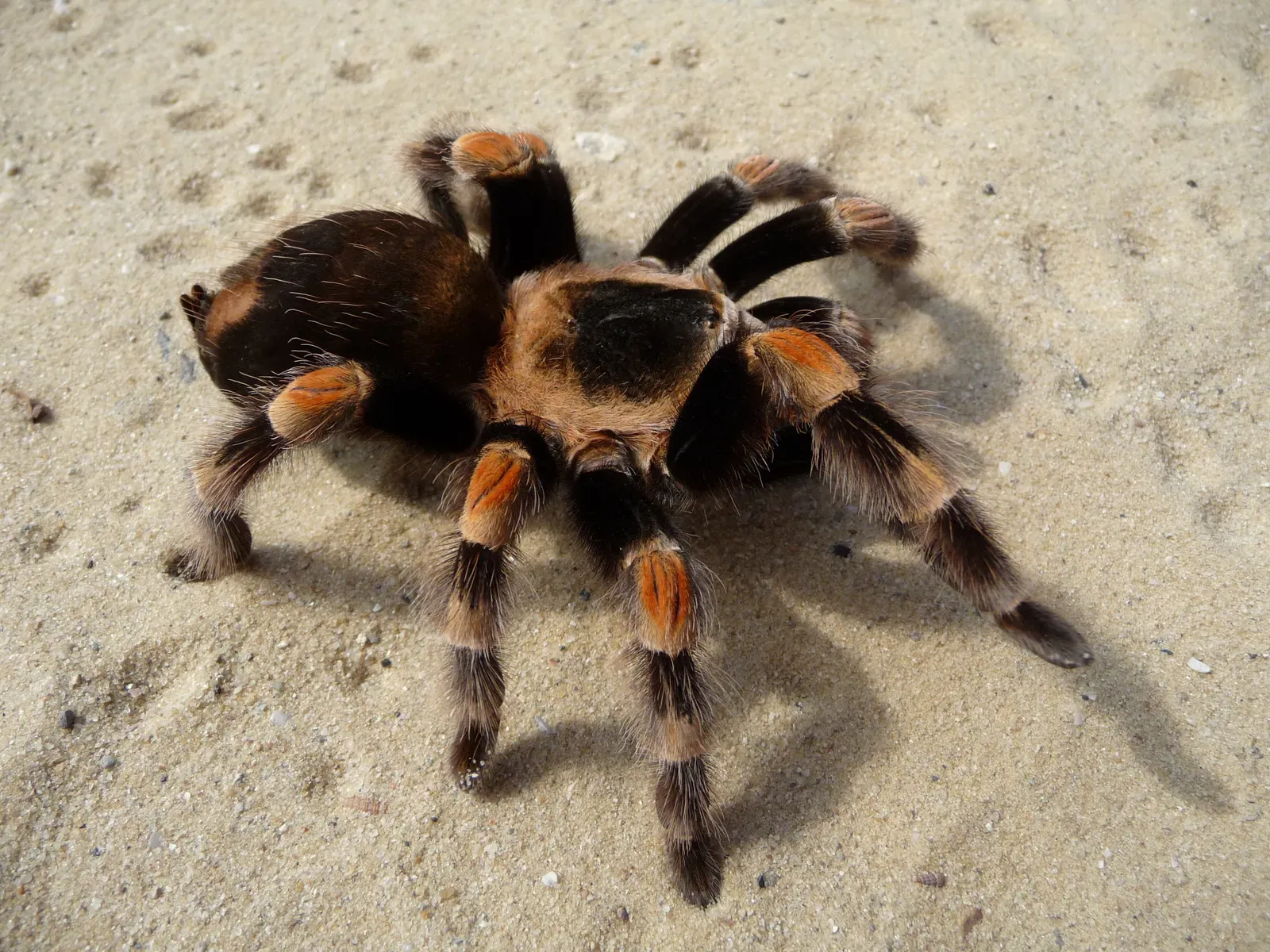
In dry forests and scrublands on Mexico’s Pacific coast, a dark, hairy spider waits by a burrow entrance. Its orange-red “knees” may look like tiny safety lights, but this shy hunter would much rather avoid a fuss than start one.
A flash of orange beside a burrow
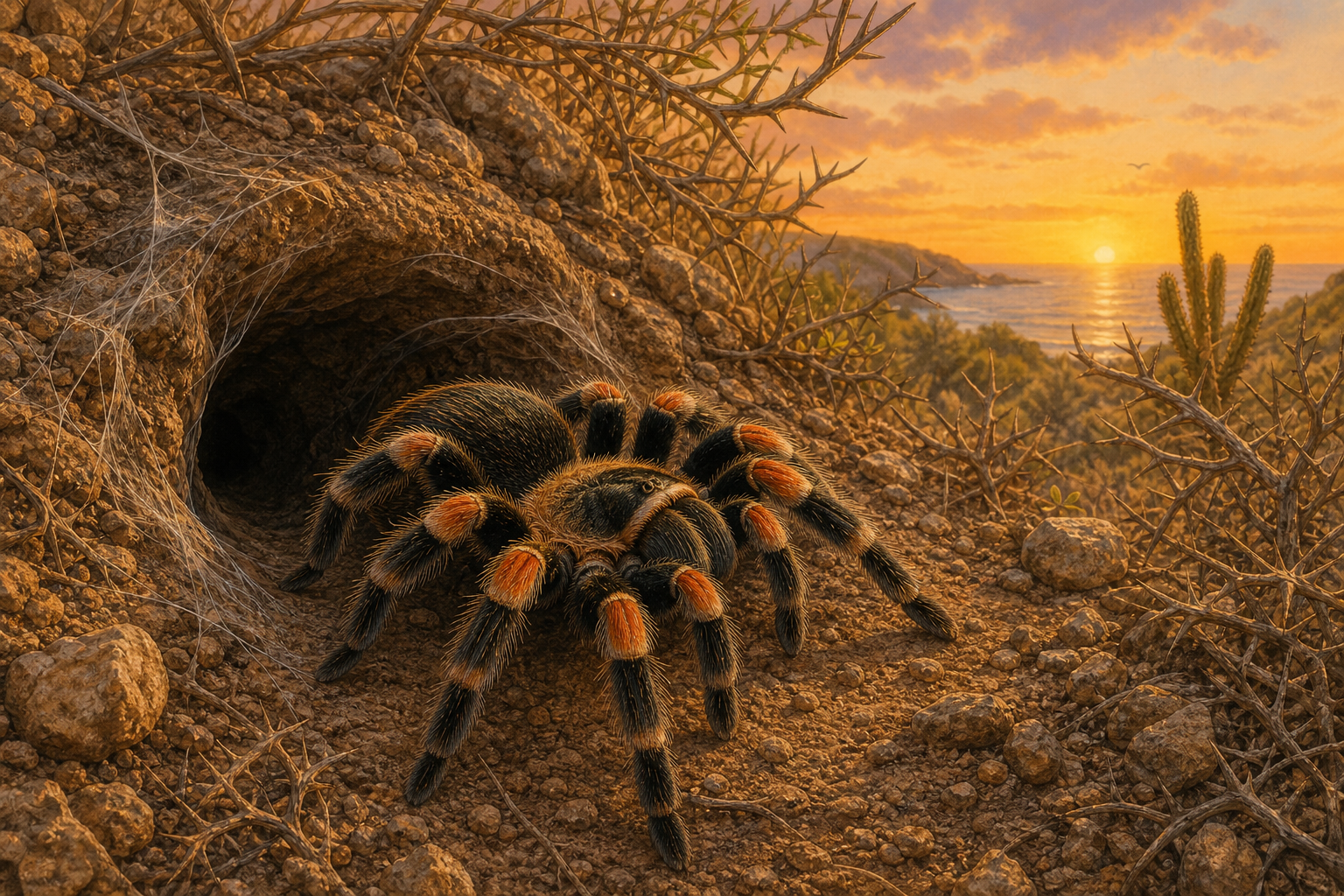
Imagine walking through warm, dry scrubland as daylight fades. There are rocks, thorny plants, and dusty ground that looks as if it has been sprinkled with cocoa powder. Near a small burrow, something dark and furry hardly moves at all. Then—flash!—bright orange-red bands show on its legs.
That is the Mexican redknee tarantula, Brachypelma hamorii. Its colourful knee bands stand out against its dark, hairy legs, giving this spider a look that is part velvet coat, part tiny firefighter uniform. It is a tarantula, which means it belongs to the spider group, not the insect group. Spiders have their own eight-legged branch of the animal family tree.
This animal is native to the central Pacific coast of Mexico. It lives in dry scrubland, dry thorn forest, and tropical deciduous forest—not a dripping rainforest scene, but places that can become dry for part of the year. A ground burrow among rocks or near thorny plants is its kind of address. Think less “web in the corner of a ceiling” and more “carefully chosen underground hideout.”
Evidence: IUCN Red List of Threatened Species: Brachypelma hamorii (Mexican Redknee Tarantula) — Red List Assessment; Animal Diversity Web, University of Michigan Museum of Zoology: Brachypelma smithi (Mexican redknee tarantula)
Why choose a burrow? Because it is a very good room
A Mexican redknee tarantula lives close to the ground and uses a burrow for shelter. Silk may appear near the entrance, but this is not the sort of spider that spins a giant net to catch flying snacks. The burrow is a safer, quieter place to wait, rest, and retreat when the world feels too busy.
Many tarantulas are solitary. This one does not need a crowd of spider neighbours or a team meeting. It is territorial and spends much of its life minding its own business near home. For a female, that familiar burrow can matter for a very long time.
The life spans of males and females can be strikingly different. Females may live around 25 to 30 years, while males generally have much shorter lives. That means a female may keep using the same patch of habitat through many seasons. A burrow is not just a hole in the soil; it is a home with a long story.
Evidence: Animal Diversity Web, University of Michigan Museum of Zoology: Brachypelma smithi (Mexican redknee tarantula); IUCN Red List of Threatened Species: Brachypelma hamorii (Mexican Redknee Tarantula) — Red List Assessment
Dinner does not fly into a web
So how does a burrow spider find food? It waits. The Mexican redknee is an ambush predator, often waiting near its burrow entrance for prey to come within reach. Insects, including beetles and crickets, are on the menu. Older natural-history accounts also record that these large tarantulas can sometimes take small animals such as frogs or mice.
When prey comes close, the tarantula grabs it and uses venom to immobilise it. This is not a recipe for people, obviously. Spiders digest food in their own unusual way, taking in liquefied tissues rather than chewing with little spider teeth. Nature has invented some extremely odd dinner tools.
By hunting small creatures, the tarantula is part of a local food web. It is a predator, but it can also be prey for animals such as birds and lizards. Even a powerful-looking, orange-kneed hunter has to stay alert. In nature, every creature is connected to someone else’s supper plan—which is a slightly rude but very real arrangement.
Is it fierce? Mostly, it would prefer a quiet exit
A big hairy spider can make a person jump backwards faster than a dropped ice cream. But the Mexican redknee tarantula is generally described as docile and shy. Its first choice is not to argue with a much larger animal. Its sensible plan is often to hide in its burrow.
If it feels threatened, though, it has a remarkable defence. With its back legs, it can flick tiny hairs from its abdomen. These are called urticating hairs, and they can irritate skin or eyes. Picture a very small, very itchy “please give me space” message. The hairs may give the tarantula time to escape rather than bite.
That is an important clue for wildlife watchers: admire wild animals from a respectful distance. Do not poke into burrows, try to pick up spiders, or test their defences. Being gentle is not the same as being a toy. A tarantula is an independent wild neighbour with its own important plans.
Evidence: Animal Diversity Web, University of Michigan Museum of Zoology: Brachypelma smithi (Mexican redknee tarantula); IUCN Red List of Threatened Species: Brachypelma hamorii (Mexican Redknee Tarantula) — Red List Assessment
A mother’s silk-wrapped treasure
The tarantula’s solitary life has one especially caring chapter. After mating, a female makes and guards a silk egg-sac. Accounts describe egg-sacs containing roughly 200 to 400 eggs. Later, she briefly protects the young spiderlings in the burrow before they disperse to begin their own tiny, eight-legged adventures.
The young do not stay in a family group forever. Eventually they spread out, each needing suitable ground, shelter, and food. That makes healthy dry forest and scrubland especially important: a spiderling cannot simply pack a suitcase and move into a paved car park.
There is also a naming wrinkle worth knowing. Mexican redknee tarantulas were long discussed under the name Brachypelma smithi, a closely related species. Today, the animal in this story is Brachypelma hamorii. Scientists sort out these family-name puzzles so that protection efforts can focus on the right animal in the right place.
Evidence: Animal Diversity Web, University of Michigan Museum of Zoology: Brachypelma smithi (Mexican redknee tarantula); IUCN Red List of Threatened Species: Brachypelma hamorii (Mexican Redknee Tarantula) — Red List Assessment
The burrow needs protecting, too
The Mexican redknee tarantula is listed as Vulnerable on the IUCN Red List, with a decreasing population trend. Two major problems are loss of dry forest and scrub habitat, and collection connected with the pet trade. When a burrow place is destroyed or a wild tarantula is taken away, the animal loses far more than a patch of dirt.
There is hope in careful action. Protecting Mexico’s Pacific-coast dry forests and scrublands protects the rocky, rooty places where tarantulas can make burrows. International trade in Brachypelma tarantulas is regulated through CITES Appendix II, which helps limit wild collection across borders.
You do not have to travel to Mexico to be a spider friend. You can practise noticing wildlife without disturbing it, share the message that wild animals belong in wild homes, and ask kind, curious questions about where animals come from. Respect can begin with something as small as not turning over a rock just to see who lives underneath.
Evidence: IUCN Red List of Threatened Species: Brachypelma hamorii (Mexican Redknee Tarantula) — Red List Assessment; Animal Diversity Web, University of Michigan Museum of Zoology: Brachypelma smithi (Mexican redknee tarantula)
A small kindness can reach a long way
Caring about a tarantula can lead to a surprisingly big thought: habitats are shared. Forests and scrublands support spiders, plants, insects, people, and many other animals. Our food choices are one of the ways we can practise that caring connection.
The World Health Organization describes healthy eating patterns as including foods such as vegetables, fruit, whole grains, pulses, nuts, and seeds. The IPCC reports that shifts toward sustainable, healthy, more plant-based diets can reduce pressure on land and biodiversity, as well as food-system emissions. That does not mean one lunch has to save the whole planet—sandwiches are not superheroes—but trying a bean dish, a lentil soup, or a veggie favourite can be a cheerful, animal-kind step.
If you are curious about changing what you eat, chat with a trusted adult. The important idea is simple: choose with care, celebrate plants on the plate, and remember that creatures with orange knees, furry legs, and underground homes are part of the same living world as us.
Evidence: World Health Organization: Healthy diet; Intergovernmental Panel on Climate Change: Climate Change 2022: Mitigation of Climate Change — Chapter 7
Kind choices for many-legged neighbours
A tarantula may seem very different from us, but it still needs a safe place to live, food to find, and freedom from being treated like a souvenir. Choosing to appreciate wild animals where they belong is a powerful kind of respect.
Our everyday choices can stretch beyond one burrow. WHO guidance includes a variety of plant foods—such as vegetables, fruits, pulses, whole grains, nuts, and seeds—as part of healthy dietary patterns. The IPCC finds that more plant-based, sustainable diets can lower pressure on land and biodiversity. With a trusted adult’s help, exploring plant-powered meals is a gentle way to care for animals and the places they call home.
Evidence: World Health Organization: Healthy diet; Intergovernmental Panel on Climate Change: Climate Change 2022: Mitigation of Climate Change — Chapter 7
Questions people ask
Does the Mexican redknee tarantula spin a big catching web?
No. It is a ground-dwelling burrow spider and an ambush hunter. Silk may be used around its burrow, but it waits for prey rather than catching it in a large flying-insect web.
Why are its knees orange-red?
Those bright bands are the feature that inspired its common name. Against the tarantula’s dark legs, they are wonderfully easy to notice.
Evidence: IUCN Red List of Threatened Species: Brachypelma hamorii (Mexican Redknee Tarantula) — Red List Assessment; Animal Diversity Web, University of Michigan Museum of Zoology: Brachypelma smithi (Mexican redknee tarantula)
Should someone handle one in the wild?
No. Give it space. When threatened, it can flick irritating hairs, and wild animals are safest when people leave them undisturbed in their homes.
Why is this tarantula vulnerable?
Its population is decreasing because dry forest and scrub habitat are lost, and because collection for the pet trade has put pressure on wild animals.
Evidence: IUCN Red List of Threatened Species: Brachypelma hamorii (Mexican Redknee Tarantula) — Red List Assessment; Animal Diversity Web, University of Michigan Museum of Zoology: Brachypelma smithi (Mexican redknee tarantula)
Read the evidence
Sources behind this story
- Brachypelma hamorii (Mexican Redknee Tarantula) — Red List Assessment — IUCN Red List of Threatened Species
- Brachypelma smithi (Mexican redknee tarantula) — Animal Diversity Web, University of Michigan Museum of Zoology
- Healthy diet — World Health Organization
- Climate Change 2022: Mitigation of Climate Change — Chapter 7 — Intergovernmental Panel on Climate Change
Health information is general education, not personal medical advice. Young readers should make food choices with a trusted adult and qualified health professional.