Today's animal friend · 19 August 2026
Meerkat Morning: The Tiny Desert Lookout with a Very Big Job
A small mongoose called a meerkat may be light enough to feel like a bag of apples, but its family teamwork is enormous. Let’s follow the lookout, the diggers and the brave bug-hunters.
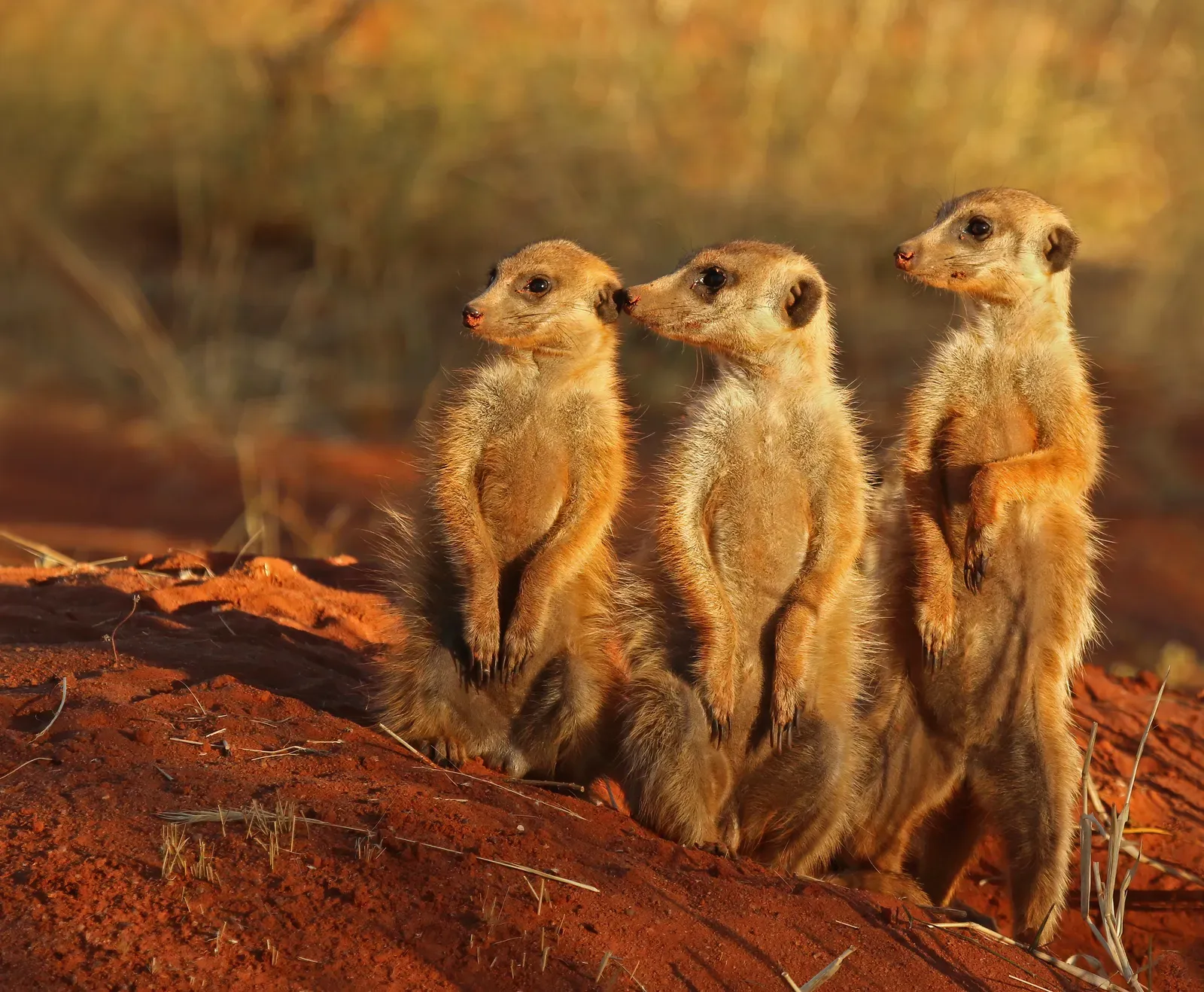
A small mongoose called a meerkat may be light enough to feel like a bag of apples, but its family teamwork is enormous. Let’s follow the lookout, the diggers and the brave bug-hunters.
A tail pops up from the sand
The dry morning is warming up in southern Africa. Sand crunches softly. Somewhere under the ground, a tunnel has gone from cool and dark to busy-busy-busy. Then—pop!—a small animal appears at a burrow entrance, rises tall on its back legs and looks around as if it has just remembered an important appointment.
This is a meerkat, also called a suricate. Its scientific name is Suricata suricatta, and it belongs to the mongoose family. A meerkat is a mammal, but not a giant, roaring kind of Carnivora animal. It is a slim little desert neighbour with a pointy face, bright eyes, a long thin tail and sharp digging claws.
Adults are roughly 24.5 to 29 centimetres from head to body—shorter than many school rulers placed end to end—and their mass is around 720 to 731 grams. Small does not mean unimportant. In a dry, open landscape, a watchful little animal can make a very big difference to its friends.
Meerkats live in arid and semi-arid parts of southern Africa, including desert, savanna and grassland. These are places where shade matters, water can be scarce and the sky may feel enormous. Their day begins in daylight, because meerkats are active during the day. First sunshine, then business. A sensible schedule, really.
Evidence: IUCN Red List of Threatened Species: Suricata suricatta (Meerkat) — Red List Assessment; Animal Diversity Web, University of Michigan Museum of Zoology: Suricata suricatta (meerkat)
Home is a maze with more than one door
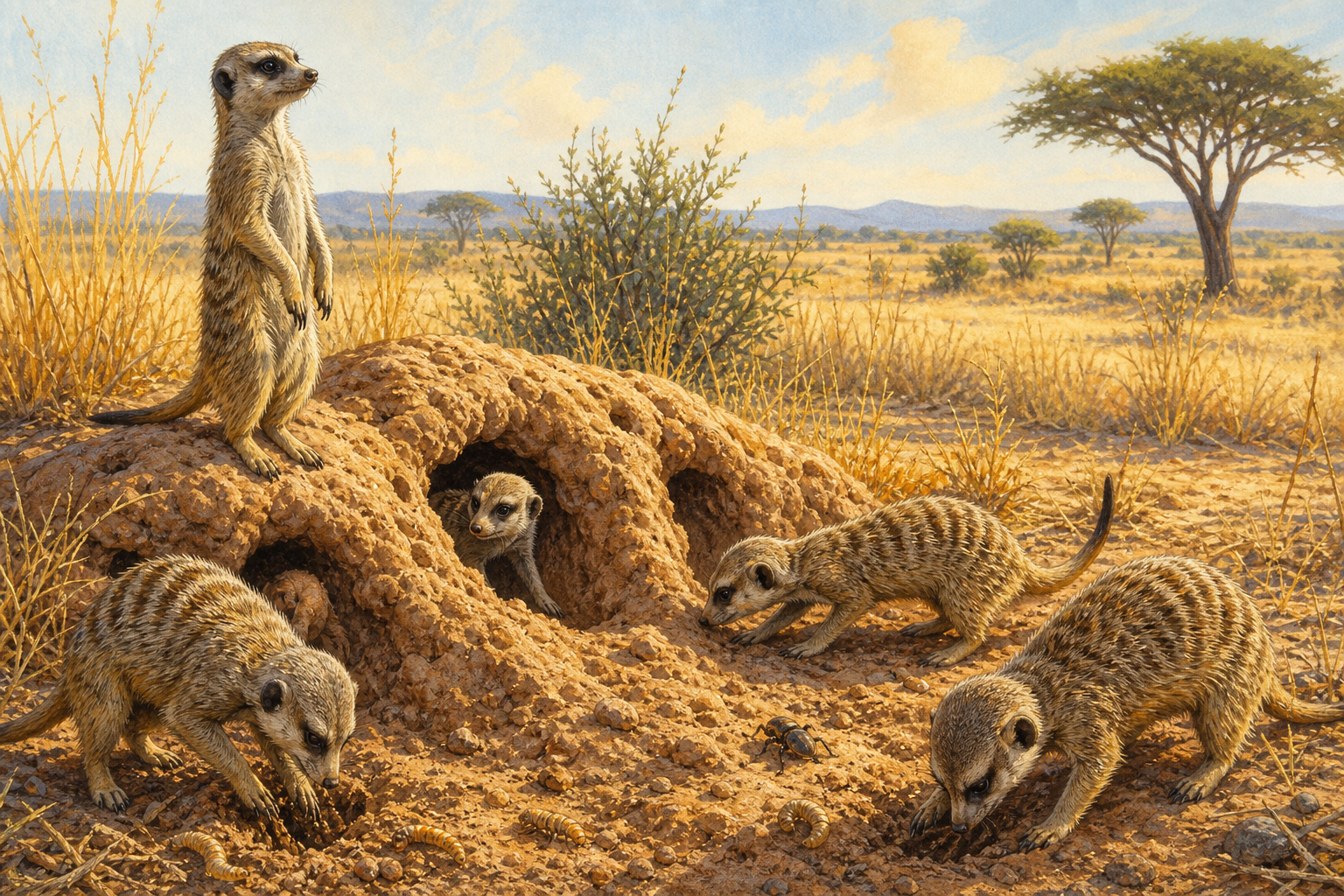
A meerkat burrow is not just a hole in the ground. It is an underground home with tunnels and several entrances. Imagine a secret clubhouse with escape routes, except the builders have paws instead of pencils and hard hats.
The burrows offer shelter in the hot, dry places where meerkats live. A group can dig and use these tunnel systems, then head above ground to search for food. Having more than one entrance is handy when the world outside feels a little too exciting. A meerkat can vanish underground with the speed of someone who has heard the words, “Time to tidy your room.”
Their claws are made for digging, and their open-country home gives them room to scan for danger. Yet a burrow is more than a hiding place in this story. It is the starting line for a whole community’s day: friends emerging, noses twitching, paws scratching and tails following one another out into the sun.
Meerkats may live for about 5 to 15 years in the wild. Over those years, a familiar burrow system and a dependable group can be especially valuable. In the meerkat world, home is not only where you sleep. It is where the team gathers before heading out.
Evidence: Animal Diversity Web, University of Michigan Museum of Zoology: Suricata suricatta (meerkat); IUCN Red List of Threatened Species: Suricata suricatta (Meerkat) — Red List Assessment
Who packed the lunch? Mostly beetles
Once the mob is out and about, the ground becomes a treasure map. Meerkats are primarily insect-eaters. They dig and search for beetles, caterpillars and other small creepy-crawlies. They also eat spiders and scorpions, and sometimes small reptiles. For a meerkat, a wriggly snack is not a reason to squeal and leap onto a chair. It is lunch.
One especially surprising fact: meerkats can eat scorpions because they are resistant to scorpion venom. That does not make a scorpion harmless, or turn it into a pet for people. It simply shows how remarkable a meerkat’s body and food-finding skills are in its own habitat.
Why dig so eagerly? Food can be hidden below the surface, and a small animal needs plenty of energy for walking, watching, calling and keeping up with the group. A meerkat’s pointed face and busy paws are perfect for this ground-level scavenger hunt.
As insect-eating predators and burrowing mammals, meerkats are part of the life of southern African drylands. Their ordinary-looking actions—sniff, scratch, nibble, dash—are woven into a much larger living place. The sandy ground is not empty at all. It is full of homes, meals, neighbours and clues.
Evidence: Animal Diversity Web, University of Michigan Museum of Zoology: Suricata suricatta (meerkat); IUCN Red List of Threatened Species: Suricata suricatta (Meerkat) — Red List Assessment
The lookout who says, “Heads up!”
Picture a group of friends searching for dropped coins in a playground. Everyone is looking down—until one friend volunteers to watch the gate. A meerkat mob does something a bit like that. While others forage, one individual may stand upright as a sentinel, scanning for danger.
If the lookout notices trouble, it gives alarm calls. The other meerkats can respond by hurrying to safety, often back toward their burrows. The sentinel is not wearing a tiny badge or carrying a whistle, sadly. But the job is real, and it helps the group forage with more awareness in open country.
This is shared teamwork, not a one-meerkat superhero show. Sentinel duty is taken by different group members and is connected with the group’s social life. Meerkats live in groups called mobs, which can include about 2 to 50 individuals. Several family units may be part of the same mob.
Adults also commonly help to rear the young of the dominant female. That means little meerkats can grow up surrounded by helpers. A mob is noisy, alert and cooperative: one animal digs, another searches, another watches, and adults help care for babies. It is a powerful reminder that being small is easier when no one has to manage everything alone.
Next time you spot someone helping a younger child, taking a turn at a task or keeping an eye out for a friend, think of the upright meerkat. Teamwork does not have to be grand and flashy. Sometimes it looks like standing still, paying attention and giving a timely call.
Evidence: Animal Diversity Web, University of Michigan Museum of Zoology: Suricata suricatta (meerkat); IUCN Red List of Threatened Species: Suricata suricatta (Meerkat) — Red List Assessment
Doing well does not mean “nothing matters”
The IUCN conservation status for meerkats is Least Concern, and the registered assessment notes describe their population trend as stable. That is welcome news: meerkats are not currently identified as needing a species-wide emergency recovery programme.
Still, “Least Concern” is not a magic shield. Meerkats depend on intact dry and semi-dry habitats where they can dig burrows and find insect prey. Drought and extreme heat may put local pressure on animals living in already hot, dry places, even though these are not described as a measured range-wide decline.
The kindest way to care is to value the whole place, not merely the cute face above the sand. A burrow needs ground. A hungry meerkat needs prey. A mob needs room to move, watch and return home. Protecting habitats means protecting the many connected lives within them.
And there is a hopeful feeling in that idea. The meerkat’s future is not a lonely story about one animal. It is a story about living landscapes, careful choices and people who notice that a sandy patch can be somebody’s busy, bustling home.
Evidence: IUCN Red List of Threatened Species: Suricata suricatta (Meerkat) — Red List Assessment; Animal Diversity Web, University of Michigan Museum of Zoology: Suricata suricatta (meerkat)
A friendly choice beyond the burrow
Caring about meerkats can begin with a simple thought: every animal has its own important life, whether it is a sentinel on the sand, a beetle under a stone or a person choosing lunch. We do not need to copy a meerkat’s insect menu—definitely not!—to notice that animals are neighbours, not things.
With a trusted adult, families can enjoy more meals built around beans, lentils, vegetables, fruit, whole grains, nuts and seeds. The World Health Organization describes these foods as part of varied healthy diets. The IPCC reports that shifts toward sustainable, healthy, more plant-based diets can reduce food-system emissions and pressure on land and biodiversity. A colourful plant-based meal can be one gentle, hopeful way to care about animals and the places they call home.
Evidence: World Health Organization: Healthy diet; Intergovernmental Panel on Climate Change: Climate Change 2022: Mitigation of Climate Change — Chapter 7
Questions people ask
Is a meerkat a cat?
No. Despite the name, a meerkat is a mongoose in the family Herpestidae. Its scientific name is Suricata suricatta, and another name for it is suricate.
Evidence: Animal Diversity Web, University of Michigan Museum of Zoology: Suricata suricatta (meerkat); IUCN Red List of Threatened Species: Suricata suricatta (Meerkat) — Red List Assessment
Why do meerkats stand upright?
While the group is foraging, one meerkat often acts as a sentinel. Standing upright helps it watch for danger, and it can give alarm calls to alert the others.
Evidence: Animal Diversity Web, University of Michigan Museum of Zoology: Suricata suricatta (meerkat); IUCN Red List of Threatened Species: Suricata suricatta (Meerkat) — Red List Assessment
Do all meerkats live alone in burrows?
No. They are social animals that live in mobs of roughly 2 to 50 individuals. Group members use burrows, forage together and commonly help rear young.
Evidence: Animal Diversity Web, University of Michigan Museum of Zoology: Suricata suricatta (meerkat); IUCN Red List of Threatened Species: Suricata suricatta (Meerkat) — Red List Assessment
Can a meerkat really eat a scorpion?
Yes. Scorpions are among the prey meerkats can eat, and the Animal Diversity Web account reports that meerkats are resistant to scorpion venom.
Evidence: Animal Diversity Web, University of Michigan Museum of Zoology: Suricata suricatta (meerkat)
Read the evidence
Sources behind this story
- Suricata suricatta (Meerkat) — Red List Assessment — IUCN Red List of Threatened Species
- Suricata suricatta (meerkat) — Animal Diversity Web, University of Michigan Museum of Zoology
- Healthy diet — World Health Organization
- Climate Change 2022: Mitigation of Climate Change — Chapter 7 — Intergovernmental Panel on Climate Change
Health information is general education, not personal medical advice. Young readers should make food choices with a trusted adult and qualified health professional.