Today's animal friend · 7 November 2026
Luna Moth: The Moon-Green Visitor of the Night
A luna moth may spend only about a week as a grown-up, but its moonlit adventure begins long before it opens those spectacular wings.
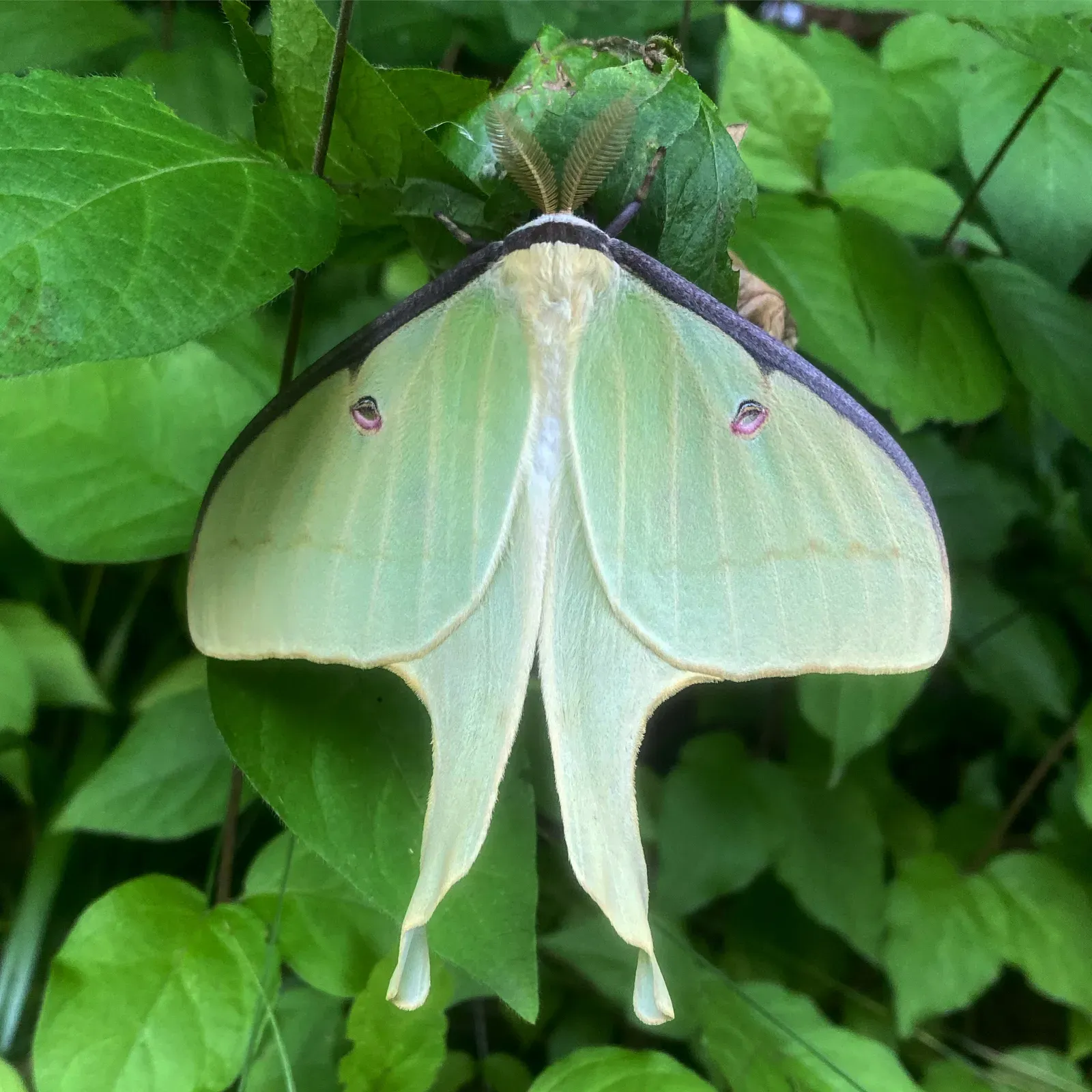
A luna moth may spend only about a week as a grown-up, but its moonlit adventure begins long before it opens those spectacular wings.
A flutter like a tiny moon
Imagine you are outside after dark. The trees are mostly black shapes, the air feels cool on your arms, and the leaves make a secret shhhh in the breeze. Then something pale floats past: not a scrap of paper, not a ghost’s handkerchief, but a luna moth.
A luna moth, also called the American moon moth, is a large silk moth of North American woodland and forests. Its pale-green wings have long, sweeping tails on the back pair. With a wingspan of about 8 to 11.5 centimetres, it can be as wide as a child’s outstretched hand. That is quite a lot of wing for an insect!
Its scientific name is Actias luna. “Luna” means moon, and once you have seen that soft green shine against a dark tree trunk, the name makes perfect sense. It looks as if a moonbeam decided it wanted wings.
Evidence: IUCN Red List of Threatened Species: Actias luna (Luna Moth) — Red List conservation status; Animal Diversity Web, University of Michigan Museum of Zoology: Actias luna (luna moth); Wikipedia: Luna moth
How can a moth skip dinner forever?
Here is the luna moth’s most surprising trick: grown-up luna moths do not eat. They have only tiny, non-working mouthparts, so there is no sipping nectar, nibbling leaves, or stopping for a midnight snack.
That sounds impossible at first. But the adult moth carries energy saved during its caterpillar days, rather like setting aside packed lunches before a very short trip. As a caterpillar, it eats leaves from broadleaf trees such as birch, walnut, hickory, and sweet gum. Those leafy meals power the change to moth and the adult’s brief life afterward.
An adult luna moth usually lives for only about 7 to 10 days. Its main job in that time is to find a mate and help begin the next generation. A short life does not mean an unimportant one. Every moth is part of a long, leafy story that connects trees, caterpillars, cocoons, and nighttime wings.
Evidence: Animal Diversity Web, University of Michigan Museum of Zoology: Actias luna (luna moth); Wikipedia: Luna moth
First, be a very hungry leaf-muncher
Before it is a floating green wonder, a luna moth is a caterpillar. This is the eating stage—the serious salad stage. A caterpillar feeds on leaves, growing and storing the energy that the adult moth will later need.
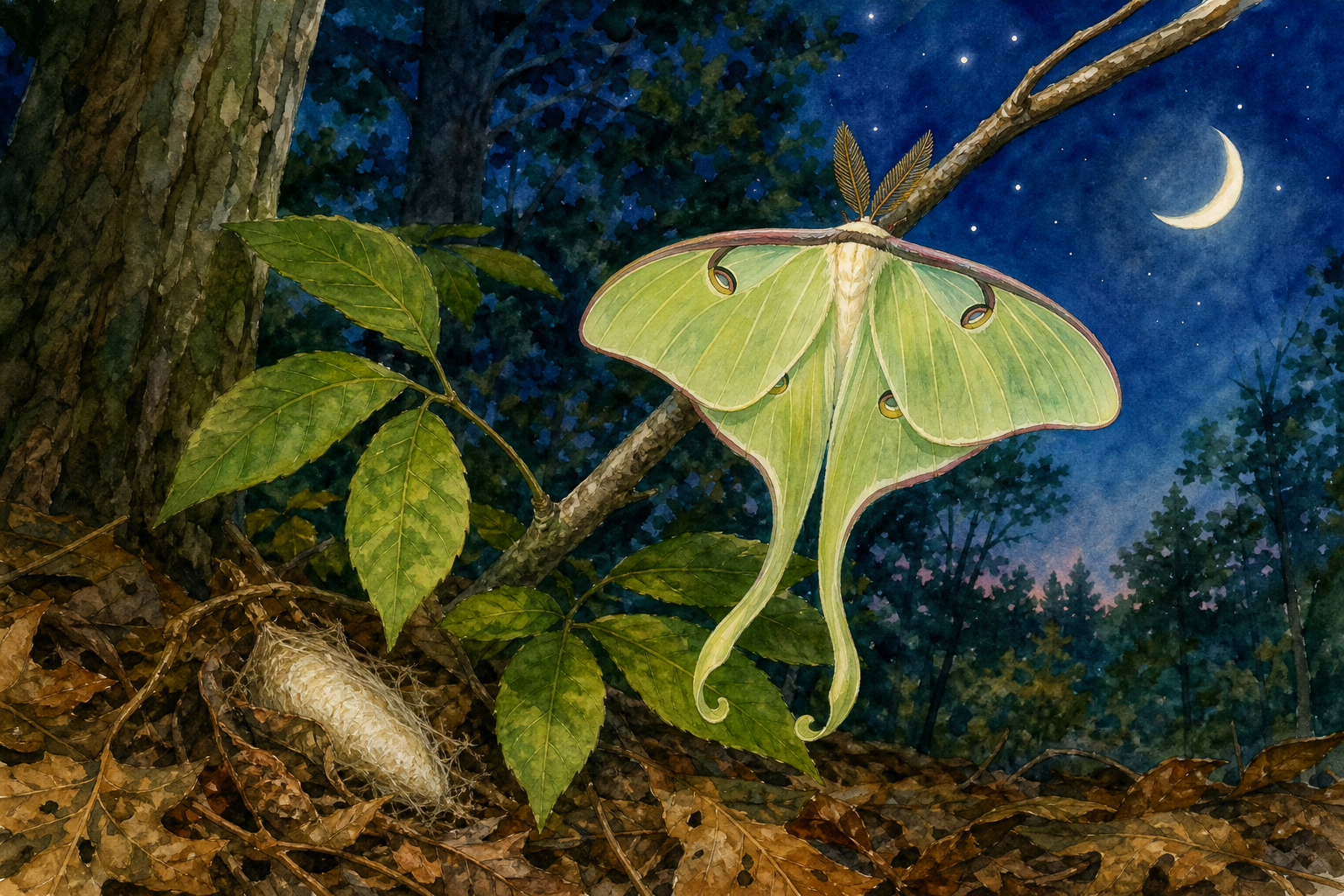
When the caterpillar is ready, it spins a silk cocoon among leaf litter. Inside, a remarkable transformation takes place. Eventually, the adult moth emerges with wings that are small, damp, and crumpled at first. It waits while they expand and dry. Think of a folded raincoat slowly opening, except this raincoat can fly.
Luna moth caterpillars are herbivores, and their leaf-eating is part of woodland life. They do not build up in numbers that cause significant damage to their host trees. A forest can hold many stories at once: a hickory leaf, a caterpillar meal, a cocoon tucked into fallen leaves, and a moth ready for the night.
Evidence: Animal Diversity Web, University of Michigan Museum of Zoology: Actias luna (luna moth); Wikipedia: Luna moth
Why are they so hard to spot?
Luna moths are active at night. That is one big reason people rarely see them, even where they are not rare. While many of us are brushing our teeth or dreaming about pancakes, luna moths may be moving through the dark woods.
Adult moths do not travel around in big, chatty clubs. They are solitary. Females release scent signals called pheromones from host trees, and males can locate them using their wonderfully feathery antennae. Those antennae are not decorations; they help with the nighttime search.
Their woodland homes are mostly in eastern North America, stretching from parts of Canada through the eastern United States. They live where suitable deciduous trees grow, and they can also occur in suburban places with the right host trees. So a quiet yard with leafy trees may hold more nighttime drama than it first appears.
Evidence: Animal Diversity Web, University of Michigan Museum of Zoology: Actias luna (luna moth); Wikipedia: Luna moth
A little darkness can be a kindness
A luna moth’s pale wings are beautiful to us, but bright nighttime lighting can make life harder for wild silk moths by disrupting mating. Habitat destruction has also been linked with declines in wild silk moths since the 1960s. Scientists do not have a species-specific global IUCN assessment for the luna moth, so it is listed as Not Evaluated there. That means there is an important gap in what has been formally assessed—not a reason to stop caring.
There are cheerful, practical ways to be a good neighbour to night-fliers. Keep deciduous trees and fallen leaves where it is safe to do so, because caterpillars need host plants and cocoons can be among leaf litter. At night, ask a grown-up whether outdoor lights truly need to be on, or whether they can be switched off when nobody is using them.
You may never see a luna moth in your own yard. Still, saving a dark corner and a leafy patch is a bit like leaving the door open for a very shy, moon-green guest.
Evidence: IUCN Red List of Threatened Species: Actias luna (Luna Moth) — Red List conservation status; Animal Diversity Web, University of Michigan Museum of Zoology: Actias luna (luna moth); Wikipedia: Luna moth
What can one gentle moth teach us?
The luna moth does not need to be loud, fierce, or famous to matter. It spends its caterpillar days eating leaves, its cocoon days hidden away, and its adult days flying under the stars. Yet it gives us a reason to notice trees, nighttime darkness, and the smaller neighbours sharing our world.
If you hope to spot one, be kind to its privacy. Look quietly near woodland edges or leafy places after dark, with a trusted adult, and do not chase or handle any moth you find. A quick glimpse is a gift, not a treasure to take home.
Then look up at the branches. Somewhere, a leaf may be growing food for a caterpillar; somewhere else, a cocoon may be waiting. The night is not empty at all. It is simply busy in a softer voice.
Evidence: Animal Diversity Web, University of Michigan Museum of Zoology: Actias luna (luna moth); Wikipedia: Luna moth
A kinder plate, a kinder patch of planet
Caring about a luna moth can begin with caring about the living world around its trees. Plant-forward meals are one positive choice families can explore together: the World Health Organization describes healthy eating patterns as including foods such as vegetables, fruit, whole grains, pulses, nuts, and seeds. Food needs differ from person to person, so choices are best discussed with a trusted adult and, when needed, a qualified health professional.
Choosing more plant-based foods can also be a gentle vote for land and biodiversity. The IPCC reports that shifts toward sustainable, healthy, more plant-based diets can reduce food-system emissions and pressure on land and biodiversity. No lunch has to be perfect. A bean burrito, lentil soup, fruit, or a favourite veggie dish can be a small, cheerful way to practise kindness toward animals—including quiet creatures with moon-green wings.
Evidence: World Health Organization: Healthy diet; Intergovernmental Panel on Climate Change: Climate Change 2022: Mitigation of Climate Change — Chapter 7
Questions people ask
Are luna moths actually green?
Yes. Adult luna moths have pale green wings, with long tails on their hindwings. Their colour can make them look almost magical in dim light.
Evidence: Animal Diversity Web, University of Michigan Museum of Zoology: Actias luna (luna moth); Wikipedia: Luna moth
Do luna moths bite or sting?
The supplied species accounts describe luna moths as leaf-eating caterpillars and non-feeding adults. If you find one, the kindest choice is to watch without handling it.
Evidence: Animal Diversity Web, University of Michigan Museum of Zoology: Actias luna (luna moth); Wikipedia: Luna moth
Why does an adult luna moth not eat?
Adult luna moths have vestigial, non-working mouthparts. They live on energy stored during their caterpillar stage and focus their short adult lives on reproduction.
Evidence: Animal Diversity Web, University of Michigan Museum of Zoology: Actias luna (luna moth); Wikipedia: Luna moth
Is the luna moth endangered?
It has not received a global IUCN Red List assessment, so its IUCN status is Not Evaluated. The available sources do not give a species-specific global population trend.
Evidence: IUCN Red List of Threatened Species: Actias luna (Luna Moth) — Red List conservation status; Animal Diversity Web, University of Michigan Museum of Zoology: Actias luna (luna moth); Wikipedia: Luna moth
Read the evidence
Sources behind this story
- Actias luna (Luna Moth) — Red List conservation status — IUCN Red List of Threatened Species
- Actias luna (luna moth) — Animal Diversity Web, University of Michigan Museum of Zoology
- Luna moth — Wikipedia
- Healthy diet — World Health Organization
- Climate Change 2022: Mitigation of Climate Change — Chapter 7 — Intergovernmental Panel on Climate Change
Health information is general education, not personal medical advice. Young readers should make food choices with a trusted adult and qualified health professional.