Today's animal friend · 6 November 2026
Lion: The Roar That Crosses a Town
At twilight on a savanna, a lion’s roar can roll over the grass for about eight kilometres. Meet Panthera leo: a family-minded hunter, a mighty voice, and a wild neighbour worth protecting.
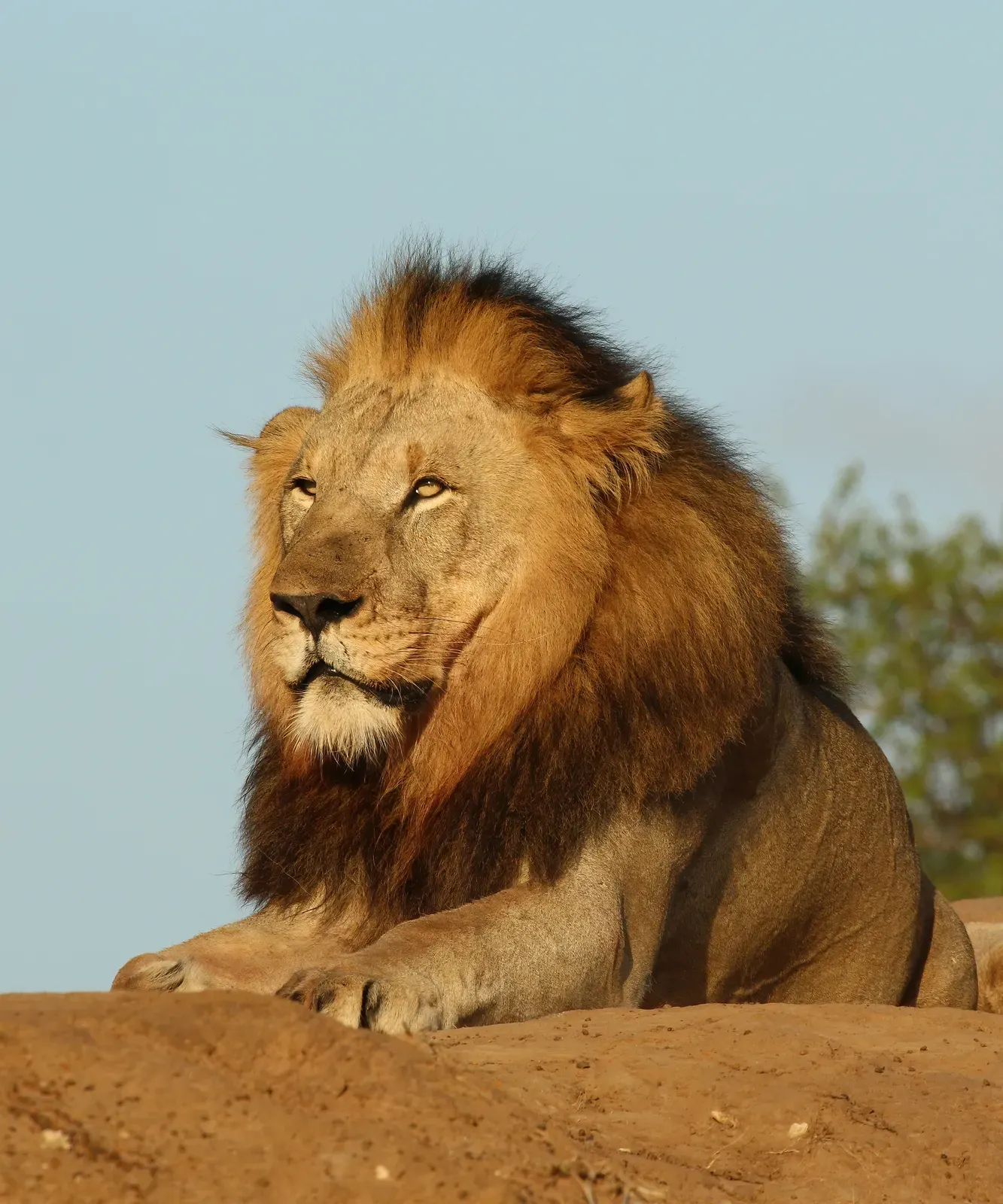
At twilight on a savanna, a lion’s roar can roll over the grass for about eight kilometres. Meet Panthera leo: a family-minded hunter, a mighty voice, and a wild neighbour worth protecting.
Listen—did the grass just thunder?
Twilight settles over open grassland. The daytime heat is slipping away, and the savanna seems to hold its breath. Then comes a deep, rolling roar. It is not a tiny “mew, please open my dinner” sound. A lion’s roar can carry about eight kilometres across open country—roughly from one far side of a town to the other.
That booming call belongs to the lion, Panthera leo, a big cat found in parts of Africa and, in one remaining Asiatic population, around India’s Gir Forest. Lions live where there is open country: grassland, savanna, scrub, and open woodland with cover and hoofed animals to hunt. They are not built for hiding in thick rainforest all day, and true desert is not their usual home either.
A lion’s golden coat can blend with dry grass like a sunbeam that learned to walk. Adult males usually grow a shaggy mane around the head and neck; lionesses are generally smooth and sleek. Yet the first thing to notice may be neither coat nor mane. It may be that enormous, far-travelling voice: a message sent through the evening air.
Evidence: IUCN Red List of Threatened Species: Panthera leo (Lion) — Red List Assessment; Animal Diversity Web, University of Michigan Museum of Zoology: Panthera leo (lion); Smithsonian’s National Zoo and Conservation Biology Institute: Lion
Why are lions rarely alone? Meet the pride
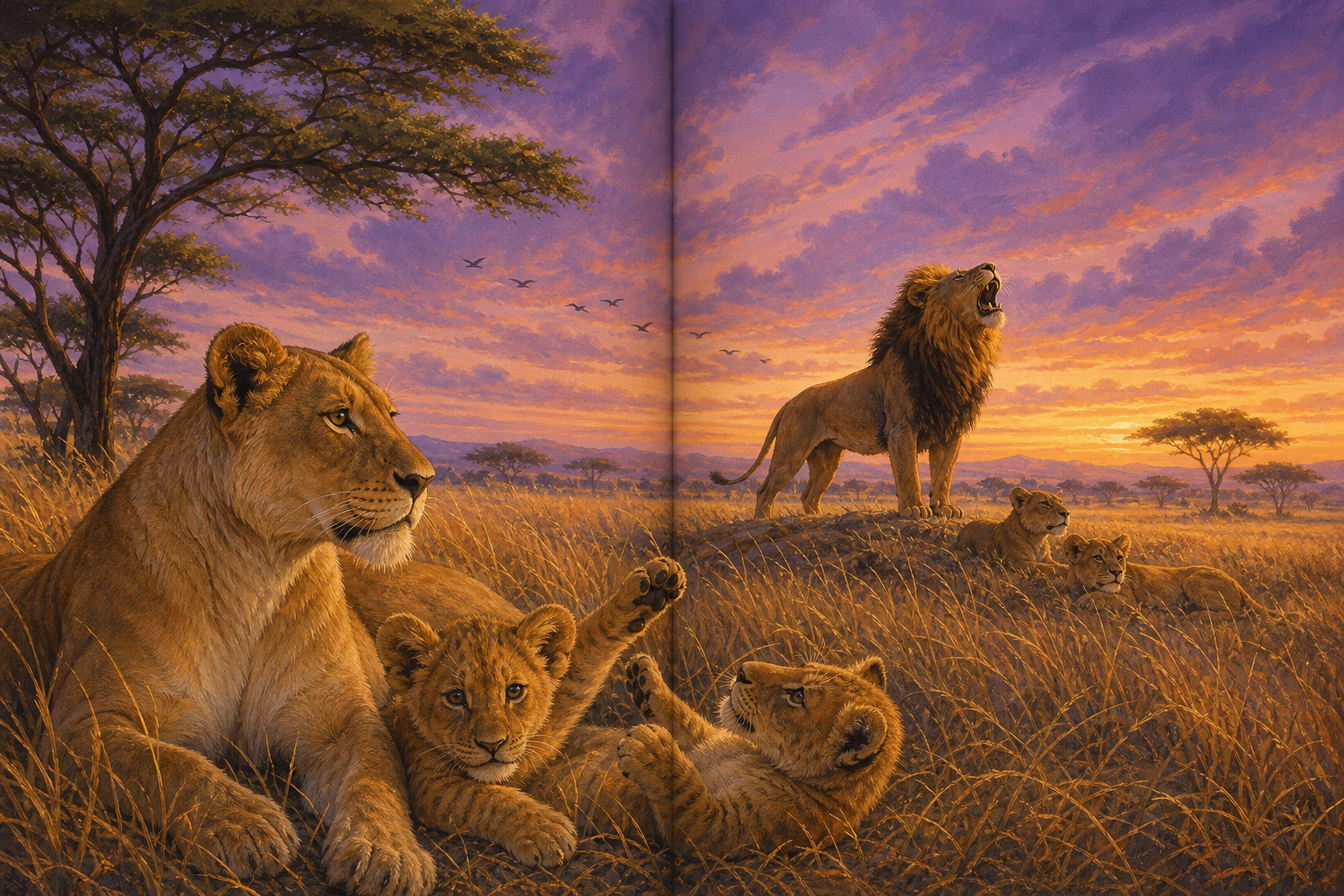
Many big cats prefer a mostly solitary life, but lions are famous for doing things differently. They live in family groups called prides. A pride may be a small gathering or a much bigger group, with related females, cubs, and one or more resident males. Think of it as an extended family with no front door and a very impressive group chat—mostly made of roars, scents, and watchful looks.
The females in a pride are often related and may remain together for life. Cubs grow up among adults and other youngsters, in a busy social world of resting, playing, following, and learning. Lions can also split into smaller groups and come back together again, depending on what is happening around them.
Roaring helps lions keep track of one another over long distances and signals where a pride lives. Both males and females can roar. In an open landscape, where grass ripples and sounds travel, a roar is a practical announcement: “We are here.” It is also one of the most spine-tingly sounds in the wild.
Evidence: Animal Diversity Web, University of Michigan Museum of Zoology: Panthera leo (lion); Smithsonian’s National Zoo and Conservation Biology Institute: Lion; IUCN Red List of Threatened Species: Panthera leo (Lion) — Red List Assessment
When the sun gets bossy, lions take a break
A lion can be about 2.4 to 3.3 metres long and stand around 1.1 to 1.2 metres at the shoulder. Adults commonly weigh roughly 120 to 250 kilograms, depending on sex and population. In other words, this is not a cat you could scoop up for a windowsill nap. Even so, lions often spend hot daytime hours resting.
That makes sense. Moving around under a blazing sun takes energy, especially for a large, fur-covered animal. Lions are often more active toward evening and at night, when the air cools and shadows stretch long over the ground. If you ever imagined lions racing about nonstop like superheroes in a film, nature has a gentler answer: sometimes the clever plan is to lie down and save your strength.
As night arrives, eyes and ears become especially useful. The open land is full of rustles, hoofbeats, and distant calls. A lion is part of that huge nighttime conversation—not the whole story, but an important wild neighbour in savanna and woodland ecosystems.
Evidence: Animal Diversity Web, University of Michigan Museum of Zoology: Panthera leo (lion); Smithsonian’s National Zoo and Conservation Biology Institute: Lion
What’s for dinner? A teamwork question
Lions are carnivores. Their prey includes medium to large hoofed mammals such as zebras, wildebeest, antelopes, gazelles, and buffalo. These are powerful, alert animals, so finding food is not as simple as strolling to a cupboard and choosing a snack.
Lionesses usually do most of the pride’s cooperative hunting. Working together can help when pursuing large prey, though hunting is never guaranteed. A hunt can end in a meal, or it can end with the prey escaping and the lions needing to rest, wait, and try again. Wild lives are full of effort.
It can feel strange to care about every animal in this story at once—the lions and the animals they hunt. But we can. A healthy wild place needs many living things: grasses, trees, insects, grazing animals, and predators. Lions depend on wild prey, and when prey becomes scarce, lions face an even harder future.
Evidence: Animal Diversity Web, University of Michigan Museum of Zoology: Panthera leo (lion); Smithsonian’s National Zoo and Conservation Biology Institute: Lion; IUCN Red List of Threatened Species: Panthera leo (Lion) — Red List Assessment
A famous cat with a shrinking map
Lions once lived across a much wider area. Today, their populations are mainly fragmented across sub-Saharan Africa, with one Asiatic population in and around India’s Gir Forest. “Fragmented” means the places where lions live are broken into separated pieces, rather than forming one big connected home. Imagine trying to visit friends when all the paths between neighbourhoods keep disappearing.
The IUCN lists the lion as Vulnerable, with a decreasing population trend in its 2016 assessment. Lions face habitat loss and fragmentation, fewer wild prey animals, and conflict with people and livestock, especially outside well-connected protected areas. These challenges are serious, but they do not mean we should turn away. They are reasons to pay attention.
There is real hope in practical care: protecting connected reserves, helping wild prey recover, and finding ways to reduce conflict between people, livestock, and lions. Dedicated protection is already important around Gir. A lion needs more than a dramatic roar to thrive. It needs space, food, safer pathways, and human neighbours who choose coexistence.
Evidence: IUCN Red List of Threatened Species: Panthera leo (Lion) — Red List Assessment; Animal Diversity Web, University of Michigan Museum of Zoology: Panthera leo (lion); Smithsonian’s National Zoo and Conservation Biology Institute: Lion
A small way to be on Team Lion
You may live very far from a pride, but your choices can still practise the kind of care lions deserve: noticing that animals have their own families, homes, and needs. Learn about wildlife-friendly places, share true lion facts, and ask grown-ups how parks and conservation groups protect habitats.
Food can be one gentle place to begin, too. For many meals, families can explore tasty plant-forward choices—perhaps beans in a burrito, lentils in soup, chickpeas in a curry, or a crunchy handful of nuts and seeds where safe to eat. The World Health Organization describes healthy diets as including foods such as vegetables, fruit, whole grains, pulses, nuts, and seeds. The IPCC reports that shifts toward sustainable, healthy, more plant-based diets can reduce pressure from food systems on climate, land, and biodiversity.
This is not a test, and nobody needs a perfect lunchbox. It is an invitation to be curious and kind. If you want to make changes to what you eat, talk with a trusted adult and, when needed, a qualified health professional. One thoughtful choice can be a quiet cheer for animals and the living world they share with us.
Evidence: World Health Organization: Healthy diet; Intergovernmental Panel on Climate Change: Climate Change 2022: Mitigation of Climate Change — Chapter 7; IUCN Red List of Threatened Species: Panthera leo (Lion) — Red List Assessment
Kindness can travel farther than a roar
Lions remind us that animals are not decorations in a landscape. Each pride is a web of family life, each cub needs a safe place to grow, and each wild home needs care. We can hold that thought when we choose how to spend, eat, learn, and speak up for nature.
Trying more plant-based foods can be one hopeful action. WHO guidance includes a variety of plant foods—vegetables, fruits, whole grains, pulses, nuts, and seeds—as part of healthy diets, while the IPCC finds that sustainable, healthy, more plant-based dietary shifts can help reduce food-system pressure on climate, land, and biodiversity. Explore with kindness, alongside a trusted adult; care is more important than being perfect.
Evidence: World Health Organization: Healthy diet; Intergovernmental Panel on Climate Change: Climate Change 2022: Mitigation of Climate Change — Chapter 7
Questions people ask
Do all lions have manes?
No. Adult male lions are usually the ones that grow a full, shaggy mane around the head and neck. Lionesses are generally sleek and do not have one.
Evidence: Animal Diversity Web, University of Michigan Museum of Zoology: Panthera leo (lion); Smithsonian’s National Zoo and Conservation Biology Institute: Lion
Where do lions live today?
Lions now live mainly in fragmented parts of sub-Saharan Africa. One Asiatic population remains in and around India’s Gir Forest landscape.
Evidence: Animal Diversity Web, University of Michigan Museum of Zoology: Panthera leo (lion); Smithsonian’s National Zoo and Conservation Biology Institute: Lion; IUCN Red List of Threatened Species: Panthera leo (Lion) — Red List Assessment
Why do lions roar?
Roaring can help lions communicate across open land, including helping pride members locate one another and signalling where they are. Both females and males roar.
Evidence: Animal Diversity Web, University of Michigan Museum of Zoology: Panthera leo (lion); Smithsonian’s National Zoo and Conservation Biology Institute: Lion
Are lions in danger?
The IUCN assessed lions as Vulnerable in 2016, with a decreasing population trend. Major pressures include shrinking and broken-up habitat, fewer wild prey animals, and conflict with people and livestock.
Evidence: IUCN Red List of Threatened Species: Panthera leo (Lion) — Red List Assessment; Animal Diversity Web, University of Michigan Museum of Zoology: Panthera leo (lion); Smithsonian’s National Zoo and Conservation Biology Institute: Lion
Read the evidence
Sources behind this story
- Panthera leo (Lion) — Red List Assessment — IUCN Red List of Threatened Species
- Panthera leo (lion) — Animal Diversity Web, University of Michigan Museum of Zoology
- Lion — Smithsonian's National Zoo and Conservation Biology Institute
- Healthy diet — World Health Organization
- Climate Change 2022: Mitigation of Climate Change — Chapter 7 — Intergovernmental Panel on Climate Change
Health information is general education, not personal medical advice. Young readers should make food choices with a trusted adult and qualified health professional.