Today's animal friend · 23 July 2026
Leopard: The Quiet, Spotted Cat of Shadows and Trees
From African savannas to Asian mountains, leopards move through a changing world with patience and power. Their story is also a reminder that wild homes, peaceful communities, and compassionate everyday choices all matter.
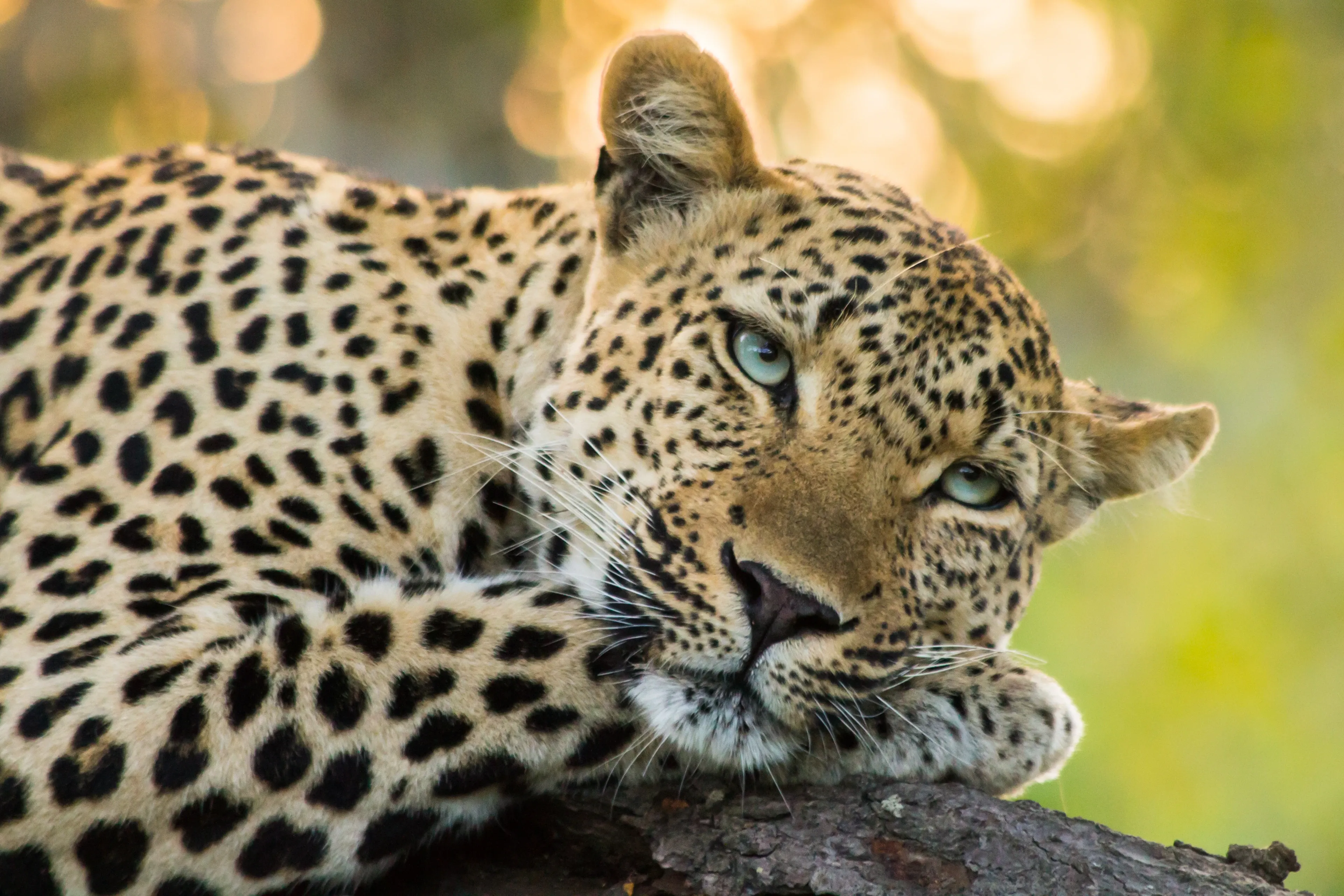
From African savannas to Asian mountains, leopards move through a changing world with patience and power. Their story is also a reminder that wild homes, peaceful communities, and compassionate everyday choices all matter.
A leopard is a master of the almost-seen
A leopard can seem to appear from nowhere: one moment there is only long grass, a leafy branch, or the deep blue of evening; the next, a golden coat patterned with dark rosettes is slipping through the scene. The leopard’s scientific name is Panthera pardus, and it belongs to the cat family, Felidae. It is a large spotted cat with a long body, broad head, and short legs built for quiet, sure-footed movement.
Those flower-shaped markings are called rosettes. Each leopard’s pattern is its own, so no two coats look exactly alike. They are beautiful to us, but for the leopard they are useful, too: broken patches of gold and dark can blend with dappled shade, grass, branches, and rocks. A leopard is not trying to put on a show. It is trying to move unnoticed through its home.
Sometimes a leopard has a coat so dark that it looks black. This animal is often called a black panther, but it is still a leopard. In bright light, the hidden rosettes may be visible beneath the dark coat. Golden leopard or black panther, each is part of the same remarkable species.
Evidence: IUCN Red List of Threatened Species: Panthera pardus (Leopard) — Red List Assessment; Animal Diversity Web, University of Michigan Museum of Zoology: Panthera pardus (leopard)
Leopards make homes across Africa and Asia
Leopards live in parts of both Africa and Asia. Their range includes many different kinds of places: woodland, savanna, grassland, rainforest, mountains, scrub, and even desert landscapes. That flexibility helps explain why they have been able to live across such a wide area. Yet a wide range does not mean an easy life; today, their remaining range is fragmented and much smaller than it once was.
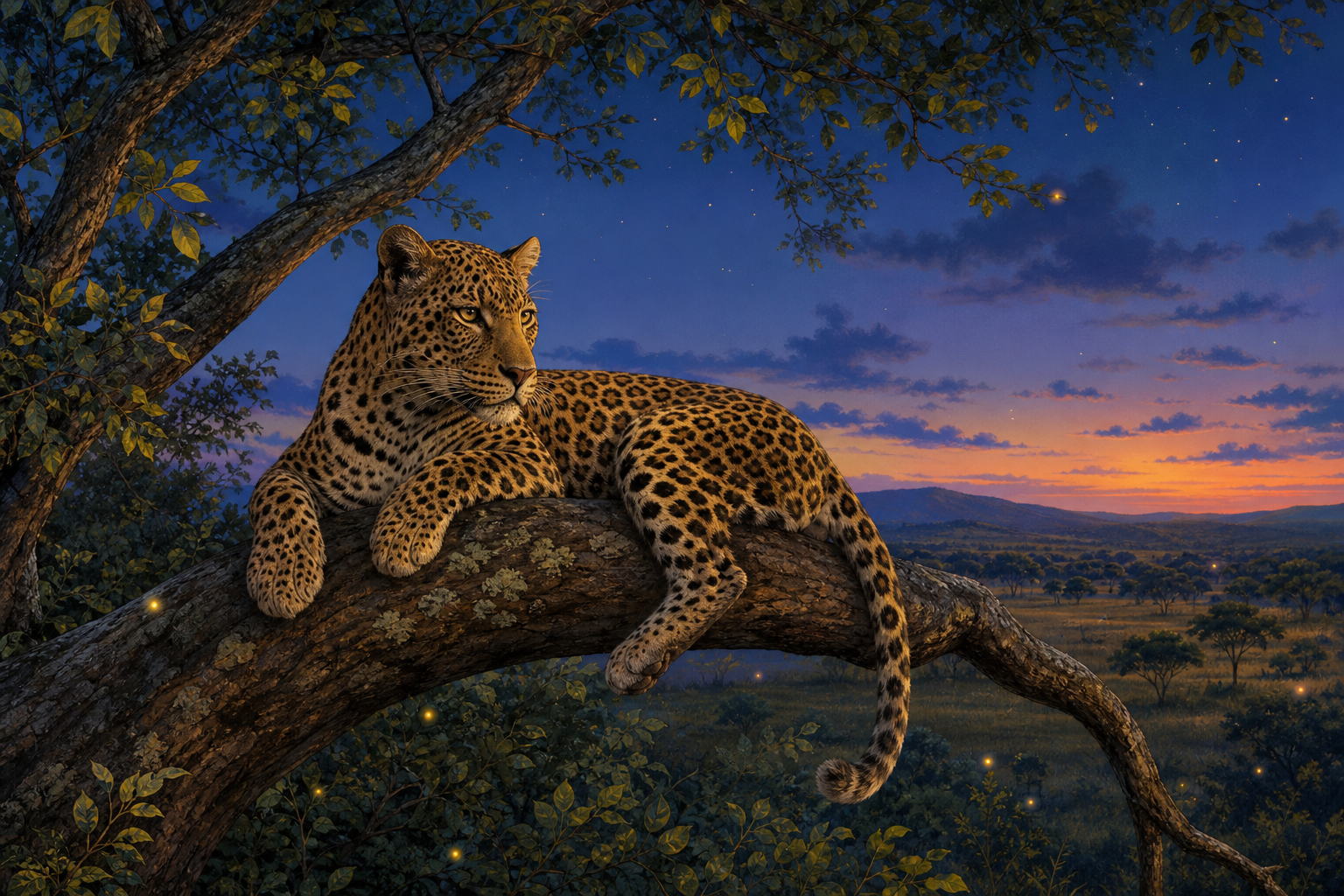
Trees are especially important in a leopard’s world. A leopard is an excellent climber and can rest high on a branch, where a breeze stirs the leaves and the ground feels far away. It can also climb down head-first, an extraordinary trick that makes a tree trunk seem more like a familiar path than a vertical wall.
Adult leopards mostly live alone. Each knows its own area well and uses scent and claw marks as signals. Adults usually come together to mate, while mothers raise their cubs on their own. This quiet independence suits an animal that relies on alert senses, careful timing, and a talent for keeping out of sight.
Evidence: IUCN Red List of Threatened Species: Panthera pardus (Leopard) — Red List Assessment; Animal Diversity Web, University of Michigan Museum of Zoology: Panthera pardus (leopard)
Twilight is when the leopard’s patient work begins
Leopards are most active at night and around twilight. As daylight softens, a leopard may begin to travel, listen, watch, and search for food. Rather than racing across open ground for a long chase, it usually stalks close and then makes a short pounce. Its silence is part of its strength.
A leopard is a carnivore. Its food can include antelopes, deer, monkeys, rodents, and birds, depending on what is available where it lives. This varied menu reflects the leopard’s adaptability, but it also means that healthy wild prey populations are important for leopards.
After making a kill, a leopard may drag it into a tree or cover it, helping it feed away from competitors. Imagine the powerful pull needed to move food up a trunk, followed by a quiet meal on a branch. It is one of the behaviours people remember most about leopards—and a clue to how they share landscapes with other predators.
Leopards vary in size, with males generally larger than females. Adults can measure roughly 1.6 to 2.3 metres in body length and weigh within a broad range that reflects sex and place. In the wild, their lifespan is commonly around 10 to 12 years, though some live longer. Behind those measurements is an individual animal: a watchful neighbour of the forest, grassland, or mountain, learning every safe route and sheltered resting place.
Evidence: Animal Diversity Web, University of Michigan Museum of Zoology: Panthera pardus (leopard)
Their future needs room, prey, and safer ways to share land
The IUCN Red List classifies the leopard as Vulnerable, with a decreasing population trend. This is serious news, but it is not a reason to give up. It is a reason to notice what leopards need: connected habitat, enough wild prey, and ways for people and leopards to live alongside one another more safely.
Habitat loss and fragmentation can divide a leopard’s world into smaller pieces. Hunting, including for trade and pest control, and conflict with people also threaten populations. Many leopards in Africa live outside protected areas, so their future is tied not only to national parks and reserves, but also to the wider landscapes where people farm, travel, and make their homes.
Hope can be practical. Protecting and expanding habitat reserves and national parks can safeguard places where leopards live. Protecting remaining populations across Africa and Asia, reducing hunting, and finding ways to prevent conflict killings can all help. These efforts work best when they respect the needs and knowledge of local communities as well as the lives of wild animals.
A leopard does not need to be famous to deserve care. It needs the ordinary essentials of a wild life: cover to move through, prey to hunt, trees to climb, and space to remain a leopard. Protecting those things also protects the many other lives woven into the same landscapes.
Evidence: IUCN Red List of Threatened Species: Panthera pardus (Leopard) — Red List Assessment; Animal Diversity Web, University of Michigan Museum of Zoology: Panthera pardus (leopard)
What a leopard can teach us about attention
It is easy to admire a leopard for its strength, but there is another lesson in its way of being: attentiveness. A leopard pauses. It listens. It chooses a path through cover instead of charging ahead. Its survival depends on noticing the small details of its surroundings.
We can practise our own kind of attention, too. On a walk, look for the patterns that help animals live: seed heads that feed birds, shady hedges that shelter insects, muddy edges marked by paws or hooves. Learning to look closely turns “nature” from a big, distant idea into a neighbourhood full of individual lives.
For young animal friends, caring can begin with curiosity rather than worry. Read about wildlife, support trustworthy conservation work with your family if you can, and speak kindly about animals as fellow living beings—not decorations, trophies, or things. The leopard’s rosettes may help it disappear into the shadows, but its needs should not disappear from our attention.
Evidence: IUCN Red List of Threatened Species: Panthera pardus (Leopard) — Red List Assessment; Animal Diversity Web, University of Michigan Museum of Zoology: Panthera pardus (leopard)
A kind choice at the table can reach beyond the table
Leopards are carnivores, and their wild lives are their own. We humans get to make choices. One gentle way to put care for animals into practice is to explore delicious plant-based meals: perhaps beans in a taco, lentils in a soup, chickpeas in a curry, or fruit, vegetables, whole grains, nuts, and seeds shared at home. The World Health Organization describes healthy dietary patterns as varied and rich in foods such as whole grains, vegetables, fruit, pulses, nuts, and seeds.
More plant-based, sustainable dietary patterns can also help reduce food-system emissions and pressure on land and biodiversity, according to the IPCC. That does not mean one meal has to carry the whole world on its shoulders. It means small, cheerful choices can be part of a wider habit of making room for animals and wild places. If you want to change what you eat, talk it over with a trusted adult and, when needed, a qualified health professional so your meals meet your own needs.
Evidence: World Health Organization: Healthy diet; Intergovernmental Panel on Climate Change: Climate Change 2022: Mitigation of Climate Change — Chapter 7
Questions people ask
Is a black panther a different animal from a leopard?
Not in this case. A black panther can be a leopard with a very dark coat. Its rosettes are still present, though they can be difficult to see unless the light is bright.
Evidence: Animal Diversity Web, University of Michigan Museum of Zoology: Panthera pardus (leopard)
Why do leopards climb trees?
Leopards are excellent climbers. They often take food into trees or cover it so they can feed away from competing animals, and trees also offer resting places.
Evidence: Animal Diversity Web, University of Michigan Museum of Zoology: Panthera pardus (leopard)
Where do leopards live?
Leopards occur in parts of Africa and Asia. They can live in a wide variety of habitats, including woodland, savanna, grassland, forest, and mountains, although their modern range is fragmented and reduced.
Evidence: IUCN Red List of Threatened Species: Panthera pardus (Leopard) — Red List Assessment; Animal Diversity Web, University of Michigan Museum of Zoology: Panthera pardus (leopard)
Are leopards endangered?
The global leopard species is classified as Vulnerable on the IUCN Red List. Its population trend is decreasing, and major pressures include habitat loss, hunting, and conflict with people.
Evidence: IUCN Red List of Threatened Species: Panthera pardus (Leopard) — Red List Assessment
Read the evidence
Sources behind this story
- Panthera pardus (Leopard) — Red List Assessment — IUCN Red List of Threatened Species
- Panthera pardus (leopard) — Animal Diversity Web, University of Michigan Museum of Zoology
- Healthy diet — World Health Organization
- Climate Change 2022: Mitigation of Climate Change — Chapter 7 — Intergovernmental Panel on Climate Change
Health information is general education, not personal medical advice. Young readers should make food choices with a trusted adult and qualified health professional.