Today's animal friend · 5 November 2026
Leatherback Sea Turtle: The Ocean’s Rubbery Giant
A leatherback’s back is not a hard, scaly shell. It is tough and rubbery, ridged like a very large, very determined waterproof backpack.
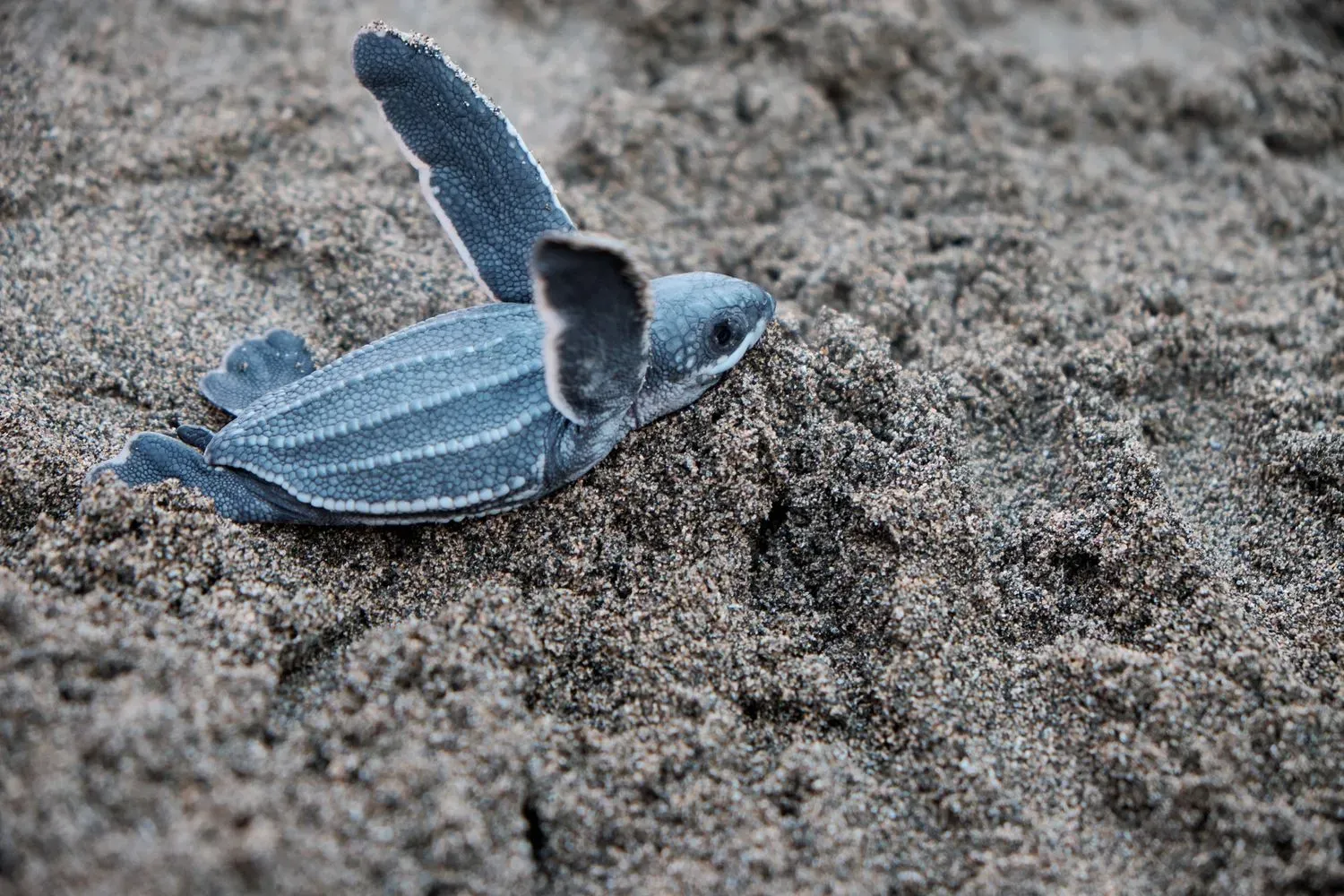
A leatherback’s back is not a hard, scaly shell. It is tough and rubbery, ridged like a very large, very determined waterproof backpack.
A giant arrives under the stars
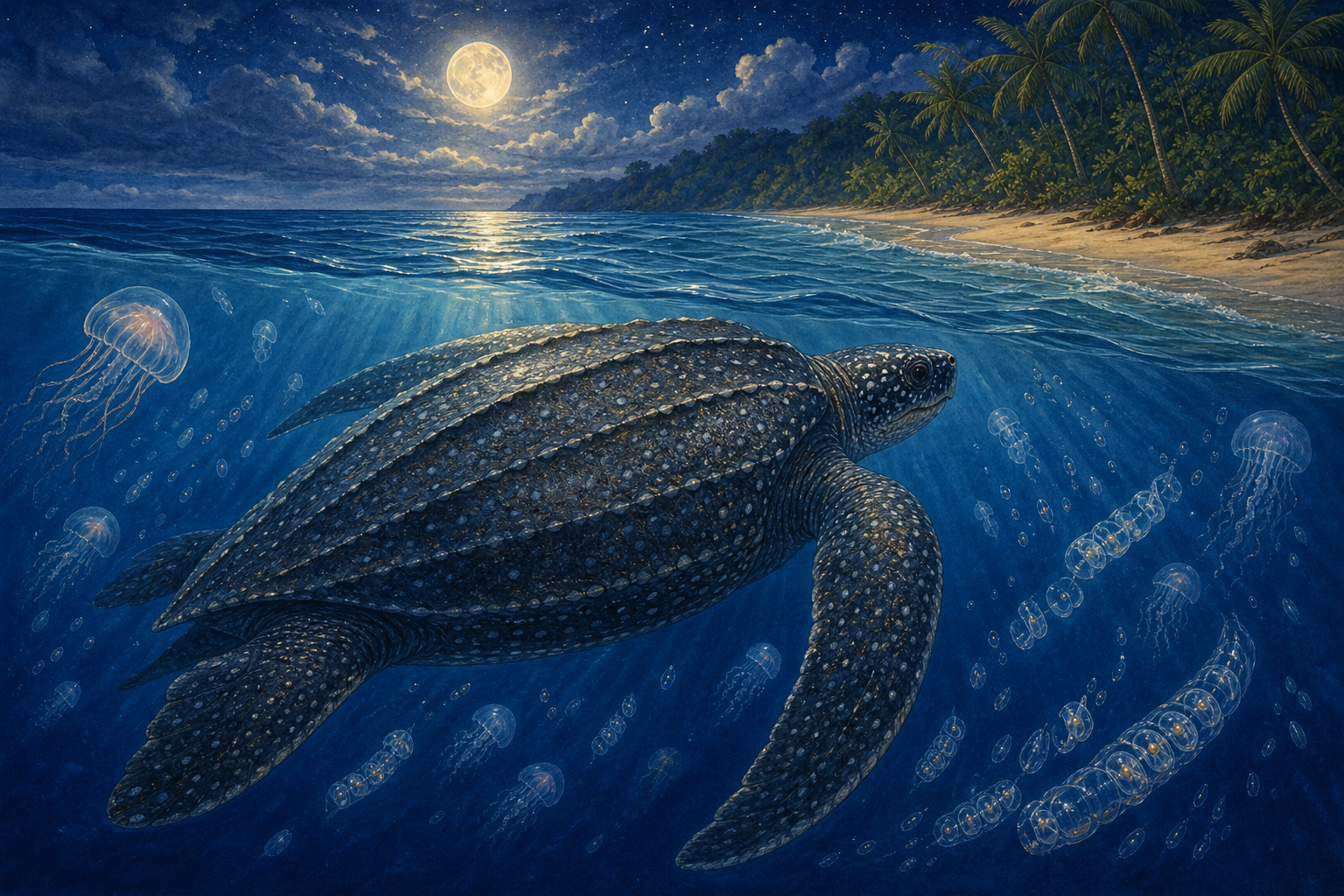
Picture a tropical beach at night. Waves make their steady shhhhhh sound, and the sand glows faintly under the moon. Then, out of the dark water, a leatherback sea turtle slowly heaves herself ashore. She is the largest turtle in the world, but there is no marching band, no spotlight, and definitely no tiny welcome sign.
Her body is made for swimming, not strolling. Moving across sand takes effort. Yet females come ashore on tropical or subtropical sandy beaches to nest, making a deep nest and laying eggs before returning to the sea. Much later, hatchlings dig upward through the sand and hurry toward the waves. It is one of nature’s most urgent little dash-for-the-ocean moments.
Most of a leatherback’s life is hidden from us, far from shore in the open ocean and coastal feeding waters. It may travel through the Atlantic, Pacific, or Indian Ocean, linking one quiet beach to an enormous blue world. A footprint in sand can belong to a traveller whose route crosses water farther than we can see.
Evidence: NOAA Fisheries (National Oceanic and Atmospheric Administration): Leatherback Turtle; IUCN Red List of Threatened Species: Dermochelys coriacea (Leatherback) — IUCN Red List conservation status; Wikipedia: Leatherback sea turtle
Why is this turtle so wonderfully un-turtle-like?
When many people imagine a turtle, they picture a hard, scaly shell. A leatherback has a different design. Its back is covered in tough, rubbery skin, with seven long ridges running from front to back. The ridges give its body a sleek, grooved look, as though someone carefully pressed long lines into a dark raincoat.
An adult leatherback is usually about 1.5 to 1.8 metres long and weighs roughly 340 to 454 kilograms. That is an astonishing amount of turtle—more like a small car’s weight than a pet turtle’s. It is also the only living member of its family, Dermochelyidae, making it a particularly unusual branch of the turtle family tree.
Its front flippers are especially long and powerful. With steady sweeps, they help the turtle move through wide, rolling seas. Imagine swimming from one neighbourhood to another with no roads, maps, snack stops, or cosy bed waiting at the end. Leatherbacks make such ocean journeys look almost easy—though their flippers are doing some very serious work.
Evidence: NOAA Fisheries (National Oceanic and Atmospheric Administration): Leatherback Turtle; Wikipedia: Leatherback sea turtle
Jellyfish for dinner? Absolutely.
A leatherback’s favourite sort of meal is not crunchy, leafy, or fishy. It specialises in soft-bodied, jelly-like creatures, especially jellyfish and salps. Salps are small, see-through animals that drift in seawater. To a person, that menu might sound like wobbly soup. To a hungry leatherback, it is dinner.
Catching slippery food calls for special equipment. Leatherbacks have sharp-edged jaws and pointed mouth parts, plus backward-pointing spines in their throats. These spines help hold jelly-like prey so it does not slide back out. It is not a fork, exactly, but it is a brilliant built-in jellyfish-grip system.
As leatherbacks travel between feeding places and nesting beaches, their lives connect distant parts of the sea. A drifting jellyfish, a deep-water dive, a faraway beach, and a ridged turtle are all chapters in one giant ocean story. The sea may look empty from a beach, but it is full of travellers and meals and mysterious routes.
Evidence: NOAA Fisheries (National Oceanic and Atmospheric Administration): Leatherback Turtle
Down, down, into the blue-dark
The ocean is not one flat swimming pool. Beneath the bright, sparkly surface are deeper layers where the light fades and the water becomes blue-dark. Leatherbacks are powerful divers and can dive deeper than any other turtle. Recorded dives have reached nearly 4,000 feet—far below where a snorkeller could ever visit.
They can hold their breath for a long time, too: up to about 85 minutes has been recorded. That does not mean a leatherback is having a nap under the waves. It is a determined swimmer searching a huge, moving world for food. Every dive is a trip into a place most people will never see firsthand.
Some leatherbacks travel more than 10,000 miles in a year between nesting and feeding areas. Adults usually spend their lives at sea rather than living in a close-knit group. When a nesting female appears on a beach, she gives us a brief glimpse of an animal whose everyday life is otherwise wonderfully out of sight.
Evidence: NOAA Fisheries (National Oceanic and Atmospheric Administration): Leatherback Turtle
A magnificent traveller needs safer seas
The global IUCN assessment listed leatherbacks as Vulnerable, with a decreasing population trend, in 2013. In the United States, the species is listed as Endangered under the Endangered Species Act. Those are different systems with different rules, so the words are not a contradiction. Both tell us something important: leatherbacks need thoughtful protection.
Fishing gear can accidentally hook or entangle turtles, and NOAA identifies accidental capture in fisheries as the greatest worldwide threat, especially for Pacific leatherbacks. Pollution and marine debris can make the ocean more dangerous. On land, collecting eggs, harming adults, and losing nesting beaches to coastal development can also put pressure on these ancient travellers.
There is hopeful work to do. Conservation teams can protect and monitor nesting beaches. Fishing methods and equipment can be changed to reduce accidental turtle catches. Countries can cooperate to care for habitat and migration routes. A leatherback crosses ocean borders without noticing them; helping one means people working together across those borders.
Evidence: IUCN Red List of Threatened Species: Dermochelys coriacea (Leatherback) — IUCN Red List conservation status; NOAA Fisheries (National Oceanic and Atmospheric Administration): Leatherback Turtle; Wikipedia: Leatherback sea turtle
What can an ocean friend do?
Begin with curiosity. If you visit a beach where turtles nest, follow local rules, give wildlife plenty of space, and let trained conservation teams do their careful work. A beach at night is not a turtle petting zoo. It can be a nursery, a resting place, and the start of a hatchling’s enormous adventure.
At home, use fewer throwaway items when you can, and make sure rubbish goes where it belongs. A wrapper that blows away may seem small, but wind and water can carry it surprisingly far. One person cannot solve every ocean problem, yet many small, sensible choices can travel outward like ripples.
Most of all, share the leatherback’s story. Tell someone about the world’s largest turtle, its rubbery ridged back, its long flippers, and its taste for jellyfish. Wonder is not the whole job of conservation—but it is often where caring begins. Once you picture that moonlit giant returning to the waves, it is hard not to root for it.
Evidence: NOAA Fisheries (National Oceanic and Atmospheric Administration): Leatherback Turtle; IUCN Red List of Threatened Species: Dermochelys coriacea (Leatherback) — IUCN Red List conservation status
A kind choice can begin at the dinner table
Leatherbacks eat jelly-like creatures that drift through their ocean home, while people get to choose from many foods. One gentle way to care about animals and the planet is to enjoy more plant-based foods, such as colourful vegetables, fruit, beans, lentils, whole grains, nuts, and seeds. A trusted adult can help decide what works for your family.
The World Health Organization includes whole grains, vegetables, fruit, pulses, nuts, and seeds in its healthy-diet guidance. The IPCC reports that shifts toward sustainable, healthy, more plant-based diets can reduce food-system emissions and pressure on land and biodiversity. No one has to be perfect: a bean taco, lentil soup, or vegetable stir-fry can be a cheerful, compassionate experiment.
Evidence: World Health Organization: Healthy diet; Intergovernmental Panel on Climate Change: Climate Change 2022: Mitigation of Climate Change — Chapter 7
Questions people ask
Is a leatherback really a turtle if it does not have a hard shell?
Yes. A leatherback is a sea turtle, but its covering is tough, rubbery, and ridged rather than hard and scaly like the shell people often picture.
Evidence: NOAA Fisheries (National Oceanic and Atmospheric Administration): Leatherback Turtle; Wikipedia: Leatherback sea turtle
What does a leatherback eat?
It mainly eats soft-bodied, jelly-like prey such as jellyfish and salps. Special throat spines point backward to help the turtle keep hold of slippery food.
Evidence: NOAA Fisheries (National Oceanic and Atmospheric Administration): Leatherback Turtle
Where do leatherbacks live?
They spend most of their lives in open-ocean and coastal feeding waters across the Atlantic, Pacific, and Indian Oceans. Females come ashore mainly on tropical or subtropical sandy beaches to nest.
Evidence: NOAA Fisheries (National Oceanic and Atmospheric Administration): Leatherback Turtle; Wikipedia: Leatherback sea turtle
Why do I see both Vulnerable and Endangered used for leatherbacks?
Vulnerable is the IUCN’s global category from its 2013 assessment. Endangered is the species’ legal status under the United States Endangered Species Act. They are different systems, and both show why protection matters.
Evidence: IUCN Red List of Threatened Species: Dermochelys coriacea (Leatherback) — IUCN Red List conservation status; NOAA Fisheries (National Oceanic and Atmospheric Administration): Leatherback Turtle; Wikipedia: Leatherback sea turtle
Read the evidence
Sources behind this story
- Dermochelys coriacea (Leatherback) — IUCN Red List conservation status — IUCN Red List of Threatened Species
- Leatherback Turtle — NOAA Fisheries (National Oceanic and Atmospheric Administration)
- Leatherback sea turtle — Wikipedia
- Healthy diet — World Health Organization
- Climate Change 2022: Mitigation of Climate Change — Chapter 7 — Intergovernmental Panel on Climate Change
Health information is general education, not personal medical advice. Young readers should make food choices with a trusted adult and qualified health professional.