Today's animal friend · 13 October 2026
Leafcutter Ants: The Rainforest’s Tiny Fungus Farmers
A leafcutter ant can be easy to miss beside a boot, yet its colony runs an extraordinary underground farm—complete with gardeners, guards, a queen, and a never-ending parade of leafy supplies.

A leafcutter ant can be easy to miss beside a boot, yet its colony runs an extraordinary underground farm—complete with gardeners, guards, a queen, and a never-ending parade of leafy supplies.
A green flag marches through the forest
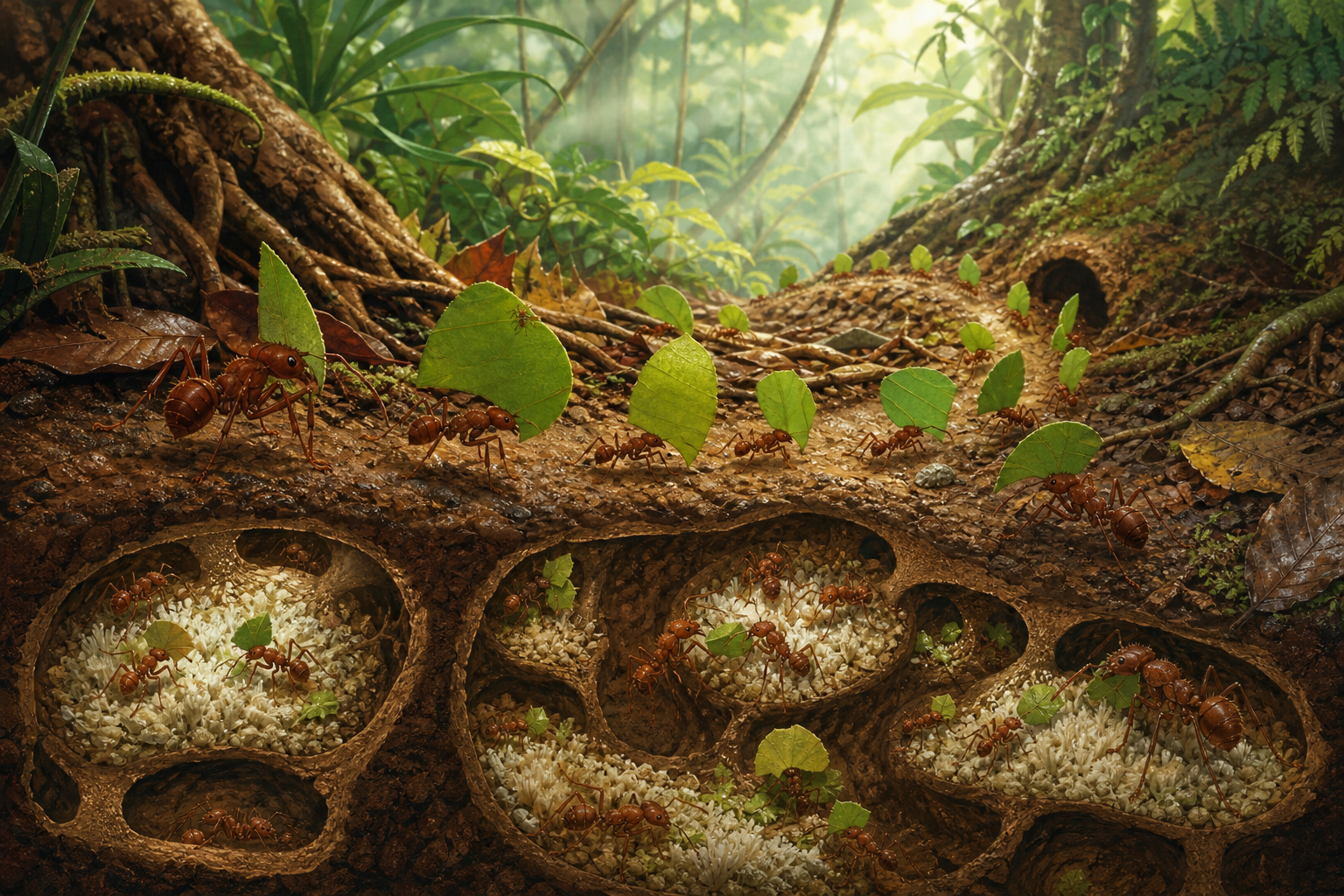
On the damp floor of a tropical forest, something curious is on the move. A bright green leaf piece seems to float over roots and fallen twigs. Then another follows. Look closer and you may find the leaf “flags” have legs: they are being carried by leafcutter ants.
This feature follows Atta cephalotes, also called the hairy-headed leafcutter ant. It lives in neotropical forests in parts of North and South America. Like all ants, it is an insect, but its leafy procession can make the forest floor feel like the scene of a very tiny parade.
Here is the wonderful twist: the ants are not mainly carrying lunch. Their leaf and flower fragments are supplies for an underground farm. Leafcutter ants grow a fungus, and the fungus is the colony’s food. An ant carrying a leaf is more like a farmer hauling ingredients than a diner heading for a salad.
Evidence: IUCN Red List of Threatened Species: Atta cephalotes — IUCN Red List status (Not Evaluated); Animal Diversity Web, University of Michigan Museum of Zoology: Atta cephalotes; Wikipedia: Atta cephalotes
Why chop a leaf if you are not having a salad?
The answer is fungus farming. Workers cut fresh pieces of leaves and flowers, carry them home, and use the plant material to cultivate a fungus garden inside the nest. The colony feeds on the fungus it grows rather than primarily on the leaves themselves.
A leaf trail is therefore a supply route. The fragments are brought to the growing rooms, where the fungus is tended as part of the colony’s shared life. It is an astonishing partnership: plant material helps support the fungus, and the fungus helps feed the ants.
It is fine to imagine a garden, but perhaps not one with tidy rows and a little watering can. These gardens are underground fungal spaces, hidden beneath the soil. Still, the big idea is exactly as surprising as it sounds: these rainforest insects farm their own food.
Evidence: Wikipedia: Atta cephalotes; Animal Diversity Web, University of Michigan Museum of Zoology: Atta cephalotes
One colony, many jobs
A leafcutter colony is not made of identical workers doing identical errands. Workers come in strikingly different sizes, and those differences suit different tasks. Think of an underground town where the delivery team, gardeners, nursery helpers, and guards all happen to be ants.
Medium-sized workers, often called media workers, harvest and carry leaves. Larger major workers help guard trails. The smallest workers, known as minims, tend the fungus and care for the brood—the colony’s eggs, larvae, and pupae.
Sometimes a minim rides atop a leaf load. It looks a bit like taking a bus made of lettuce. This little passenger can help protect the carrier from parasitic phorid flies. Even the journey home is teamwork.
A highly social colony has one queen and many workers. A large colony may contain up to about five million ants, while a queen may live for more than 20 years. That is a long time to be the founder of such a bustling hidden community.
Evidence: Wikipedia: Atta cephalotes; Animal Diversity Web, University of Michigan Museum of Zoology: Atta cephalotes
How does an ant find the way home? Follow the perfume road
To human eyes, the rainforest floor can look like a giant obstacle course of roots, stones, puddles, and leaf litter. Finding one nest entrance again would be difficult. Leafcutter workers have a useful navigation clue: pheromone trails.
Pheromones are chemical signals. As workers travel, they can leave scents that recruit nestmates to a foraging place and help guide them along the route. An invisible trail may be saying something like, “Useful plant pieces this way!”
Atta cephalotes can be active during the day and at night. So the traffic of leaf bundles may pass beneath sunlit leaves, then continue when the forest becomes shadowy and filled with nighttime calls. A familiar path is never simply empty ground when ants can read it with their senses.
Evidence: IUCN Red List of Threatened Species: Atta cephalotes — IUCN Red List status (Not Evaluated); Animal Diversity Web, University of Michigan Museum of Zoology: Atta cephalotes; Wikipedia: Atta cephalotes
Below the soil, a farm needs fresh air
The nest is more than a hole in the earth. Atta cephalotes has an underground system of chambers linked to its fungus-growing life. Nest areas are often reported at around 200 square metres, and some chambers have been reported as deep as about seven metres—an enormous construction project for insects.
Air matters in these hidden rooms. Fungus gardens produce carbon dioxide, and nest position and passages can help with ventilation. The ants are not making skyscrapers, but they are shaping a home around the needs of the living fungus they cultivate.
By cutting foliage and excavating soil, leafcutters noticeably reshape their neighbourhood. Scientists are still working out the full measured effects of this species on soil and forest growth. That makes it more honest—and more exciting—to keep asking questions rather than give the ants superhero powers they have not been proven to have.
Evidence: Wikipedia: Atta cephalotes
A rainforest neighbour worth noticing
Atta cephalotes ranges through the Neotropics from Mexico to Bolivia, with populations in Amazonia and north-eastern Brazil. In a forest, an individual ant may be tiny, but the leaf parade gives away a huge shared project happening right underfoot.
This species is Not Evaluated on the IUCN Red List. That does not mean “safe,” and it does not mean “in danger.” It means there is no global IUCN assessment to give us a verdict. Local rainforest clearing could reduce places where colonies can nest, but its global extinction risk should not be guessed at.
A hopeful response begins with paying attention. Protecting rainforest habitat and supporting careful natural-history research help people understand the lives woven through a forest. The next time an insect carries something that looks much bigger than itself, pause before saying “just a bug.” You may be watching a farmer on its way to work.
Evidence: IUCN Red List of Threatened Species: Atta cephalotes — IUCN Red List status (Not Evaluated); Animal Diversity Web, University of Michigan Museum of Zoology: Atta cephalotes; Wikipedia: Atta cephalotes
A small kindness can travel far
Leafcutter ants reveal that a meal can belong to a much bigger web: plants, fungus, soil, rain, forest, and a colony working together. Their story can make us curious about the plants on our own plates, too. A varied diet can include whole grains, vegetables, fruit, pulses, nuts, and seeds. A trusted adult and a qualified health professional can help with questions about what is right for an individual child.
When a family can, choosing more plant-based meals is one gentle way to practise care for animals and the living world. Global health guidance includes plant foods in healthy varied diets, and climate science finds that shifts toward sustainable, healthy, more plant-based diets can reduce food-system pressure on land, biodiversity, and climate. No one has to be perfect: trying a bean dish, tasting a new fruit, or helping make a colourful vegetable meal can be a kind beginning.
Evidence: World Health Organization: Healthy diet; Intergovernmental Panel on Climate Change: Climate Change 2022: Mitigation of Climate Change — Chapter 7
Questions people ask
Do leafcutter ants eat the leaves they carry?
Not mainly. They use leaf and flower fragments to grow fungus in underground gardens, then feed on the fungus. The leafy bundles are farm supplies, not packed lunches.
Evidence: Wikipedia: Atta cephalotes; Animal Diversity Web, University of Michigan Museum of Zoology: Atta cephalotes
How many ants can live in one colony?
A large Atta cephalotes colony can contain up to about five million ants. It has one queen and workers whose sizes and jobs differ.
Evidence: Wikipedia: Atta cephalotes
Are leafcutter ants awake only in daytime?
No. The available species information records activity by day and night, so a leaf-carrying trail may be busy in sunshine or darkness.
Evidence: IUCN Red List of Threatened Species: Atta cephalotes — IUCN Red List status (Not Evaluated); Animal Diversity Web, University of Michigan Museum of Zoology: Atta cephalotes; Wikipedia: Atta cephalotes
Are leafcutter ants endangered?
We cannot say from a global IUCN assessment because Atta cephalotes is Not Evaluated. Caring for rainforest habitat and learning more about the species are sensible hopeful actions.
Evidence: IUCN Red List of Threatened Species: Atta cephalotes — IUCN Red List status (Not Evaluated); Wikipedia: Atta cephalotes
Read the evidence
Sources behind this story
- Atta cephalotes — IUCN Red List status (Not Evaluated) — IUCN Red List of Threatened Species
- Atta cephalotes — Animal Diversity Web, University of Michigan Museum of Zoology
- Atta cephalotes — Wikipedia
- Healthy diet — World Health Organization
- Climate Change 2022: Mitigation of Climate Change — Chapter 7 — Intergovernmental Panel on Climate Change
Health information is general education, not personal medical advice. Young readers should make food choices with a trusted adult and qualified health professional.