Today's animal friend · 5 August 2026
The Koala in the Leafy Sleeping Castle
Follow the rustle of eucalyptus leaves and meet one of Australia’s most specialised tree-dwellers—then discover gentle ways people can help its forest home.
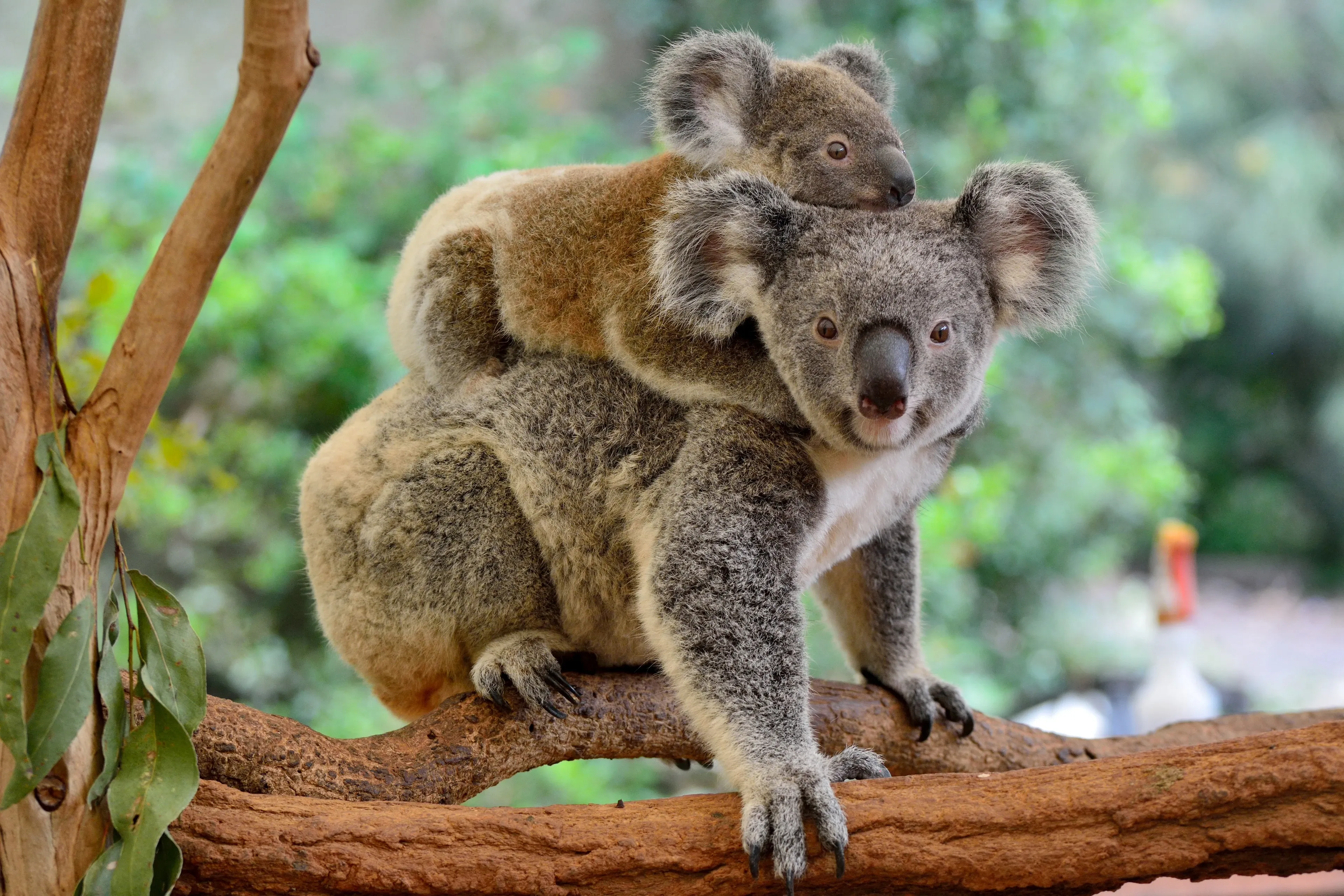
Follow the rustle of eucalyptus leaves and meet one of Australia’s most specialised tree-dwellers—then discover gentle ways people can help its forest home.
A fluffy ear twitches in the twilight
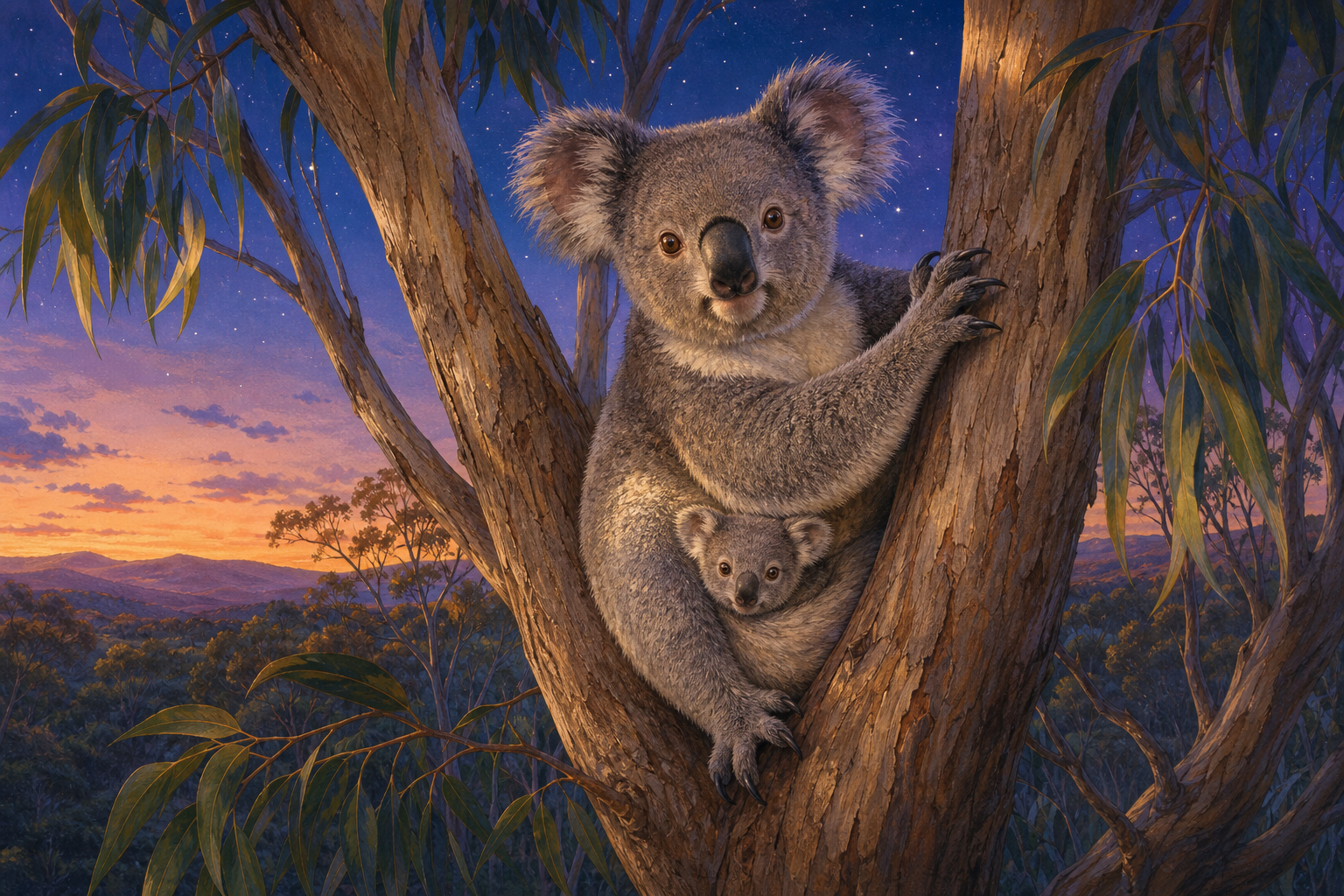
The eucalyptus woodland is beginning to change shifts. Daylight softens, leaves whisper in a dry little breeze, and somewhere high above the ground a round, grey animal uncurls from the fork of a branch. Its big black nose points toward the evening. A koala is waking up.
That may seem unfairly relaxing. Koalas can sleep or rest for many hours a day—up to twenty hours in the fullest sleepy summaries. But this is not because they are lazy loafs in fluffy pyjamas. Their leafy food is low in energy, so saving energy is a clever part of koala life.
At night and around twilight, a koala is more likely to stir, climb, and feed. It moves through the branches with paws built for gripping and sharp claws that help it hold on. From below, it may look like a soft toy that someone carefully placed in a tree. From the koala’s point of view, though, this is a busy home in the sky: bedroom, snack cupboard, lookout point, and climbing frame all in one.
Evidence: IUCN Red List of Threatened Species: Phascolarctos cinereus (Koala) — Red List Assessment; Wikipedia (Wikimedia Foundation): Koala; Animal Diversity Web, University of Michigan Museum of Zoology: Phascolarctos cinereus (koala)
First surprise: this “bear” is not a bear
People sometimes say “koala bear,” which sounds friendly—but it is a mix-up. A koala is a marsupial, not a bear. Its scientific name is Phascolarctos cinereus, and it belongs to the marsupial family Phascolarctidae. Its closest living relatives are wombats, which makes a much better quiz answer than “bear.”
Marsupials are mammals whose young are cared for in a pouch. A baby koala is called a joey. Early in life, the joey grows in its mother’s pouch; later it can ride on her back. Imagine having a warm, moving backpack that is also your mum. Convenient, although probably tricky at the school gates.
Adult koalas are roughly 60 to 85 centimetres long and can weigh about 4 to 15 kilograms. Koalas in southern areas are usually bigger than those in northern areas. Yet size is not the main trick that helps them live above the forest floor. It is their tree-ready body: strong gripping paws, claws, and a calm talent for settling safely among branches.
Evidence: IUCN Red List of Threatened Species: Phascolarctos cinereus (Koala) — Red List Assessment; Wikipedia (Wikimedia Foundation): Koala; Animal Diversity Web, University of Michigan Museum of Zoology: Phascolarctos cinereus (koala)
Why choose a dinner that makes almost everyone else say “No thanks”?
A koala is an herbivore that eats almost entirely eucalyptus leaves. To us, leaves might seem like a very disappointing packed lunch. To a koala, particular eucalyptus trees are the menu. The leaves are tough, low in energy, and contain parts that most other mammals cannot handle well. Koalas are specialists: they have made a living from a food many animals leave alone.
That specialised menu helps explain the long rests. A koala cannot zoom around all day like an animal eating a richer diet. Instead, it uses energy carefully. Rest, wake, climb, munch, repeat. There is something rather wise about knowing when to save your batteries.
Koalas live in eucalyptus woodlands and open forests in Australia, especially in coastal and near-coastal parts of Queensland, New South Wales, Victoria, and South Australia. They do not simply need any old tree. They need places where suitable food trees remain. A patch of woodland may look quiet to us, but to a koala it is a map of meals, resting spots, and routes through the branches.
Koalas are mostly solitary outside the close care between a mother and joey. Quiet does not always mean silent, though. During the breeding season, males can make a surprisingly loud bellow. Picture a sound that does not match the gentle-looking, sleepy face at all. Forests are full of surprises.
Evidence: IUCN Red List of Threatened Species: Phascolarctos cinereus (Koala) — Red List Assessment; Wikipedia (Wikimedia Foundation): Koala; Animal Diversity Web, University of Michigan Museum of Zoology: Phascolarctos cinereus (koala)
One tree can be a whole neighbourhood
A koala spends most of its time in trees, and that tells us something important: forests are not just scenery behind the animal. They are the animal’s life-supporting neighbourhood. Eucalyptus woodland provides food and places to rest, while branches connect parts of a koala’s world.
Koalas are specialised tree-dwelling leaf-eaters woven closely into eucalyptus forest and woodland food webs. That is a fancy way of saying their lives are tied to the lives of these forests. When we notice a koala, we can also notice the leaves, shade, bark, and branching pathways that make its life possible.
This is a lovely reason to look closer outdoors. A tree is never merely “a tree.” It can be a weather shield, a home, a food source, a meeting place, or a stepping-stone to another tree. For a koala, a eucalyptus can be several of those things before breakfast—or, more likely, before a very late leafy supper.
Evidence: IUCN Red List of Threatened Species: Phascolarctos cinereus (Koala) — Red List Assessment; Wikipedia (Wikimedia Foundation): Koala; Animal Diversity Web, University of Michigan Museum of Zoology: Phascolarctos cinereus (koala)
When the leafy castle is harder to find
The IUCN lists the koala as Vulnerable, with a decreasing population trend. That word, vulnerable, means the species faces a high risk unless the pressures on it are reduced. It is a serious label, but it is not a reason to give up. It is a reason to care carefully and act together.
Habitat loss and fragmentation can leave fewer suitable trees and make forest homes harder to move between. Bushfires, drought, heat stress, and disease can also make life difficult. Climate change is expected to shrink suitable koala range in parts of eastern and southern Australia. None of these challenges is solved by one person waving a magic leaf. Real help takes many people and steady work.
There are hopeful actions that match the problems: protecting and restoring eucalyptus habitat, reducing fire and drought impacts where possible, and supporting rescue and disease-management programmes. People who plant and care for habitat, help injured koalas, study their needs, and protect woodland are all part of the story.
You do not have to be in Australia to practise being a thoughtful wildlife neighbour. Learn which native plants support animals where you live. Visit nature places gently. Share reliable facts instead of rumours. And remember that protecting an animal often begins with protecting the places it depends on.
Evidence: IUCN Red List of Threatened Species: Phascolarctos cinereus (Koala) — Red List Assessment; Wikipedia (Wikimedia Foundation): Koala; Animal Diversity Web, University of Michigan Museum of Zoology: Phascolarctos cinereus (koala)
A small promise, carried like a leaf
The koala’s life offers a quiet reminder: every animal is somebody, not something. This one has a preferred kind of tree, a careful energy-saving routine, a mother-and-joey bond, and a forest world that can be damaged or protected. Seeing that clearly can make kindness feel practical.
At meals, families can explore more plant-forward choices together—perhaps vegetables, fruit, whole grains, pulses, nuts, or seeds in foods everyone enjoys. The World Health Organization describes these foods as parts of healthy, varied eating patterns. Food needs differ from person to person, so children should make any diet changes with a trusted adult and a qualified health professional, not from a dare or a trendy video.
There is a planet-sized reason to be curious, too. The IPCC reports that shifts toward sustainable, healthy, more plant-based diets can reduce food-system emissions and pressure on land and biodiversity. A bean burrito, lentil soup, or chickpea sandwich will not personally rescue a koala by Tuesday. Still, kind everyday choices can join a bigger effort to leave more room for forests, wildlife, and one another.
So imagine the koala again, tucked into its leafy sleeping castle as dusk turns darker. Its world is wonderfully particular: eucalyptus scent, sturdy branches, moonlit climbing, and the occasional astonishing bellow. It is worth protecting not because it is a mascot or a cartoon, but because it is a real, remarkable neighbour on Earth.
Evidence: IUCN Red List of Threatened Species: Phascolarctos cinereus (Koala) — Red List Assessment; Wikipedia (Wikimedia Foundation): Koala; Animal Diversity Web, University of Michigan Museum of Zoology: Phascolarctos cinereus (koala); World Health Organization: Healthy diet; Intergovernmental Panel on Climate Change: Climate Change 2022: Mitigation of Climate Change — Chapter 7
Kind choices can grow from curious hearts
Caring about koalas can stretch beyond admiring their fluffy ears. Choosing and protecting plant-rich meals can be a gentle way to show concern for animals and the living places they need. WHO guidance includes vegetables, fruit, whole grains, pulses, nuts, and seeds in healthy, varied diets; families can explore such foods in ways that work for them.
The IPCC finds that sustainable, healthy, more plant-based diets can help lower food-system emissions and reduce pressure on land and biodiversity. That makes every curious new plant-based meal an invitation: enjoy something tasty, waste less, and help make room in our shared world for forests and wildlife. Any child considering a bigger diet change should talk it through with a trusted adult and a qualified health professional.
Evidence: World Health Organization: Healthy diet; Intergovernmental Panel on Climate Change: Climate Change 2022: Mitigation of Climate Change — Chapter 7
Questions people ask
Is a koala really a bear?
No. “Koala bear” is a common nickname, but koalas are marsupials. Like other marsupials, they care for their young in a pouch.
Evidence: IUCN Red List of Threatened Species: Phascolarctos cinereus (Koala) — Red List Assessment; Wikipedia (Wikimedia Foundation): Koala; Animal Diversity Web, University of Michigan Museum of Zoology: Phascolarctos cinereus (koala)
Why do koalas sleep so much?
Eucalyptus leaves give little energy and are a difficult food for most mammals. Koalas conserve energy by resting and sleeping for many hours, sometimes described as up to twenty hours a day.
Evidence: Wikipedia (Wikimedia Foundation): Koala; Animal Diversity Web, University of Michigan Museum of Zoology: Phascolarctos cinereus (koala)
Where do koalas live?
They live in eucalyptus woodlands and open forests in Australia, mainly in coastal and near-coastal areas of Queensland, New South Wales, Victoria, and South Australia.
Evidence: IUCN Red List of Threatened Species: Phascolarctos cinereus (Koala) — Red List Assessment; Wikipedia (Wikimedia Foundation): Koala; Animal Diversity Web, University of Michigan Museum of Zoology: Phascolarctos cinereus (koala)
What makes koalas vulnerable?
Their challenges include loss and fragmentation of habitat, bushfires, drought and heat stress, and disease. The IUCN lists the species as Vulnerable with a decreasing population trend.
Evidence: IUCN Red List of Threatened Species: Phascolarctos cinereus (Koala) — Red List Assessment; Wikipedia (Wikimedia Foundation): Koala; Animal Diversity Web, University of Michigan Museum of Zoology: Phascolarctos cinereus (koala)
Read the evidence
Sources behind this story
- Phascolarctos cinereus (Koala) — Red List Assessment — IUCN Red List of Threatened Species
- Koala — Wikipedia (Wikimedia Foundation)
- Phascolarctos cinereus (koala) — Animal Diversity Web, University of Michigan Museum of Zoology
- Healthy diet — World Health Organization
- Climate Change 2022: Mitigation of Climate Change — Chapter 7 — Intergovernmental Panel on Climate Change
Health information is general education, not personal medical advice. Young readers should make food choices with a trusted adult and qualified health professional.