Today's animal friend · 4 November 2026
King Cobra: The Forest’s Leaf-Pile Architect
A surprising snake-eater with a leaf-litter nest, a quiet escape plan, and a forest home worth protecting.

A surprising snake-eater with a leaf-litter nest, a quiet escape plan, and a forest home worth protecting.
A rustle in the leaves—and a very long surprise
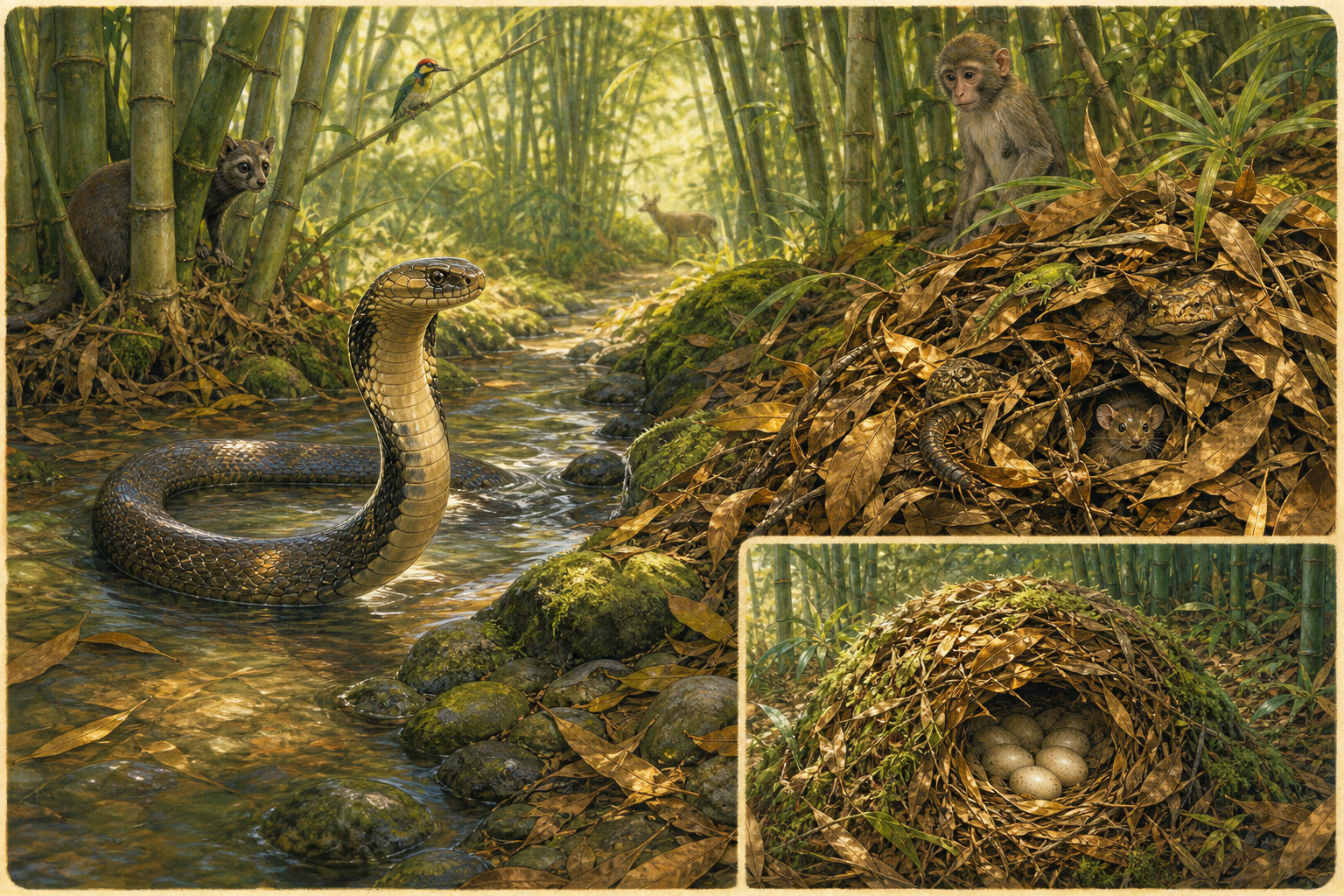
Imagine walking beside a stream in a warm Asian forest. Bamboo taps softly overhead. Damp leaves squish underfoot. Then the leaf litter moves—not with the hurried skitter of a lizard, but with a smooth, powerful glide.
A king cobra may be travelling through this shady world. It is the longest venomous snake in the world. Many are around 3 to 4 metres long, and especially large individuals can reach about 5.5 metres—longer than many grown-ups are tall. That is a lot of snake to fit into one leafy scene.
Its scientific name is Ophiophagus hannah. Ophiophagus means “snake-eater,” which is a rather direct name—as if someone had called a badger “Worm-Muncher.” The king cobra’s name gives away one of its biggest secrets before it even arrives on the page.
Evidence: IUCN Red List of Threatened Species: Ophiophagus hannah (King Cobra) — Red List Assessment; Animal Diversity Web, University of Michigan Museum of Zoology: Ophiophagus hannah (Hamadryad, King Cobra); Wikipedia: King cobra
Where does this grand glider go?
King cobras live in parts of southern and southeastern Asia. They use places with dense cover, including forests, rainforests, bamboo thickets, and mangrove swamps, often near streams. A tangle of plants is not messy to a king cobra. It is a travel route, a hiding place, and a world full of scent clues to investigate.
These snakes are mainly active in the daytime. While people are heading outdoors for school, work, or a walk, a king cobra may be on the move too. It is usually solitary except around breeding time, slipping through its habitat with no need for a marching band or a team jersey.
A healthy forest is more than a backdrop. It is the cobra’s home: the place where it can shelter, search for food, and raise young. When we picture a forest, it helps to remember that every fallen leaf and streamside patch may matter to somebody living there.
Evidence: IUCN Red List of Threatened Species: Ophiophagus hannah (King Cobra) — Red List Assessment; Animal Diversity Web, University of Michigan Museum of Zoology: Ophiophagus hannah (Hamadryad, King Cobra); Wikipedia: King cobra
Why call it a snake-eater? Because it really is one
Most of a king cobra’s meals are other snakes. It also eats lizards sometimes. That makes it a carnivore and a top snake-hunting predator in the forest and wetland food webs where it lives.
How does it find a meal in all that green? Like other snakes, it uses its tongue to collect tiny scent clues from the air and ground. Think of it as reading invisible smell-notes: “A snake passed here.” “Perhaps it went that way.”
The king cobra uses venom when hunting. Venom helps it catch prey, just as an owl’s hooked beak and talons help it catch food. This does not make the cobra a movie monster; it is an animal surviving in its own habitat. Its place in the food web is to hunt other snakes and, now and then, lizards.
Evidence: Animal Diversity Web, University of Michigan Museum of Zoology: Ophiophagus hannah (Hamadryad, King Cobra); Wikipedia: King cobra
That hood is a warning, not an invitation
King cobras usually prefer to avoid people. If one feels threatened or cornered, it can raise the front part of its body, spread its famous hood, and hiss. This is the snake’s clearest way of saying, “I need space, please.”
The best response is wonderfully un-dramatic: stay calm, keep well away, and tell an adult or local wildlife professional if help is needed. Never try to touch, catch, feed, or move any wild snake. Wild animals do not need us to be brave near them; they need us to be respectful from a safe distance.
That tall posture can look astonishing, but it also tells us something important. Animals often use signals to avoid a fight. A cobra’s hood is not a costume for showing off. It is a warning meant to give everyone a chance to back away.
Evidence: Animal Diversity Web, University of Michigan Museum of Zoology: Ophiophagus hannah (Hamadryad, King Cobra); Wikipedia: King cobra
The snake that builds a nursery
Here comes the king cobra’s most surprising family fact: the female is the only snake known to build a nest. She gathers fallen leaves into a mound, lays her eggs inside, and remains nearby to guard them until they hatch.
Picture a parent carefully raking a little leaf fort in the forest. It is not made of bricks or blankets, but it is still a nursery—built for eggs that need protection. After hatching, the young are independent, ready to begin their own snake-sized adventures.
This behaviour is a lovely reminder that care can look very different across the animal world. Some parents carry babies, some bring food, and a king cobra mother gathers leaves. In a forest full of surprises, even a snake can be a nest-builder.
Evidence: Animal Diversity Web, University of Michigan Museum of Zoology: Ophiophagus hannah (Hamadryad, King Cobra); Wikipedia: King cobra
A magnificent neighbour that needs room
King cobras were listed as Vulnerable in the historical 2011 IUCN assessment for Ophiophagus hannah, with a decreasing population trend. Scientists are also updating their understanding of king-cobra classification, so conservation listings need regular checking. What is clear is that forest clearing, farmland spreading into forest, and wildlife trade put pressure on these snakes.
It can feel enormous to think about protecting an enormous snake. But the heart of the answer is simple: protect forest homes, leave wild animals in the wild, and support efforts that reduce illegal wildlife trade. Keeping forests connected and leafy helps king cobras—and many other animals sharing those places.
You do not have to live near a bamboo thicket to care. You can learn about wildlife, share accurate stories instead of scary rumours, and notice how a habitat is a home rather than empty space waiting to be used. The king cobra is not asking for applause. It needs room to glide, hunt, and build its extraordinary leaf nest.
Evidence: IUCN Red List of Threatened Species: Ophiophagus hannah (King Cobra) — Red List Assessment; Animal Diversity Web, University of Michigan Museum of Zoology: Ophiophagus hannah (Hamadryad, King Cobra); Wikipedia: King cobra
One kind choice can reach farther than you think
Caring about a king cobra can begin with caring about its forest home—and about the many animals with whom we share the planet. At meals, a trusted adult can help you explore tasty plant-forward choices such as beans, lentils, vegetables, fruit, whole grains, nuts, and seeds. The World Health Organization describes these foods as parts of varied, healthy diets. Every family’s needs are different, so food changes are best discussed with an adult and a qualified health professional.
Plant-forward eating can also be a gentle vote for living space. The IPCC reports that shifts toward sustainable, healthy, more plant-based diets can reduce food-system emissions and pressure on land and biodiversity. No one needs to be perfect. Trying a plant-based meal, wasting less food, and being curious about where food comes from are caring steps—for animals, forests, and our shared home.
Evidence: World Health Organization: Healthy diet; Intergovernmental Panel on Climate Change: Climate Change 2022: Mitigation of Climate Change — Chapter 7
Questions people ask
Is a king cobra really a cobra?
Its common name says cobra, but the king cobra belongs to its own genus, Ophiophagus, rather than the genus Naja that contains the “true” cobras. Its scientific name points to its snake-eating diet.
Evidence: Animal Diversity Web, University of Michigan Museum of Zoology: Ophiophagus hannah (Hamadryad, King Cobra); Wikipedia: King cobra
What should I do if I see a wild snake?
Give it plenty of space and do not touch, catch, or try to move it. A king cobra usually prefers to avoid people, and its hood and hiss are warnings that it feels threatened.
Evidence: Animal Diversity Web, University of Michigan Museum of Zoology: Ophiophagus hannah (Hamadryad, King Cobra); Wikipedia: King cobra
Do king cobras live in every forest?
No. They occur in parts of Asia and use habitats such as forests, bamboo thickets, mangrove swamps, and dense cover near streams. Their range does not mean they live in every patch of land within it.
Evidence: Animal Diversity Web, University of Michigan Museum of Zoology: Ophiophagus hannah (Hamadryad, King Cobra); Wikipedia: King cobra
Why are leaf nests such a big deal?
Because the female king cobra is the only snake known to build a nest. She gathers leaves into a mound for her eggs and guards the nest until the young hatch.
Evidence: Animal Diversity Web, University of Michigan Museum of Zoology: Ophiophagus hannah (Hamadryad, King Cobra); Wikipedia: King cobra
Read the evidence
Sources behind this story
- Ophiophagus hannah (King Cobra) — Red List Assessment — IUCN Red List of Threatened Species
- Ophiophagus hannah (Hamadryad, King Cobra) — Animal Diversity Web, University of Michigan Museum of Zoology
- King cobra — Wikipedia
- Healthy diet — World Health Organization
- Climate Change 2022: Mitigation of Climate Change — Chapter 7 — Intergovernmental Panel on Climate Change
Health information is general education, not personal medical advice. Young readers should make food choices with a trusted adult and qualified health professional.