Today's animal friend · 3 November 2026
Kea: The Mountain Parrot with a Pocket-Inspector Beak
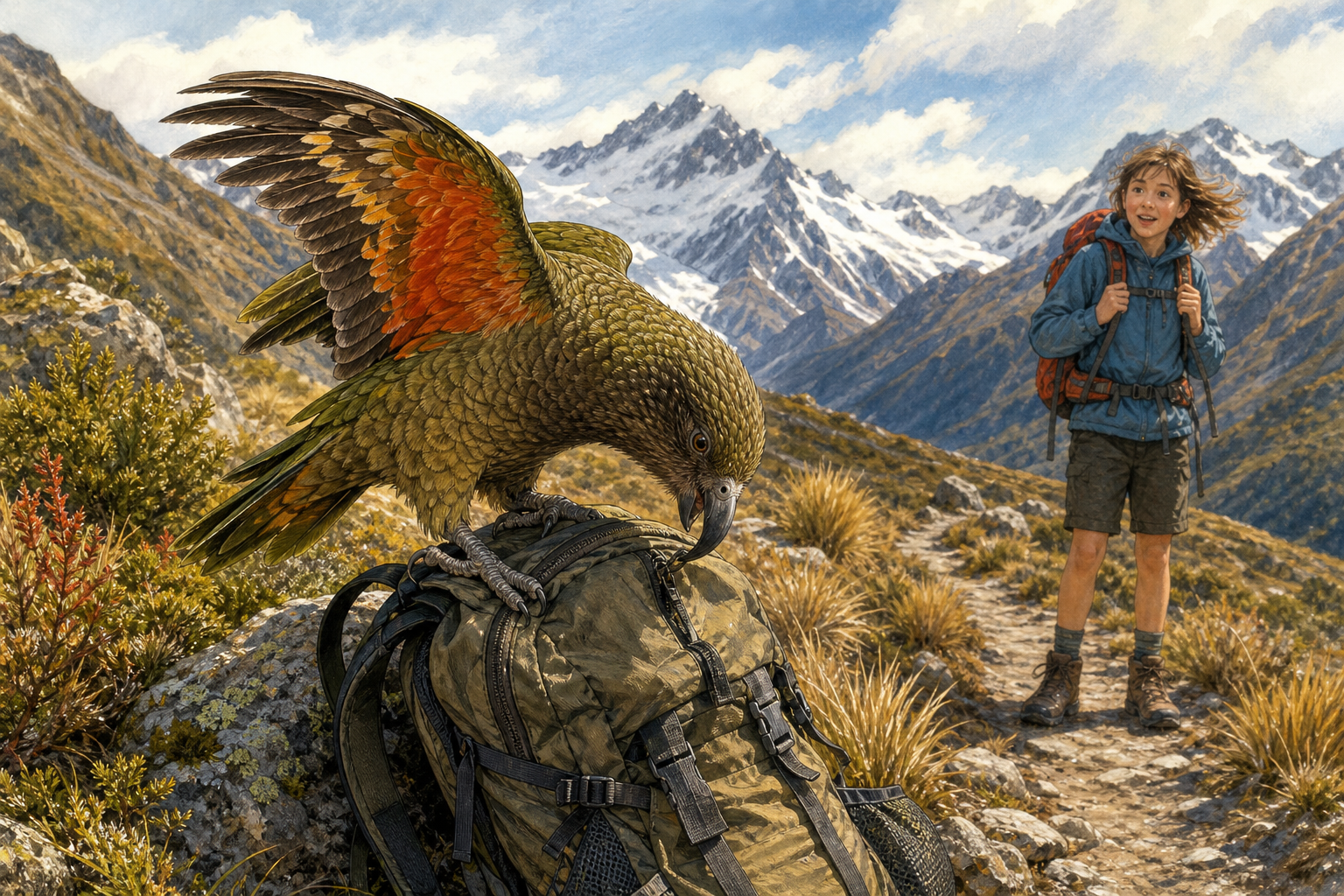
A snowy ridge, a flash of orange beneath green wings, and—oh no—is that bird checking your backpack zip? Let’s follow one of the world’s most curious parrots.

A snowy ridge, a flash of orange beneath green wings, and—oh no—is that bird checking your backpack zip? Let’s follow one of the world’s most curious parrots.
A flash of orange over the snow
Imagine you are walking along a chilly mountain track. The wind tugs your jacket. Gravel crunches under your boots. Then a large green parrot swoops down nearby, folds its wings, and reveals a quick flash of orange-red feathers underneath. That is a kea—and it may already be wondering whether your shoelaces are interesting.
Kea live on Aotearoa New Zealand’s South Island, where they use mountain forests as well as alpine and subalpine scrub and grassland. They are the world’s only parrot that lives in the mountains. Most parrots make us think of warm jungles and steamy leaves; the kea makes its home among cold peaks and snow. What a place for a parrot!
A kea is an olive-green bird with a strong, hooked bill. Adults are about 46 to 50 centimetres long—roughly the length of a school ruler plus another half ruler. During the day, a kea may travel through a landscape of forests, ridges, rocks, and open grassy places, looking for food and new things to investigate.
Evidence: IUCN Red List of Threatened Species / BirdLife International (Red List Authority for birds): Nestor notabilis (Kea) — Red List Assessment; Animal Diversity Web, University of Michigan Museum of Zoology: Nestor notabilis (kea); Wikipedia: Kea
Why is that parrot inspecting a boot?
Because kea are famously curious. A parked car, a backpack, a boot, a latch: to a kea, these may be less like boring objects and more like a mystery box waiting to be explored. They use their powerful beaks to tug, poke, and pull. That does not mean they are being “naughty” in the way a person might be. They are investigating their surroundings.
Kea can solve puzzles and open locks or latches. In studies, they have also shown self-control: sometimes waiting for a better reward instead of immediately grabbing a smaller one. Picture being offered one tiny berry now or a more tempting snack a little later—and managing to wait. That takes a thoughtful bird brain.
Their cleverness is not a party trick. In a tough mountain home, flexibility matters. Weather changes, food can be scattered, and a curious animal that explores carefully may discover a meal or a safer way through its day. Kea are often seen near one another, especially where food or people are around, so an interesting discovery may become a busy gathering.
Evidence: Wikipedia: Kea; Animal Diversity Web, University of Michigan Museum of Zoology: Nestor notabilis (kea)
What’s on a kea’s mountain menu?
Kea are omnivores, meaning they eat both plant foods and animal foods. Their menu can include roots, shoots, leaves, berries, nectar, and insects. A kea might dig for something below the ground, nibble plant parts, sip nectar from a flower, or search for insects. It is a varied mountain picnic, with no picnic blanket required.
This flexible eating helps kea cope with the high country. They forage across mountain and forest food webs, taking what is available rather than relying on just one kind of meal. Their hooked beaks are useful exploration tools as well as eating tools—rather like having a pair of hands built into your face, though probably much harder to use for tying shoelaces.
Kea remind us that wild animals do not need to be useful to us to matter. Their lives are full of their own choices: where to fly, what to investigate, when to rest, and which berry, leaf, or insect to seek next. A mountain is richer when a bright-minded parrot is part of its daily bustle.
Evidence: Animal Diversity Web, University of Michigan Museum of Zoology: Nestor notabilis (kea); Wikipedia: Kea
A mountain home that needs friends
Here is the hard part of the story: the kea is listed as Endangered, and its population is decreasing. Estimates often place the number of birds at about 3,000 to 7,000. That is not many for a bird spread across the wild landscapes of an entire island.
Kea face several dangers. Introduced mammals, including stoats and possums, can prey on nests. Kea have also been deliberately shot, and lead from building materials can poison them. None of those dangers is something a clever beak can simply puzzle its way out of.
But there is hope with real work behind it. Protecting nests from predators, reducing kea contact with lead at alpine buildings, and keeping legal protections in place can all support the remaining populations. Caring for kea means caring for the whole lively mountain neighbourhood: forests, scrub, grassland, insects, flowers, and every hidden nook where a parrot might forage.
If you ever visit kea country, the kindest adventure is a respectful one. Give birds room, keep your belongings secure, and follow local wildlife guidance. A kea’s curiosity is wonderful—but it deserves a safe world in which to be curious.
Evidence: IUCN Red List of Threatened Species / BirdLife International (Red List Authority for birds): Nestor notabilis (Kea) — Red List Assessment; Wikipedia: Kea; Animal Diversity Web, University of Michigan Museum of Zoology: Nestor notabilis (kea)
The question a kea seems to ask: “What happens if I try this?”
That may be the best way to remember a kea: not just as a green bird in the snow, but as a question with wings. It explores. It tests. It notices. Somewhere on a South Island ridge, a kea may be tilting its head at a strange new object, deciding whether to pull it, peck it, or watch it for a while.
We can borrow the good part of that curiosity. What plants grow where we live? Which birds visit after rain? How can we make fewer problems for animals in the places we share? Questions are the beginning of attention, and attention can grow into care.
The kea does not need us to turn it into a cartoon prankster or a mountain mascot. It needs us to notice its real life: an endangered alpine parrot, built for a dramatic home, with orange underwings and a mind eager to explore. That is more than amazing enough.
Evidence: IUCN Red List of Threatened Species / BirdLife International (Red List Authority for birds): Nestor notabilis (Kea) — Red List Assessment; Animal Diversity Web, University of Michigan Museum of Zoology: Nestor notabilis (kea); Wikipedia: Kea
One small choice, shared with many lives
A kea’s mountain menu includes many plant foods, and its story can invite us to think kindly about the food choices available to us, too. Meals built around vegetables, fruit, whole grains, pulses such as beans and lentils, nuts, and seeds can be varied and colourful. If your family is curious about more plant-based meals, make it an adventure with a trusted adult: perhaps try a bean burrito, lentil soup, or a rainbow-packed sandwich.
There is a planet-sized reason for gentle curiosity, too. The World Health Organization describes healthy eating patterns that include plenty of plant foods, while the IPCC reports that shifts toward sustainable, healthy, more plant-based diets can reduce pressure from food systems on climate, land, and biodiversity. No one has to be perfect. Each compassionate, plant-forward choice can be a small way of saying, “There is room on Earth for other animals’ wild lives.”
Evidence: World Health Organization: Healthy diet; Intergovernmental Panel on Climate Change: Climate Change 2022: Mitigation of Climate Change — Chapter 7
Questions people ask
Are kea really parrots?
Yes. The kea is a parrot called Nestor notabilis. Unlike the tropical parrots many people imagine, it lives in the mountainous South Island of Aotearoa New Zealand.
Evidence: Animal Diversity Web, University of Michigan Museum of Zoology: Nestor notabilis (kea); Wikipedia: Kea
Why do kea pull at backpacks and cars?
Kea are highly curious and explore objects with their strong, hooked beaks. Zips, latches, boots, and car parts can become puzzles for an investigating bird.
Evidence: Wikipedia: Kea; Animal Diversity Web, University of Michigan Museum of Zoology: Nestor notabilis (kea)
Do kea eat only plants?
No. Kea are omnivores. Their foods include roots, shoots, leaves, berries, nectar, and insects.
Evidence: Animal Diversity Web, University of Michigan Museum of Zoology: Nestor notabilis (kea); Wikipedia: Kea
How can people help kea?
Support protection of mountain habitats and nest areas, follow local wildlife guidance, and help prevent lead exposure around alpine buildings. Respectful visitors also give kea space rather than encouraging risky close encounters.
Evidence: IUCN Red List of Threatened Species / BirdLife International (Red List Authority for birds): Nestor notabilis (Kea) — Red List Assessment; Wikipedia: Kea
Read the evidence
Sources behind this story
- Nestor notabilis (Kea) — Red List Assessment — IUCN Red List of Threatened Species / BirdLife International (Red List Authority for birds)
- Nestor notabilis (kea) — Animal Diversity Web, University of Michigan Museum of Zoology
- Kea — Wikipedia
- Healthy diet — World Health Organization
- Climate Change 2022: Mitigation of Climate Change — Chapter 7 — Intergovernmental Panel on Climate Change
Health information is general education, not personal medical advice. Young readers should make food choices with a trusted adult and qualified health professional.