Today's animal friend · 26 July 2026
Humpback Whale: The Ocean’s Big-Winged Bubble Maker
A whale with flippers like enormous wings can gather fish with bubble rings, cross whole oceans, and remind us that every living thing deserves room to thrive.
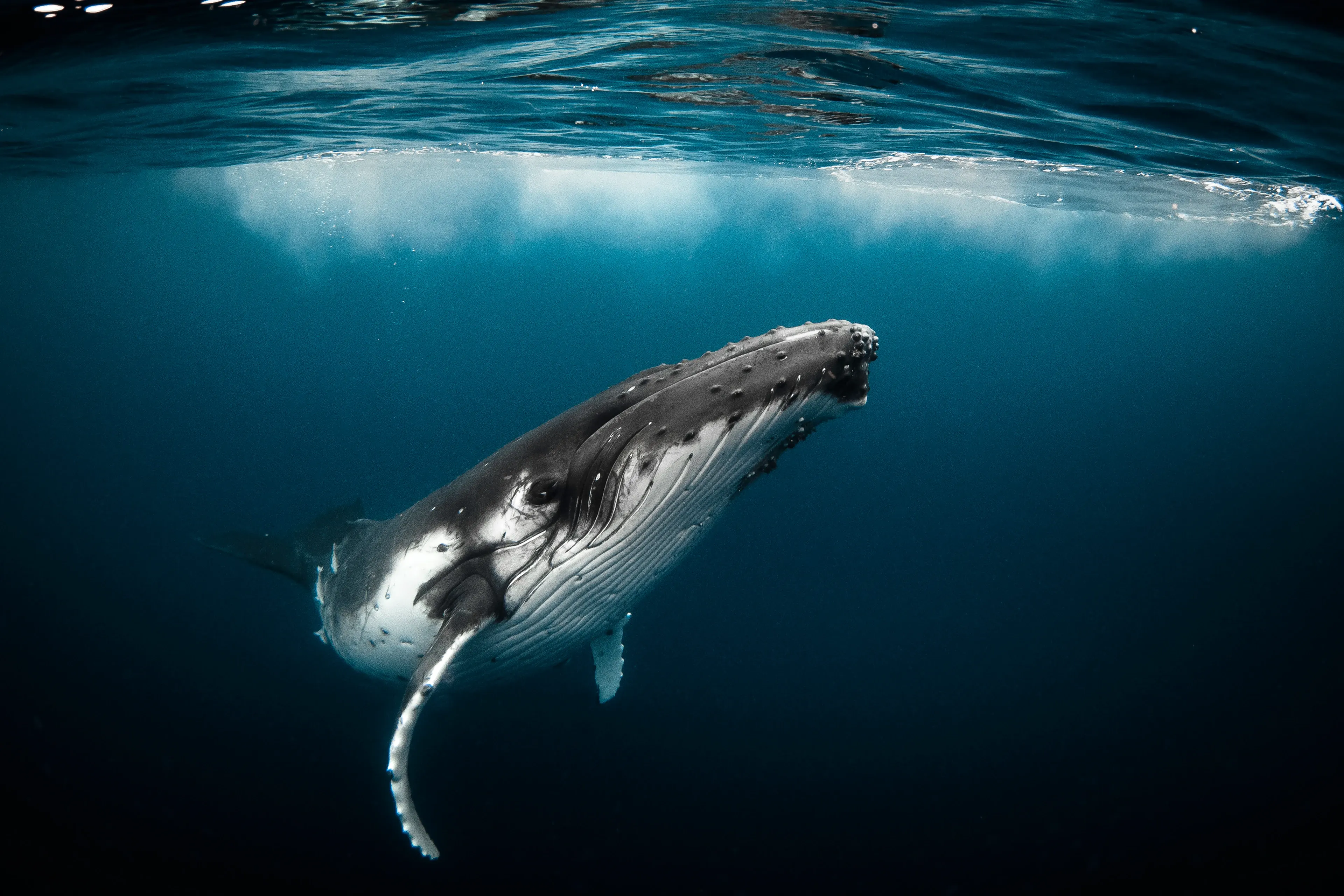
A whale with flippers like enormous wings can gather fish with bubble rings, cross whole oceans, and remind us that every living thing deserves room to thrive.
A giant rises from the blue
Imagine the sea suddenly exploding into white spray. Up comes a humpback whale, lifting its huge body above the waves before crashing back down with a colossal splash. It is the sort of splash that would make every person in a swimming pool yell, “WHO DID THAT?”
Humpback whales are among the world’s biggest animals. An adult can reach about 18 metres long—roughly the length of a big bus—and weigh about 36,000 kilograms. Yet this ocean giant eats tiny krill and small fish. That is a wonderfully strange thought: a bus-sized animal having a meal made of creatures much smaller than your hand.
Its scientific name is Megaptera novaeangliae. Megaptera means “big wing,” and that nickname fits perfectly. A humpback’s front flippers are longer than those of any other whale. When one lifts a flipper from the water, it can look as if a giant ocean friend is waving hello.
Evidence: NOAA Fisheries (National Oceanic and Atmospheric Administration): Humpback Whale — Species Directory; Wikipedia: Humpback whale; IUCN Red List of Threatened Species: Megaptera novaeangliae (Humpback Whale) — Red List Assessment
How can a whale catch a cloud of fish? Bubbles!
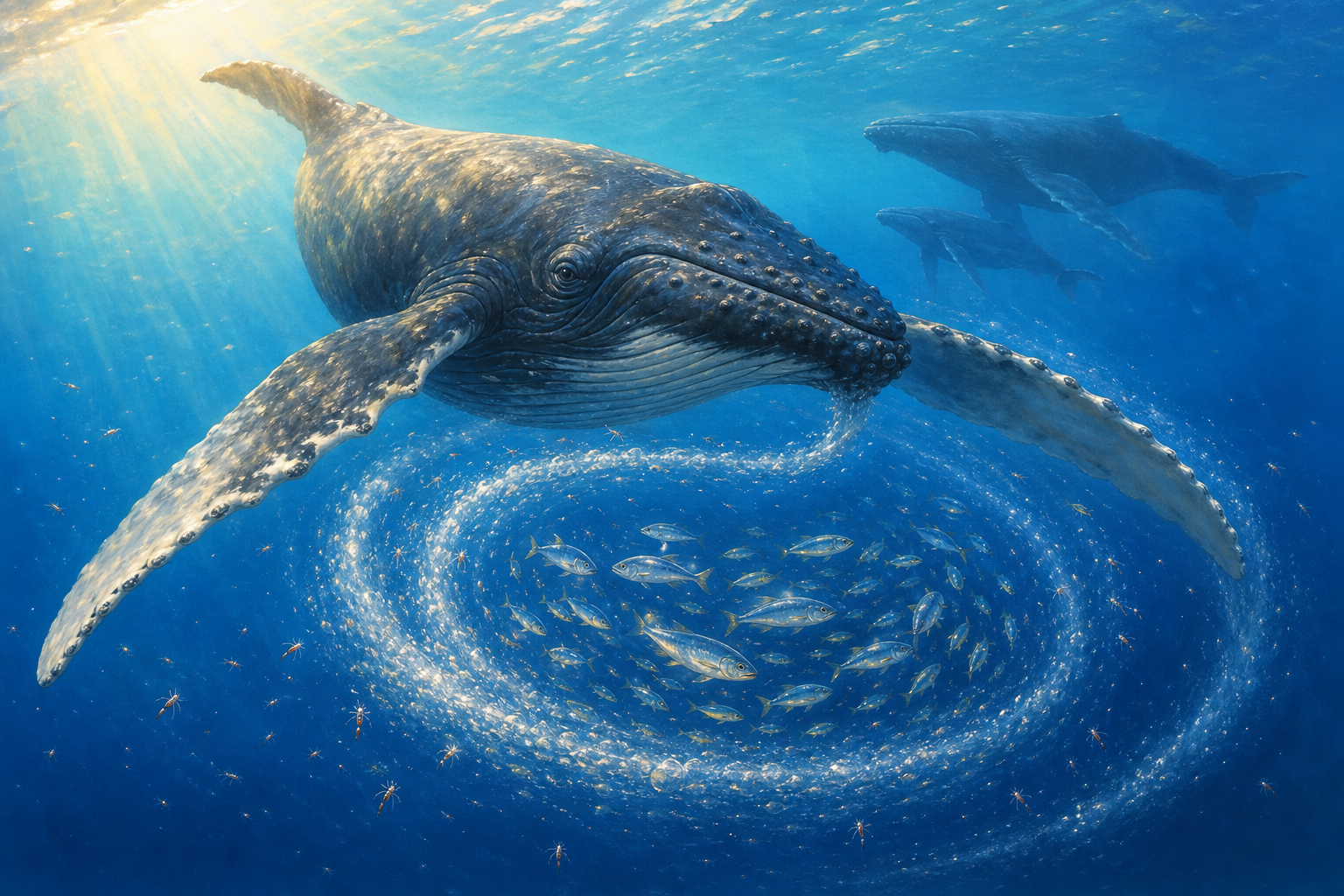
Humpbacks are filter-feeders. Instead of chasing one snack at a time, they take in krill and small schooling fish in great mouthfuls. But first, some humpbacks make the underwater world fizz.
In bubble-net feeding, a whale blows rings of bubbles beneath the surface. The bubbles help gather small fish into a tight, shimmering ball. Then the humpback swims upward through the middle with its mouth wide open. It is a little like making a bubble fence around runaway marbles—except the fence is underwater, the marbles are fish, and the builder is a whale.
Sometimes whales work together while feeding. That does not mean every humpback is always part of a permanent whale club: they are often alone or in small temporary groups. Still, when food gathers in one place, teamwork can appear. The sea can be a very good place for a clever shared lunch.
Evidence: NOAA Fisheries (National Oceanic and Atmospheric Administration): Humpback Whale — Species Directory; Wikipedia: Humpback whale
The long swim between two different homes
A humpback whale’s year can include one of the longest journeys made by any animal. Humpbacks travel thousands of miles between feeding seas and warmer breeding or calving seas. Some populations travel about 5,000 miles. That is not a quick trip to the corner shop; it is an ocean-crossing adventure with no suitcase, no map held in flippers, and definitely no snack stops at motorway cafés.
They live across the major oceans, including the Pacific, Atlantic, Indian, Arctic, and Southern oceans. They use open ocean and coastal waters. Many feed in productive, cooler waters and travel toward warmer coastal waters for breeding and calves, although not every population follows exactly the same route.
A mother and calf may travel together, while other humpbacks may meet in places where food or breeding opportunities bring many whales close. Their lives are full of movement: not just swimming from here to there, but finding the right seas at the right times.
Evidence: NOAA Fisheries (National Oceanic and Atmospheric Administration): Humpback Whale — Species Directory; Wikipedia: Humpback whale; IUCN Red List of Threatened Species: Megaptera novaeangliae (Humpback Whale) — Red List Assessment
Songs, splashes, and a tail with something to say
Humpbacks are famous for sounds as well as splashes. Male humpbacks sing long, complex songs. In some places, a song can last from about 4 to 33 minutes and travel a long distance through water. Whales in the same region may sing the same tune. Picture a neighbourhood where the song on everyone’s lips is not on a phone or radio, but rolling through the sea.
They are also known for breaching—leaping out of the water—and for slapping the surface with flippers or tails. We do not need to pretend we know exactly what every splash means to enjoy it. A humpback’s movements can be a reminder that animals have their own ways of communicating and living, whether or not humans understand every note and gesture.
That is part of the magic of watching wildlife: we can be curious without treating an animal like a puzzle we must completely solve. Sometimes the best response is simply respectful amazement.
Evidence: NOAA Fisheries (National Oceanic and Atmospheric Administration): Humpback Whale — Species Directory; Wikipedia: Humpback whale
A comeback story—with important chapters still to write
Long ago, commercial whaling caused humpback numbers to crash. Protection from commercial whaling helped many populations recover. Globally, the humpback whale is listed as Least Concern by the IUCN, with an increasing population trend in the 2018 assessment context. Estimates summarised there suggest around 135,000 humpbacks, including about 84,000 grown-ups.
That is hopeful news, but “Least Concern” does not mean “nothing to worry about.” Some populations face greater risks than others, and humpbacks can still become tangled in fishing gear, be struck by ships, be disturbed by vessel activity, or be affected by underwater noise and changing climate conditions.
Think of the ocean as a shared neighbourhood. Whales need clear, safer routes through it, fishing gear that is less likely to entangle them, and enough quiet space to travel, feed, and communicate. People have already shown that protection can help. Now the job is to keep paying attention.
Evidence: IUCN Red List of Threatened Species: Megaptera novaeangliae (Humpback Whale) — Red List Assessment; NOAA Fisheries (National Oceanic and Atmospheric Administration): Humpback Whale — Species Directory; Wikipedia: Humpback whale
What can a young ocean friend do?
You do not have to own a boat—or be able to hold your breath for ages—to care about humpbacks. Start with curiosity. Learn which ocean animals live near you or along coasts you visit. If you are lucky enough to see whales from shore or a boat, give them space and follow local wildlife-viewing rules. A whale is not a floating photo prop; it is a traveller trying to get on with its day.
You can also notice the choices that connect dinner tables to big blue seas. Choosing more plant-forward meals can be a kind way to make room in our thoughts for animals, while also being one option that can support healthier, more sustainable food systems. A colourful plate of vegetables, fruit, whole grains, pulses, nuts, and seeds can be an adventure of its own—perhaps with a trusted adult helping choose and prepare it.
Most of all, keep the question alive: what would make the ocean a kinder neighbourhood for its wild residents? Humpbacks cannot send us a postcard. But a giant splash, a bubble ring, and a far-carrying song are pretty excellent reminders to listen.
Evidence: NOAA Fisheries (National Oceanic and Atmospheric Administration): Humpback Whale — Species Directory; World Health Organization: Healthy diet; Intergovernmental Panel on Climate Change: Climate Change 2022: Mitigation of Climate Change — Chapter 7
A gentle choice for a shared planet
When we picture a humpback travelling through dark blue water with a calf nearby or bubbles rising around a meal, it is easier to remember that the ocean belongs to its residents too. Caring can look like learning, giving wildlife space, and speaking up for cleaner, safer seas.
Food choices can be part of that caring picture. The World Health Organization describes healthy diets as varied and rich in foods such as vegetables, fruit, whole grains, pulses, nuts, and seeds. The IPCC reports that shifts toward sustainable, healthy, more plant-based diets can reduce food-system emissions and pressure on land and biodiversity. With a trusted adult, trying a bean taco, lentil soup, or crunchy vegetable wrap can be one cheerful, animal-kind choice—not a test, just an invitation to explore.
Evidence: World Health Organization: Healthy diet; Intergovernmental Panel on Climate Change: Climate Change 2022: Mitigation of Climate Change — Chapter 7
Questions people ask
Is a humpback whale a fish?
No. A humpback whale is a mammal. It is a baleen rorqual in the whale family Balaenopteridae, and it feeds on krill and small fish by filtering food rather than being a fish itself.
Evidence: NOAA Fisheries (National Oceanic and Atmospheric Administration): Humpback Whale — Species Directory; Wikipedia: Humpback whale
Why is it called a humpback whale?
The name comes from the small hump that can show when the whale curves its back to dive. Its scientific genus name, Megaptera, means “big wing,” because of its extremely long front flippers.
Evidence: NOAA Fisheries (National Oceanic and Atmospheric Administration): Humpback Whale — Species Directory; Wikipedia: Humpback whale
Are humpback whales safe now that numbers have increased?
Their global status and increasing trend are encouraging, but safety is not guaranteed. Entanglement, ship strikes, noise, disturbance, and climate-related changes can still harm humpbacks, and recovery is uneven among populations.
Evidence: IUCN Red List of Threatened Species: Megaptera novaeangliae (Humpback Whale) — Red List Assessment; NOAA Fisheries (National Oceanic and Atmospheric Administration): Humpback Whale — Species Directory; Wikipedia: Humpback whale
Read the evidence
Sources behind this story
- Megaptera novaeangliae (Humpback Whale) — Red List Assessment — IUCN Red List of Threatened Species
- Humpback Whale — Species Directory — NOAA Fisheries (National Oceanic and Atmospheric Administration)
- Humpback whale — Wikipedia
- Healthy diet — World Health Organization
- Climate Change 2022: Mitigation of Climate Change — Chapter 7 — Intergovernmental Panel on Climate Change
Health information is general education, not personal medical advice. Young readers should make food choices with a trusted adult and qualified health professional.