Today's animal friend · 30 October 2026
Harbour Seals: The Spotted Swimmers of the Shore
Follow the splash, the whiskers, and the mysterious V-shaped nostrils to meet Phoca vitulina, a seal who needs quiet shores and clean water.

Follow the splash, the whiskers, and the mysterious V-shaped nostrils to meet Phoca vitulina, a seal who needs quiet shores and clean water.
Splash! A pup’s first day is no ordinary day
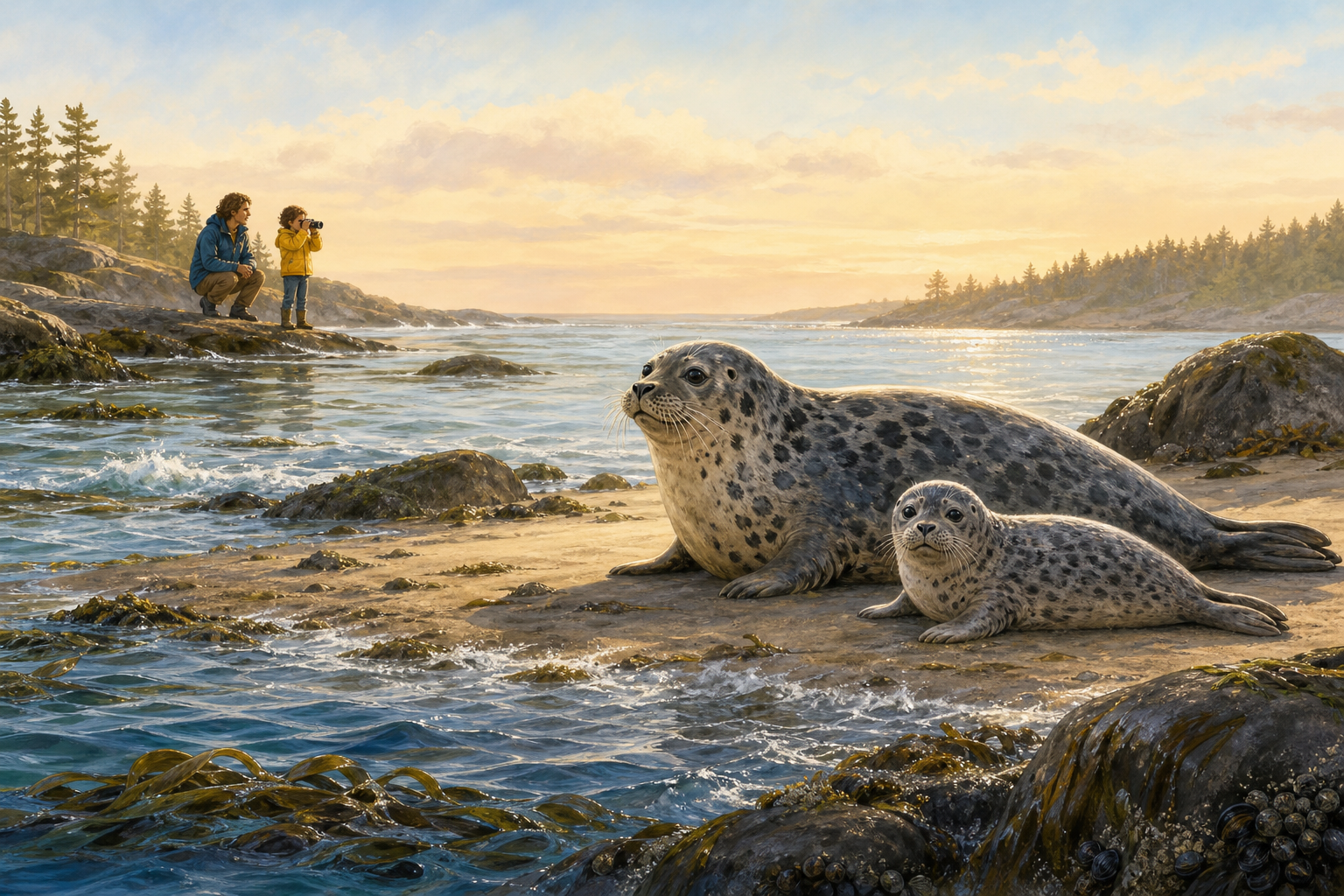
Imagine arriving in the world beside the sea, with waves fizzing over the sand and gulls calling overhead. Before most baby animals can manage a wobbly walk, a harbour seal pup can swim and dive within a few hours of being born. That is an astonishingly speedy start to life.
Harbour seals, also called harbor seals or common seals, are mammals named Phoca vitulina. They are true seals, which means they belong to the family Phocidae. Their home is not one single beach: harbour seals live along cool coasts in the Atlantic, Pacific, and Arctic oceans.
A pup is born on shore and cared for by its mother. Her milk is very rich, helping the youngster grow round and chubby over about four to six weeks before it begins catching its own food. Think of it as an extremely important sea-baby growth spurt—with no school lunchbox required.
Evidence: IUCN Red List of Threatened Species: Phoca vitulina (Harbour Seal) — Red List Assessment; Animal Diversity Web, University of Michigan Museum of Zoology: Phoca vitulina (harbor seal); Wikipedia: Harbor seal
Can you spot the seal hiding in plain sight?
A harbour seal may look like a smooth grey-brown pebble at first. Then the pebble blinks. Its rounded head, dark eyes, spotted coat, and small V-shaped nostrils give it away. Those nostrils are one handy clue that helps people tell harbour seals from some other seals.
Their coats may be grey, brown, or silvery, dotted with darker or lighter spots. No two seals have exactly the same spot pattern, so every animal seems to be wearing its own speckled raincoat. Looking carefully at those markings helps scientists and wildlife watchers recognise individual seals without bothering them.
Adults are roughly 1.4 to 1.9 metres long—about as long as a tall grown-up is high—and can weigh from about 45 to 170 kilograms. That is a big range, but either way, these are solidly built swimmers, not slippery little fish pretending to be mammals.
Evidence: Animal Diversity Web, University of Michigan Museum of Zoology: Phoca vitulina (harbor seal); Wikipedia: Harbor seal; IUCN Red List of Threatened Species: Phoca vitulina (Harbour Seal) — Red List Assessment
Why is that seal lounging on a rock?
A seal in the water can glide and steer beautifully. A seal on land is much less speedy. Yet harbour seals still climb onto rocks, sandbanks, and quiet beaches to rest. This is called hauling out. A favourite haul-out spot may have several seals snoozing nearby, like a very damp, whiskery sleepover.
They haul out to rest, moult, and have pups. At sea, harbour seals are often on their own; at haul-out places and during the breeding season, they can gather together. The group does not have to be a noisy club. Sometimes the nicest company is simply another seal napping a flipper-length away.
Harbour seals use coasts, bays, estuaries, rocky shores, sandy beaches, and nearby ocean waters. They generally stay close to shore, where they can find food and a safe place to come ashore. A beach that looks empty to us may be an important seal bedroom, nursery, and resting room all at once.
Evidence: Animal Diversity Web, University of Michigan Museum of Zoology: Phoca vitulina (harbor seal); Wikipedia: Harbor seal; IUCN Red List of Threatened Species: Phoca vitulina (Harbour Seal) — Red List Assessment
What is on a seal’s seafood menu?
Harbour seals are carnivores. They hunt fish such as herring, cod, and mackerel, and they also eat squid and crabs. Their meals depend on what is plentiful and easy to catch nearby, so the menu can change from one coast to another.
Underwater, a harbour seal is much more graceful than it is on a beach. Its flippers help it steer as it searches and dives for prey. It is a coastal predator, part of a busy food web that connects fish and invertebrates with larger animals along the shore.
That is one reason a healthy coast matters. When we protect water and shore habitats, we are not just helping one spotted face pop above the waves. We are helping the living neighbourhood around it—from small creatures in the water to the animals that depend on them.
Evidence: Animal Diversity Web, University of Michigan Museum of Zoology: Phoca vitulina (harbor seal); Wikipedia: Harbor seal; IUCN Red List of Threatened Species: Phoca vitulina (Harbour Seal) — Red List Assessment
Good news, with a “please be careful” reminder
Globally, the harbour seal is listed as Least Concern on the IUCN Red List. Estimates put the global population at roughly 350,000 to 500,000, with an overall stable trend. That is encouraging news—but it does not mean every local group of seals is safe. Some subspecies face much greater risk.
Harbour seals can be harmed by pollution, disease, disturbance at resting places, and fishing gear that entangles them. A resting seal may look as though it needs rescuing, but getting close can frighten it away from the very place it needs to rest or care for a pup.
The kindest wildlife-watching superpower is distance. If you see a seal hauled out, watch quietly from far away, keep dogs well away, and let responsible local wildlife experts decide if help is needed. We can also support cleaner coasts and fisheries that reduce accidental bycatch. Quiet choices can make a shoreline feel safer.
Evidence: IUCN Red List of Threatened Species: Phoca vitulina (Harbour Seal) — Red List Assessment; Animal Diversity Web, University of Michigan Museum of Zoology: Phoca vitulina (harbor seal); Wikipedia: Harbor seal
A shore friend worth cheering for
Harbour seals have been sharing northern coasts with waves, tides, and rocky ledges for a long time. A seal’s spotted coat, watchful eyes, and sudden splash can remind us that a familiar beach is full of lives different from our own.
Try this on your next seaside walk: pause before racing to the water. Listen for gulls, look for tide pools, and leave the shore cleaner and calmer than you found it. You may not meet a harbour seal—and that is fine. Giving wildlife space is part of being a good neighbour.
And if you do see one resting safely in the distance, perhaps it will look less like a lump on a rock and more like what it is: a remarkable coastal mammal taking a well-earned break between ocean adventures.
Evidence: Animal Diversity Web, University of Michigan Museum of Zoology: Phoca vitulina (harbor seal); Wikipedia: Harbor seal; IUCN Red List of Threatened Species: Phoca vitulina (Harbour Seal) — Red List Assessment
One gentle choice for seas, seals, and supper
It can feel strange to admire a seal hunting fish and then remember that people make food choices, too. We can hold both thoughts kindly: harbour seals need the foods that suit their wild lives, while humans can explore delicious plant-forward meals with the adults who care for them.
The World Health Organization describes healthy diets as varied and rich in foods such as vegetables, fruit, whole grains, pulses, nuts, and seeds. The IPCC reports that shifts toward sustainable, healthy, more plant-based diets can reduce food-system emissions and pressure on land and biodiversity. A bean burrito, lentil soup, or veggie pasta night can be a cheerful way to practise care for animals and our shared planet—no scolding, just curiosity and kindness.
Evidence: World Health Organization: Healthy diet; Intergovernmental Panel on Climate Change: Climate Change 2022: Mitigation of Climate Change — Chapter 7
Questions people ask
Are harbour seals the same as sea lions?
No. Harbour seals are true seals in the family Phocidae. They have the rounded heads, spotted coats, and V-shaped nostrils described for Phoca vitulina. Sea lions are different pinnipeds.
Evidence: Animal Diversity Web, University of Michigan Museum of Zoology: Phoca vitulina (harbor seal); Wikipedia: Harbor seal
Why should I not walk up to a seal on the beach?
Haul-out sites are places where seals rest and pups may be cared for. Human disturbance can interrupt this important time, so the helpful choice is to watch quietly from far away and follow local wildlife advice.
Evidence: Animal Diversity Web, University of Michigan Museum of Zoology: Phoca vitulina (harbor seal); Wikipedia: Harbor seal; IUCN Red List of Threatened Species: Phoca vitulina (Harbour Seal) — Red List Assessment
How long can harbour seals live?
Reported lifespans vary, but females may live about 30 to 35 years and males about 20 to 25 years. Like us, each seal’s life story is its own.
Evidence: Animal Diversity Web, University of Michigan Museum of Zoology: Phoca vitulina (harbor seal); Wikipedia: Harbor seal
Read the evidence
Sources behind this story
- Phoca vitulina (Harbour Seal) — Red List Assessment — IUCN Red List of Threatened Species
- Phoca vitulina (harbor seal) — Animal Diversity Web, University of Michigan Museum of Zoology
- Harbor seal — Wikipedia
- Healthy diet — World Health Organization
- Climate Change 2022: Mitigation of Climate Change — Chapter 7 — Intergovernmental Panel on Climate Change
Health information is general education, not personal medical advice. Young readers should make food choices with a trusted adult and qualified health professional.