Today's animal friend · 29 October 2026
Guppy Glitter in a Sunlit Stream
A guppy may fit across a small child’s thumb, but its stream-side story travels from South America and the Caribbean to waters around the world.

A guppy may fit across a small child’s thumb, but its stream-side story travels from South America and the Caribbean to waters around the world.
A tiny flash says, “Did you see that?”
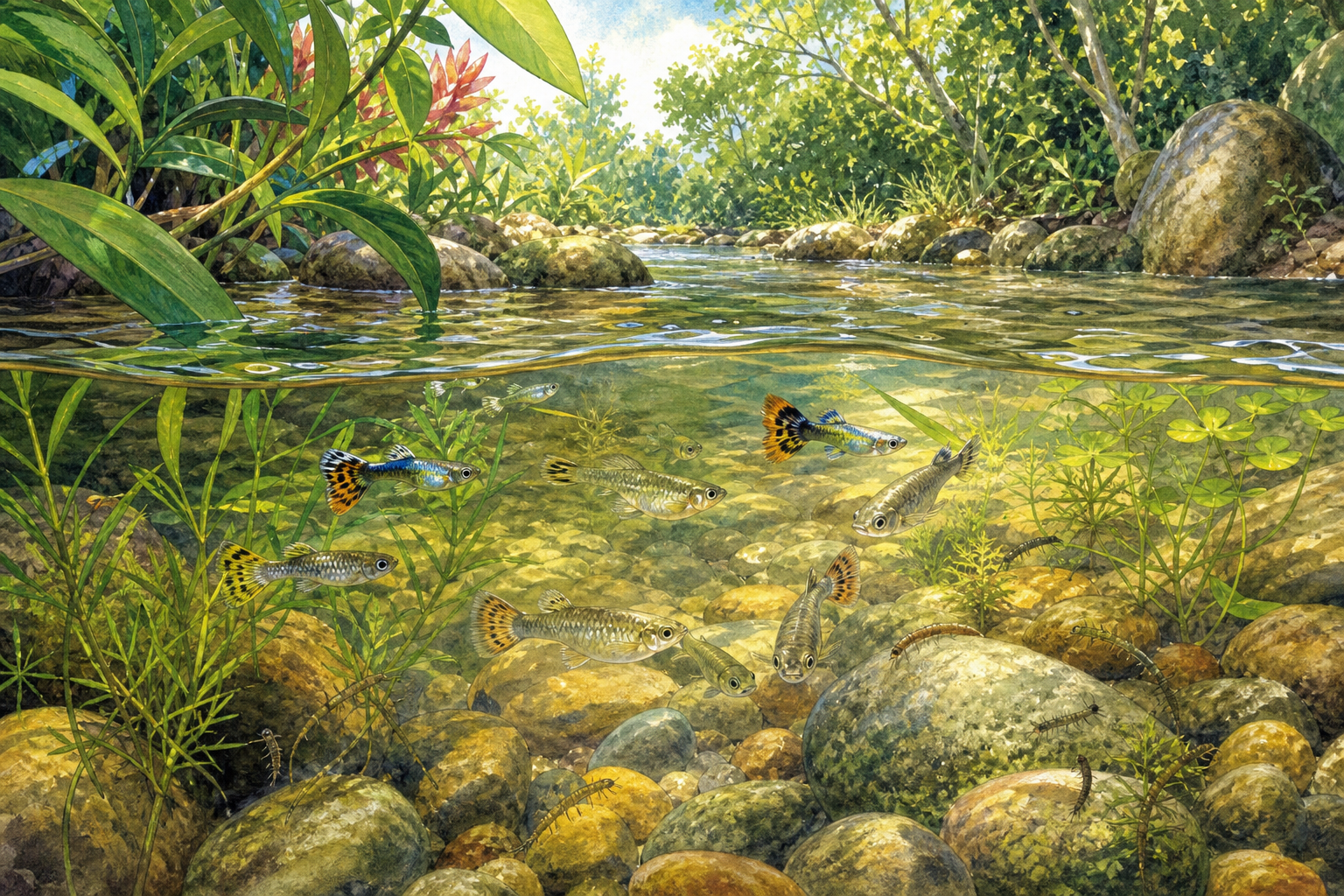
Imagine crouching beside a warm, shallow stream. Sunlight wobbles on the water like crumpled silver foil. Then—zip!—a little fish flickers past, wearing a splash of colour that seems far too cheerful for someone so small. Meet the guppy, or Poecilia reticulata. It is also called the rainbow fish and, rather grandly, the millionfish.
Wild guppies live in freshwater streams, rivers, pools, and ponds. Their native home is northeast South America and nearby Caribbean islands. They are daytime fish, so the bright hours are when their underwater neighbourhood is buzzing with nibbling, swimming, and keeping an eye out.
A guppy is a ray-finned fish, which sounds like it ought to wear a superhero cape. Really, it means it belongs to the enormous group of fishes with fins supported by fine bony rays. This little swimmer belongs to the fish family Poeciliidae.
Evidence: IUCN Red List of Threatened Species: Poecilia reticulata (Guppy) — Red List Assessment; Animal Diversity Web, University of Michigan Museum of Zoology: Poecilia reticulata (Rainbow fish); Wikipedia: Guppy
Why do some guppies look like swimming confetti?
Male guppies are famous for bright splashes, spots, and stripes. A male is usually about 1.5 to 4 centimetres long: small enough that a row of them could fit along a pencil. Females are often larger, around 3 to 7 centimetres long, and are generally silvery-grey rather than boldly patterned.
Those colours are not a costume party for us. They are part of guppy courtship. Males display to females, even bending their bodies in a curved, S-like pose. In a moving stream, that is quite a performance for a fish with no arms, no drum kit, and no stage manager.
Not every guppy people see looks just like a wild guppy. Aquarium-bred fancy strains can be especially ornate. The wild guppy’s own story is still full of colour, though: a small animal making a living in a changeable, watery world.
Evidence: Wikipedia: Guppy; Animal Diversity Web, University of Michigan Museum of Zoology: Poecilia reticulata (Rainbow fish)
What is on the guppy lunch menu? A little of nearly everything
Guppies are omnivores. Think of them as careful stream snackers, not picky restaurant critics. They feed on algae and diatoms—tiny algae with intricate structures—as well as zooplankton, little invertebrates, aquatic insect larvae, plant fragments, and detritus, which is bits of natural material in the water.
Their menu can change with what is available nearby. In one place, algae may be an important part of the meal; elsewhere, tiny drifting creatures or insect larvae may be easier to find. That flexible appetite helps explain how guppies can make use of many small freshwater habitats.
A guppy’s feeding is a reminder that a stream is not just water rushing between banks. It is a busy pantry of green films, floating specks, wrigglers, and hidden crumbs. Look closely at a healthy-looking patch of water and you may be seeing a whole neighbourhood at work.
Evidence: Wikipedia: Guppy; IUCN Red List of Threatened Species: Poecilia reticulata (Guppy) — Red List Assessment; Animal Diversity Web, University of Michigan Museum of Zoology: Poecilia reticulata (Rainbow fish)
The baby-fish surprise: no eggs left behind
Here is the guppy fact most likely to make you blink: mother guppies give birth to live, fully formed babies. Guppies are livebearers, rather than fish that lay eggs and leave them in the water. The newborn fish are called fry.
And the fry do not wait around for swimming lessons. They can swim straight away. They may gather with other young guppies, but there is no long period of parental care after birth. From their first moments, these tiny fish need to move, find food, and stay alert in their watery home.
This may be why the nickname millionfish sounds less silly once you know the story. Guppies breed readily, and they have become one of the world’s most widespread tropical fishes. Yet every fry is still an individual little swimmer, beginning a daring life among ripples and reeds.
Evidence: Wikipedia: Guppy; IUCN Red List of Threatened Species: Poecilia reticulata (Guppy) — Red List Assessment; Animal Diversity Web, University of Michigan Museum of Zoology: Poecilia reticulata (Rainbow fish)
A school is not made of bricks
Guppies often travel in shoals or schools. That does not mean they carry backpacks or practise spelling underwater—sadly. It means they swim together in groups. Group living can help fish as they search for food and watch for danger. Guppies have even been observed inspecting predators, which is a brave-sounding job for an animal smaller than a biscuit crumb.
Their lives move quickly. Wild guppies typically live for around two years. During that time, they feed in daylight, court, gather with others, and navigate the constant puzzle of a flowing freshwater world.
Small does not mean unimportant. Guppies are consumers in their freshwater communities, eating algae and small animals. Their everyday nibbles link them to many other lives in the stream. A tiny fish can be one bright thread in a much bigger living fabric.
Evidence: Wikipedia: Guppy
When travelling fish need thoughtful human neighbours
Guppies are native to parts of South America and the Caribbean, but people have introduced them widely to warm places on other continents. Sometimes this was connected with attempts at mosquito control. A fish may look harmless, but releasing aquarium animals or moving them into new waterways can upset the local community of native fishes.
That is why caring for guppies includes a simple promise: never release a pet fish into a pond, river, drain, or stream. If a family can no longer care for an aquarium animal, a trusted adult can seek advice from a local aquarium shop, rescue group, or other appropriate animal-care service instead.
The guppy is listed as Least Concern on the IUCN Red List, meaning it is not currently assessed as facing a high global risk of extinction. That is happy news, not a reason to stop caring. Native freshwater homes and the animals already living in them deserve gentle, thoughtful protection.
Evidence: IUCN Red List of Threatened Species: Poecilia reticulata (Guppy) — Red List Assessment; Wikipedia: Guppy
How to become a guppy-sized nature detective
You do not need to scoop up wildlife to admire it. If you visit a stream or pond with an adult, pause quietly and look for movement near the edges. Notice reflections, water plants, insects, and ripples. Ask: who might be eating here? Who might be hiding? The best wildlife detectives leave a place as they found it—or kinder.
Guppies invite a bigger question too: how can something so tiny have such a far-reaching story? Their colours, group life, live-born fry, and travels with people show that even a thumb-sized fish is not “just a fish.” It is a neighbour with its own needs and a place in a living community.
So next time sunlight dances on water, imagine a guppy flashing through it like a dropped rainbow bead. Look closely, tread lightly, and let that quick silver-and-colour flick remind you that small lives are full of surprises.
Evidence: Wikipedia: Guppy; IUCN Red List of Threatened Species: Poecilia reticulata (Guppy) — Red List Assessment; Animal Diversity Web, University of Michigan Museum of Zoology: Poecilia reticulata (Rainbow fish)
A kind choice can begin at lunch—and at the water’s edge
Caring about guppies can make us notice that rivers, ponds, farms, homes, and meals are all connected. A colourful fish is not decoration for a human story; it is a life with its own stream to swim and its own work to do. We can enjoy animals with curiosity while giving wildlife room to stay wild.
One gentle way families can care for animals and the planet is to explore tasty plant-forward meals together: beans, lentils, peas, whole grains, vegetables, fruit, nuts, and seeds can all be part of a varied diet. The World Health Organization includes these foods in healthy dietary patterns. Food choices that are more plant-based can also help reduce pressure on land and biodiversity and cut food-system emissions. No one needs to be perfect; a new plant-based meal is simply one kind, hopeful step. Ask a trusted adult if you want to try a change that suits your family.
And for guppies, kindness is wonderfully practical: protect freshwater places, watch wildlife without taking it home, and never release aquarium fish into local water. That lets each stream’s own residents keep their neighbourhoods their own.
Evidence: World Health Organization: Healthy diet; Intergovernmental Panel on Climate Change: Climate Change 2022: Mitigation of Climate Change — Chapter 7; Wikipedia: Guppy
Questions people ask
How big is a wild guppy?
Males are typically about 1.5–4 centimetres long, while females are usually about 3–7 centimetres long. That makes even a larger female a very small stream explorer.
Evidence: Wikipedia: Guppy
Why is it called a millionfish?
The nickname points to how readily guppies breed. Mothers give birth to free-swimming fry rather than laying eggs, so guppy families can grow quickly.
Evidence: Wikipedia: Guppy; Animal Diversity Web, University of Michigan Museum of Zoology: Poecilia reticulata (Rainbow fish)
Are guppies native everywhere people find them?
No. They are native to northeast South America and nearby Caribbean islands, but people have introduced them widely elsewhere. Introduced guppies can affect native fish communities.
Evidence: Wikipedia: Guppy
Read the evidence
Sources behind this story
- Poecilia reticulata (Guppy) — Red List Assessment — IUCN Red List of Threatened Species
- Poecilia reticulata (Rainbow fish) — Animal Diversity Web, University of Michigan Museum of Zoology
- Guppy — Wikipedia
- Healthy diet — World Health Organization
- Climate Change 2022: Mitigation of Climate Change — Chapter 7 — Intergovernmental Panel on Climate Change
Health information is general education, not personal medical advice. Young readers should make food choices with a trusted adult and qualified health professional.