Today's animal friend · 24 July 2026
Grey Wolves: The Family Voices of the Wild
A grey wolf’s howl may sound like a lonely song, but it often carries a family message: stay close, this territory is ours, and we are here.
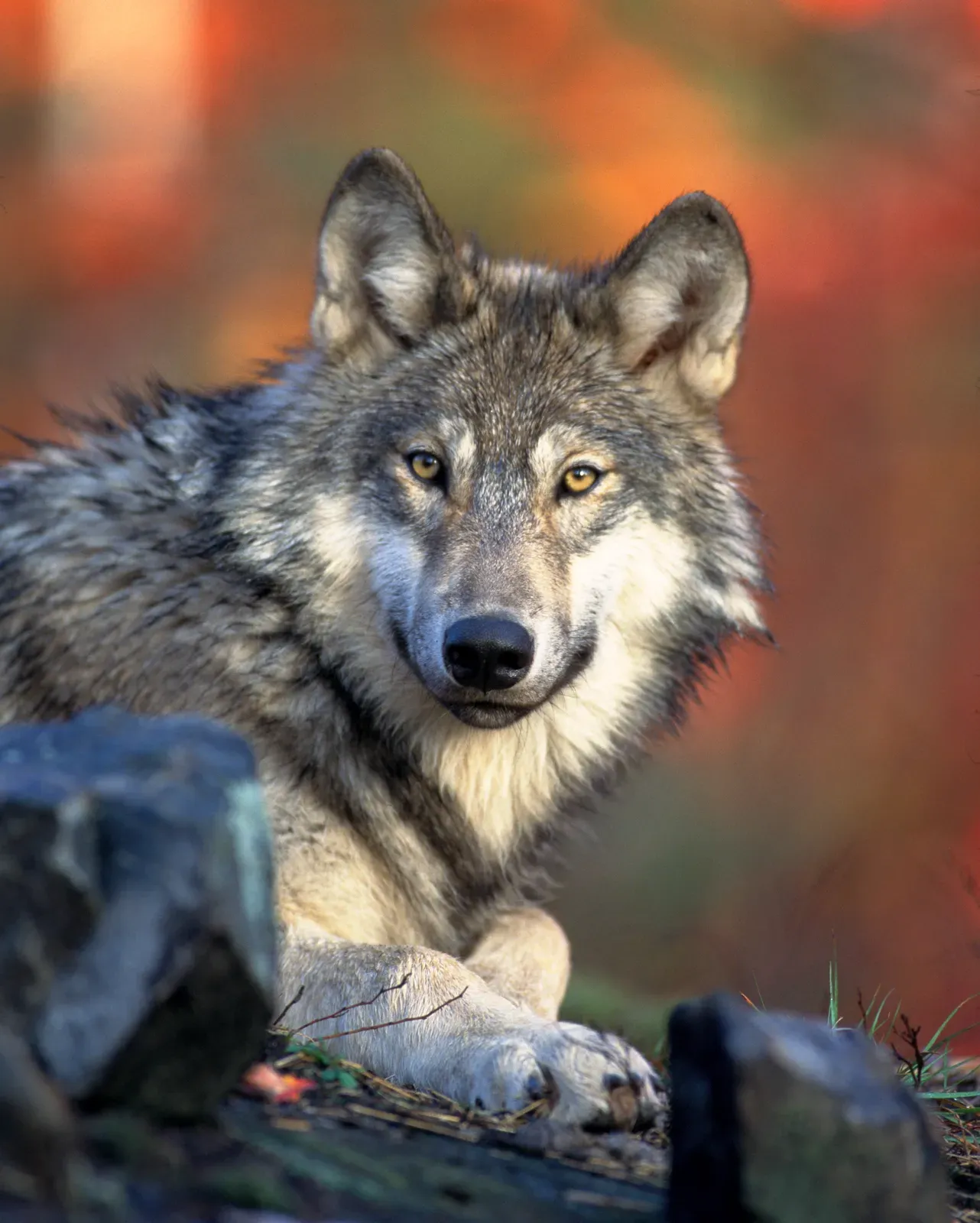
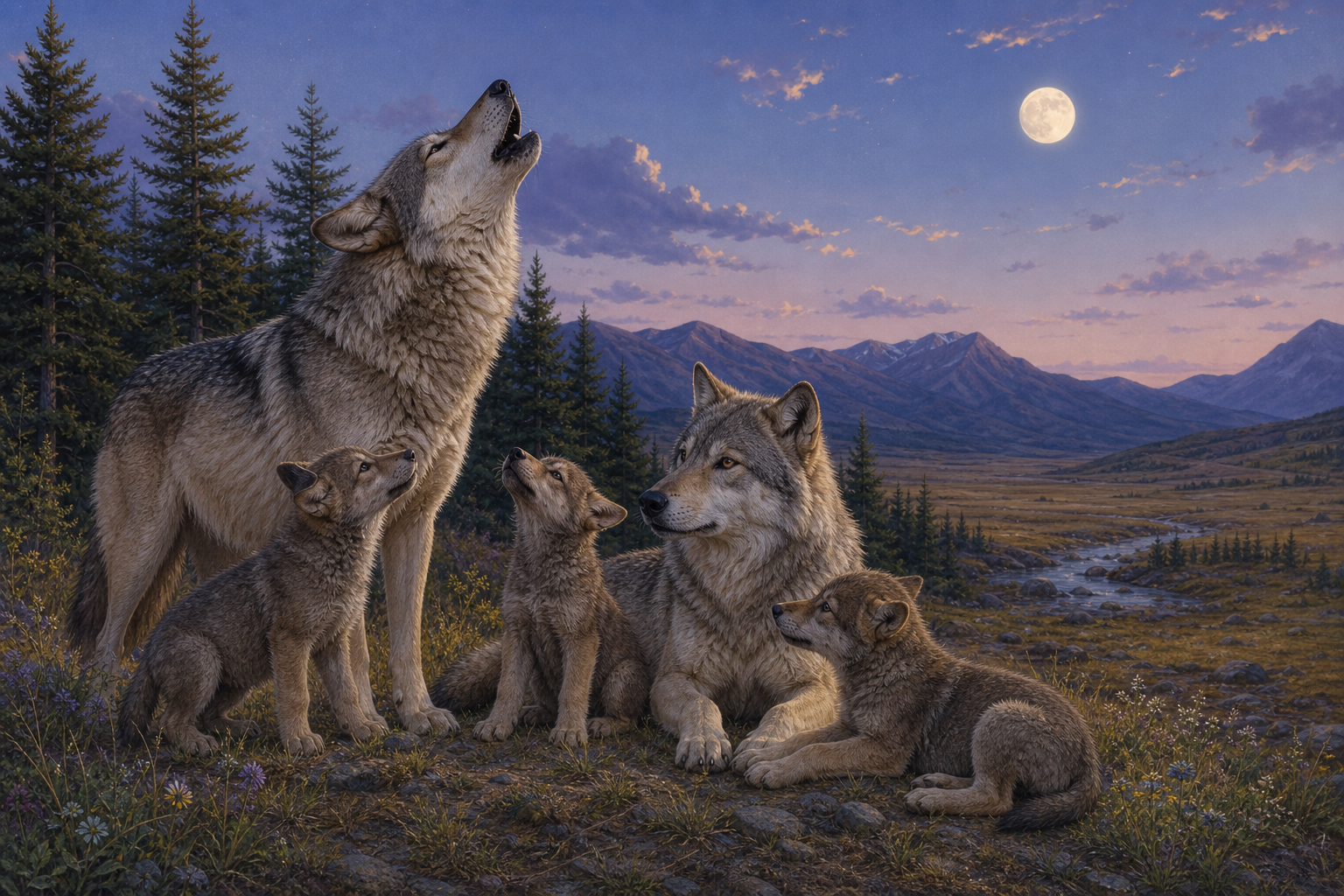
A grey wolf’s howl may sound like a lonely song, but it often carries a family message: stay close, this territory is ours, and we are here.
Grey wolves are social wild canids with a powerful sense of family
The grey wolf, Canis lupus, is also called the gray wolf, timber wolf, or simply wolf. It is the largest wild member of the dog family, so there is a real family connection behind the familiar alert ears, expressive face, and busy tail of a pet dog. Every dog, from the smallest companion to the tallest hound, is related to the grey wolf.
Yet a wolf is not a wild pet dog. It is an animal shaped for a life of travel, listening, cooperation, and survival in changing landscapes. A thick coat may be grey, brown, black, or almost white. Pointed ears catch sounds, while a bushy tail and body language help wolves share information with one another.
A wolf’s usual company is its pack: a close family group often built around a breeding pair and their young. Family members do not simply happen to be in the same place. They travel, rest, and search for food together, and several adults may help care for the pups. That shared work is one of the most wonderful clues to understanding wolves: their strength is not only in their legs or teeth, but in their relationships.
Evidence: IUCN Red List of Threatened Species: Canis lupus (Grey wolf) — Red List Assessment; Wikipedia (Wikimedia Foundation): Wolf; Animal Diversity Web, University of Michigan Museum of Zoology: Canis lupus (gray wolf)
They belong in forests, tundra, grasslands, and mountains across parts of the Northern Hem
Grey wolves live across parts of North America, Europe, and Asia. Their homes can look very different: shadowy forests, open grasslands, cold tundra, rugged mountains, and other northern landscapes. Rather than needing one exact kind of scenery, wolves need enough cover, room to move, and prey to find.
That does not mean wolves fill every suitable-looking place. Their former range was much broader, while many southern or densely settled areas now have only scattered wolf populations or none. A map of a species’ historic home and a map of where it lives today can tell two different stories.
An adult wolf is typically about 0.87 to 1.3 metres from nose to tail tip and stands roughly 60 to 90 centimetres at the shoulder. Adults vary greatly in weight, from about 23 to 80 kilograms, with northern wolves generally larger than southern ones. They are built for steady travel, not for a quick dash followed by a long nap. While searching for prey, a wolf may cover around 25 kilometres in a day; this is an average, not a daily rule.
Evidence: IUCN Red List of Threatened Species: Canis lupus (Grey wolf) — Red List Assessment; Wikipedia (Wikimedia Foundation): Wolf; Animal Diversity Web, University of Michigan Museum of Zoology: Canis lupus (gray wolf)
A howl is a long-distance family conversation
Picture dusk settling over a valley. One wolf lifts its muzzle, and a long call travels through the darkening air. Soon another voice may answer. Howling can help pack members gather when they are spread out, and it can let neighbouring packs know that a territory is already occupied.
The howl is only one part of wolf communication. Wolves also use whines, growls, facial expressions, posture, and tail movements. A whole conversation can happen without a single human-style word. Paying attention to one another matters when a family must stay together over a large territory.
This is a helpful reminder that a howl is not automatically a sign of sadness. Sometimes it is a practical call: Where are you? Come this way. We are together. Because wolves are most active around twilight and at night, people may hear their voices long before they see the animals themselves.
Evidence: Wikipedia (Wikimedia Foundation): Wolf; Animal Diversity Web, University of Michigan Museum of Zoology: Canis lupus (gray wolf)
Pack teamwork helps wolves find food
Grey wolves are carnivores. Their food often includes large hoofed animals such as deer, moose, elk, and caribou or reindeer. They also eat smaller mammals and carrion, and where livestock is available, wolves may take it too. What a wolf finds depends on its location, season, opportunities, and whether it is travelling with a pack or alone.
Working together can help a pack follow and catch prey that would be difficult for one animal to manage. This does not make wolves villains, nor does it make hunting a game. It is how wild wolves obtain food. In the ecosystems where they live, wolves are apex predators and can help regulate large hoofed-animal populations, including by removing weaker animals from herds. The details of those effects vary from one landscape to another.
For young pups, food arrives through family care. Pups are born in a den, and multiple pack members feed them. As they grow, they have much to learn: how to travel with others, respond to signals, and live in a world where the rest of the pack matters.
Evidence: Wikipedia (Wikimedia Foundation): Wolf; Animal Diversity Web, University of Michigan Museum of Zoology: Canis lupus (gray wolf)
Globally, grey wolves are Least Concern—but local care still matters
The IUCN lists the grey wolf globally as Least Concern, with a stable overall population trend. This reflects its still-wide range. It is encouraging news, but it is not a reason to stop paying attention: a global label cannot describe every country, valley, or pack.
Wolves have been reduced or lost in many places, and pressures continue. Conflict with people, hunting, habitat loss and fragmentation, and barriers in settled landscapes can make it difficult for wolf populations to recover or reconnect. Where wolves and livestock share a landscape, coexistence needs thoughtful, practical solutions.
There is hope in work already done. Legal protection, recovery planning, and reintroduction into suitable protected landscapes have helped some regional populations recover. A fair future for wolves asks people to make room for wild neighbours while also supporting communities that live near them. The goal is not a landscape without people, but one with wiser ways of sharing it.
Evidence: IUCN Red List of Threatened Species: Canis lupus (Grey wolf) — Red List Assessment; Wikipedia (Wikimedia Foundation): Wolf; Animal Diversity Web, University of Michigan Museum of Zoology: Canis lupus (gray wolf)
The wolf’s lesson is that every living family needs room to thrive
A grey wolf’s life is deeply connected to other lives: its pack, the animals it hunts, the land it crosses, and the human communities nearby. Watching wolves with respect can broaden empathy. It can help us notice that animals are not objects in a story; they are individuals with needs, bonds, and places to be.
Our own food choices are one gentle place to practise that empathy. Meals centred on vegetables, fruit, whole grains, pulses, nuts, and seeds can be colourful, filling, and shared with people we love. The World Health Organization includes these foods in guidance on healthy diets, while the IPCC reports that shifts toward sustainable, healthy, more plant-based diets can reduce food-system emissions and pressure on land and biodiversity.
No one meal has to carry the whole world on its plate. Try being curious: a bean chilli, lentil pasta sauce, chickpea wrap, or tofu-and-vegetable stir-fry can be a friendly experiment. If you are considering a bigger change in how you eat, talk it over with a trusted adult and an appropriate qualified health professional. Kindness can be practical, delicious, and gradual.
Evidence: World Health Organization: Healthy diet; Intergovernmental Panel on Climate Change: Climate Change 2022: Mitigation of Climate Change — Chapter 7
A small, kind choice: make room on the menu
Wolves remind us that wild lives are woven into families, habitats, and food webs. We can answer that reminder with curiosity and care rather than pretending that animals exist only for us.
Choosing more plant-based meals is a positive way to show concern for animals and for the living world. WHO guidance highlights varied diets rich in foods such as vegetables, fruit, whole grains, pulses, nuts, and seeds; the IPCC finds that more plant-based sustainable diets can lessen food-system emissions and pressure on land and biodiversity. Invite a grown-up to help you discover a plant-powered favourite—kindness tastes better when it is shared.
Evidence: World Health Organization: Healthy diet; Intergovernmental Panel on Climate Change: Climate Change 2022: Mitigation of Climate Change — Chapter 7
Questions people ask
Are grey wolves and pet dogs related?
Yes. Domestic dogs derive from the grey wolf lineage, though wolves are wild animals with their own needs and behaviours.
Evidence: Wikipedia (Wikimedia Foundation): Wolf; Animal Diversity Web, University of Michigan Museum of Zoology: Canis lupus (gray wolf)
Why do wolves howl?
Howling helps pack members assemble and helps wolves advertise their territory to other packs.
Evidence: Wikipedia (Wikimedia Foundation): Wolf; Animal Diversity Web, University of Michigan Museum of Zoology: Canis lupus (gray wolf)
Do wolves always live in packs?
They are strongly social and commonly live in family packs, but pack membership can change as young wolves disperse and conditions change.
Evidence: Wikipedia (Wikimedia Foundation): Wolf; Animal Diversity Web, University of Michigan Museum of Zoology: Canis lupus (gray wolf)
How long can a wild grey wolf live?
Wild wolves average about five to six years, and some can live to around 13 years.
Evidence: Animal Diversity Web, University of Michigan Museum of Zoology: Canis lupus (gray wolf)
Read the evidence
Sources behind this story
- Canis lupus (Grey wolf) — Red List Assessment — IUCN Red List of Threatened Species
- Wolf — Wikipedia (Wikimedia Foundation)
- Canis lupus (gray wolf) — Animal Diversity Web, University of Michigan Museum of Zoology
- Healthy diet — World Health Organization
- Climate Change 2022: Mitigation of Climate Change — Chapter 7 — Intergovernmental Panel on Climate Change
Health information is general education, not personal medical advice. Young readers should make food choices with a trusted adult and qualified health professional.