Today's animal friend · 28 October 2026
The Kelp-Forest Wanderer with a Five-Toothed Smile
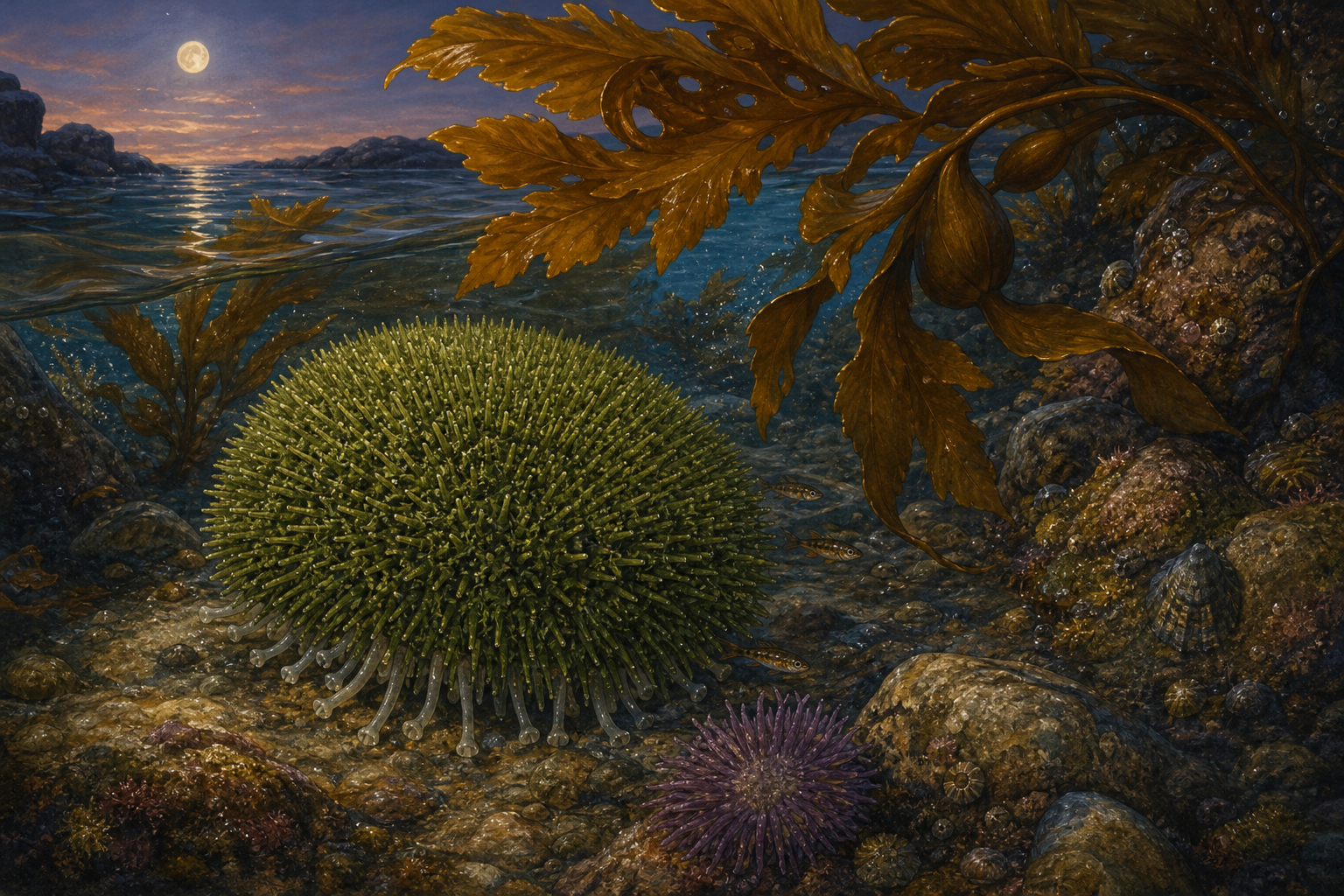
It may look like a green pincushion that has rolled into the sea, but the northern sea urchin has a remarkable way of walking, eating, and helping shape its kelp-forest neighbourhood.

It may look like a green pincushion that has rolled into the sea, but the northern sea urchin has a remarkable way of walking, eating, and helping shape its kelp-forest neighbourhood.
A prickly pebble starts to stroll
Imagine kneeling beside a chilly tide pool. The water wiggles with seaweed, rocks shine darkly, and there—so still you might mistake it for a pebble—is a green sea urchin. Then it moves. Not quickly, not with a splashy grand entrance, but with the determined shuffle of someone carrying a very full backpack.
The green sea urchin, also called the northern sea urchin, is Strongylocentrotus droebachiensis. It lives in cold northern waters of the Arctic, Atlantic, and Pacific oceans. It can be found on rocky, gravelly, or sandy seabeds, from the shore’s intertidal zone to much deeper water. Kelp forests and tide pools can be part of its underwater world too.
Its round body is covered with spines, giving it the look of a small green ball that politely asked a cactus for fashion advice. The firm round shell beneath the spines is called a test. Green sea urchins are compact: usually no more than about 8 centimetres across when the spines are not counted. That is around the width of a small orange or tennis ball.
So why stop to watch a creature that travels at a snail-ish pace? Because beneath those spikes is a busy little explorer with surprising equipment—and a very important appetite.
Evidence: IUCN Red List of Threatened Species: Strongylocentrotus droebachiensis — conservation status; Animal Diversity Web, University of Michigan Museum of Zoology: Strongylocentrotus droebachiensis (green sea urchin); Wikipedia: Strongylocentrotus droebachiensis
Hundreds of tiny feet—yes, really
An urchin does not have feet like yours, paws like a seal’s, or fins like a fish’s. Instead, it has hundreds of bendy tube feet poking out between its spines. Many have sucker-like tips. The urchin uses them to grip a rock, stretch forward, and pull itself along. Picture hundreds of miniature sticky hands doing a slow-motion climbing wall challenge.
The tube feet work using water pressure inside the animal’s body. They help it cling to surfaces, move about, and handle food. Its spines can help with movement as well. Together, feet and spines make an excellent team for a life among waves that would happily swoosh an unprepared animal away.
Green sea urchins are often more active at night. By day, they may stay tucked among rocks or seaweed; later, they emerge to look for algae and kelp. That is a sensible plan in a place where hiding spots matter. A rocky seabed is not just a floor—it is a whole maze of cracks, shadows, and seaweed curtains.
Next time you see a tide pool, remember: what seems quiet at human speed may be full of tiny journeys. An urchin’s expedition might only cross one rock, but for its tube feet, that rock is a mountain range.
Evidence: Animal Diversity Web, University of Michigan Museum of Zoology: Strongylocentrotus droebachiensis (green sea urchin); Wikipedia: Strongylocentrotus droebachiensis
What is Aristotle’s lantern doing under there?
Turn a green sea urchin over only in your imagination—wild animals are best watched gently where they are—and you would find its mouth on the underside. Inside is a special five-toothed structure that scientists call Aristotle’s lantern. It sounds as if it ought to glow on a camping trip, but it is actually a powerful scraping and chewing tool.
The urchin mainly grazes on kelp, seaweed, and other algae. Its five teeth scrape food from rocks, rather like a very tiny gardener trimming a green carpet. Kelp can be tall and swishy; algae can make rocks look furry. To an urchin, this is not decoration. It is dinner.
The word “mainly” is important. Records also describe green sea urchins sometimes eating animal food, including worms, sponges, or injured urchins. Still, grazing algae and kelp is a major part of their feeding life. Nature does not always fit neatly into one lunchbox label.
As urchins nibble, they can influence how much seaweed covers an area. Their grazing is one thread in the tangled kelp-forest story. Their spines can also offer small fish a sheltered place to tuck in. A spiky neighbour can be useful, after all.
Evidence: Animal Diversity Web, University of Michigan Museum of Zoology: Strongylocentrotus droebachiensis (green sea urchin); Wikipedia: Strongylocentrotus droebachiensis
A cold-water citizen of enormous coasts
This species belongs to a group called echinoderms, the same big family branch that includes sea stars. Green sea urchins live around northern coasts, including parts of Alaska to Washington, the western Baltic Sea, and the coast of Korea. Their range circles cold ocean regions rather than drifting into tropical coral-reef waters.
A young urchin begins life very differently from the spiny round adult. Its early stage drifts in the water, then later settles and changes into the radial body plan of an urchin. Growing up underwater can be quite a plot twist.
Adult urchins are not known as cooperative social groups. Yet during reproduction, separate male and female urchins release eggs and sperm into the water. Having many urchins gathered in an area can help that broadcast method work. That is togetherness with a purpose, not a sea-urchin sleepover.
A cold coast can look tough: hard rocks, surging water, and water cold enough to make a human yelp. But a green sea urchin is built for it. Its gripping feet, spiny protection, and rock-scraping teeth make it a quiet specialist in this briny world.
Evidence: Animal Diversity Web, University of Michigan Museum of Zoology: Strongylocentrotus droebachiensis (green sea urchin); Wikipedia: Strongylocentrotus droebachiensis; IUCN Red List of Threatened Species: Strongylocentrotus droebachiensis — conservation status
Are green sea urchins safe? The honest answer
The green sea urchin has not been formally evaluated on the IUCN Red List, so it does not have an IUCN threat category to report. Other registered sources describe it as common and not facing a species-wide extinction or overfishing threat, and it has been listed as Secure by NatureServe. That is encouraging news, but “common” never means “unimportant.”
In some places, people harvest urchins for their roe. Sources also report local disease outbreaks, including paramoebiasis in Nova Scotia, that can cause many urchins to die. These are reasons to pay attention to local populations rather than assuming every shore will always have the same number of prickly grazers.
Scientists, fishers, and coastal communities can help by monitoring urchin numbers, disease, and the balance between kelp and urchin grazing. Where harvesting happens, careful regulation matters. Looking after an ecosystem is a bit like tending a community garden: take notice, avoid grabbing more than can grow back, and make room for every helper.
You can help too, even far from a northern coast. Be a respectful tide-pool visitor: look closely, leave animals and seaweed where they belong, and never poke or collect wildlife. A photograph, sketch, or muddy-shoe memory lasts longer than a creature taken from its home.
Evidence: IUCN Red List of Threatened Species: Strongylocentrotus droebachiensis — conservation status; Animal Diversity Web, University of Michigan Museum of Zoology: Strongylocentrotus droebachiensis (green sea urchin); Wikipedia: Strongylocentrotus droebachiensis
A kind choice can begin at the dinner table
It is easy to think caring for ocean animals must involve a boat, a wetsuit, and extremely brave toes. Those can be wonderful tools, but everyday choices count too. When we notice that a sea urchin is an individual animal—one that grips rocks, searches for food, and finds shelter—we can practise making room for animals in our thoughts.
Trying more plant-based meals is one positive way some families choose to care for animals and the living places animals depend on. The World Health Organization describes healthy diets as varied and rich in foods such as vegetables, fruit, whole grains, pulses, nuts, and seeds. The IPCC reports that shifts toward sustainable, healthy, more plant-based diets can reduce food-system emissions and pressure on land and biodiversity.
That does not mean there is one perfect plate for every person. Food needs and family traditions vary, so children should chat with a trusted adult and a qualified health professional about personal diet questions. But a bean burrito, lentil soup, chickpea sandwich, or veggie pasta can be a cheerful experiment—not a lecture in disguise.
Perhaps that is the green sea urchin’s gentle challenge: look beneath the spines. The ocean is full of lives that may seem strange at first. When we stay curious and choose compassion where we can, the world becomes a little safer for its quiet wanderers.
Evidence: World Health Organization: Healthy diet; Intergovernmental Panel on Climate Change: Climate Change 2022: Mitigation of Climate Change — Chapter 7; Animal Diversity Web, University of Michigan Museum of Zoology: Strongylocentrotus droebachiensis (green sea urchin); Wikipedia: Strongylocentrotus droebachiensis
Let the tide pool stay wild
A green sea urchin is not a decoration or a souvenir. It is a small animal on a real journey through its home, using its tube feet to hold fast and its teeth to graze. Watching without touching or taking is a simple act of friendship.
Care can travel beyond the shore. Varied, plant-rich meals can support a healthy eating pattern, and more plant-based dietary shifts can lessen pressure from food systems on climate, land, and biodiversity. With a trusted adult’s guidance, choosing a plant-based dish now and then is one gentle way to practise kindness toward animals and their habitats.
Evidence: World Health Organization: Healthy diet; Intergovernmental Panel on Climate Change: Climate Change 2022: Mitigation of Climate Change — Chapter 7; Animal Diversity Web, University of Michigan Museum of Zoology: Strongylocentrotus droebachiensis (green sea urchin); Wikipedia: Strongylocentrotus droebachiensis
Questions people ask
Does a green sea urchin really have hundreds of feet?
Yes. It has many stretchy tube feet between its spines. Their sucker-like ends help it cling to rocks, move, and handle food.
Evidence: Animal Diversity Web, University of Michigan Museum of Zoology: Strongylocentrotus droebachiensis (green sea urchin); Wikipedia: Strongylocentrotus droebachiensis
Why is its mouth called Aristotle’s lantern?
Scientists use that nickname for the urchin’s five-toothed mouth apparatus on its underside. It helps scrape and chew algae and kelp.
Evidence: Animal Diversity Web, University of Michigan Museum of Zoology: Strongylocentrotus droebachiensis (green sea urchin); Wikipedia: Strongylocentrotus droebachiensis
How big is it?
The round test usually does not exceed about 8 centimetres across, without counting the spines. Think small-orange size rather than beach-ball size.
Evidence: Animal Diversity Web, University of Michigan Museum of Zoology: Strongylocentrotus droebachiensis (green sea urchin); Wikipedia: Strongylocentrotus droebachiensis
Is it endangered?
It has not been formally evaluated on the IUCN Red List. Registered sources describe it as common and secure overall, while noting local concerns such as harvesting and disease outbreaks.
Evidence: IUCN Red List of Threatened Species: Strongylocentrotus droebachiensis — conservation status; Animal Diversity Web, University of Michigan Museum of Zoology: Strongylocentrotus droebachiensis (green sea urchin); Wikipedia: Strongylocentrotus droebachiensis
Read the evidence
Sources behind this story
- Strongylocentrotus droebachiensis — conservation status — IUCN Red List of Threatened Species
- Strongylocentrotus droebachiensis (green sea urchin) — Animal Diversity Web, University of Michigan Museum of Zoology
- Strongylocentrotus droebachiensis — Wikipedia
- Healthy diet — World Health Organization
- Climate Change 2022: Mitigation of Climate Change — Chapter 7 — Intergovernmental Panel on Climate Change
Health information is general education, not personal medical advice. Young readers should make food choices with a trusted adult and qualified health professional.