Today's animal friend · 2 October 2026
The Great Horned Owl’s Whisper-Wing Night Patrol
Those “horns” are not horns, its wings can hush the air, and its deep hoot may be the first clue that a remarkable night hunter is nearby.

Those “horns” are not horns, its wings can hush the air, and its deep hoot may be the first clue that a remarkable night hunter is nearby.
A hoot floats through the dusk
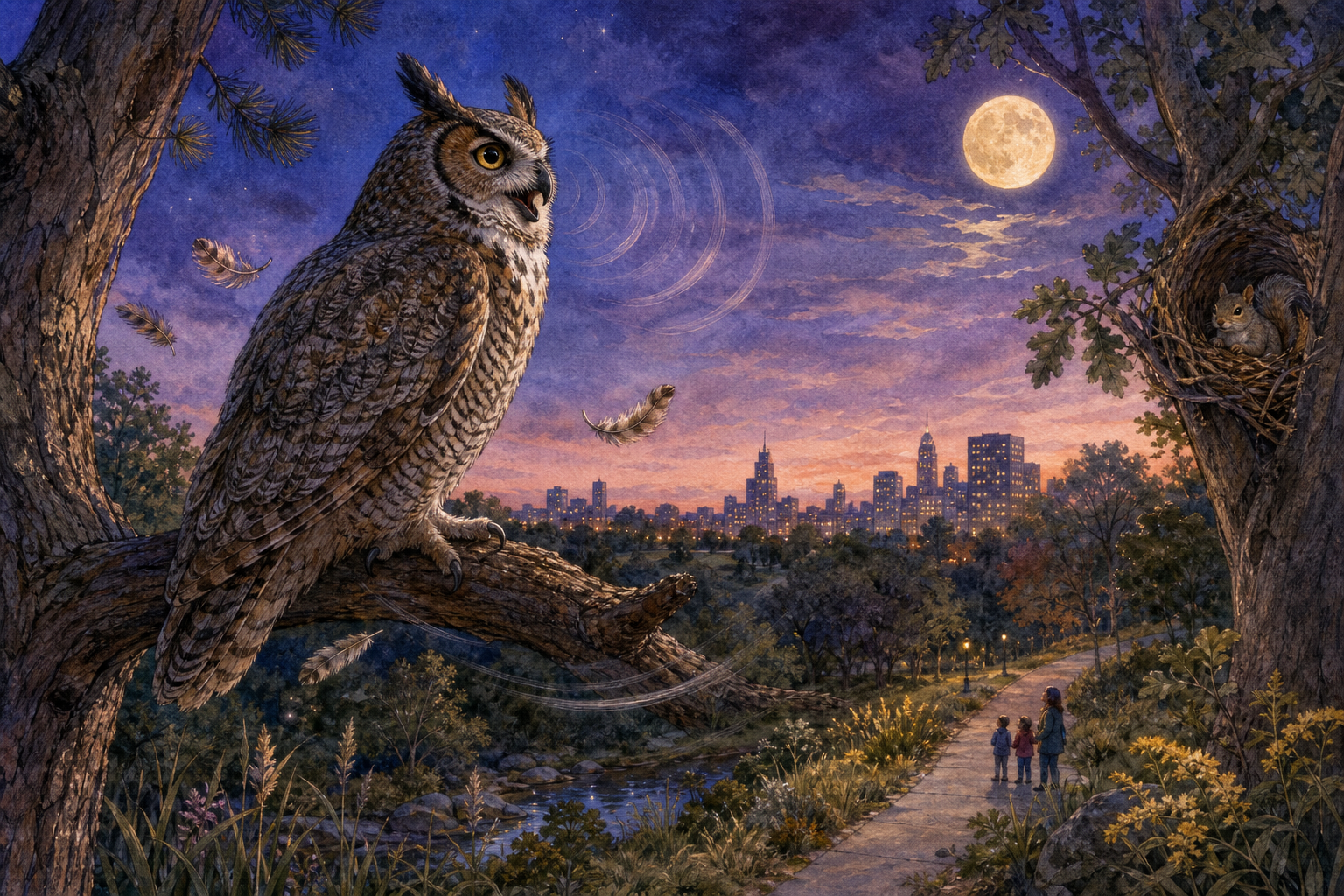
The playground is empty. A last scooter wheel clicks somewhere down the street. Then, from a tall dark tree—hoo, hoo-hoo, hoo. The sound rolls across the evening like someone blowing gently over the top of a giant bottle. You may be hearing a Great Horned Owl, also called a tiger owl or hoot owl.
This owl is a creature of night and twilight. While many of us are putting on pyjamas or hunting for a missing sock, it may be waking beneath a leafy branch, ready to watch the world turn shadowy. Great horned owls live across much of North and South America, in places as different as forests, grasslands, deserts, and city parks. That is a spectacularly wide address list.
A pair may hoot back and forth, call-and-reply style, as if they are playing the world’s slowest and most mysterious game of Marco Polo. Mated pairs defend territories, though these owls usually hunt alone. Their voices help announce that this patch of nighttime world is already spoken for.
Evidence: IUCN Red List of Threatened Species / BirdLife International (Red List Authority for birds): Bubo virginianus (Great Horned Owl) — Red List Assessment; Animal Diversity Web, University of Michigan Museum of Zoology: Bubo virginianus (great horned owl); Cornell Lab of Ornithology — All About Birds: Great Horned Owl Life History; Wikipedia: Great horned owl
Wait—are those really horns?
Here is the first Great Horned Owl surprise: the two pointy shapes on its head are neither horns nor ears. They are feather tufts. Think of them as a feathery costume accessory, like two tiny eyebrows that got very ambitious.
Nobody is completely sure what the tufts do. They may help an owl blend into bark or send signals to other owls. Its real ears are hidden at the sides of its head. So if you ever draw one, give it the tufts—but do not expect it to moo, charge, or wear a medieval helmet.
The Great Horned Owl’s scientific name is Bubo virginianus. It is a true owl, in the owl order called Strigiformes. It is a large bird: roughly 43 to 64 centimetres long, or about as long as a school ruler plus another chunk of ruler. Females average larger than males. Even so, an owl sitting still can look oddly like a lumpy piece of tree. That is one reason a daytime search often finds only branches, leaves, and the feeling that the owl is winning hide-and-seek.
Evidence: Animal Diversity Web, University of Michigan Museum of Zoology: Bubo virginianus (great horned owl); Wikipedia: Great horned owl
The almost-silent swoop
Now picture a mouse rustling through dry leaves. Above it, a Great Horned Owl waits on a perch. It watches and listens. Then it swoops. The special edges of its flight feathers help soften the sound of air moving over its wings, so its approach can be almost silent. No jangly backpack. No crinkly crisp packet. Just hush.
That quiet flight is important because great horned owls are carnivores. Their varied meals can include rabbits, hares, mice, voles, squirrels, and birds. What they eat depends on where they live and what is available. An owl in one habitat may find a different menu from an owl in another; wildlife does not use one identical dinner plan.
Great horned owls often perch and then drop or glide toward prey. Their strong feet help them catch and hold it. They are among the top predators in many of the places where they live, and by taking rodents and other prey, they can play a part in the busy food webs around farms, parks, and wild land. A food web is like a huge invisible tangle of connections: every creature’s life touches other lives.
A little kindness from far away can matter to an owl. Poisons used against rats and mice, called rodenticides, can build up in prey animals and harm owls that eat them. Protecting these birds means paying attention not only to the owl in the tree, but also to the whole neighbourhood beneath its wings.
Evidence: Animal Diversity Web, University of Michigan Museum of Zoology: Bubo virginianus (great horned owl); Cornell Lab of Ornithology — All About Birds: Great Horned Owl Life History; Wikipedia: Great horned owl
An owl with many kinds of home
Great Horned Owls are impressively adaptable. They can live in woodland and forest, open grassland, desert, farmland, swamps, parks, and cities. Usually, they need places to hunt as well as trees, cliffs, or structures where they can rest and nest. A city park with mature trees may seem ordinary to us, but to an owl it can be a useful nighttime lookout.
They often use nests already made by other animals, including nests left by hawks, crows, herons, or squirrels. It is a little like moving into a house after the previous residents have gone—except an owl does not need to pack boxes or argue over sofa colours.
By day, a Great Horned Owl usually roosts quietly in cover. Its brown-and-grey feathers can help it disappear among branches and bark. If you are hoping to spot one, look without disturbing the trees or trying to get close. Listening at dusk, from a respectful distance, is often the best adventure. Let the owl choose whether it wants to be seen.
Evidence: Animal Diversity Web, University of Michigan Museum of Zoology: Bubo virginianus (great horned owl); Cornell Lab of Ornithology — All About Birds: Great Horned Owl Life History; Wikipedia: Great horned owl
Good news needs good neighbours
The Great Horned Owl is listed by the IUCN as Least Concern, and estimates describe millions of breeding birds worldwide. Its overall population is considered stable. That is encouraging news for a bird with such a mighty voice—but it is not a reason to stop caring. Even adaptable animals need safe places to live.
These owls depend on suitable nest sites and can be harmed when toxins pass from prey to predator. Keeping mature trees and other nesting places, protecting a mixture of wooded and open spaces, and choosing safer ways to manage rodents can all help. Grown-ups, land managers, and communities make many of these decisions, but young nature-noticers can ask thoughtful questions too.
Try becoming an owl-friendly detective on an evening walk. What trees might offer cover? Is there open ground nearby where small animals live? Can you hear a bird call, even if you cannot see its maker? Do not play recordings to lure owls, and never approach a nest. The best clue is often simply a faraway hoot, reminding us that the dark is full of lives carrying on their own adventures.
Evidence: IUCN Red List of Threatened Species / BirdLife International (Red List Authority for birds): Bubo virginianus (Great Horned Owl) — Red List Assessment; Cornell Lab of Ornithology — All About Birds: Great Horned Owl Life History; Wikipedia: Great horned owl
A gentle choice for the owl’s world
A Great Horned Owl does not get to choose its supper: it is a wild carnivore, shaped for its own place in the food web. We humans have many more choices. One caring way to notice animals is to remember that every creature is somebody, not something.
Meals built around vegetables, fruits, beans, lentils, whole grains, nuts, and seeds can be delicious, colourful, and kind to the wider living world. The World Health Organization includes these foods in guidance about healthy diets, and the IPCC reports that shifts toward sustainable, healthy, more plant-based diets can reduce pressure on land, biodiversity, and food-system emissions.
You do not have to make every decision alone. Perhaps help a trusted adult choose a bean burrito, lentil soup, veggie pasta, or a fruit-and-oat snack. Small, cheerful plant-forward choices are one way to say: there is room on Earth for owls, rabbits, trees, and us too.
Evidence: World Health Organization: Healthy diet; Intergovernmental Panel on Climate Change: Climate Change 2022: Mitigation of Climate Change — Chapter 7
Questions people ask
Can a Great Horned Owl really fly silently?
Almost silently. Soft, specially edged feathers help hush the sound of air over its wings, giving this night hunter a quieter approach than many birds.
Evidence: Cornell Lab of Ornithology — All About Birds: Great Horned Owl Life History; Wikipedia: Great horned owl
Why does it hoot?
Deep hoots help mated pairs communicate and defend their territory. A pair may answer one another across the dark.
Evidence: Animal Diversity Web, University of Michigan Museum of Zoology: Bubo virginianus (great horned owl); Cornell Lab of Ornithology — All About Birds: Great Horned Owl Life History
Does it live only in deep forests?
No. Great Horned Owls are adaptable and may live in forests, deserts, grasslands, farmland, parks, and cities, as long as they can find places to roost or nest and areas to hunt.
Evidence: Animal Diversity Web, University of Michigan Museum of Zoology: Bubo virginianus (great horned owl); Cornell Lab of Ornithology — All About Birds: Great Horned Owl Life History; Wikipedia: Great horned owl
What should I do if I find an owl?
Give it plenty of space, keep pets away if you can do so safely, and tell a trusted adult. Never try to feed, touch, or take home a wild owl. A local licensed wildlife rehabilitator can advise if the bird seems injured.
Evidence: Cornell Lab of Ornithology — All About Birds: Great Horned Owl Life History
Read the evidence
Sources behind this story
- Bubo virginianus (Great Horned Owl) — Red List Assessment — IUCN Red List of Threatened Species / BirdLife International (Red List Authority for birds)
- Bubo virginianus (great horned owl) — Animal Diversity Web, University of Michigan Museum of Zoology
- Great Horned Owl Life History — Cornell Lab of Ornithology — All About Birds
- Great horned owl — Wikipedia
- Healthy diet — World Health Organization
- Climate Change 2022: Mitigation of Climate Change — Chapter 7 — Intergovernmental Panel on Climate Change
Health information is general education, not personal medical advice. Young readers should make food choices with a trusted adult and qualified health professional.