Today's animal friend · 1 October 2026
Meet the Goliath Birdeater: The Rainforest Spider With a Very Silly Name
On the damp forest floor of northern South America, a golden-brown giant steps quietly from its burrow—and shows why even a spider with an alarming name deserves a little awe.
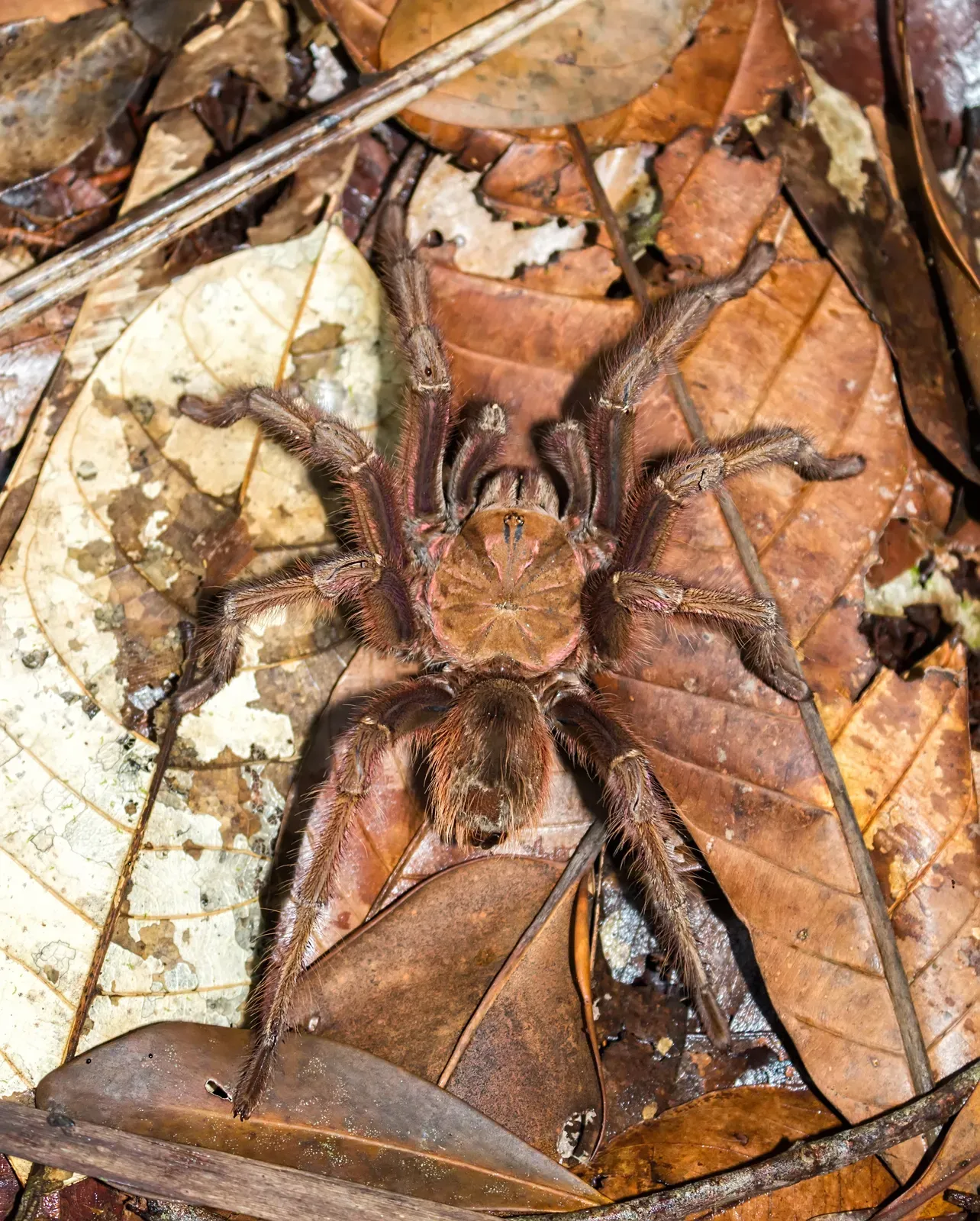
On the damp forest floor of northern South America, a golden-brown giant steps quietly from its burrow—and shows why even a spider with an alarming name deserves a little awe.
A leaf rustles. Is it a tiny mammal? Nope—a spider.
Imagine crouching beside a rainforest path after dark. The ground feels damp and springy under fallen leaves. Somewhere nearby, something makes a faint rustle. Out from a deep burrow comes a tan-and-golden spider with legs spread wide, moving carefully through the leaf litter. Meet the Goliath birdeater, also called the Goliath tarantula: Theraphosa blondi.
This is not an ordinary “oops, there’s a spider in the bathroom” moment. The Goliath birdeater is the heaviest spider in the world by mass. It can weigh up to about 175 grams—roughly the weight of a ripe apple. Its body can reach about 13 centimetres long, and its leg span can stretch to around 30 centimetres, about as wide as a dinner plate.
That enormous size may make us blink twice. But big does not mean bossy. This tarantula is a ground-living rainforest neighbour, built for a hidden life among soil, roots, puddly places, and leaves. A dinner plate with legs? Perhaps. A movie monster? Not really.
Evidence: IUCN Red List of Threatened Species: Theraphosa blondi — Red List category; Animal Diversity Web, University of Michigan Museum of Zoology: Theraphosa blondi; Wikipedia: Goliath birdeater
Why call it a birdeater if birds are hardly on the menu?
Excellent question. The name makes it sound as if this spider dines beneath a tiny tablecloth, waiting for roast sparrow. In reality, birds are rarely part of its diet. Its usual meals include large insects, earthworms, and amphibians. It may also take other small vertebrates when the chance appears.
The Goliath birdeater is a carnivore and a nighttime hunter. It travels over the forest floor, then takes prey back to its burrow. Like other spiders, it does not chew dinner into crunchy bites. Instead, it liquefies food and consumes it—a strange idea to us, perhaps, but perfectly practical when you have spider mouthparts rather than teeth.
This hunter is part of the busy rainforest-floor community. It eats animals such as arthropods, worms, and small vertebrates, while doing its own quiet work under the trees. Every leaf layer can hold a whole hidden neighbourhood: scuttlers, hoppers, diggers, and one very large tarantula trying not to be noticed.
Evidence: IUCN Red List of Threatened Species: Theraphosa blondi — Red List category; Animal Diversity Web, University of Michigan Museum of Zoology: Theraphosa blondi; Wikipedia: Goliath birdeater
Home is a burrow with a night shift
Goliath birdeaters live in northern South America, including rainforest regions in places such as Guyana, Suriname, French Guiana, northern Brazil, eastern Colombia, and southern Venezuela. They are terrestrial, meaning they live on the ground rather than spinning a life high in a tree.
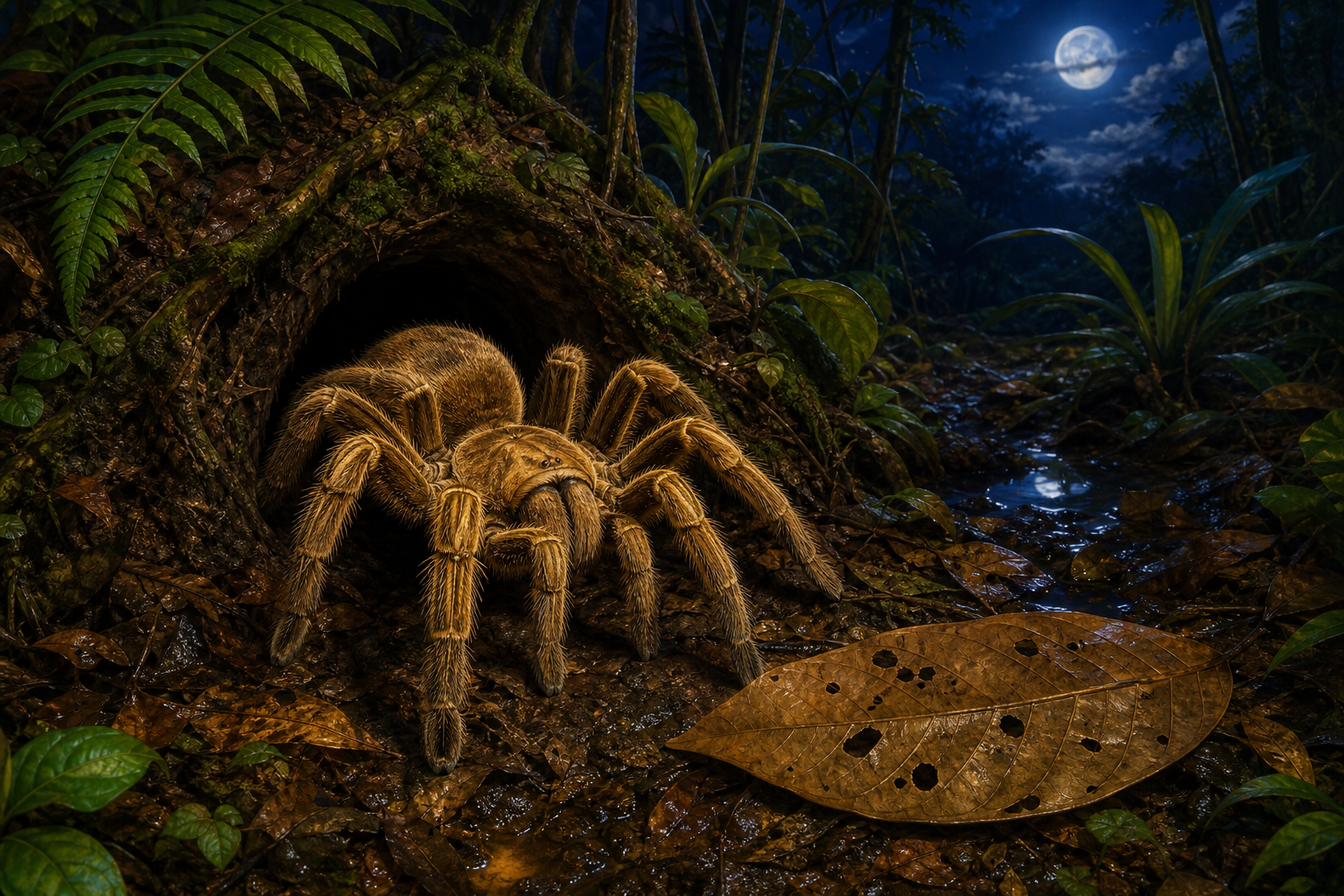
By day, a Goliath birdeater rests in a deep burrow. These burrows are often found in marshy or swampy upland rainforest areas. Think of one as a cool, dark hideaway below the noisy leaf layer—not a cosy bedroom exactly, unless your idea of cosy includes eight legs and mud on the doorstep.
At night, the spider emerges. Darkness is when the forest changes shifts: daytime birds settle down, while many other animals begin to creep, flutter, and hunt. For a nocturnal tarantula, the forest floor becomes a pathway of smells, vibrations, and possible meals. It is less like charging onto a stage and more like taking a careful midnight walk in socks.
Evidence: IUCN Red List of Threatened Species: Theraphosa blondi — Red List category; Animal Diversity Web, University of Michigan Museum of Zoology: Theraphosa blondi; Wikipedia: Goliath birdeater
Its first message is: “Please give me space.”
A giant spider does have ways to defend itself, but the most interesting ones are warning signals. When disturbed, the Goliath birdeater can make a hissing sound by rubbing special hairs on its legs and pedipalps together. This sound-making is called stridulation. Crickets do something similar, although the tarantula’s version is much more “forest-floor percussion.”
It can also release tiny urticating hairs from its abdomen. These hairs can be irritating, so they are a very good reason to admire this spider from a respectful distance and never try to touch one. Wild animals do not need surprise handshakes.
The spider has large fangs, but bites are uncommon, and the recorded venom effects are described as mild, comparable to a wasp sting. Still, “usually avoids trouble” is not the same as “safe to pick up.” The kindest choice—for a person and a tarantula—is to leave it room to retreat into its burrow.
Evidence: IUCN Red List of Threatened Species: Theraphosa blondi — Red List category; Animal Diversity Web, University of Michigan Museum of Zoology: Theraphosa blondi; Wikipedia: Goliath birdeater
A record-breaker with a question mark beside its name
The Goliath birdeater has not been evaluated for the IUCN Red List. That means there is no global Red List assessment here to tell us whether its population is growing, shrinking, or staying steady. It is an important reminder that “we do not know yet” is a real scientific answer, not a shrug.
What is clear is that this tarantula relies on rainforest ground and burrow habitats in northern South America. Looking after those places gives creatures such as this one somewhere to hunt, hide, and continue their nighttime lives. A rainforest is not only tall trees and colourful birds; it is also damp soil, deep tunnels, and the animals beneath our feet.
You do not have to travel to a rainforest to practise being a wildlife friend. Notice spiders without rushing to squash them. Ask questions when an animal’s name sounds frightening. Draw the creature, read about its home, and remember: being unfamiliar is not the same thing as being unimportant.
Evidence: IUCN Red List of Threatened Species: Theraphosa blondi — Red List category; Animal Diversity Web, University of Michigan Museum of Zoology: Theraphosa blondi; Wikipedia: Goliath birdeater
The next time you hear “spider,” picture a whole world
The Goliath birdeater may be famous for being huge, but its best trick may be making us look again. Behind the dramatic name is a solitary nighttime animal, golden-brown and hairy, slipping through a rainforest world we rarely see. It is a hunter, a burrow-maker, and a reminder that the ground beneath a forest can be as full of stories as its treetops.
So if you could follow its trail for one night, what would you listen for first: the whisper of leaves, the tiny rasp of its warning sound, or rain tapping the roof of its burrow? Big questions can begin with eight careful feet.
Evidence: IUCN Red List of Threatened Species: Theraphosa blondi — Red List category; Animal Diversity Web, University of Michigan Museum of Zoology: Theraphosa blondi; Wikipedia: Goliath birdeater
One gentle choice can reach farther than we think
Caring about a rainforest spider can start with caring about all the lives tangled together in a habitat. At meals, families can explore tasty plant-forward foods such as beans, lentils, vegetables, fruits, whole grains, nuts, and seeds. The World Health Organization describes these foods as parts of healthy, varied eating patterns.
Choosing more plant-based meals can also be a kind way to reduce pressure on land and biodiversity, while helping lower food-system emissions. The IPCC identifies shifts toward sustainable, healthy, more plant-based diets as an important option. No one needs a perfect plate: perhaps try a colourful bean burrito, lentil pasta sauce, or crunchy chickpeas with a trusted grown-up. Small, cheerful choices can be one way of saying, “There is room in the world for rainforest neighbours, too.”
Evidence: World Health Organization: Healthy diet; Intergovernmental Panel on Climate Change: Climate Change 2022: Mitigation of Climate Change — Chapter 7
Questions people ask
Is the Goliath birdeater really the world’s biggest spider?
It is the heaviest spider in the world by mass, reaching about 175 grams. It is also among the largest spiders by size, with a leg span up to around 30 centimetres.
Evidence: Animal Diversity Web, University of Michigan Museum of Zoology: Theraphosa blondi; Wikipedia: Goliath birdeater
Does it eat birds?
Very rarely. Despite the name, its diet is mainly large arthropods, worms, and amphibians. It may take other small vertebrates opportunistically.
Evidence: IUCN Red List of Threatened Species: Theraphosa blondi — Red List category; Animal Diversity Web, University of Michigan Museum of Zoology: Theraphosa blondi; Wikipedia: Goliath birdeater
Why does it make a hissing sound?
When bothered, it can stridulate: rub special hairs on its legs and pedipalps to make a warning sound. It can also release irritating hairs from its abdomen, so distance is the polite choice.
Evidence: Animal Diversity Web, University of Michigan Museum of Zoology: Theraphosa blondi; Wikipedia: Goliath birdeater
Is this spider endangered?
It has not been evaluated for the IUCN Red List, so a global conservation category and population trend are not available in the registered sources.
Evidence: IUCN Red List of Threatened Species: Theraphosa blondi — Red List category; Wikipedia: Goliath birdeater
Read the evidence
Sources behind this story
- Theraphosa blondi — Red List category — IUCN Red List of Threatened Species
- Theraphosa blondi — Animal Diversity Web, University of Michigan Museum of Zoology
- Goliath birdeater — Wikipedia
- Healthy diet — World Health Organization
- Climate Change 2022: Mitigation of Climate Change — Chapter 7 — Intergovernmental Panel on Climate Change
Health information is general education, not personal medical advice. Young readers should make food choices with a trusted adult and qualified health professional.