Today's animal friend · 29 September 2026
The Reef’s Night-Shift Giant: Meet the Giant Moray
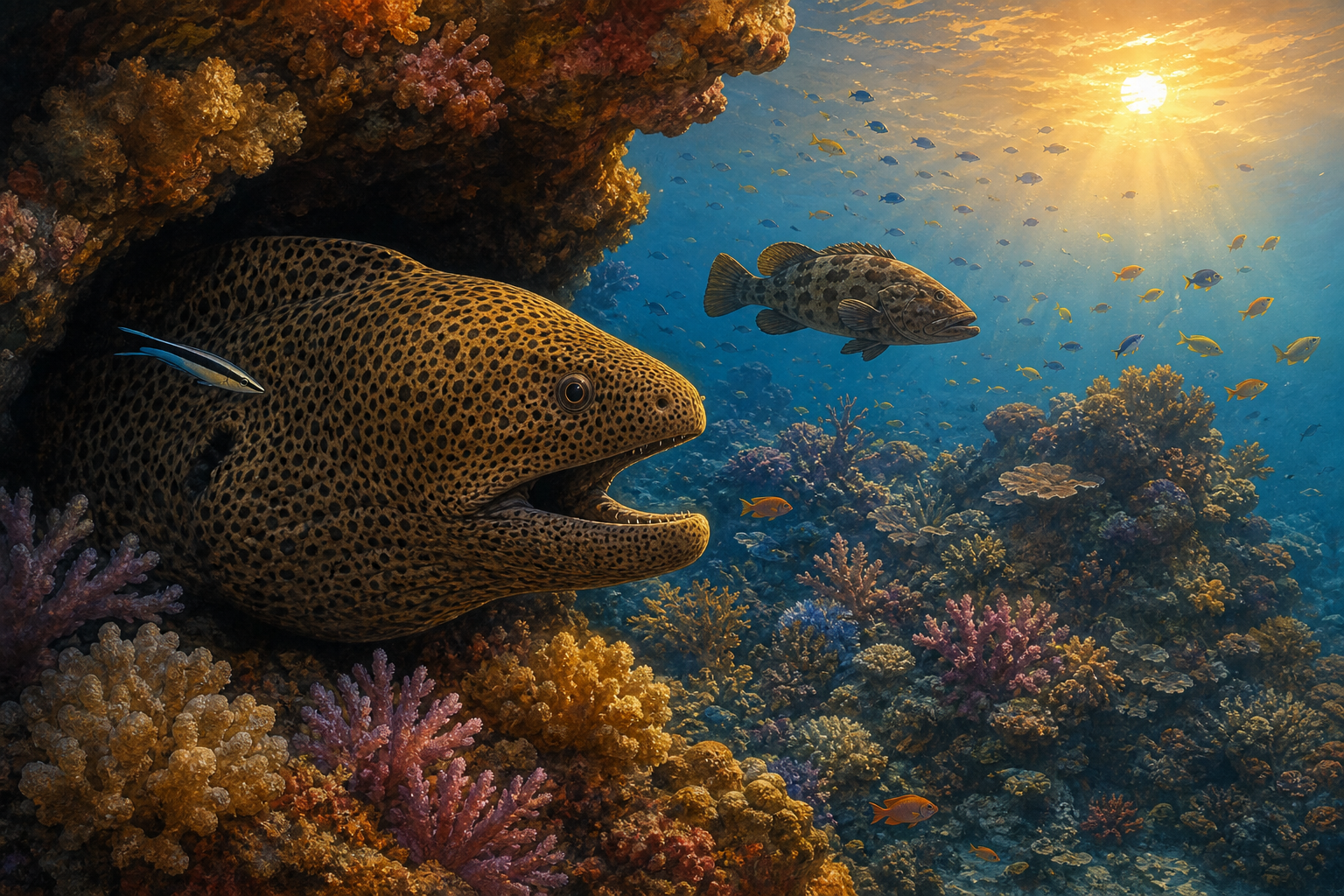
By day it may be a watchful face in a coral crack. By night, Gymnothorax javanicus glides out into the reef’s shadowy lanes—large, patterned, and far shyer than its toothy grin suggests.

By day it may be a watchful face in a coral crack. By night, Gymnothorax javanicus glides out into the reef’s shadowy lanes—large, patterned, and far shyer than its toothy grin suggests.
A face in the coral wall
Imagine snorkeling over a coral reef where sunlight flickers like wobbly gold coins. Parrotfish crunch, tiny fish zip past, and then—wait. Is that a rock with eyes? From a narrow crack, a giant moray may peer out, opening and closing its mouth again and again.
That mouth movement can look like a grumpy underwater yawn, but it is part of breathing: water moves through the mouth and over the gills. The giant moray, also called the Java moray or giant moray eel, is a marine eel named Gymnothorax javanicus. It belongs to the moray family, Muraenidae.
Although its face can seem fierce in a photograph, this animal is usually calm and shy. In daytime it prefers the excellent real-estate of a reef crevice: snug, shadowy, and full of places to watch the bustling neighbourhood go by. A respectful observer gives it plenty of room. Nobody enjoys being surprised in their own doorway—not even an eel with a very impressive set of teeth.
Evidence: IUCN Red List of Threatened Species: Gymnothorax javanicus (Giant Moray) — Red List Assessment; FishBase (Froese, R. and D. Pauly, eds.): Gymnothorax javanicus — Species Summary; Wikipedia: Giant moray
Longer than a car—and dressed for the reef
A giant moray can grow to a little over 3 metres long, about 10 feet, and may weigh about 30 kilograms. That makes it one of the world’s biggest moray eels. Its body is long and bendy rather than bulky, made for threading through reef cracks where a car-sized creature would definitely get stuck.
Its markings are a reef-ready disguise. Young giant morays are tan with big black spots. Adults wear finer dark speckles that can look leopard-like. Among dappled coral, sand, and shadow, those patterns help the eel fade into the busy scenery. The reef is not painted one flat colour; it is more like a giant, wriggling patchwork quilt.
Can you spot the difference between hiding and disappearing? The eel has not turned invisible. Its pattern simply makes a searching eye work harder. That is one reason a careful snorkeler might pass a giant moray’s doorway without noticing its quiet owner at all.
Evidence: FishBase (Froese, R. and D. Pauly, eds.): Gymnothorax javanicus — Species Summary; Wikipedia: Giant moray; IUCN Red List of Threatened Species: Gymnothorax javanicus (Giant Moray) — Red List Assessment
When the reef turns blue, the night shift begins
Giant morays rest in crevices during the day, then hunt within the reef at night. Their menu includes fish and sometimes crustaceans—animals such as crabs or shrimps with hard outer shells. Rather than racing around in open water like some fish, a moray can slip along the reef’s nooks and edges, following scents as it searches.
This is a carnivore’s life, but it is not a monster story. A reef is a community of eaters and eaten, hiders and seekers. As a large predator in local reef food webs, the giant moray is one part of that living puzzle. It has even been recorded eating lionfish in the Red Sea.
Sometimes a giant moray does something especially surprising: it can hunt cooperatively with a roving coral grouper. Picture two very different neighbours sharing a search party—one able to cruise around coral, the other able to investigate the narrow spaces. Giant morays are generally solitary in their holes, so this is not an eel squad with matching hats. It is a temporary teamwork moment.
Evidence: FishBase (Froese, R. and D. Pauly, eds.): Gymnothorax javanicus — Species Summary; Wikipedia: Giant moray
A mouth-cleaning appointment, please
A giant moray’s mouth is not only for breathing and eating. Cleaner wrasses are known to clean inside it. These small reef fish pick food bits or other unwanted material from larger fish. Imagine being so trusted that a tiny helper can swim close to your teeth while you hold still. That is brave work—and very good manners from the moray.
This tells us something lovely about reefs: no creature is just a background character. A giant eel, a small cleaner fish, branching coral, and a darting grouper all use the same underwater city in different ways. When reefs have many safe homes and healthy relationships, there is more room for astonishing encounters.
The giant moray lives in warm Indo-Pacific waters, including the Indian and Pacific Oceans. It is associated with lagoons and outer reef slopes, sheltering among coral and rocks. Its range is wide, from the Red Sea and East Africa across to places including Hawaii and Polynesia. A wide range does not mean every reef is identical, though; each reef is its own colourful, complicated world.
Evidence: FishBase (Froese, R. and D. Pauly, eds.): Gymnothorax javanicus — Species Summary; Wikipedia: Giant moray; IUCN Red List of Threatened Species: Gymnothorax javanicus (Giant Moray) — Red List Assessment
How to be a kind reef visitor
If you are ever lucky enough to see a giant moray, let the eel choose the distance. Do not poke into a crevice, chase it, feed it, or put hands near its mouth. Giant morays are not usually aggressive toward people, but any wild animal may defend itself if threatened, cornered, or disturbed near food. The best wildlife encounter leaves the animal free to carry on with its day—or night.
Globally, the giant moray is listed as Least Concern on the IUCN Red List. That is encouraging, but it is not a reason to stop caring. The available information does not give a clear global population trend, and reefs need watchful protection. Looking after coral-reef habitat and paying attention to local harvest are sensible ways to support the places where giant morays live.
You do not need to travel across an ocean to practise reef kindness. Learn about ocean habitats, share reliable wildlife stories, avoid taking souvenirs from nature, and cheer for protected places. Caring begins with noticing: that ‘rock with eyes’ is a neighbour with a nighttime job.
Evidence: IUCN Red List of Threatened Species: Gymnothorax javanicus (Giant Moray) — Red List Assessment; FishBase (Froese, R. and D. Pauly, eds.): Gymnothorax javanicus — Species Summary; Wikipedia: Giant moray
A gentle choice for reefs—and all their neighbours
It is easy to care about a giant moray once you picture it tucked into its coral doorway, waiting for the cooler night. Care can reach beyond the shoreline, too. Meals built around vegetables, fruit, whole grains, pulses, nuts, and seeds can be colourful, satisfying choices to explore with your family. The World Health Organization describes these foods as parts of healthy dietary patterns; for personal food questions, a trusted adult and qualified health professional can help.
Choosing more plant-based meals can also be a quiet ocean-friendly habit. The IPCC reports that shifts toward sustainable, healthy, more plant-based diets can reduce food-system emissions and pressure on land and biodiversity. No one meal has to be perfect. Perhaps try bean tacos, a chickpea curry, or a favourite pasta with lentils, then imagine raising a fork to the whole reef neighbourhood—moray included.
Evidence: World Health Organization: Healthy diet; Intergovernmental Panel on Climate Change: Climate Change 2022: Mitigation of Climate Change — Chapter 7
Questions people ask
Why does a giant moray keep opening its mouth?
It may look like a dramatic grin, but moving water through its mouth and over its gills helps it breathe. Give it space rather than trying to get a closer look.
Evidence: Wikipedia: Giant moray; FishBase (Froese, R. and D. Pauly, eds.): Gymnothorax javanicus — Species Summary
Are giant morays dangerous to people?
They are not usually aggressive, but they may bite if threatened, cornered, or disturbed near food. The safe, kind choice is to watch from a distance and never feed or touch one.
Evidence: Wikipedia: Giant moray; FishBase (Froese, R. and D. Pauly, eds.): Gymnothorax javanicus — Species Summary
Where would I find one?
Giant morays live around warm Indo-Pacific coral reefs, including lagoons and reef slopes. By day, look only with your eyes: they often shelter in cracks and crevices.
Evidence: FishBase (Froese, R. and D. Pauly, eds.): Gymnothorax javanicus — Species Summary; Wikipedia: Giant moray; IUCN Red List of Threatened Species: Gymnothorax javanicus (Giant Moray) — Red List Assessment
Do giant morays have friends?
They are generally solitary in their reef shelters, yet they have been observed cooperating with roving coral groupers during hunts. Cleaner wrasses also clean inside their mouths.
Evidence: Wikipedia: Giant moray; FishBase (Froese, R. and D. Pauly, eds.): Gymnothorax javanicus — Species Summary
Read the evidence
Sources behind this story
- Gymnothorax javanicus (Giant Moray) — Red List Assessment — IUCN Red List of Threatened Species
- Gymnothorax javanicus — Species Summary — FishBase (Froese, R. and D. Pauly, eds.)
- Giant moray — Wikipedia
- Healthy diet — World Health Organization
- Climate Change 2022: Mitigation of Climate Change — Chapter 7 — Intergovernmental Panel on Climate Change
Health information is general education, not personal medical advice. Young readers should make food choices with a trusted adult and qualified health professional.