Today's animal friend · 26 September 2026
The Lizard With a Pop-Up Collar
In the tropical savannas, woodlands, and dry forests of northern Australia and southern New Guinea, one lizard spends most of its day in the trees—until it needs to put on a very big show.

In the tropical savannas, woodlands, and dry forests of northern Australia and southern New Guinea, one lizard spends most of its day in the trees—until it needs to put on a very big show.
A rustle, a freeze, a FLOOF!
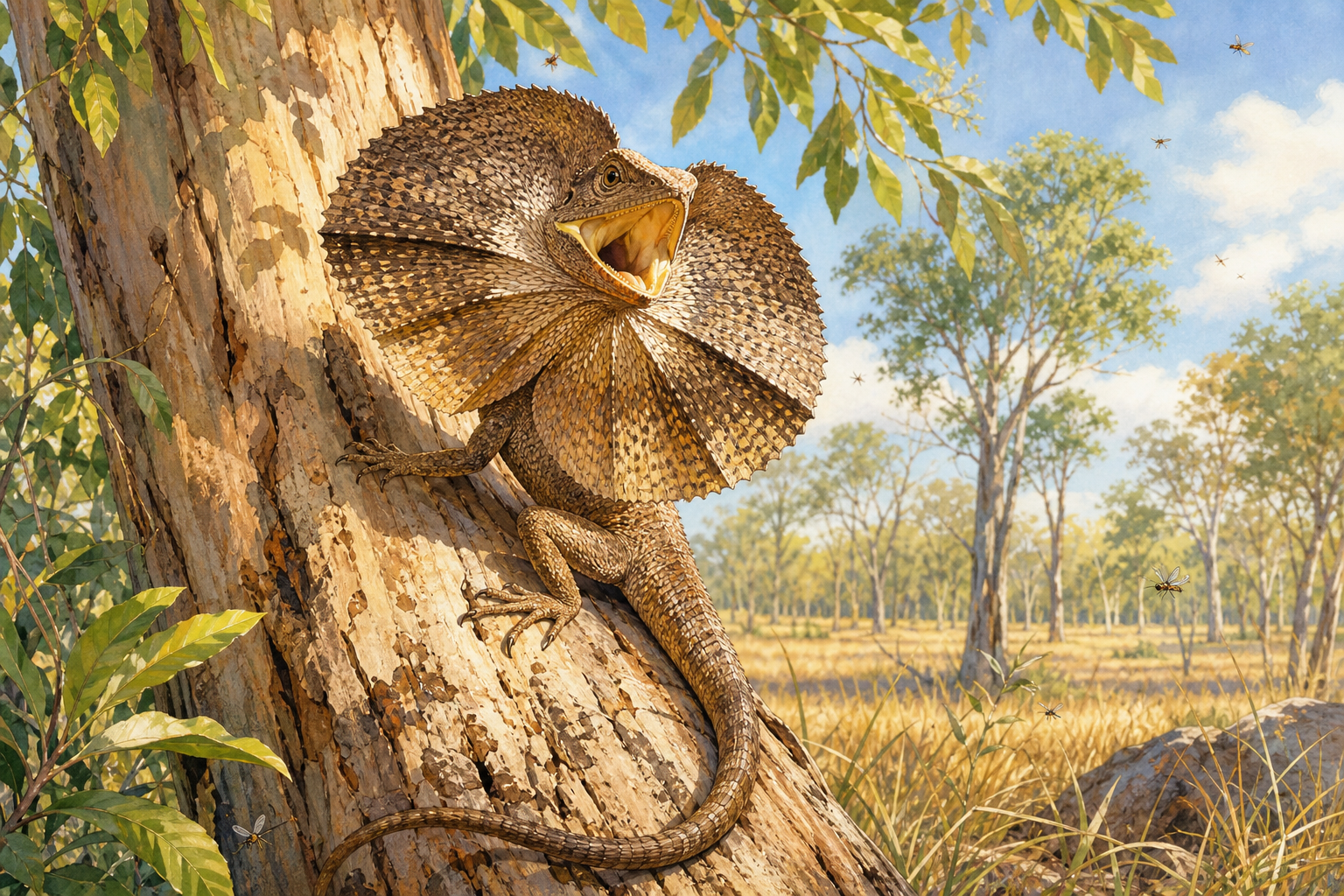
Imagine walking beneath warm, leafy branches when a patch of bark suddenly has eyes. A frilled lizard has been sitting so still that it is easy to miss. Then something worries it. First, it may freeze. But if the danger stays close, out comes one of nature’s best surprise costumes: a broad frill of skin around its neck.
The lizard opens its brightly coloured pink or yellow mouth, spreads that frill wide, and may hiss. In one speedy moment, a fairly ordinary-looking reptile becomes a much bigger-looking, rather grumpy-looking creature. It is like a tiny dinosaur wearing an umbrella collar. The point is not to start a fight. It is a bluff designed to make a predator hesitate, giving the lizard time to escape unharmed.
This brilliant animal is the frilled lizard, also called a frillneck lizard or frilled dragon. Its scientific name is Chlamydosaurus kingii. And its famous frill is usually folded away neatly when there is no need for drama. Everyone needs a party trick; this one happens to be built around the neck.
Evidence: IUCN Red List of Threatened Species: Chlamydosaurus kingii (Frilled Lizard) — Red List Assessment; Animal Diversity Web, University of Michigan Museum of Zoology: Chlamydosaurus kingii (Frilled Lizard); Wikipedia: Frilled lizard
Home is where the branches are
Frilled lizards live in tropical savanna, woodland, and dry forest in northern Australia and southern New Guinea. These are places of sunshine, trunks, branches, and plenty of interesting corners to explore. Their colours can be grey, brown, or orangey-brown, helping them blend in with tree bark.
They are strongly arboreal, which means tree-loving. In fact, they spend more than 90 percent of their time up in trees. That is a lot of branch time—more than a nine-out-of-ten score for being off the ground. A tree is a lookout point, a hiding place, and a route through their woodland world.
Frilled lizards are active during the day. They do come down sometimes: to find food, interact with other lizards, or travel to another tree. But they are largely solitary tree-dwellers, so we should not imagine them holding busy lizard meetings in every branch fork. The details of their social lives are still not strongly documented in the sources we have.
Evidence: IUCN Red List of Threatened Species: Chlamydosaurus kingii (Frilled Lizard) — Red List Assessment; Animal Diversity Web, University of Michigan Museum of Zoology: Chlamydosaurus kingii (Frilled Lizard); Wikipedia: Frilled lizard
Why run on four legs when two will do?
If a frilled lizard needs to hurry away, it can dash on its two back legs. Its front legs and tail lift as it races toward the nearest tree. Seeing a lizard run upright must look a little like watching a wind-up toy suddenly decide it has an important appointment.
This is an escape move, not a daily parade. The frill display can make a threat pause; then the lizard can make its getaway. Freezing, bluffing, and running are different parts of a sensible safety plan. A frilled lizard does not need to win an argument with a larger animal. It needs a safe place to be—often back on a trunk or among branches.
A large frilled lizard can reach about 90 centimetres in total length, including its long tail, and adults weigh at least about 600 grams. That may sound big, but much of that length is tail. Even a lizard with a showy collar still has to fit through the busy world of branches, bark, and leaves.
Evidence: Animal Diversity Web, University of Michigan Museum of Zoology: Chlamydosaurus kingii (Frilled Lizard); Wikipedia: Frilled lizard
What is on the lizard lunch menu?
The frilled lizard is an insectivore. That means it mainly eats insects, as well as spiders and other invertebrates—animals without backbones. In its woodland home, it is part of the lively web of creatures that includes bugs, plants, trees, and the animals that share the habitat.
Picture a frilled lizard watching from a tree or coming down to feed. It is not searching for a packed lunch or a slice of cake, sadly for lizard birthday parties. It is looking for small prey such as insects and other crawly creatures. Its diet is one reason a healthy habitat matters: the lizard needs its food to be there, too.
Every species has its own way of belonging. The frilled lizard’s job in this ecosystem is not to entertain us with its frill, even though it is very good at that. It is an arboreal insect-eater living its own alert, branchy life.
Evidence: Animal Diversity Web, University of Michigan Museum of Zoology: Chlamydosaurus kingii (Frilled Lizard); Wikipedia: Frilled lizard
A famous face, but not a souvenir
Globally, the frilled lizard is listed as Least Concern on the IUCN Red List. Its wide range and abundance are encouraging news. Still, “Least Concern” does not mean “nothing matters.” The available sources note that local declines may be possible, and collection for the pet trade is a concern for some wild populations.
The kindest way to admire a wild frilled lizard is to let it remain where it belongs: in its sunny woodland home, choosing its own branch and opening its frill only when it feels it must. Wild animals are not costumes, decorations, or souvenirs. They are neighbours with their own important lives.
Protecting savanna, woodland, and dry forest across the lizard’s native range helps protect the places it needs. Learning about animals can help, too. The more people notice that a bark-coloured lizard is not “just a lizard,” the more likely they are to care about the trees, insects, and safe wild spaces around it.
Evidence: IUCN Red List of Threatened Species: Chlamydosaurus kingii (Frilled Lizard) — Red List Assessment; Wikipedia: Frilled lizard
Try a frill-sized question
Next time you see a lizard, bird, beetle, or spider outdoors, pause before rushing past. Where might it be going? What cover does it use? What food might it be looking for? You do not need to touch, catch, or bring it home to become a good wildlife detective. Quiet observation is a superpower.
The frilled lizard reminds us that bravery is not always about standing your ground. Sometimes it is about making a clever warning, then zooming safely toward a tree. Its frill is a reminder that even a creature that usually blends into the background can have something astonishing to share.
And perhaps that is the best outdoor adventure: looking closely enough to notice the hidden wonders already there. A folded frill, a still eye, a sudden two-legged dash—hello, remarkable neighbour.
Evidence: Animal Diversity Web, University of Michigan Museum of Zoology: Chlamydosaurus kingii (Frilled Lizard); Wikipedia: Frilled lizard
A small choice with room for every friend
Caring about a frilled lizard can begin with caring about its home: living trees, healthy land, and the many small creatures in a food web. We can also practise respect by enjoying wild animals from a distance rather than treating them as pets or products.
At our own tables, plant-rich foods such as vegetables, fruit, pulses, whole grains, nuts, and seeds can be delicious ways to show care for animals and the planet. The World Health Organization includes these foods in guidance on healthy diets, while the IPCC reports that shifts toward sustainable, healthy, more plant-based diets can reduce pressure on land, biodiversity, and food-system emissions. Food choices can be talked through with a trusted adult, especially if your family is considering a change. No guilt required—just curiosity, kindness, and maybe a truly excellent bean taco.
Evidence: World Health Organization: Healthy diet; Intergovernmental Panel on Climate Change: Climate Change 2022: Mitigation of Climate Change — Chapter 7
Questions people ask
Does a frilled lizard wear its frill all the time?
No. The frill is normally folded around the neck. When the lizard feels threatened, it can open its mouth and spread the frill to look larger and more alarming.
Evidence: Animal Diversity Web, University of Michigan Museum of Zoology: Chlamydosaurus kingii (Frilled Lizard); Wikipedia: Frilled lizard
Can frilled lizards really run on two legs?
Yes. When escaping, they can run bipedally on their hind legs, with the front legs and tail lifted, often heading for a tree.
Evidence: Animal Diversity Web, University of Michigan Museum of Zoology: Chlamydosaurus kingii (Frilled Lizard); Wikipedia: Frilled lizard
Where do frilled lizards live?
They live in tropical savanna, woodland, and dry forest across northern Australia and southern New Guinea, and spend most of their time in trees.
Evidence: IUCN Red List of Threatened Species: Chlamydosaurus kingii (Frilled Lizard) — Red List Assessment; Animal Diversity Web, University of Michigan Museum of Zoology: Chlamydosaurus kingii (Frilled Lizard); Wikipedia: Frilled lizard
Read the evidence
Sources behind this story
- Chlamydosaurus kingii (Frilled Lizard) — Red List Assessment — IUCN Red List of Threatened Species
- Chlamydosaurus kingii (Frilled Lizard) — Animal Diversity Web, University of Michigan Museum of Zoology
- Frilled lizard — Wikipedia
- Healthy diet — World Health Organization
- Climate Change 2022: Mitigation of Climate Change — Chapter 7 — Intergovernmental Panel on Climate Change
Health information is general education, not personal medical advice. Young readers should make food choices with a trusted adult and qualified health professional.