Today's animal friend · 25 September 2026
The Rainy-Night Rainbow: Meet the Fire Salamander
A bright woodland wanderer hunts tiny snacks, raises swimming babies, and reminds us why clean water and gentle choices matter.

A bright woodland wanderer hunts tiny snacks, raises swimming babies, and reminds us why clean water and gentle choices matter.
A flash of yellow under the leaves
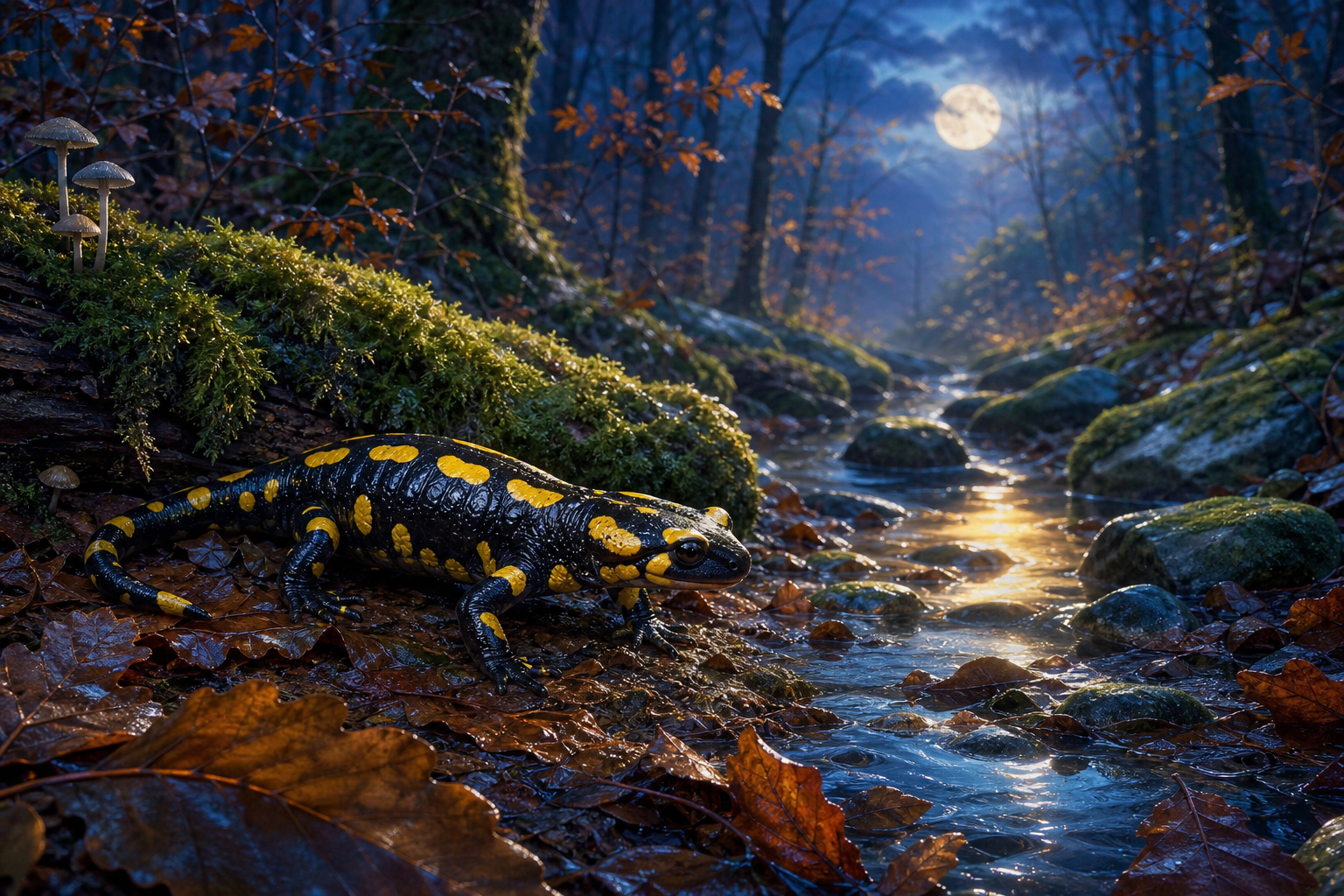
Rain has polished every leaf in the woodland. A twig goes tick-tick beneath a boot. Then, beside a mossy log, something shines: black as a wet pebble, splashed with yellow like a tiny lightning storm. It is not a dropped sweet wrapper—thank goodness. It is a fire salamander, Salamandra salamandra, taking a slow, determined walk through its European forest home.
The fire salamander is an amphibian, related to frogs and newts. An adult is usually about 15 to 25 centimetres long: longer than a pencil, though much less interested in homework. Its yellow marks may look like spots or stripes, and each animal’s pattern is special. That glossy skin needs damp surroundings, so this salamander belongs in cool deciduous woods and woodland near fresh water.
Despite the name, a fire salamander is not a creature of flames. The name may sound like it should burst from a campfire wearing a cape. Instead, it is a secretive forest-floor neighbour, most likely to appear when the ground is wet and the air smells of rain.
Evidence: IUCN Red List of Threatened Species: Salamandra salamandra (Fire Salamander) — Red List Assessment; Animal Diversity Web, University of Michigan Museum of Zoology: Salamandra salamandra (fire salamander); Wikipedia (English): Fire salamander
Why wear colours that shout?
Those bold yellow-and-black markings are a message. They tell a hungry animal, “Please choose another snack.” Fire salamander skin produces a poisonous, nasty-tasting secretion, so its colours warn predators to leave it alone. This is called warning colouration, but you can think of it as the salamander wearing a very clear “do not nibble” jacket.
That defence is clever, but it is also a reason people should never pick up a fire salamander. Looking carefully is wonderful; touching is not. A salamander’s skin is important and delicate, and its defensive secretions are not for human hands. The kindest wildlife rule is beautifully simple: give a wild animal space, enjoy the sight, and let it carry on with its important salamander business.
Its colours do not mean it is fierce or looking for trouble. A fire salamander is more like a cautious night walker than a tiny dragon. The bright pattern lets it avoid a chase or a fight in the first place. Quiet confidence beats fussing about, especially when you have only little legs.
Evidence: Animal Diversity Web, University of Michigan Museum of Zoology: Salamandra salamandra (fire salamander); Wikipedia (English): Fire salamander; IUCN Red List of Threatened Species: Salamandra salamandra (Fire Salamander) — Red List Assessment
The midnight snack patrol
When daylight fills the forest, fire salamanders often tuck themselves beneath logs, stones, and leaf litter. At twilight and night, especially when rain has made the ground pleasantly squelchy, they come out. Imagine setting off through a giant salad bowl of leaves, where every raindrop is as big as a beach ball compared with you. That is a salamander-sized adventure.
What is on the menu? Small creatures without backbones: insects, spiders, earthworms, slugs, and millipedes. A fire salamander is a carnivore, hunting these forest-floor animals rather than munching leaves. By eating small invertebrates, it plays a part in the busy woodland food web. It can also be prey for larger animals, although its warning skin helps stop casual predators.
They are mostly solitary, so do not expect a marching salamander parade. One shining individual sliding quietly through the leaves is more likely. Its slow-looking journey is full of information, though: damp places to explore, prey to find, and a route toward the fresh water that matters so much to its family story.
Evidence: Animal Diversity Web, University of Michigan Museum of Zoology: Salamandra salamandra (fire salamander); Wikipedia (English): Fire salamander; IUCN Red List of Threatened Species: Salamandra salamandra (Fire Salamander) — Red List Assessment
A mother’s watery nursery
Here is one of the fire salamander’s most surprising tricks. Instead of usually laying eggs on land, a mother typically gives birth to tiny larvae in a cool stream or pond. The babies begin life swimming underwater. They have feathery gills, which help them breathe there, before they grow legs and later move onto land.
That means a leafy forest alone is not enough. The salamanders need nearby clean fresh water for their young, as well as damp places on land where adults can shelter and hunt. A brook that looks ordinary to us can be a nursery, a starting line, and a future forest explorer’s first world.
Some fire salamanders have been reported to reach about 50 years old. That is an extraordinary possibility for an amphibian—long enough to outlast many favourite backpacks. It does not mean every salamander will live that long, but it makes every careful choice for their habitat feel especially meaningful.
Evidence: Animal Diversity Web, University of Michigan Museum of Zoology: Salamandra salamandra (fire salamander); Wikipedia (English): Fire salamander; IUCN Red List of Threatened Species: Salamandra salamandra (Fire Salamander) — Red List Assessment
A beautiful neighbour that needs room to thrive
Fire salamanders are found across much of Europe, but being widespread does not make them worry-proof. Their forests can be lost or damaged, and pollution can spoil the clean water their larvae need. They also face a serious skin disease caused by a chytrid fungus called Bsal. It has caused severe declines in some affected local populations.
You may see different conservation labels for this species in different places. The supplied IUCN record is an older 2009 assessment listing it as Least Concern, while another supplied source displays Vulnerable and points to more recent concern about Bsal. Rather than pretend this puzzle has one confirmed current answer, the honest answer is that the live global status needs checking. What is clear is that local salamanders can need urgent care.
Hope is not just a crossed-fingers feeling. Protecting damp deciduous woodland, keeping breeding streams clean, monitoring salamander populations, and taking biosecurity seriously can all help reduce risks. If your family visits wildlife areas, follow local signs, stay on paths where asked, and never move animals from one place to another. A careful visitor can be a helpful neighbour.
Evidence: IUCN Red List of Threatened Species: Salamandra salamandra (Fire Salamander) — Red List Assessment; Wikipedia (English): Fire salamander; Animal Diversity Web, University of Michigan Museum of Zoology: Salamandra salamandra (fire salamander)
Small kindnesses, wide ripples
Caring about a salamander can begin with noticing one: the small hunter under leaves, the mother seeking clean water, the bright animal whose body says “please don’t touch.” It can also stretch to choices far beyond the woodland. When we make room in our thoughts for animals as fellow travellers, protecting their homes starts to feel personal.
At meals, families can explore delicious plant-forward choices such as beans, lentils, vegetables, fruit, whole grains, nuts, and seeds. The World Health Organization includes these foods in guidance on healthy diets, while the IPCC reports that shifts toward sustainable, healthy, more plant-based diets can reduce food-system emissions and pressure on land and biodiversity. Food needs differ between people, so new eating plans are best talked over with a trusted adult and a qualified health professional.
Nobody needs to be perfect to be kind. Perhaps it is trying a lentil soup, choosing a bean burrito, or helping make a colourful vegetable dinner. These choices can be a gentle vote for a world with more space for forests, streams, and their glossy little residents. Somewhere on a rainy night, a fire salamander may be continuing its unhurried, yellow-flashing journey.
Evidence: World Health Organization: Healthy diet; Intergovernmental Panel on Climate Change: Climate Change 2022: Mitigation of Climate Change — Chapter 7; IUCN Red List of Threatened Species: Salamandra salamandra (Fire Salamander) — Red List Assessment; Wikipedia (English): Fire salamander
A friendly choice for forests and friends
The fire salamander does not ask us to be superheroes. It asks for the basics: living forests, clean water, and room to be wild. Choosing more plant-based foods can be a warm, practical way to extend that care beyond a woodland walk.
WHO guidance describes varied diets rich in foods such as vegetables, fruit, whole grains, pulses, nuts, and seeds. The IPCC finds that sustainable, healthy, more plant-based diets can lower food-system emissions and reduce pressure on land and biodiversity. With help from adults, a tasty plant-based meal can be one small act of friendship toward animals and their habitats.
Evidence: World Health Organization: Healthy diet; Intergovernmental Panel on Climate Change: Climate Change 2022: Mitigation of Climate Change — Chapter 7
Questions people ask
Is a fire salamander actually made of fire?
No. It is an amphibian that lives in cool, damp woodland. Its fiery-looking name suits its bright yellow-and-black pattern, not its habitat.
Evidence: Animal Diversity Web, University of Michigan Museum of Zoology: Salamandra salamandra (fire salamander); Wikipedia (English): Fire salamander
Can I touch one if I find it?
It is best not to. Fire salamanders have poisonous defensive skin secretions, and wild animals are safest when watched from a respectful distance.
Evidence: Animal Diversity Web, University of Michigan Museum of Zoology: Salamandra salamandra (fire salamander); Wikipedia (English): Fire salamander
What do baby fire salamanders look like?
They begin as swimming larvae in cool streams or ponds. They breathe underwater with feathery gills before developing legs and moving onto land.
Evidence: Animal Diversity Web, University of Michigan Museum of Zoology: Salamandra salamandra (fire salamander); Wikipedia (English): Fire salamander; IUCN Red List of Threatened Species: Salamandra salamandra (Fire Salamander) — Red List Assessment
Are fire salamanders safe everywhere?
Not necessarily. The supplied sources describe threats from Bsal fungus, habitat loss, and water pollution. They also disagree about the current global conservation label, so that status should be checked directly before using it as a final answer.
Evidence: IUCN Red List of Threatened Species: Salamandra salamandra (Fire Salamander) — Red List Assessment; Wikipedia (English): Fire salamander
Read the evidence
Sources behind this story
- Salamandra salamandra (Fire Salamander) — Red List Assessment — IUCN Red List of Threatened Species
- Salamandra salamandra (fire salamander) — Animal Diversity Web, University of Michigan Museum of Zoology
- Fire salamander — Wikipedia (English)
- Healthy diet — World Health Organization
- Climate Change 2022: Mitigation of Climate Change — Chapter 7 — Intergovernmental Panel on Climate Change
Health information is general education, not personal medical advice. Young readers should make food choices with a trusted adult and qualified health professional.